Resilience isn’t an innate trait you’re born with; it is a muscle that pre-teens build by reframing failure as data rather than a verdict on their character. For parents in their 30s and 40s, the shift from praising a child’s “intelligence” to praising their “process” is the single most effective way to foster a growth mindset that survives the transition into high school.
- Process vs. Outcome: Shift praise away from “You’re so smart” toward “I saw how you tried three different ways to solve that.”
- The ‘Yet’ Framework: Adding the word “yet” to self-limiting statements (e.g., “I don’t get this math problem… yet”) is scientifically proven to reduce anxiety.
- Normalize Friction: Resilience is built in the “struggle zone”—if a task is too easy, no growth is happening.
The Science of the ‘Struggle Zone’
We often treat frustration as a sign that we need to step in and fix things. For a pre-teen, however, that moment of “I can’t do this” is actually the most important neurological window they have. When a 11 or 12-year-old encounters a problem they cannot immediately solve, their brain is literally firing signals that demand a new strategy. If we jump in to rescue them, we effectively cut that learning process short.
The concept of the “Growth Mindset,” popularized by psychologist Carol Dweck, suggests that intelligence is not fixed. In our 30s and 40s, we are often managing our own professional failures, so we tend to project our anxiety onto our children. We want to spare them the sting of a bad grade or a lost game. But by shielding them from the discomfort of failure, we are denying them the opportunity to develop the neural pathways associated with grit.
Think of it like weight training. If you lift a weight that is too light, your muscles never tear, so they never grow. If you lift a weight that is too heavy, you risk injury. The “Struggle Zone” is that medium-heavy weight. It feels uncomfortable, it might involve some grumbling, but it is exactly where the brain builds the capacity to handle future, larger stressors.
Redefining Praise to Shape Identity
Most of us were raised on “You’re so smart” or “You’re a natural at this.” While intended to be encouraging, this type of praise is actually damaging. When you tell a child they are “smart,” they begin to fear that if they fail, they are no longer “smart.” They start to avoid challenges that might prove they aren’t as gifted as you said.
Instead, focus your feedback on the process. When your pre-teen shows you a project, don’t say, “You’re so talented.” Say, “I noticed you spent an extra hour researching sources for this—that research really made your argument stronger.” This shifts the focus from an internal, unchangeable trait (talent) to an external, controllable action (effort/strategy).
The Comparison Table: Fixed vs. Growth Feedback
| Scenario | Fixed Mindset Feedback (Avoid) | Growth Mindset Feedback (Use) |
|---|---|---|
| Child gets an A on a math test | “You’re a math genius!” | “You really put in the time to practice those equations.” |
| Child fails a music audition | “Maybe music isn’t your thing.” | “What part of your practice could you adjust for next time?” |
| Child struggles with chores | “Why are you so lazy?” | “What’s the hardest part about this task? Let’s break it down.” |
The goal here isn’t to be a cheerleader; it’s to be a coach. A coach doesn’t say, “You’re the best.” A coach says, “Your footwork was off in that drill—let’s go back and try it again, focusing on your stance.”
Normalizing the ‘Not Yet’
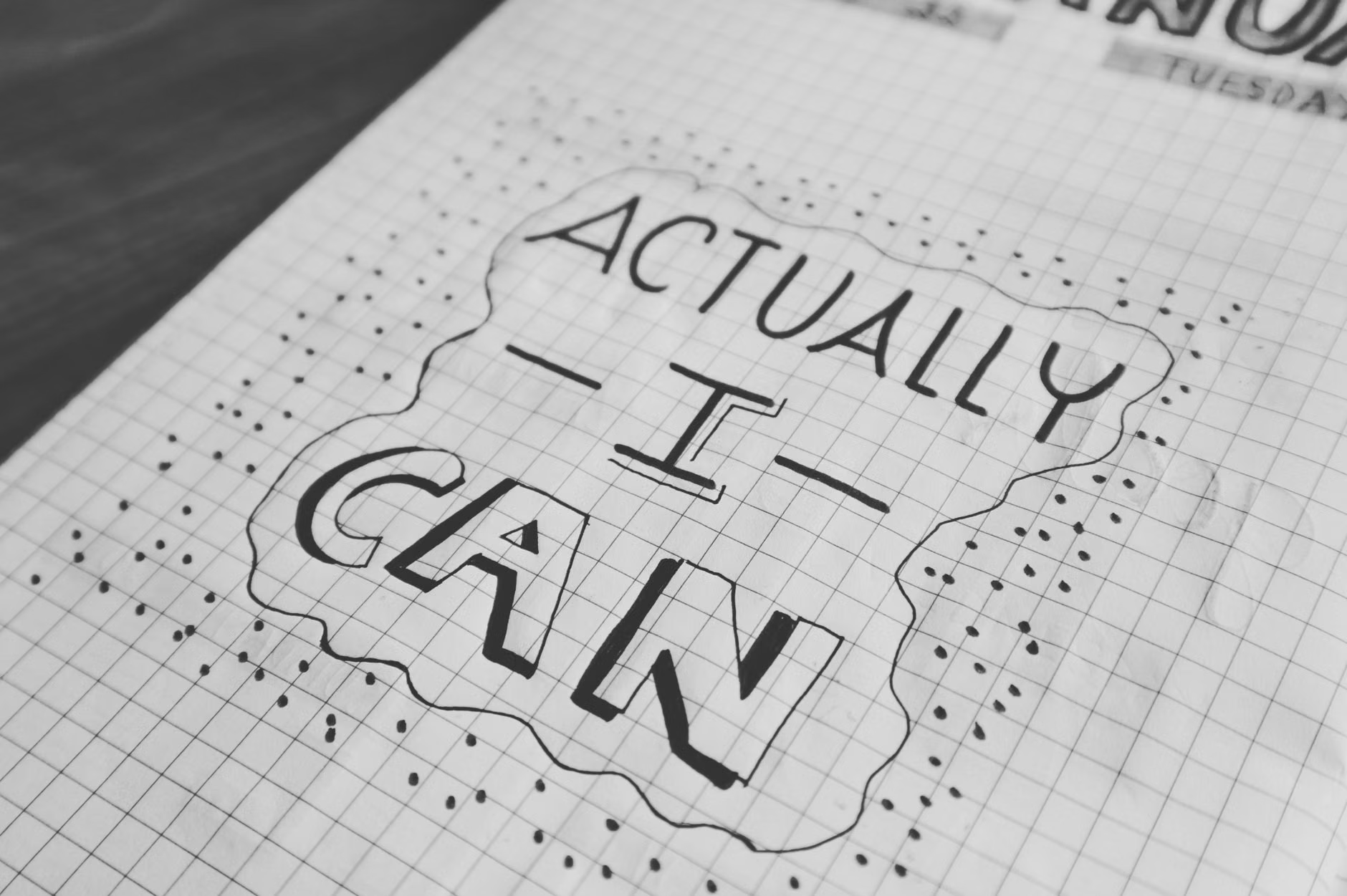
One of the most powerful tools in resilience training is the word “yet.” It is a small, three-letter word that completely changes the trajectory of a child’s internal monologue. When your pre-teen complains, “I don’t understand how to code this,” simply ask them, “You don’t understand it… yet?”
This phrasing forces a pause. It separates their current lack of knowledge from their future potential. It creates a bridge between the frustration of the present and the competence of the future.
In practice, this looks like a household culture where “I can’t” is treated as an incomplete sentence. If a child says, “I can’t do this,” you can model the behavior by saying, “I hear you. It’s frustrating. What is one part of this that you *could* do, or what is one resource you could look at to get closer to the answer?”

Why Resilience Training Matters in the Social Media Era
For pre-teens today, the stakes feel higher than they did for us. They are constantly exposed to curated versions of other people’s lives. If they don’t have a strong, growth-oriented identity, they will inevitably use social media as a yardstick for their own worth. When they see a peer succeeding, they may interpret that as proof that they themselves are failing.
Resilience training acts as a buffer against this. A child with a growth mindset understands that the influencer they see on screen is simply at a different point in their own “process.” They are less likely to view success as a finite resource and more likely to view it as a path that can be learned.
Furthermore, the pressure of academic performance in the pre-teen years often leads to “perfectionism paralysis.” This is when a child is so afraid of getting a B that they don’t turn in their assignment at all. This isn’t laziness; it’s a defense mechanism. By teaching them that a “failed” attempt is just a data point for improvement, you remove the fear of the grade and replace it with the curiosity of the learning process.
Practical Steps to Implement at Home
You don’t need a curriculum or a therapist to start this. In fact, the best resilience training happens in the mundane moments of family life. Here are three steps you can take this week:
1. Model Your Own ‘Struggle’
Children learn more from what we do than what we say. When you are struggling with a task—whether it’s fixing a leaky faucet, learning a new software for work, or cooking a new recipe—talk about it out loud. Say, “I’m finding this really difficult, and I’m feeling annoyed. I’m going to take a break, look at the manual again, and try a different approach.”
2. Conduct ‘Failure Reviews’ at Dinner
Instead of just asking “How was your day?”, try asking, “What did you struggle with today?” When they share a challenge, don’t offer the solution immediately. Ask, “What did you try? What do you think you’ll try next time?” This validates the struggle as a normal, productive part of the day.
3. Create a ‘Failure Log’
This sounds counterintuitive, but it works. Keep a small notebook where you and your child write down things that didn’t go as planned. Next to the “failure,” write down one thing you learned from it. This turns a negative experience into a tangible “win” of information.

Common Pitfalls and How to Avoid Them
The most common mistake parents make is “over-validating” the frustration. If your child comes home crying because they failed a test, your instinct is to say, “It’s okay, you’re still smart, the test was unfair.” This actually invalidates their experience and denies them the chance to own their outcome.
Instead, try: “I can see you’re really upset. That makes sense—you put in a lot of work. Let’s look at the test together and see where the gaps were. Was it the study method? Was it the time management?”
Another pitfall is the “Praise Trap.” It is very easy to revert to “Good job!” when you are busy or tired. That is okay. Resilience training is a long-term strategy, not a daily perfection test. If you catch yourself praising the outcome, just follow it up with a comment about the process: “You got an A! You must have really studied the chapters on photosynthesis to get that score.”
The Hidden Cost of ‘Easy Wins’
There is a hidden danger in our modern world of convenience: the “Easy Win.” From instant delivery to answer-key websites, pre-teens have access to shortcuts that bypass the struggle. While these are efficient, they are the enemies of resilience.
If your child is constantly getting “easy wins,” they are not building the cognitive or emotional stamina to handle the real world. As a parent, you have to intentionally introduce “friction.” This might mean letting them figure out how to assemble their own furniture, letting them negotiate their own conflicts with a teacher, or letting them deal with the natural consequences of forgetting their lunch at home.
It feels harsh in the moment, but the trade-off is significant. A child who has learned to navigate small inconveniences is a teenager who can handle a college rejection letter or a professional setback without spiraling into a crisis. The goal is to provide a “scaffold” for their growth—supportive enough to keep them safe, but sparse enough to ensure they are the ones doing the heavy lifting.
Frequently Asked Questions
Q: My child has anxiety about school. Is a growth mindset just more pressure?
A: If framed correctly, it is actually a pressure-relief valve. Anxiety often stems from the belief that there is one “right” way to be successful and that any deviation means you are a failure. A growth mindset reframes the entire school experience as a series of experiments. It allows them to view a bad grade as a “failed experiment” rather than a “failed person.”
Q: At what age is it too late to start teaching a growth mindset?
A: It is never too late. While the pre-teen years (10-13) are a critical period because of the brain’s plasticity, the principles of growth mindset are applicable to adults as well. If you start now, you are essentially “re-wiring” their approach to challenge during a time when they are already starting to define their own identity.
Q: What if my child is naturally gifted? Should I still focus on process?
A: Absolutely. In fact, it is even more important. Gifted children are the most at risk for developing a “fixed mindset” because they have become accustomed to things coming easily. When they hit a wall—which they inevitably will in high school or university—they are often the ones most prone to giving up because they have never learned the mechanics of how to struggle through a difficult task.
The Long-Term View
Resilience is not about being tough or emotionless; it is about knowing how to recover. It is about understanding that your current ability is just a temporary state. By changing the way we talk about effort, failure, and success, we are giving our children the most important tool they will ever own: the belief that they can change, learn, and grow, regardless of the starting point.
Start small. Change one comment today. Look for the “not yet.” And most importantly, allow your child the dignity of their own struggle. They are building the foundation of who they will become, and the best thing you can do is stand by as their coach, not their shield.
For further reading on the psychological foundations of this approach, you can explore resources from the Mindset Works organization, which provides evidence-based research on the impact of growth mindset on academic and social development.