The most effective way to teach your son body positivity is not through lectures on self-esteem, but by modeling how you treat your own body as a tool for living rather than an object for display.
- Shift from aesthetics to function: Stop commenting on your own physical appearance and start highlighting what your body allows you to do, such as hiking, playing, or working.
- Curate the digital environment: Boys in their teens are heavily influenced by social media algorithms that promote unrealistic “alpha” physiques; actively discuss the artifice behind these images.
- Normalize vulnerability: Acknowledging your own insecurities without wallowing in them teaches your son that perfection is not the goal, but emotional intelligence is.
If you are a man in your 30s or 40s, you likely grew up in an era where “body positivity” was not part of the conversation. You might have been taught that a man’s worth is tied to his physical strength, his ability to “bulk up,” or his stoicism in the face of discomfort. Now, as you navigate parenthood, you may notice your son—whether he is seven or seventeen—beginning to internalize those same pressures. He might be staring at his reflection a little too long, criticizing his build, or obsessing over fitness trends he saw on TikTok.
The challenge for fathers today is that we are the primary architects of our sons’ internal monologues. If you treat your body as a project that is never quite “finished” or “good enough,” your son will likely adopt that same framework. Here is how to navigate this, moving away from superficial metrics and toward a sustainable, healthy relationship with the body.
Redefining the ‘Strong’ Narrative
Historically, the “strong” male body was a static ideal—broad shoulders, defined muscles, and a complete lack of visible “flaws.” This rigid definition is a trap. When we talk about strength with our sons, we often focus on the outcome (the look) rather than the process (the capability). The first step in changing this is to pivot your language.
Consider the difference between these two approaches:
- The Aesthetic Trap: “I need to hit the gym because I’ve put on a few pounds and I don’t like how my shirts fit.”
- The Functional Pivot: “I’m going for a run because it helps clear my head, and I want to make sure I have the stamina to keep up with you on our bike rides this weekend.”
By focusing on function—stamina, mobility, mental clarity, and strength for daily tasks—you teach your son that his body is an instrument, not an ornament. When you treat exercise as a way to celebrate what your body can do, rather than a punishment for what it is, you provide him with a framework for self-worth that is immune to the inevitable changes that come with aging or injury.

This shift isn’t just about semantics; it is about cognitive reframing. If your son hears you constantly evaluating your body based on a mirror, he will assume that is the primary metric for success. If he hears you evaluating your body based on its utility, he learns to value himself in the same way.
The Hidden Influence of Digital Social Comparison
For parents in their 30s and 40s, social media is a tool, but for our sons, it is an environment. Platforms like Instagram and TikTok are saturated with “fitness influencers” who often use lighting, angles, performance-enhancing substances, and editing to create an impossible standard of masculinity. This is not just a “teen issue”; it is a systemic challenge to a boy’s sense of self.
Common mistakes fathers make include ignoring these platforms or, conversely, banning them entirely without discussion. Both approaches miss the point. Instead, you need to engage in “media literacy” with your son. When you see a post together, ask open-ended questions:
- “Do you think that guy actually looks like that at 7:00 AM, or is this a calculated photo?”
- “What do you think the trade-offs are for someone to maintain that specific physique year-round?”
- “Do you feel like your own goals are being shaped by what you see here, or by what you actually enjoy doing?”
By dissecting the image, you remove its power. You help your son understand that the “perfect” body is often a full-time job for the person displaying it, and it is rarely a realistic or healthy goal for a growing person.
Addressing Insecurity Without Toxic Positivity
There is a fine line between supporting your son and dismissing his valid feelings. If your son expresses dissatisfaction with his body, your instinct might be to say, “You look fine, don’t worry about it.” While well-intentioned, this is often received as, “Your feelings are invalid, and I don’t want to talk about this.”
Instead, aim for “validated curiosity.” Ask him what specifically bothers him and why. Is he being teased at school? Is he struggling to keep up in sports? Is he feeling pressure to fit into a specific social group? By identifying the root cause, you move the conversation from “body image” to “life experience.”
If he feels he is “too small” or “too soft,” discuss the reality of puberty and growth. Many boys hit their growth spurts at different times. Helping him understand that his body is currently in a state of flux—and that it will inevitably change—can provide the perspective he needs to stop obsessing over his current state.
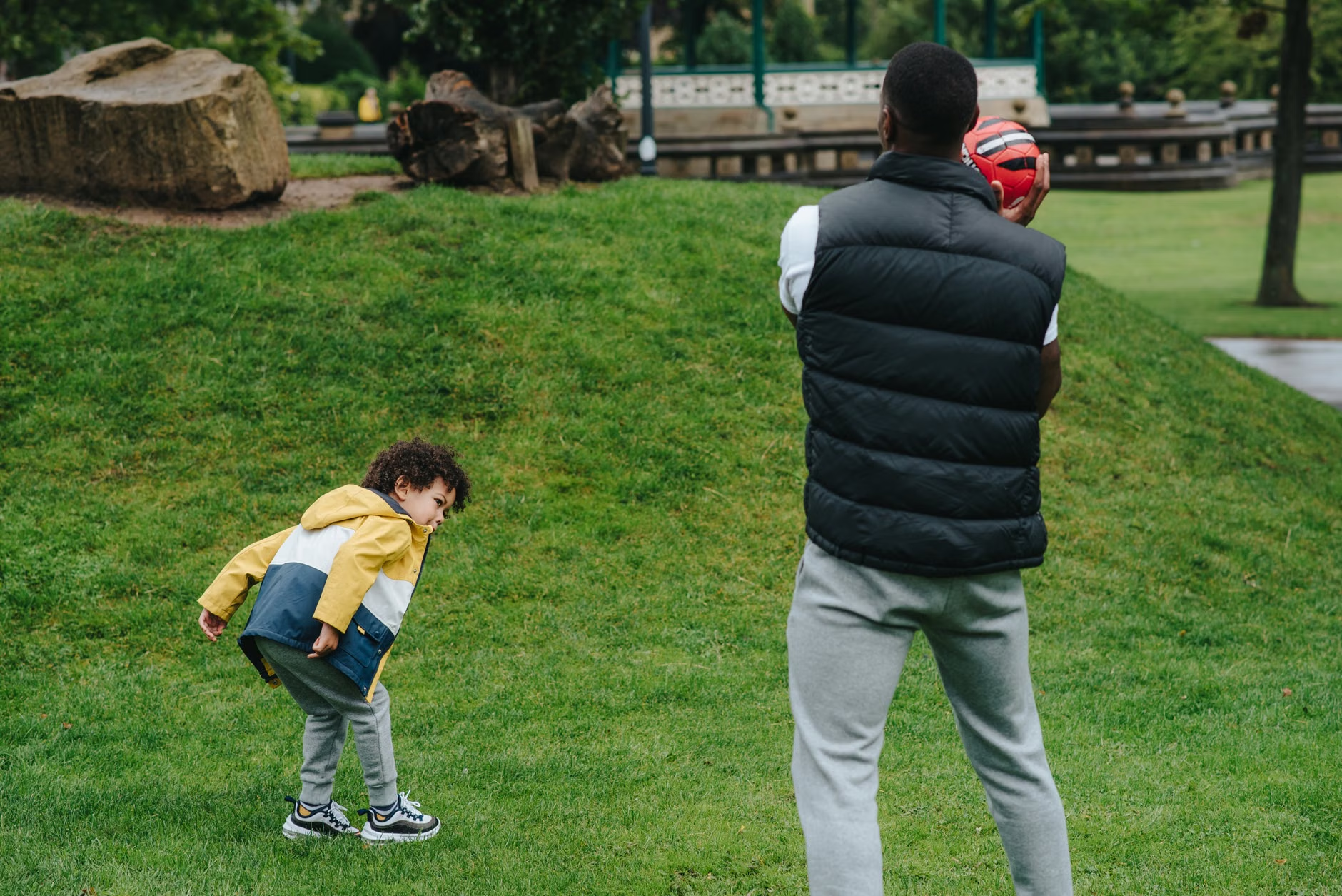
The Practical Guide: Building Healthy Habits Together
The most effective way to instill body positivity is through shared, non-aesthetic activities. When you and your son engage in physical tasks together, the focus is on the activity, not the physique. Use the following table to identify activities that foster a healthy relationship with the body:
| Activity Type | Focus Area | Why it works |
|---|---|---|
| Outdoor Exploration | Stamina & Resilience | Teaches that the body can handle discomfort and reward you with new experiences. |
| Collaborative Cooking | Fuel & Nutrition | Removes the “diet” stigma; focuses on food as energy for performance. |
| Skill-based Sports | Coordination & Strategy | Focuses on what the body can achieve through practice rather than how it looks. |
Note that each of these activities has a secondary benefit. Cooking together, for instance, is a critical life skill. If your son learns to cook, he is less likely to rely on processed foods that are often marketed to boys as “easy” ways to gain mass. You are giving him the tools to manage his own health, which is the ultimate form of body positivity.
The Role of Vulnerability in Fatherhood
One of the most overlooked variables in a child’s development is the father’s willingness to show his own human limitations. If you are a man in your 40s, you likely have parts of your body you are not fond of—perhaps a scar, a changing hairline, or the effects of desk work. If you hide these or express constant self-loathing, your son learns that he is expected to be flawless.
Instead, practice “casual acceptance.” If you are changing for the gym and look in the mirror, avoid the “gut-check” sigh. If you feel compelled to critique yourself, catch it and rephrase it. Say, “My knees are a bit stiff today, so I’m going to focus on mobility work.” This demonstrates that you are in tune with your body’s needs and that you treat yourself with the same respect you would treat a friend.

This is not about ignoring your health. If you have genuine health concerns, address them with a professional. But keep those conversations separate from your son’s perception of his own body. Your health management is your business; your attitude toward your body is his lesson.
Common Pitfalls and How to Avoid Them
Many fathers fall into the trap of “performance-based praise.” We tell our sons they are “strong” or “tough” when they excel in sports. While encouragement is good, be careful not to link these qualities exclusively to their physical form. If a boy ties his identity to being “the strong one,” he may feel a sense of failure if he gets injured, grows differently than his peers, or loses interest in sports.
Broaden your praise. Acknowledge his persistence, his strategy, his kindness, and his ability to work as part of a team. When he succeeds, praise the effort, not the result. When he fails, praise the resilience it took to try. This helps him build a multi-dimensional identity that is not dependent on his physical appearance.
Another major mistake is the “silent assumption.” We often assume that because our sons don’t talk about their bodies, they aren’t thinking about them. In reality, body dysmorphia and eating disorders in young men are significantly under-reported. According to the National Eating Disorders Association (NEDA), men are often overlooked in screening processes because their symptoms—such as an obsession with “clean eating” or “excessive muscle building”—are often mistaken for healthy habits. Stay observant. If he starts skipping meals, withdrawing from social events, or becoming obsessive about exercise routines, it is time to have a direct, non-judgmental conversation or seek professional guidance.
Establishing a New Foundation
The transition from a “look-focused” culture to a “function-focused” culture is a marathon, not a sprint. You will not fix his self-image in a single conversation. It is a slow, steady process of modeling behavior, adjusting language, and creating an environment where your son feels safe to be himself—regardless of what the current trend dictates.
Remember that your primary role is not to be a perfect role model, but a present and honest one. If you make a mistake—if you catch yourself body-shaming or focusing on aesthetics—admit it. “I just realized I was being pretty hard on myself about my appearance, and that wasn’t very helpful for me or fair to my own progress.” Being able to correct yourself in front of your son is perhaps the most powerful lesson in body positivity you can provide.
Ultimately, you are teaching him that his worth is intrinsic. It is not something he earns through a gym membership, a specific body fat percentage, or a certain physical stature. It is something he owns simply by existing. By shifting your own focus, you give him the freedom to do the same.
Frequently Asked Questions
1. How do I address my son’s obsession with ‘bulking up’ without sounding dismissive?
Acknowledge his goal but ask about the why. Is he trying to improve performance in a specific sport, or is he trying to feel more confident socially? If it is performance-based, connect him with a coach who can provide a safe, structured plan. If it is social, use the opportunity to discuss the difference between “healthy strength” and “aesthetic obsession.” Frame it around long-term health and joint longevity rather than just size.
2. What if my son is being bullied for his body weight?
This is a serious issue that requires a two-pronged approach. First, address the bullying through school channels or by talking to the other child’s parents. Second, bolster your son’s self-esteem at home by focusing on his non-physical strengths. Ensure he feels that his worth is defined by his character, his skills, and his relationships, not by the cruel comments of others. Never minimize the pain he is feeling; acknowledge it and provide a safe space for him to process those emotions.
3. At what age should I start having these conversations?
You can start as early as the elementary school years by being mindful of the language you use. By the time he hits puberty, these conversations should be normalized. You don’t need to have a “big talk” about body image; instead, weave these concepts into daily life—when you’re grocery shopping, exercising, or watching media together. The more casual and consistent the dialogue, the more comfortable he will be coming to you when he feels insecure.
For further resources on body image and men’s mental health, consider visiting the National Alliance on Mental Illness (NAMI) or local health department websites for guidance on identifying the signs of body dysmorphia and supporting adolescent development.