Key Takeaways
- The “Carbon Border” is not a direct tax on your food: It is a levy on carbon-intensive imports (like steel, cement, and electricity), but the ripple effect will likely increase the overhead costs for food production and logistics.
- Supply Chain Volatility: As countries implement carbon pricing, the cost of transporting goods across borders will fluctuate based on the carbon footprint of the production method, potentially raising the prices of imported out-of-season produce.
- Strategic Shopping: To mitigate these inevitable cost shifts, focus on regional seasonality and reducing food waste; these actions provide a direct hedge against the inflationary pressure of carbon-linked supply chain costs.
You’ve likely noticed that the price of your weekly grocery haul has been on a slow, steady climb. While we often blame inflation or supply chain snags, there’s a new, complex layer being added to the global economic cake: the Carbon Border Adjustment Mechanism, or CBAM. It sounds like something out of a dense policy paper, but for those of us trying to balance family budgets while keeping the fridge stocked, it’s a factor that will influence how much we pay for everything from the energy used to process our food to the fuel used to ship it.

What Exactly Is a ‘Carbon Border’ Tax?
To understand why this hits your wallet, we first need to strip away the jargon. Governments around the world are increasingly putting a price on carbon emissions to meet climate goals. If a domestic company has to pay for their carbon emissions, but a company in another country doesn’t, the domestic company is at a disadvantage. They end up charging more, and the cheaper, “dirtier” imports win. To level the playing field, governments are introducing a “Carbon Border Adjustment Mechanism.”
Essentially, it’s a tariff applied to goods imported from countries that don’t have an equivalent carbon price. The logic is simple: if you want to sell your goods in our market, you must pay for the carbon footprint of those goods, just as our local producers do. While the initial rollout of these taxes—most notably in the European Union—focuses on heavy industries like steel, aluminum, and fertilizers, the “fertilizer” part is where the alarm bells should start ringing for anyone concerned about food prices.
Fertilizers are the bedrock of modern agriculture. They are energy-intensive to produce and rely heavily on natural gas. When the cost of importing fertilizer rises due to carbon tariffs, that cost doesn’t just evaporate. It moves down the line. The manufacturer pays more, the farmer pays more for inputs, and eventually, the grocery store pays more for the produce. For a family in their 30s or 40s, this means that even if you aren’t paying a “carbon tax” at the checkout, you are paying a “carbon-linked production premium.”
The Ripple Effect: From Fertilizer to Your Dinner Table
The link between carbon policy and your grocery bill isn’t immediate, but it is systemic. Let’s look at the lifecycle of a typical bag of frozen vegetables or a box of cereal. It involves extraction, manufacturing, processing, packaging, and shipping. At each of these stages, carbon is emitted. If the shipping vessel uses heavy fuel oil, or if the factory in the country of origin relies on a coal-heavy power grid, the carbon cost is high.
When an import tax is applied to these carbon-intensive goods, the importer has to absorb that cost. In a competitive market, they try to pass as much of that cost as possible to the retailer. By the time that product reaches your local supermarket, the price has been adjusted to account for the border levy. This is not just a theoretical risk; it is a fundamental shift in how global trade will operate over the next decade as more countries adopt similar frameworks to meet the Paris Agreement targets.
Consider the difference between locally sourced produce and imported items. If you buy strawberries grown in your own country, the carbon cost is likely lower, and there is no “border” to cross, meaning no carbon tariff impact. If you buy out-of-season berries imported from a country with lax carbon regulations, the importer will now have to pay a levy to bring them into your country. This makes the local option, which might have previously been more expensive, suddenly price-competitive. While this is great for local farmers, it creates a “price floor” where the cheapest options on the shelf—usually the imported ones—begin to rise in cost.
The Real-Life Scenario: Comparing Costs
Let’s look at a hypothetical scenario for a family of four. You typically spend $200 a week on groceries. About 30% of your items are imported from countries that are likely to be subject to carbon border adjustments in the coming years. If these tariffs lead to a conservative 5% increase in the cost of those specific items, your weekly bill doesn’t just jump by a massive amount, but it creates a persistent, creeping inflation that compounds over time.
| Category | Carbon Tax Sensitivity | Impact on Price |
|---|---|---|
| Imported Tropical Fruit | High (Shipping + Cooling) | Significant increase |
| Processed Grain/Cereal | Medium (Fertilizer + Energy) | Moderate increase |
| Locally Grown Seasonal Veg | Low | Minimal change |
| Imported Canned Goods | Medium (Shipping + Packaging) | Moderate increase |
This table illustrates why your choice of “what” to buy matters more than ever. By identifying which items are high-sensitivity, you can start to shift your habits before the price spikes hit your wallet. The goal isn’t to stop buying imported goods entirely, but to be aware that the “cheap” imported label may soon be a thing of the past.
Why This Matters for Your Household Budget
If you are in your 30s or 40s, you are likely in the “peak expense” years of your life. You have kids to feed, a mortgage or rent to pay, and perhaps a retirement fund you’re trying to build. A 5% or 10% increase in the grocery budget might sound manageable, but when combined with rising energy costs and interest rates, it adds up. The carbon border tax is a “stealth” tax. It doesn’t appear on your receipt as a line item, but it is baked into the cost of goods sold (COGS).
The most important insight here is the “Carbon-Intensity Gap.” This is the difference in cost between a product made with renewable energy and one made with fossil fuels. As carbon border taxes become more common, products that are produced using cleaner methods will become relatively cheaper compared to their dirtier counterparts. This creates a market advantage for sustainable brands. If you find yourself complaining about food prices, look at the origin of the product. Is it coming from a region that is heavily reliant on coal? If so, expect that price to rise faster than others.
Another overlooked variable is packaging. Many people focus on the food itself, but the production of plastic and aluminum is extremely carbon-intensive. If the country of origin has a high carbon tax, the packaging alone could push the price of a imported product above that of a locally produced alternative. This is why buying in bulk or choosing products with minimal, sustainable packaging is not just an environmental choice—it’s a financial one.
Practical Steps to Hedge Against Rising Costs
So, how do you protect your family budget from these changes? It requires a shift in how you view your grocery shopping. It’s no longer just about the price tag at the bottom; it’s about the supply chain behind the item. Here are four steps you can take today:
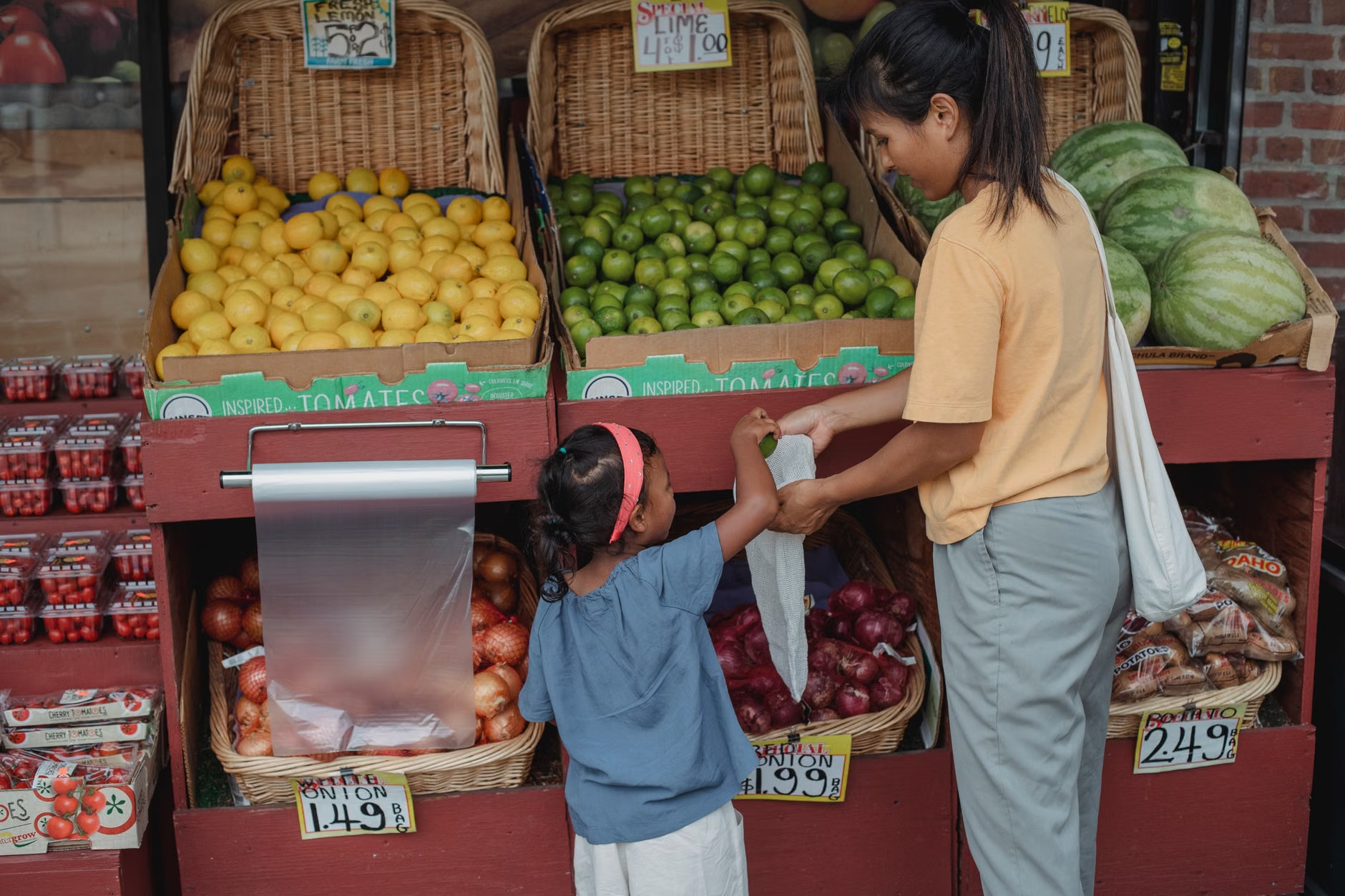
- Prioritize Seasonality: Out-of-season produce is almost always imported. By sticking to what is in season locally, you bypass the entire carbon border tax issue. It’s usually cheaper, tastes better, and supports the local economy.
- Audit Your “Pantry Staples”: Look at the labels on your most-purchased items—cereal, pasta, canned goods. Check the country of origin. If you see products coming from regions with high carbon-intensity, look for a local or regional alternative. You might be surprised to find that the price difference has already started to shrink.
- Reduce Food Waste: This is the most effective hedge against any price increase. If you throw away 20% of your groceries, you are essentially paying a 20% “waste tax” on top of any inflationary pressure. Use a meal planning app or a simple whiteboard to track what needs to be eaten first.
- Embrace “Lower-Carbon” Proteins: Animal agriculture is a massive carbon emitter. While you don’t need to go vegan, shifting even one or two meals a week to plant-based proteins can help insulate your budget from the volatility of meat prices, which are highly sensitive to both fertilizer costs and transport logistics.
Common Misconceptions and Reality Checks
There is a common misconception that “green” food is always more expensive. While that was true a decade ago, the landscape is shifting. As carbon border taxes force producers to account for their emissions, the “true cost” of cheap, high-carbon food is being revealed. You aren’t necessarily paying more for “organic” or “sustainable”—you are simply paying for the true cost of production, while the cheaper, high-carbon options are losing their artificial price advantage.
Another mistake is assuming that all imports will become unaffordable. That’s not the case. Many countries are already transitioning to renewable energy for their manufacturing sectors to avoid these exact taxes. A product imported from a country with a high renewable energy mix will be much less affected by carbon border taxes than one from a country still heavily reliant on coal. Keep an eye on the origin, not just the price. If you see a product from a country known for aggressive green energy policies, it might actually be a safer bet for price stability.
Finally, don’t fall for the “everything is going to be expensive” trap. The economy is dynamic. When one supply chain becomes too expensive, competitors emerge. We are already seeing a rise in “near-shoring,” where companies move production closer to the consumer to avoid logistics costs and carbon tariffs. This is a net positive for food security and price stability in the long run.
The Bottom Line for Your Family
The carbon border tax is a structural change to global trade, not a short-term blip. It will act as a slow-moving pressure on the cost of imported goods, particularly those that are energy-intensive to produce or transport. For a family in their 30s or 40s, the best strategy is to lean into regionality and efficiency. By focusing your shopping on seasonal, locally produced items and minimizing waste, you aren’t just doing your part for the planet—you are building a robust defense against the inflationary pressures of the new, carbon-conscious global economy.
This transition will take time, and there will be bumps in the road. However, by being a more informed and strategic shopper, you can navigate these changes without breaking your budget. Start small, track your spending on imported versus local goods, and you’ll find that you have more control over your grocery bill than you might have thought.
Frequently Asked Questions
Q: Will the carbon border tax immediately double the price of my groceries?
A: No. The tax is applied to the carbon intensity of the production, not the retail price of the food itself. While it will add cost, it is a gradual, incremental pressure rather than a sudden shock. Most estimates suggest a marginal impact on total food costs compared to other inflationary factors like fuel prices and labor shortages.
Q: Should I stop buying all imported food to save money?
A: That isn’t necessary or practical. Many items, like coffee, chocolate, or tropical fruits, cannot be grown locally in many climates. The goal is to be mindful of “carbon-intensive” imports—like non-seasonal vegetables or processed goods from countries with heavy reliance on fossil fuels—where local alternatives are easily available.
Q: How can I tell if a product is “carbon-intensive” just by looking at the label?
A: While labels rarely list “carbon intensity,” you can use the country of origin as a proxy. Countries that are part of international climate agreements and have their own carbon pricing systems are generally moving toward lower-carbon production methods. A quick search of the brand’s sustainability practices or the country’s energy mix can give you a good idea of their carbon footprint.
For further reading on how global carbon policies are being implemented, you can refer to the official European Commission’s guide on the Carbon Border Adjustment Mechanism (CBAM).