The most effective way to lower your monthly electricity bill is to shift your heavy appliance usage to off-peak hours, a strategy now automated by “energy-buffer” pricing models that adjust your power consumption based on real-time grid demand.
Key Takeaways
- Automation is mandatory: Manual scheduling is prone to human error; using smart plugs or native app automation ensures you never miss a cheaper rate window.
- Understand the “Buffer”: Energy-buffer pricing isn’t just about timing; it’s about allowing your appliances to pause or throttle power during grid spikes, which utility providers reward with lower tariffs.
- Prioritize high-draw loads: Focus your automation efforts on the “Big Three”—the dishwasher, the clothes dryer, and the EV charger—as these account for the vast majority of your variable electricity costs.
If you are in your 30s or 40s, balancing the chaotic schedule of work, school runs, and household chores, the last thing you want to do is wake up at 2 AM to start the dishwasher. Yet, that is exactly what traditional “time-of-use” (TOU) pricing encourages. The reality of modern energy management is that the grid is becoming increasingly stressed, and utility companies are passing these costs onto consumers through fluctuating pricing.
Energy-buffer pricing—often referred to as dynamic or demand-response pricing—is the industry’s answer to this. It treats your home not just as a consumer of electricity, but as a flexible buffer that can absorb or shed load depending on what the grid needs. If you can align your habits with this rhythm, you aren’t just saving pennies; you are effectively lowering your annual utility expenditure by 15% to 25%.
What Exactly Is Energy-Buffer Pricing?
At its core, energy-buffer pricing is a billing structure where the cost per kilowatt-hour (kWh) changes based on the total demand on the electrical grid. When everyone comes home at 6 PM and turns on their AC, ovens, and TVs, the grid reaches a “peak.” To prevent brownouts, utility companies pay a premium for energy from external sources. They then pass that high cost to you.
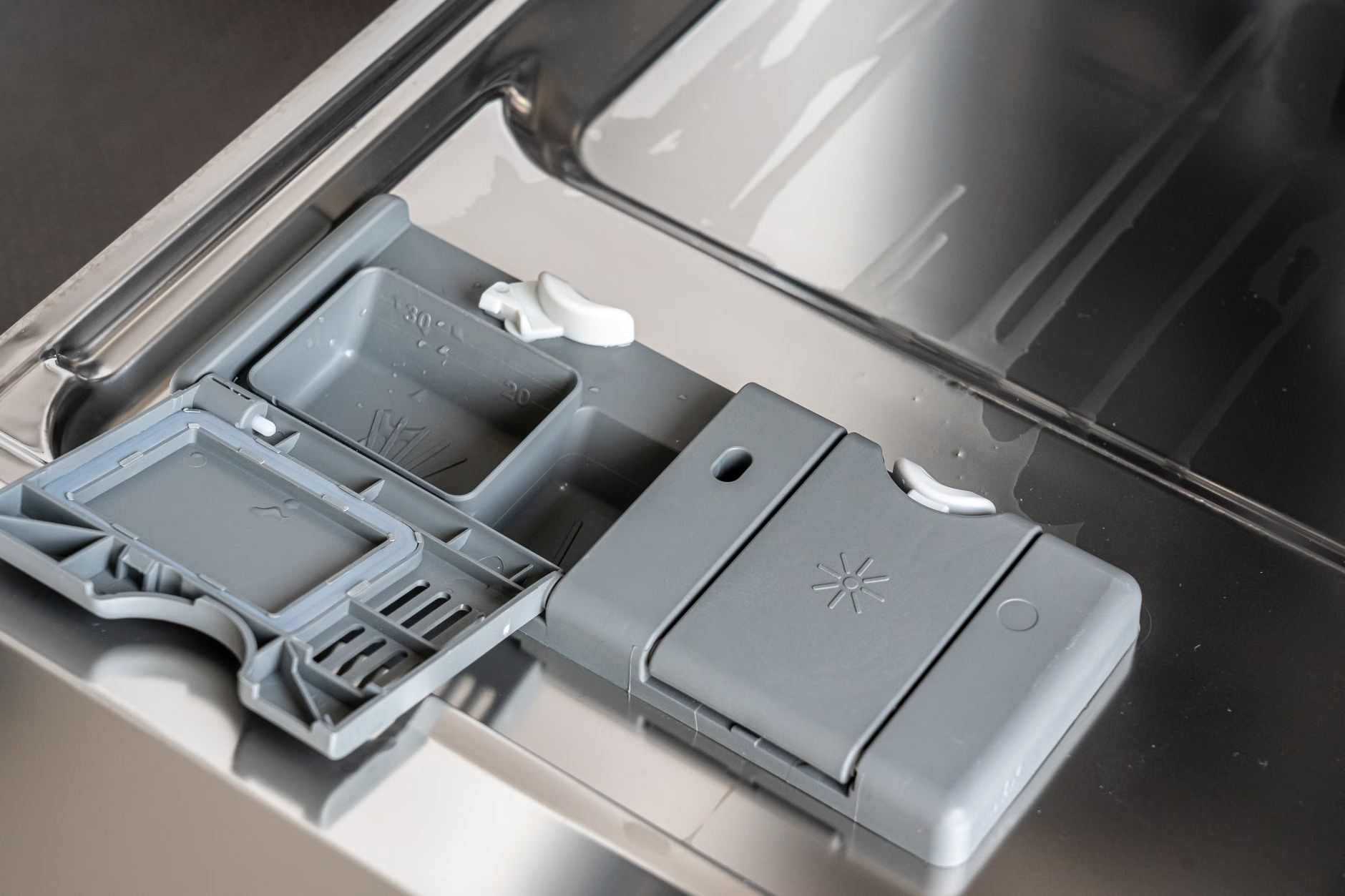
An “energy-buffer” system essentially allows your smart devices to “talk” to the grid. Instead of your dishwasher drawing a constant, high-intensity current during that 6 PM spike, a smart controller can “buffer” the cycle. It might pause for five minutes, reduce the water heater temperature by two degrees, or delay the start until 9 PM when the grid settles. You get the same clean dishes, but the utility company avoids the cost of buying expensive, last-minute power.
This isn’t just a niche concept for tech enthusiasts. In regions like California (under various PG&E demand-response programs), parts of the UK (with Octopus Energy’s Agile tariff), and Australia (with virtual power plant trials), this is becoming the standard for residential energy contracts. The “buffer” is your home’s ability to be flexible.
The Financial Mechanics: Why It Matters for Your Household Budget
For a family of four, the kitchen and laundry room are the primary battlegrounds for energy efficiency. Most people think about turning off lights, but lighting accounts for a small fraction of your total bill compared to thermal loads (heating/cooling) and motor-driven appliances (dryers/dishwashers).
Let’s look at a typical scenario comparing standard flat-rate pricing versus dynamic energy-buffer pricing. In a flat-rate system, you pay, for example, $0.20 per kWh regardless of when you use it. In a dynamic system, the price might fluctuate between $0.08 during the “valley” (late night) and $0.45 during the “peak” (late afternoon).
| Appliance | Avg. Draw (kW) | Standard Cost (Daily) | Automated Buffer Cost (Daily) |
|---|---|---|---|
| Dishwasher | 1.5 | $0.60 | $0.24 |
| Clothes Dryer | 3.0 | $1.80 | $0.72 |
| Smart AC/Heat | 2.0 | $4.80 | $3.20 |
The math is clear: by shifting the dryer and dishwasher to off-peak hours and allowing the AC to “buffer” its cooling cycles (letting the room temperature float within a comfortable 2-degree range during peak hours), the savings are significant. The key insight here is that you do not need to sacrifice comfort. Modern smart home automation handles the “buffer” so seamlessly that you often don’t even notice the shifts.
How to Set Up Your Home for Energy-Buffer Success
You don’t need a PhD in electrical engineering to implement this. Most modern appliances come with “delay start” functions, but that is a primitive way to manage energy. To truly capture the benefits of energy-buffer pricing, you need an integrated ecosystem.
1. The Controller Layer
Start with a hub that supports integration with your utility provider’s API. Platforms like Home Assistant (if you are tech-savvy) or commercial solutions like Google Home and Amazon Alexa (when paired with specific smart-grid compatible plugs) act as the brain. They monitor the current price of electricity and send “go” or “stop” signals to your appliances.
2. The Appliance Layer
Look for appliances that are “Smart Grid Ready” (often branded as SG-Ready). These devices have an internal logic that allows them to respond to external signals. If you are buying new, check for this label. If you are working with existing appliances, use high-quality smart plugs that monitor power consumption. A smart plug can cut the power to a “dumb” appliance entirely when prices spike, or simply act as a data logger so you can see which devices are the biggest offenders.
3. The Monitoring Layer
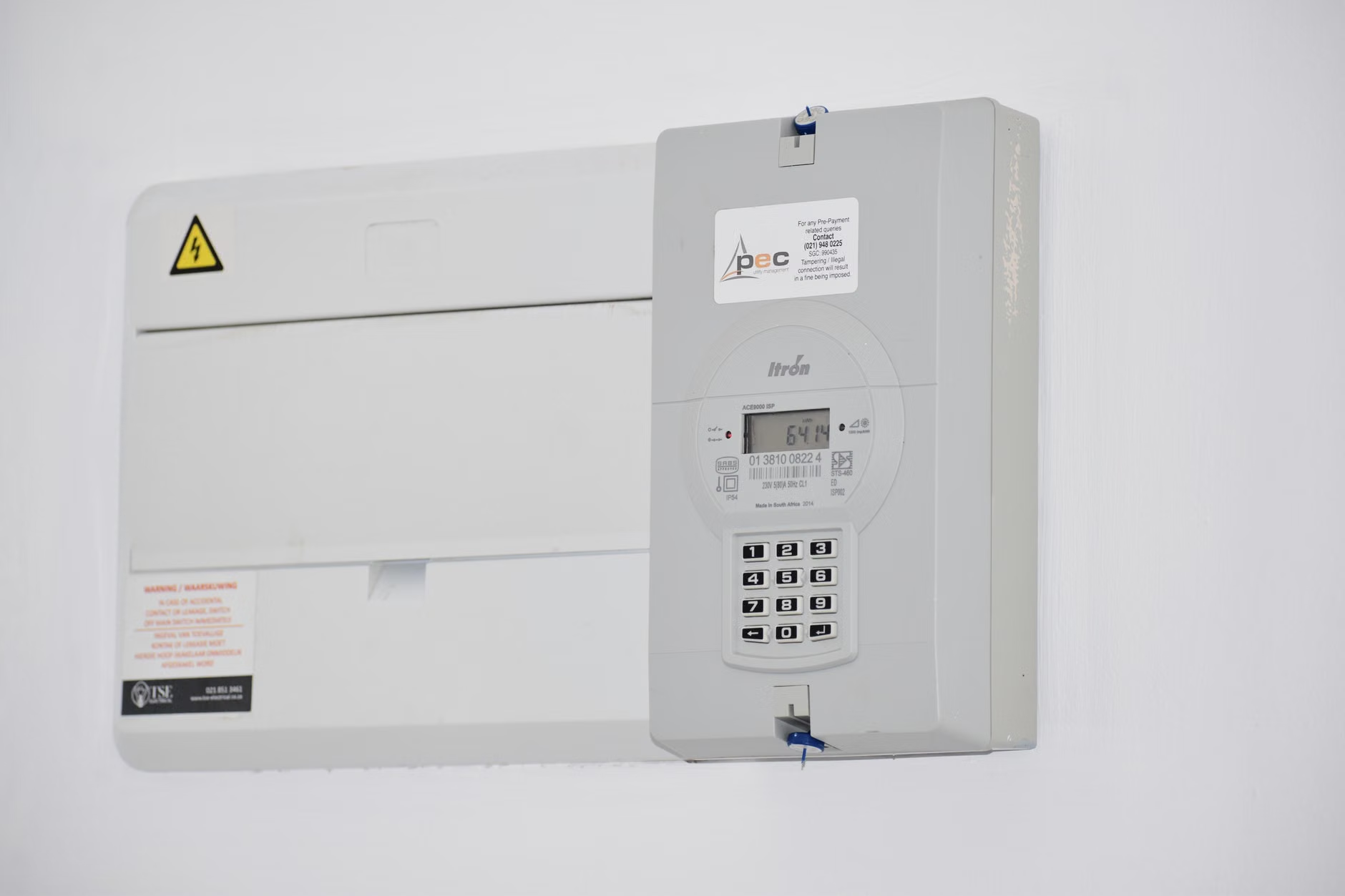
Install a real-time energy monitor like a Sense or an Emporia Vue. These devices attach to your main electrical panel and use machine learning to identify the “fingerprint” of each appliance. Once you know exactly when your dryer is running and how much it costs, you can create automation rules like: “If electricity price > $0.30/kWh, turn off the dryer.”
Common Pitfalls and How to Avoid Them
The most common mistake people make is over-automating. You do not want your refrigerator turning off for an hour just to save five cents. Refrigerators are “thermal batteries”—they hold cold well—but they should never be part of a aggressive load-shedding strategy that risks food spoilage.
Another pitfall is “automation fatigue.” If your smart home is constantly pinging your phone with alerts about price changes, you will eventually turn the system off. Set it and forget it. The best automation is invisible. If you have to intervene manually more than once a month, your rules are too complex. Aim for “set-point” automation: define your comfort range (e.g., “Keep the house between 70°F and 74°F”) and let the system decide when to run the cooling based on the cheapest electricity available within that window.
Finally, watch out for “hidden peaks.” Some appliances, like electric water heaters, have a “boost” or “fast heat” mode. Ensure these are disabled in your automation settings. If your system is trying to save money by delaying a cycle, a “boost” mode might accidentally trigger a high-draw cycle right in the middle of a peak pricing window, completely negating your savings.
Advanced Strategies: Integrating Solar and Battery Storage
If you have solar panels, you are already in the “pro” league of energy-buffer pricing. Your goal shifts from just avoiding high grid prices to maximizing “self-consumption.” This means using every watt your panels produce before you ever pull from the grid.
The “energy-buffer” in this context is your home battery (like a Tesla Powerwall or similar). The logic changes: instead of just waiting for cheap grid power, your automation should prioritize charging your battery during the cheapest hours (or from excess solar) and then discharging that battery during the peak hours when grid prices are highest. This is known as “arbitrage.” You are essentially buying low and selling (or using) high.
For those in their 30s and 40s with families, this also provides an excellent backup power solution. The energy-buffer system ensures your battery is always topped off for grid outages, while simultaneously optimizing your daily spend. It’s the ultimate form of household financial hedging.
The Future of Home Energy Management
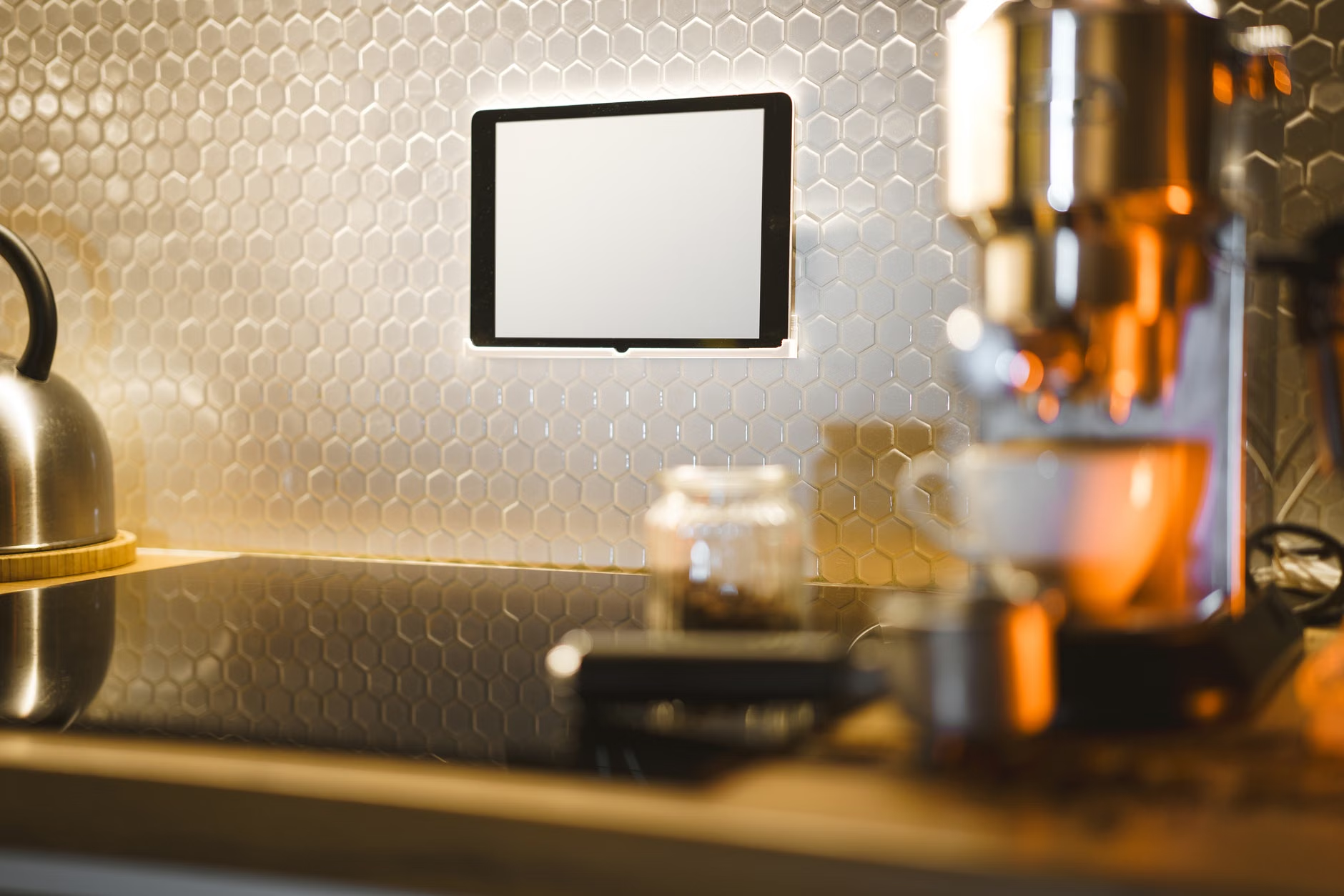
We are moving toward a world where your appliances will “bid” for energy. Your dishwasher will effectively tell the grid, “I need to run for 45 minutes sometime in the next three hours; what is the best price you can give me?” The grid will respond, and the dishwasher will execute the cycle at the optimal moment.
This is the “Internet of Energy.” As these systems become more standardized, the need for manual configuration will disappear. Utility providers will provide the app, the smart plugs will be pre-configured, and the consumer will simply see a lower bill at the end of the month. Until that ubiquity arrives, taking the steps to automate your own home’s buffer is the best way to future-proof your finances.
Start small. Identify your biggest energy user—usually the dryer or the HVAC system—and focus your automation there first. Once you see the savings on your utility statement, the incentive to expand to other appliances will be obvious. Remember, the goal isn’t to be a tech expert; it’s to be a smart consumer who lets technology do the heavy lifting.
Frequently Asked Questions
Does energy-buffer pricing actually save money if I have a large family?
Yes, but the strategy changes. With a larger family, you have more “load” to shift. While you can’t easily shift cooking times (kids need to eat!), you can absolutely shift laundry, dishwasher cycles, and EV charging. The sheer volume of these tasks means that even small savings per cycle add up to significant monthly reductions for larger households.
What if I don’t have smart appliances? Can I still participate?
Absolutely. You don’t need a smart washing machine to benefit. A simple, high-quality smart plug (make sure it is rated for the wattage of your appliance) can act as a remote switch. You can set up an automation to cut the power to the device during peak hours or simply use the plug to track when the device is drawing power so you can manually shift your habits to off-peak times.
Is there a risk that my appliances will wear out faster by being turned on and off frequently?
Modern appliances are designed to handle power cycles. However, you should avoid “hard-cycling” sensitive electronics (like computers or smart TVs). Focus your automation on resistive loads like heating elements (water heaters, dryers, ovens) and motor-driven loads (dishwashers, pool pumps). These are much more resilient to being paused or delayed than complex digital controllers.
For further reading on how to optimize your home for specific utility programs, consult your local energy provider’s website. Many utility companies in the U.S. provide specific “Demand Response” guides at Energy.gov/energysaver, which offers a comprehensive breakdown of how to integrate smart technology safely and effectively.
Ultimately, energy-buffer pricing is about taking control of your home’s relationship with the grid. It requires a bit of upfront effort to set up your automation rules, but once the system is live, it works silently in the background, ensuring your family budget is protected from the volatility of peak-hour electricity costs. Start with one appliance, monitor the results for a month, and build from there.