- Quality over Quantity: Professional networking is shifting from high-volume social events to low-volume, high-value skill acquisition.
- The ‘After-School’ Model: By treating evening hours like a structured class, you create clear boundaries between work, parenting, and personal growth.
- Immediate ROI: Focusing on “stackable” skills—like data literacy or specialized management techniques—yields faster career dividends than generic networking.
The traditional “after-work drink” as a cornerstone of career advancement is quietly dying. For those of us in our 30s and 40s, balancing the relentless demands of a career with the logistical marathon of parenting, the old model of networking feels less like an opportunity and more like an energy leak. We aren’t looking for more “contacts”; we are looking for more competence.
This is where the “After-School-Club” pivot comes in. It’s the intentional practice of reclaiming your post-work hours for structured learning, skill-stacking, or deep work, effectively treating the evening as a second, optional school session designed entirely by you, for you. It’s not about burning the midnight oil for your employer; it’s about investing in the one asset that actually appreciates: your own capability.
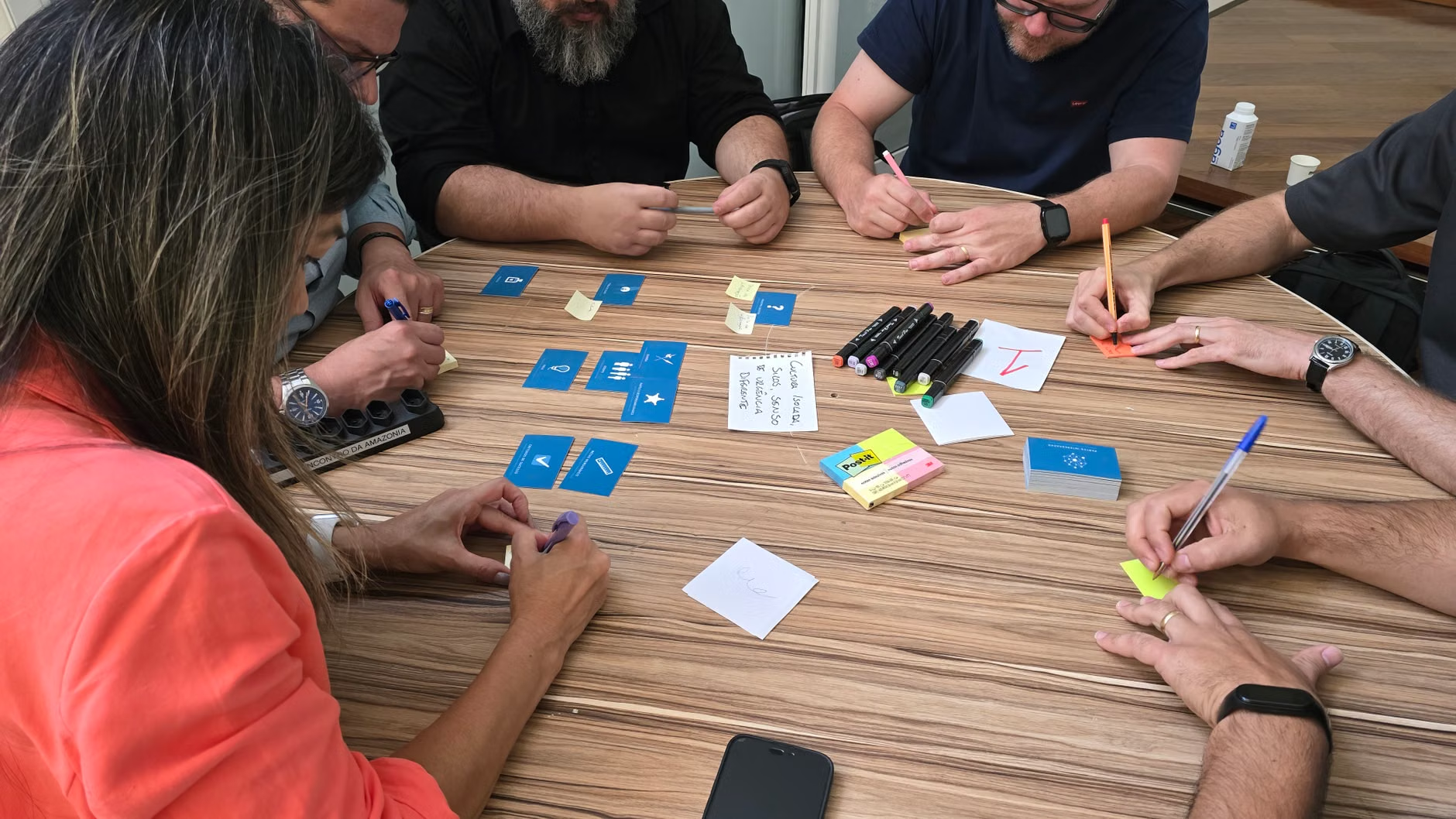
Why the Networking Fatigue is Real
Networking, as we’ve been taught to do it, is fundamentally flawed for the mid-career professional. It relies on serendipity, high-energy social interactions, and a significant time investment with a low, often unquantifiable, return on investment (ROI). When you are juggling school pickups, meal prep, and the lingering cognitive load of a full workday, the idea of spending two hours in a crowded room exchanging business cards with people you’ll likely never see again feels like a chore, not a strategy.
Research into professional development suggests that as we enter our mid-career phase, our value in the marketplace shifts from who we know to what we can specifically solve. The “After-School-Club” pivot acknowledges this reality. It shifts your focus from external validation to internal capacity building. By replacing one or two networking events per month with a structured learning block, you aren’t just saving time—you are systematically increasing your market value.
The Math of Time Allocation
Consider the typical monthly investment of a professional who attends two networking events. If you account for travel, preparation, and the “recovery time” required after a late evening, you are likely spending about 8 to 10 hours a month on networking. If that time were reallocated to learning a new technical skill, such as advanced data visualization, project management certification, or a new language for international business, you would accumulate roughly 120 hours of focused study per year. That is the equivalent of a part-time university credit load, completed entirely on your own terms.
| Activity | Time Cost (Monthly) | Primary Benefit | Risk/Trade-off |
|---|---|---|---|
| Traditional Networking | 8–12 hours | Weak-tie connections | High burnout, low ROI |
| Structured Skill-Building | 8–12 hours | High-value expertise | Requires discipline |
Defining Your ‘After-School’ Curriculum
The biggest mistake people make when they start this pivot is trying to do too much. They sign up for a full master’s degree while also trying to learn coding, all while managing a household. This is a recipe for failure. The “After-School-Club” approach works only if it is sustainable. You need a curriculum that fits into the gaps of your life, not one that forces you to sacrifice sleep or family time.
Start by identifying your “Skill Stack.” This is a concept popularized by Scott Adams, which suggests that you don’t need to be the best in the world at one thing; you need to be in the top 25% of two or three complementary skills. For example, if you are a manager, don’t just study “management.” Study “data analytics” to back up your decisions and “persuasive writing” to communicate them. This combination makes you exponentially more valuable than a manager who only knows management.
Step-by-Step Implementation
- Audit your evening energy: Don’t schedule difficult learning for 9:00 PM if your brain is mush by 8:00 PM. Use your “prime time”—the hour when you are most alert—for the hardest material.
- Limit the scope: Pick one specific skill per quarter. Do not try to learn three things at once. If it’s Python, just do Python. If it’s public speaking, just do that.
- Create a ‘Study Ritual’: Treat this like a real class. Set a start time, clear your workspace, and have your materials ready. The ritual cues your brain that it’s time to focus.
- Accountability through output: Instead of just reading or watching videos, commit to producing something. Write an article, build a dashboard, or create a presentation. Output forces you to actually learn the material.

The Hidden Costs of the Pivot
While this sounds ideal, there are trade-offs. The most immediate one is the loss of “weak ties.” Sociologist Mark Granovetter famously argued that our most important job opportunities come from “weak ties”—people we don’t know well. By withdrawing from the networking circuit, you do risk losing touch with a broader, albeit shallower, network. The solution isn’t to stop networking entirely; it’s to make it asynchronous.
Use platforms like LinkedIn or industry-specific forums to maintain your presence without the time sink of physical attendance. Share what you are learning in your “After-School-Club.” This creates a “learning-in-public” effect, where your professional network sees you gaining new skills, which often leads to higher-quality inquiries than you would have received at a cocktail hour.
Common Pitfalls to Avoid
- The ‘Course Collector’ Trap: Buying courses is not the same as learning. If you have more than two unfinished courses in your dashboard, stop buying. Finish what you have before adding more.
- Ignoring the ‘Why’: If you are learning a skill just because it’s “trending,” you will likely abandon it when it gets difficult. Ensure the skill has a direct application to your current role or your desired next step.
- The ‘Perfectionist’ Bottleneck: You don’t need to be an expert to use a skill. Aim for “competent enough to be dangerous.” You can refine the skill through practice in your actual work.
Integrating Family and Personal Life
How do you do this when you have children? The key is transparency and integration. If you are hiding in a room for three hours, you are creating resentment. Instead, involve your family in the process. If your children are old enough, let them see you studying. It sets an incredible example of lifelong learning. If they are younger, negotiate “study blocks” with your partner where you each get dedicated time for personal growth, balanced by equal time for leisure.
Furthermore, don’t view your “After-School-Club” as separate from your life. If you are learning about nutrition, cook healthier meals for the family as your “project.” If you are learning video editing, make a family movie. When you bridge the gap between your personal interests and your development, it feels less like a burden and more like a hobby.

The Long-Term Dividend
What happens after a year of this? You will have four major new competencies and a portfolio of work to show for it. Contrast this with the person who spent that same year going to monthly industry mixers. They might have a stack of business cards, but you have a stack of evidence. In the current economic climate, evidence of skill is the only currency that truly matters.
The “After-School-Club” pivot isn’t about working harder; it’s about working more intelligently. It recognizes that in your 30s and 40s, your time is your most precious resource. By treating your evenings as a sanctuary for growth rather than a drain for social obligation, you aren’t just surviving your professional life—you are actively designing it.
Final Thoughts: Taking the First Step
If you are feeling the itch to change, don’t wait for a “better time.” There is no such thing as a week where you have “extra time.” You have to carve it out. Start tonight. Pick one skill you want to master, find one reputable source for that skill (not just a random YouTube video), and commit to just 30 minutes. That’s it. 30 minutes of deep, focused learning is infinitely better than three hours of distracted networking. Your career will thank you, and more importantly, your sense of personal agency will skyrocket.
Remember, the goal isn’t to be perfect. The goal is to be better than you were yesterday. And in a world that is constantly changing, that is the best insurance policy you can have.
Frequently Asked Questions
Q: How do I know which skills are actually worth learning?
A: Look at the job descriptions for the roles you want to have in three to five years. Identify the common technical or soft skills that appear in those descriptions but are missing from your current resume. That is your curriculum. Don’t chase trends; chase the requirements of your target role.
Q: What if I don’t have a quiet space to study at home?
A: You don’t need a home office. Many professionals use their local library, a quiet corner of a coffee shop, or even their car during a lunch break to get their “after-school” time in. The environment matters less than the consistency of the ritual you build around it.
Q: Is this pivot meant to replace networking entirely?
A: No. It is meant to replace inefficient networking. You should still maintain your existing professional relationships, but do it in a way that respects your time—like scheduling a quarterly coffee chat rather than attending monthly evening events. Quality relationships don’t require constant, high-energy maintenance.
For further reading on skill-stacking and professional development, see the resources provided by the Harvard Business Review on career management and the Coursera platform for structured learning paths.