- Risk is not the same as hazard: Risk is the uncertainty of an outcome (which helps children learn judgment), while a hazard is a hidden danger (like a rusty nail) that should be removed.
- The “Helicopter” trade-off: Constant intervention prevents children from developing their own internal risk-assessment skills, often leading to higher anxiety later in life.
- The 3-Step Assessment: Before letting your child engage with a new environment, identify the “challenging element,” determine the “consequence of a fall,” and assess the “child’s current physical capability.”
You are standing at the edge of the local park, watching your six-year-old eye a pile of uneven, mossy logs stacked near the back of the playground. Your instinct might be to shout, “Be careful!” or rush over to hold their hand. But stop for a second. Is the child actually in danger, or are they just engaging in the kind of “risky play” that modern developmental psychologists argue is essential for building resilience?
In our hyper-sanitized urban environments, we have essentially “designed out” the very challenges that children need to learn how to navigate. We trade scraped knees for a lack of physical confidence. But how do you, as a busy parent in your 30s or 40s, tell the difference between a growth-inducing challenge and a genuine emergency? This guide breaks down the science of risk-assessment for nature-play, giving you the tools to step back without feeling like you’re abandoning your child to chaos.
Understanding the Difference: Risk vs. Hazard
The biggest hurdle for most parents is the linguistic confusion between “risk” and “hazard.” If you can master this distinction, you will instantly lower your stress levels at the park. In the world of play safety, a hazard is something that is not obvious to a child and could cause injury that they cannot prevent—like a rusted metal protrusion, broken glass, or a swing set with a faulty chain. These are unacceptable. You should report or avoid these immediately.
Risk, on the other hand, is the potential for an outcome where the child can see the challenge and decide how to manage it. Climbing a tree is a risk. Jumping from a height is a risk. When a child engages with a risk, their brain is doing high-speed calculations: “How far is my reach? Is this branch slippery? What happens if I lose my balance?”
When we remove all risk, we essentially blindfold our children to the consequences of their physical actions. A child who has never experienced a controlled fall from a low height is far more likely to experience a serious injury later in life because they haven’t developed the proprioception—the awareness of their body in space—that comes from thousands of micro-tumbles in early childhood.

The “Four-Point” Risk Assessment Strategy
You don’t need a degree in engineering to evaluate a play space. You just need a systematic way to look at the environment. When you arrive at a new park or a patch of woods, run through these four criteria before deciding whether to intervene.
1. Is the challenge visible?
If the child can see the challenge, they can assess it. A pile of rocks is visible; a hole covered by tall grass is not. If you see something that a child might not notice—like a hidden dip in the ground—point it out clearly. Say, “That hole is hidden by the grass, so step around it,” rather than “Be careful.” Keep your communication specific, not vague.
2. What is the “consequence of failure”?
Ask yourself: If they fall, what happens? If the answer is a scraped knee, a bruised ego, or a bit of mud on their clothes, it is usually a healthy risk. If the answer involves a high drop onto concrete, a deep body of water they can’t manage, or a sharp object, that is a hard “no.” We want to encourage “risky play,” not “dangerous play.”
3. Has the child demonstrated the prerequisite skill?
This is where your knowledge of your child’s development comes in. Have they climbed smaller things before? Do they have the grip strength for this specific branch? If they are attempting something significantly beyond their current physical capability, it is okay to suggest a “practice” version first. For example, “Try this lower branch first to see if your hands feel steady.”
4. What is the emotional state of the child?
Sometimes, a child isn’t actually interested in the challenge; they are doing it because they feel pressured by peers or because they are bored. Watch their body language. Are they focused and determined? Or are they frantic and shaky? A child who is focused is in a “flow state,” which is exactly where learning happens.
| Scenario | Assessment | Parental Action |
|---|---|---|
| Climbing a tree with a 1.5m drop to soft mulch. | Manageable Risk | Observe silently. Stay within earshot. |
| Running near a busy road or hidden traffic. | Hazardous | Immediate intervention/relocation. |
| Balancing on a log over a shallow, dry ditch. | Healthy Risk | Encourage persistence. |
Why “Helicoptering” Backfires in the Long Run
We live in an era where parenting is often judged by how closely we hover. However, research into “helicopter parenting”—or over-control—consistently shows a correlation with higher levels of anxiety and lower self-efficacy in adolescents. When a child hears “Be careful!” every five minutes, they internalize a message: “The world is dangerous, and I am not capable of handling it without help.”
Think of your role as a “safety consultant” rather than a “bodyguard.” A bodyguard is there to prevent any harm at all costs. A consultant provides the framework, assesses the big-picture risks, and then empowers the client to do the work themselves. When you see your child struggling to balance on a log, try to replace “Be careful!” with “Where are you going to put your foot next?” or “Does that feel stable?”
This shifts the cognitive load back to the child. It forces them to look at their environment, analyze the surface, and adjust their weight. This is the exact mental process they will need later in life—whether they are navigating a difficult conversation at work or managing their own finances. The playground is the training ground for executive function.
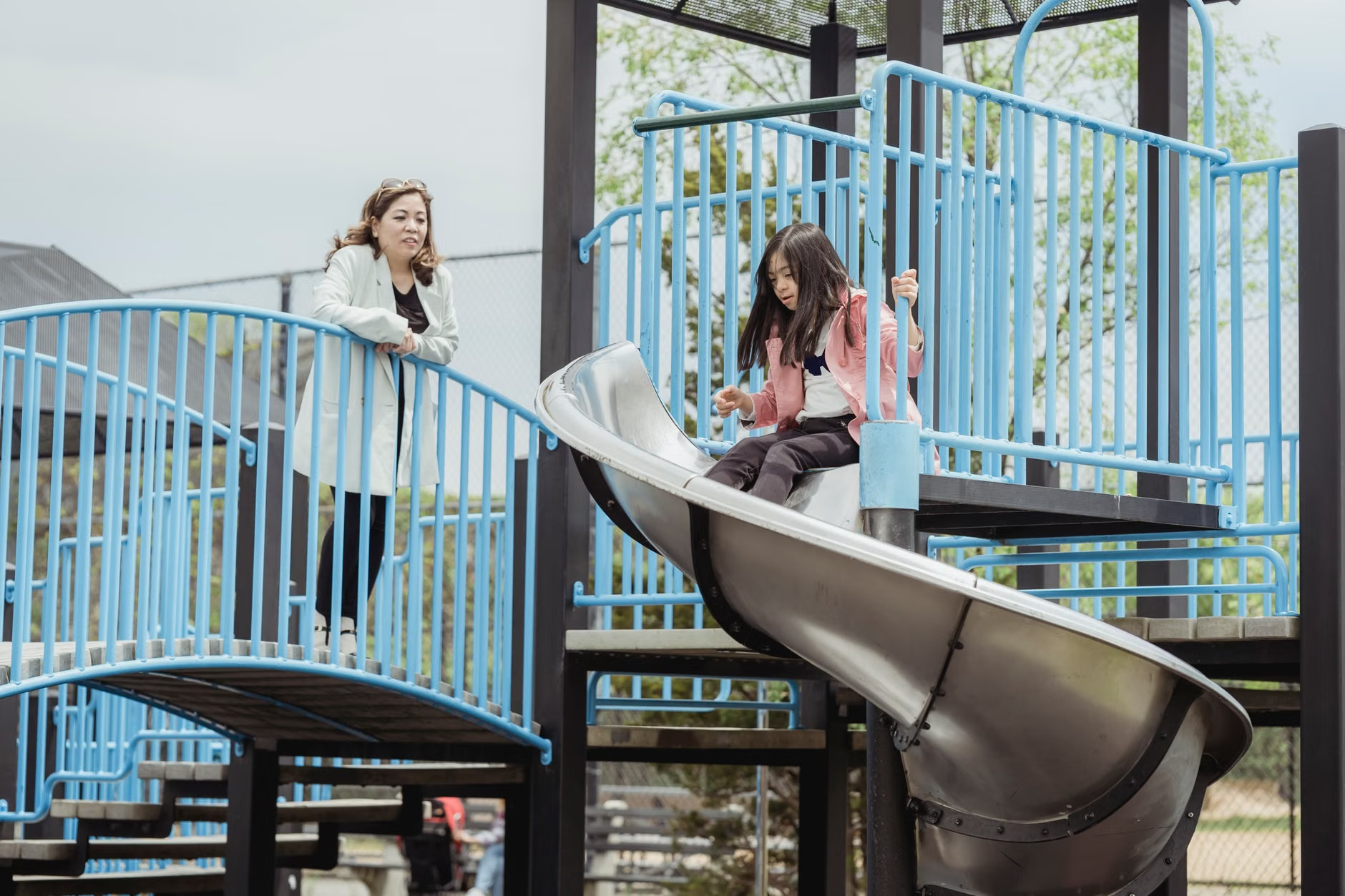
Many of us live in dense cities where the “nature” is limited to a manicured park or a small community garden. You might feel that “nature-play” is impossible in your concrete-heavy neighborhood. This is a common misconception. Nature-play isn’t about the size of the forest; it’s about the presence of loose parts.
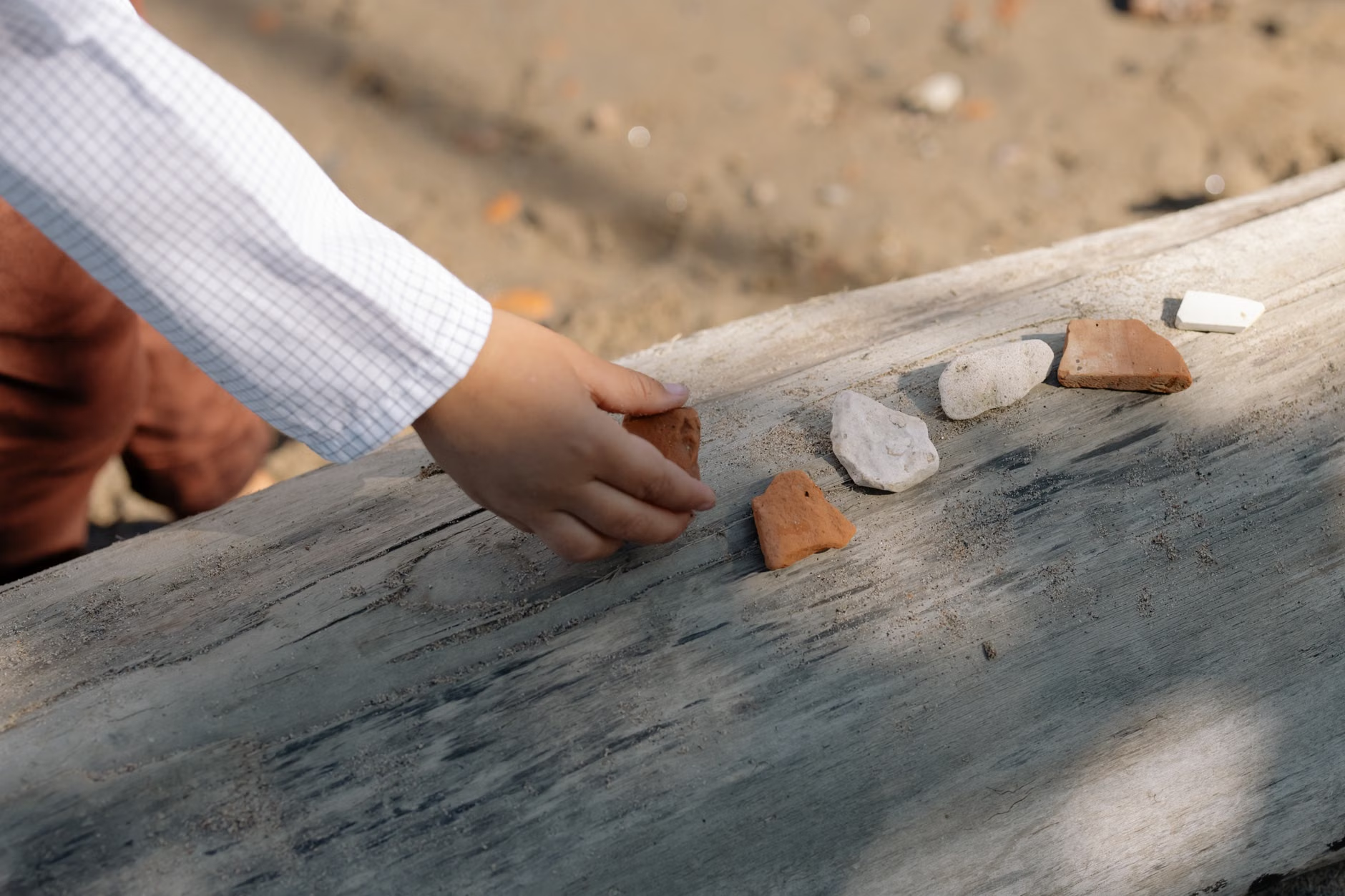
Loose parts are any materials that can be moved, carried, combined, redesigned, lined up, or taken apart. In a forest, these are sticks, stones, leaves, and pinecones. In a city, these can be cardboard boxes, fabric scraps, pebbles, or even a collection of interesting trash (like bottle caps or clean plastic containers).
The goal is to provide an environment that isn’t prescriptive. A plastic slide tells the child exactly what to do: sit, slide, repeat. A pile of sticks and rocks allows for infinite play scenarios: building a fort, creating a store, or setting up a obstacle course. If your local park is too “standard,” bring your own loose parts. A small bag of stones or a few lengths of rope can transform a boring bench into a construction site for a child’s imagination.
Common Mistakes Parents Make (And How to Fix Them)
Even with the best intentions, it is easy to fall into traps that stifle play. Here are three common mistakes and how to adjust your approach for better outcomes.
The “Interruption of Flow”
You see your child deeply engaged in stacking rocks. You walk over and say, “That’s great! Do you want to build a tower?” By labeling their play or suggesting a direction, you have just turned an internal creative process into a performance for you. The fix: If you want to engage, observe. If you must speak, ask a genuine question: “What is the hardest part of that stack to keep balanced?”
The “Safety Overload”
We often warn children about things that are not actually risks, such as getting dirty or getting wet. This teaches children that discomfort is a hazard. The fix: Dress them for the mess. If they know their clothes are meant for play, they won’t fear the mud. Let them embrace the tactile experience of the outdoors.
The “Comparison Trap”
Watching another child climb higher or faster can trigger a competitive parental instinct. You might feel the urge to push your child to do the same. The fix: Remember that every child has a different “risk threshold.” Your child’s development is not a race. If they are happy exploring the ground level, that is a valid and important form of play.
The Role of “Loose Parts” in Cognitive Development
There is a growing body of research on the benefits of loose-parts play, often referred to as “Theory of Loose Parts,” coined by architect Simon Nicholson. The core idea is that the more “open” an environment is, the more creative and inventive the child becomes.
When a child plays with a fixed piece of equipment, their play is limited by the design. When they play with loose parts, they are the designers. This requires a different type of cognitive effort. They have to plan, trial-and-error, and negotiate with others if they are playing in a group. In urban settings, this is vital because our spaces are so often designed to be “safe” and “static.” Injecting loose parts into these spaces brings back the element of unpredictability that is essential for brain development.
If you are looking to advocate for better play spaces in your neighborhood, suggest the implementation of a “loose parts” program at your local school or park. Many cities are beginning to adopt “junk playgrounds” or “adventure playgrounds” where children have access to wood, tires, and fabric. These are statistically some of the safest places for children to play, despite the appearance of “clutter,” because the children are constantly engaged in assessing the environment.
Establishing Your Family “Risk Policy”
Every family has a different comfort level, and that is okay. The key is to be consistent so your child knows what to expect. You might decide that “climbing is okay if you can get down by yourself” is your golden rule. This is a brilliant, simple boundary. It forces the child to consider their exit strategy before they even start the ascent.
Whatever your rules are, communicate them clearly. Instead of a blanket “be careful,” try to use “check your balance” or “look for your handholds.” These are actionable instructions that teach them how to be safe, rather than just telling them that they are in danger. Over time, these phrases will become their own internal monologue, helping them navigate the world long after they’ve left the playground.
Remember, the goal of nature-play isn’t to create an Olympic gymnast; it’s to raise a person who understands their own limits, respects the physical world, and has the confidence to take measured risks. By stepping back and acting as a guide rather than a shield, you are giving your child the best possible tool for their future: the ability to trust themselves.
Frequently Asked Questions
1. At what age should I start allowing “risky” play?
Risky play begins the moment a child starts to move. A toddler learning to walk is engaging in risky play! The key is to match the challenge to their current motor skills. Start with small, manageable challenges like stepping over a log or navigating uneven ground, and observe how they handle it. If they are showing signs of frustration or fear, they aren’t ready for that specific challenge yet.
2. My child gets upset when they fall. Should I stop the activity?
Not necessarily. A fall is a learning experience. Instead of immediately rushing in to pick them up, pause and assess. Are they hurt, or are they just startled? If they are unhurt, acknowledge their effort: “Whoa, that was a big tumble. Are you okay? You were trying to reach that branch, weren’t you?” This validates their effort and helps them process the fall as a part of the learning process rather than a failure.
3. How do I deal with other parents who think I’m being “negligent” for letting my child climb?
This is the hardest part of the social aspect of modern parenting. If a stranger comments, stay calm and keep it brief. A simple, “He’s practicing his climbing skills and I’m watching him closely; he’s doing great,” is usually enough. You don’t need to justify your parenting philosophy to everyone. Focus on your child and your own comfort level, and remember that you are doing the long-term work of building their independence.
Further reading and resources:
For more on the benefits of risky play, check out the research from the Outdoor Play Canada initiative, which provides extensive evidence-based resources on how nature-play impacts long-term health and development. Additionally, the Play Scotland organization offers excellent guides on managing risk in play environments that are applicable globally.