The most effective way to regain your focus in 2026 isn’t a new productivity app or a smarter AI assistant; it is the deliberate return to analog tools that do exactly one thing and do it well.
- Single-tasking superiority: Analog tools are inherently limited, which forces your brain to focus on one task at a time, unlike digital devices designed for infinite distraction.
- Cognitive offloading: The act of physically writing down tasks and schedules creates a stronger neural connection, reducing the “mental load” that often leads to parenting burnout.
- Intentional friction: Adding a small amount of friction—like having to pick up a pen or flip a calendar page—prevents the mindless scrolling that consumes hours of your day.
If you are in your 30s or 40s, you likely remember a time before the “notification economy” took hold of our lives. You remember the satisfaction of crossing off a physical to-do list and the simplicity of a wall calendar that didn’t sync, ping, or demand an update. Today, however, our lives are managed by supercomputers that double as entertainment hubs, grocery shoppers, and communication portals. We have traded our attention span for convenience, and the cost is becoming impossible to ignore.
You’ve probably felt it: the phantom vibration in your pocket, the “just one more email” trap that turns a five-minute check-in into an hour of doomscrolling, or the frustration of trying to find a family schedule buried under a dozen app notifications. The ‘Minimalist-Tech’ movement isn’t about throwing your phone into the ocean; it’s about reclaiming your cognitive space by choosing the right tool for the right job—and often, that tool is made of paper.
The Cognitive Science of Why Analog Works
There is a growing body of research suggesting that our brains process information differently when we engage with analog media. When we type on a screen, we are often operating in a state of “continuous partial attention.” We are primed to switch tasks, to check for messages, and to navigate interfaces. The digital environment is designed to be slippery; it is optimized for speed and flow, which is the enemy of deep, reflective thought.
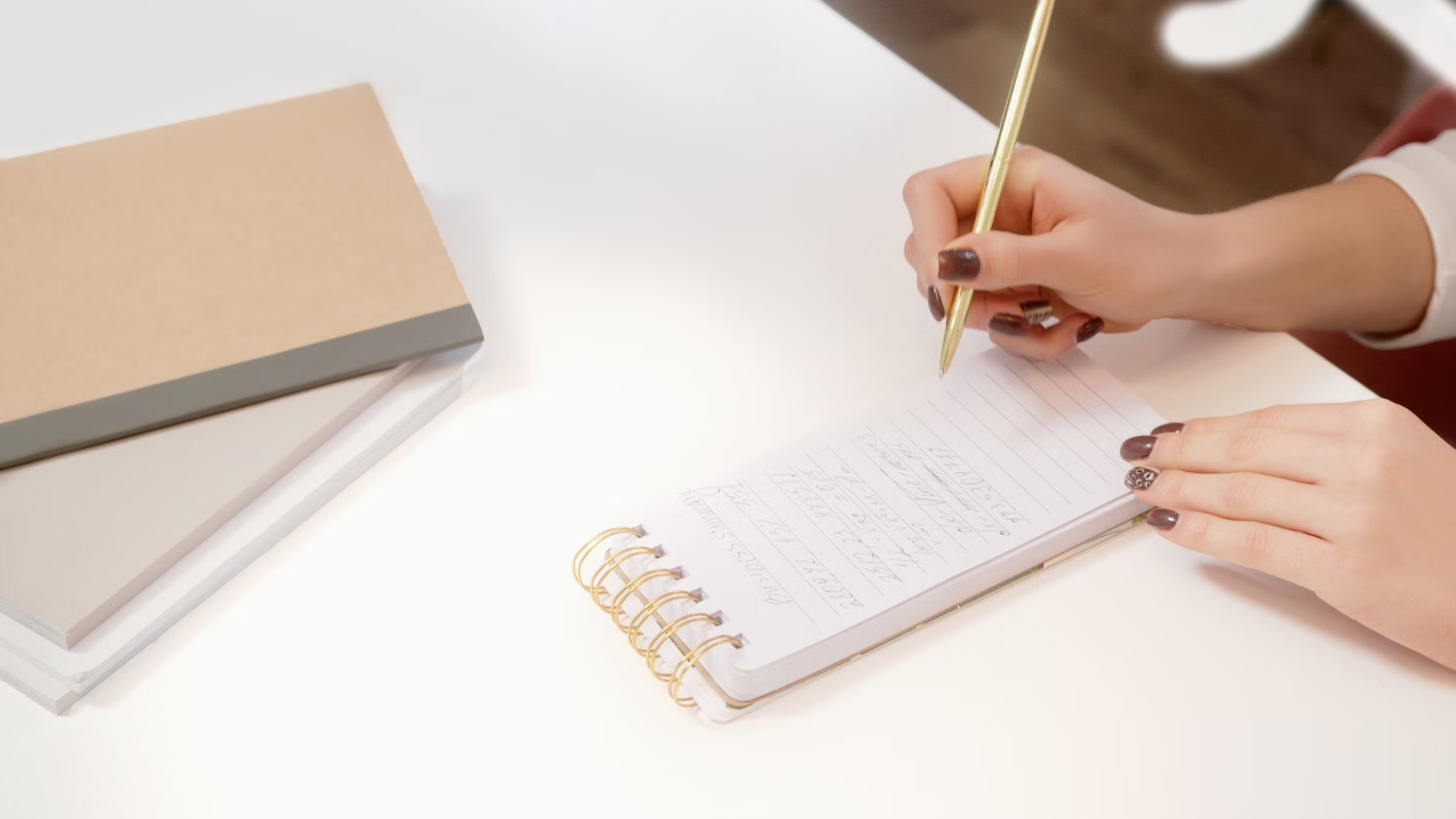
In contrast, analog tools provide “tactile grounding.” When you write with a pen on paper, you are forced to slow down. You cannot “copy-paste” your thoughts, and you cannot delete them with a single tap. This physical process, known as encoding, helps move information from your working memory into long-term memory. For parents juggling work projects, school permission slips, and meal planning, this deeper engagement means you are less likely to forget the details that actually matter.
Furthermore, digital tools are prone to “feature creep.” Your calendar app might try to suggest events, your notes app might try to format your text, and your email client might try to categorize your messages. These features, while helpful in theory, create “cognitive tax.” Every time you have to decide whether to click a button or dismiss a prompt, you are using up your limited daily supply of willpower. Analog tools have zero features. A notebook is a notebook. A wall calendar is a wall calendar. They do not require your decision-making energy to operate.
The ‘Digital Parking Lot’: Managing Your Phone
The biggest hurdle for anyone attempting a more analog lifestyle is the smartphone. It is a necessary evil for modern living, but it is also a black hole for attention. The secret to managing it isn’t willpower; it’s design. If your phone is always in your pocket, you will always be tempted to check it. You need to create a physical environment that makes your phone harder to access when you are trying to be present.
Start by establishing a “Digital Parking Lot.” This is a literal or figurative space in your home—a wooden tray in the entryway, a drawer in the kitchen, or a shelf in the hallway—where your phone lives when you are at home. When you walk through the door, the phone gets “parked.” If you need to check something, you have to walk to that spot. This adds just enough friction to prevent you from picking it up out of boredom.
This is particularly effective for parents. When you are playing with your children or helping them with homework, the phone should be in the parking lot. You might worry about missing an important call, but in reality, almost nothing is truly urgent. If it is an emergency, people will call twice or leave a voicemail. By creating this boundary, you are modeling healthy tech habits for your children and, more importantly, giving yourself the permission to be fully present in the moment.
Choosing Your Analog Toolkit
Transitioning to an analog-heavy workflow doesn’t mean you need to buy expensive stationery. It means choosing tools that fit your specific pain points. Here is how to evaluate what you actually need:
| Task | Digital Pitfall | Analog Solution |
|---|---|---|
| Family Scheduling | Notifications and fragmented apps | Large-format wall calendar in the kitchen |
| Daily To-Dos | Infinite lists and infinite updates | Small pocket notebook (the ‘Rule of 3’) |
| Long-term Planning | Getting lost in project management software | Whiteboard or large corkboard in office |
| Reading/Learning | Distracted by news feeds and pop-ups | Physical books or e-ink readers (no browser) |
The “Rule of 3” is a particularly effective strategy for those of us who struggle with endless to-do lists. Instead of writing down twenty tasks, write down the three most important things you need to achieve today. Everything else is secondary. By limiting your list, you are forced to prioritize. When you finish those three items, you have succeeded for the day. This reduces the crushing feeling of a “never-ending to-do list” that is common in digital apps.
The Social Impact of Analog
There is a subtle, almost invisible social benefit to using analog tools in public. When you pull out a paper notebook during a meeting or while waiting for a child at soccer practice, you are signaling that you are not “connected.” You aren’t scrolling, you aren’t checking stats, and you aren’t looking for a distraction. You are engaged in your own thoughts or the conversation at hand.
In 2026, the most precious commodity is silence—not just auditory silence, but mental silence. Our digital lives are filled with the opinions of others, the breaking news of the day, and the curated lives of our acquaintances. When you step back into the analog world, you create a private space where you can formulate your own opinions and process your own experiences without the constant input of an algorithm.
This is also a vital lesson for our families. If our children see us constantly tethered to a screen, they will learn that the “real” world is inside the device, not in the room with them. By using a physical calendar to track family events, you allow your children to see time pass. They can see the blocks of time, they can cross off the days, and they can understand the rhythm of a week in a way that a digital calendar simply cannot convey.
Common Pitfalls and How to Avoid Them
The most common mistake people make when starting a minimalist-tech journey is trying to do too much at once. Do not throw away your smartphone or delete all your apps on day one. You will likely feel overwhelmed and return to your old habits within a week. Instead, treat it like an experiment.
Start with one area of your life. Maybe it’s your morning routine. For one week, commit to not touching your phone for the first hour of the day. Use an analog alarm clock. Read a physical book. Write your goals for the day on a piece of paper. If you find that this improves your mood and your productivity, you can expand it to other areas of your life.
Another common mistake is “analog clutter.” Just as digital files can pile up, paper can also become a source of stress. Keep your analog system simple. If you find yourself spending more time organizing your notebook than actually doing the work, you are doing it wrong. The goal is to spend less time managing tools and more time living your life.

The Reality of Hybrid Living
We live in a digital world, and we shouldn’t pretend otherwise. You still need your email for work, you still need your maps to navigate, and you still need your banking apps. The goal of the minimalist-tech movement is not to be a Luddite; it is to be a conscious consumer of technology.
Think of it as a “digital diet.” You don’t stop eating just because you want to be healthier; you just stop eating junk food. Digital junk food includes infinite social media feeds, clickbait news, and unnecessary notifications. You can keep the “healthy” digital tools that provide genuine value while swapping out the “junk” for analog alternatives.
For example, keep your work email on your computer, but remove it from your phone. Use a digital app for your grocery list (because it’s genuinely efficient for family sharing), but use a paper planner for your personal goals and reflections. This hybrid approach allows you to leverage the best of both worlds without being consumed by either.
When Should You Reconsider?
While the benefits of analog tools are clear, there are edge cases where digital is objectively better. If you are a parent tracking a child’s medical data, a digital log is safer and easier to share with a doctor. If you are managing a complex household budget, a spreadsheet is far more powerful than a ledger. The key is to be honest about why you are using a tool.
Ask yourself: “Am I using this digital tool because it is the most efficient way to solve this problem, or am I using it because it is the default path?” If the answer is the latter, it is time to consider an analog alternative. If the answer is the former, keep using it, but audit it regularly to ensure it isn’t becoming a source of distraction.
Building Your Own Analog Sanctuary
Creating an analog sanctuary in your home doesn’t require a dedicated study. It can be as simple as a clear surface. Clear your dining table of all electronics during meals. Use a physical coaster for your drink instead of a phone stand. These small, deliberate actions signal to your brain that this space is for connection and rest, not for consumption.
If you have children, involve them. Let them help you fill out the wall calendar. Let them see you writing in your journal. When children see that you value the physical world, they are more likely to value it themselves. It is a powerful way to bridge the generational divide in a world that is increasingly obsessed with the virtual.
Practical First Steps for This Week
If you want to start this journey today, here are three actionable steps you can take:
- Buy a physical alarm clock: This is the single most effective way to stop checking your phone first thing in the morning. Keep it at least three feet away from your bed.
- Get a wall calendar: Place it in a high-traffic area, like the kitchen. Use a specific color-coded pen system for different family members.
- Declutter your home screen: Delete any app that you don’t use at least once a day. If you don’t use it daily, you don’t need it on your home screen. This reduces the visual noise every time you unlock your phone.
The transition to a more analog life is not about rejecting the future. It is about choosing to live in the present. By intentionally choosing when to engage with technology and when to step away, you reclaim the one thing that no app can give you back: your time.
Remember that this is a practice, not a destination. You will have days where you fall back into old habits, and that is perfectly fine. The beauty of analog tools is that they are always there, waiting for you to pick them up again. There is no software update required, no login screen to navigate, and no algorithm trying to keep you engaged. Just you, your tools, and your life.
Stay grounded, stay intentional, and don’t be afraid to disconnect to reconnect.
Frequently Asked Questions
1. Won’t I miss important updates if I stop checking my phone constantly?
In reality, very few things are truly “urgent.” Most notifications are just noise. By checking your phone at designated times—such as twice a day—you still stay informed without sacrificing your focus. If something is truly an emergency, people will call you directly.
2. How do I convince my family to join me in this analog movement?
Don’t force it. Focus on leading by example. When your family sees you becoming more present, less stressed, and more engaged, they will likely become curious. Frame it as “more time for fun” rather than “less time for phones,” and emphasize the benefits of having a shared, physical space for family plans.
3. Is it really better to write things down than to type them?
Yes. Research indicates that the physical act of writing engages different parts of the brain compared to typing. It promotes deeper reflection and better information retention. For managing tasks and personal reflections, the friction of writing is a feature, not a bug, as it forces you to think more clearly about what you are recording.
For further reading on the impact of digital media on cognitive function, you can consult research from the American Psychological Association on the effects of constant connectivity.