The most effective way to build a lasting bond with your child is not through forced “quality time” conversations, but by engaging in a shared-hobby model where the activity itself acts as the bridge between generations.
- Shift from “Supervising” to “Participating”: Move away from watching your kids play and toward doing things with them where both parties are learners.
- The “Parallel Skill” Approach: Choose hobbies where you and your child can start at different levels but progress together, reducing the power imbalance of “teacher vs. student.”
- Consistency Over Intensity: Low-pressure, recurring sessions are scientifically more effective for emotional bonding than one-off “big event” trips.
If you are in your 30s or 40s, you likely know the feeling: you return home after a long day of meetings, emails, and logistical juggling, only to feel that your interaction with your children is limited to a cycle of “How was school?” and “Did you finish your homework?” It is not that you don’t want to connect; it is that the traditional “parenting” role feels like an extension of the workday. You are managing, directing, and supervising.
The shared-hobby model flips this script. Instead of being the manager of their lives, you become a partner in a pursuit. This shifts the dynamic from a hierarchy to a collaboration. But how do you actually implement this when you are exhausted, short on time, and often overwhelmed by your own digital life?
Why “Quality Time” Often Fails
We often treat “quality time” as a scheduled, high-pressure event. We take our children to the zoo, a museum, or a theme park, expecting a profound bonding moment to occur because we spent money or traveled a distance. The reality is often quite different. The parent is tired, the child is overstimulated, and the “bonding” is interrupted by meltdowns or the constant checking of a smartphone.
The shared-hobby model works because it removes the pressure to “have fun.” When you are both focused on a task—whether it is baking sourdough, coding a simple game, fixing a bicycle, or learning to garden—the conversation happens organically. You are not looking into each other’s eyes across a dinner table, which can feel intimidating for children; you are looking at the same object, working toward the same goal. This is what psychologists call “shoulder-to-shoulder” interaction, and it is significantly more effective for communication than face-to-face interrogation.
Choosing the Right Hobby for Your Dynamic
Not every hobby is suitable for every age or temperament. The goal is to find an activity that allows for “parallel progression.” If you are an expert at something and your child is a complete novice, you will naturally default to teaching. While teaching is part of parenting, it is not “bonding.” You want an activity where you can both be slightly clumsy or where you are both learning a new skill simultaneously.
Consider the following criteria when selecting your shared hobby:
| Criteria | Why it matters |
|---|---|
| Low Barrier to Entry | You want to start within 5 minutes, not 50 minutes of setup. |
| Tangible Results | A physical object or a completed task provides a sense of shared accomplishment. |
| Scalability | The hobby should grow with your child’s capabilities. |
| No “Right” Way | Avoid hobbies that are strictly competitive or require rigid adherence to rules. |
For example, if you choose woodworking, you don’t need to build a dining room table. Start with a simple birdhouse or a small storage box. If you choose coding, start with a simple block-based language like Scratch rather than diving into C++. If you choose hiking, start with local nature trails rather than ambitious mountain summits. The goal is to maintain the activity as a “safe space” where mistakes are just part of the process.
The Logistics: Managing Time in a Busy Life
The biggest hurdle for parents in their 30s and 40s is time poverty. You don’t have four hours on a Saturday to dedicate to a hobby. The shared-hobby model thrives on the “micro-session” approach. If you can dedicate 20 minutes twice a week, that is far more valuable than a four-hour marathon once a month. Consistency builds the habit and the expectation of connection.
When you make the hobby a standing appointment, it becomes part of the family rhythm. Let’s say you choose to learn basic gardening. You don’t need to spend all day in the dirt. 15 minutes of watering, weeding, and checking for growth on Tuesday and Thursday evenings is enough. The key is to protect that time as if it were a high-priority meeting at work. If you cancel on your boss, you have consequences. If you cancel on your child, you signal that the hobby—and by extension, the connection—is secondary to everything else.
Handling the “I’m Bored” Phase
There will be times when your child doesn’t want to participate. This is normal. The key is to remain consistent with your own engagement. If you are working on your shared model—say, sketching or model building—and you do it at the table, often the child will eventually drift over to see what you are doing. If you force the hobby, it becomes a chore. If you model the enjoyment of the hobby, it becomes an invitation.
Common Pitfalls and How to Avoid Them
Even with good intentions, it is easy to fall into traps that kill the spirit of the hobby. Being aware of these common mistakes will save you a lot of frustration.
The “Expert” Trap: If you are genuinely good at the hobby, you will be tempted to correct your child’s technique. Resist this. If you are building a model airplane and they put the wing on slightly crooked, let it stay crooked. The goal is the shared experience, not the quality of the final product. If you “fix” everything for them, they will stop wanting to participate because they feel incompetent.
The “Device” Intrusion: This is the most common killer of the shared-hobby model. Keep your phone in another room. If you are constantly checking your email or social media while “bonding,” you are sending a clear message that your digital life is more interesting than your child. Treat the hobby time as a tech-free zone for everyone involved.
The “Achievement” Focus: We live in a culture that values output. Did we win? Did we finish? Did we make something cool? Try to shift your internal focus to the process. If you spent 30 minutes talking about the weather, the school day, or just laughing at a mistake you made while working on the project, that is a successful session, even if you didn’t finish the task.

Integrating the Model into Different Age Groups
The shared-hobby model must evolve as your child grows. What works for a seven-year-old will be met with eye-rolls by a fourteen-year-old. The core philosophy remains the same, but the “delivery” changes.
For Younger Children (Ages 5-9)
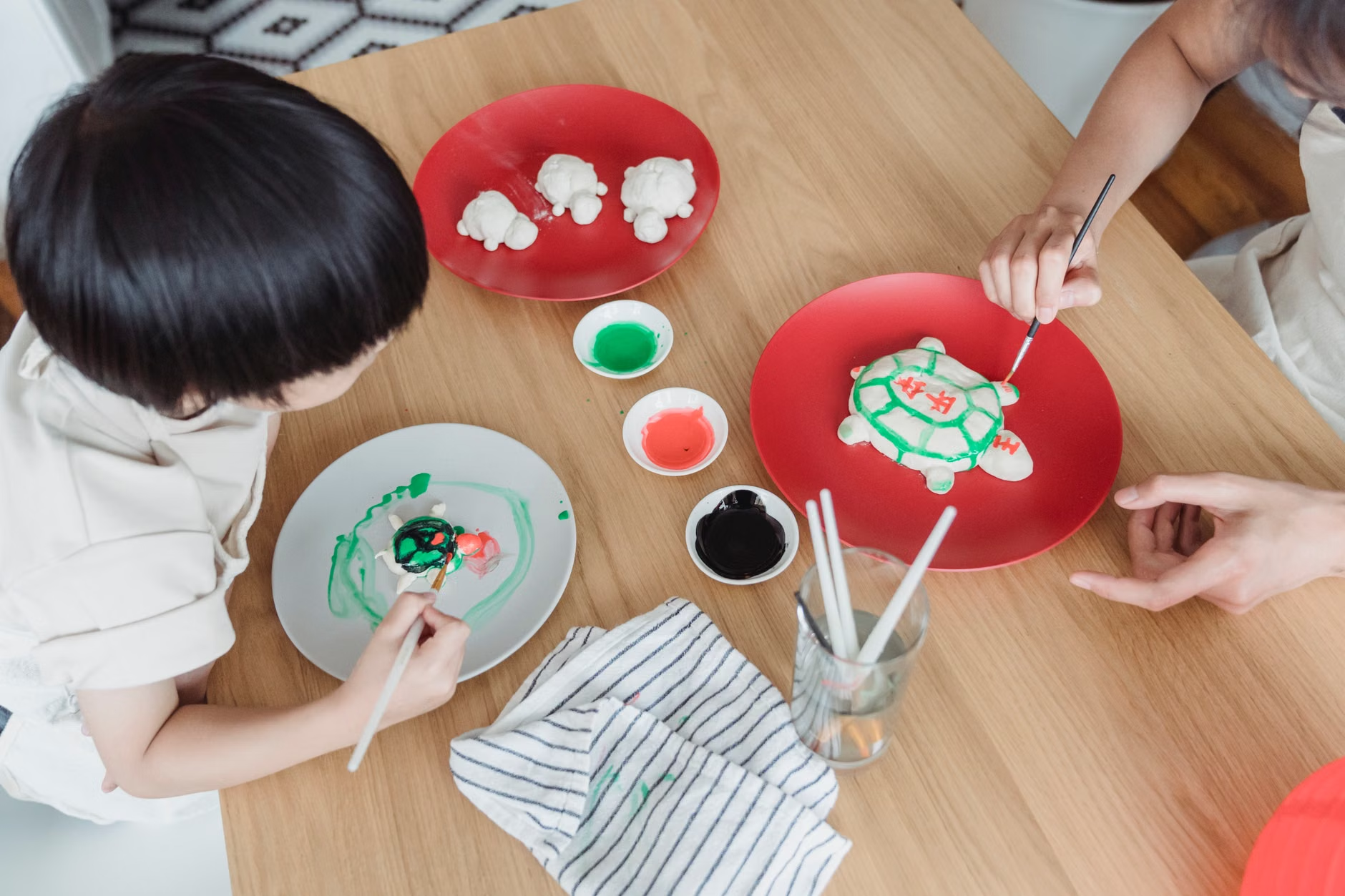
At this age, the hobby should be highly tactile. Think building sets, basic painting, simple gardening, or baking. The focus here is on sensory input and following simple sequences. You are teaching them how to focus and how to manage frustration when a piece doesn’t fit or the dough is too sticky.
For Pre-teens (Ages 10-13)
This is the transition phase. They are becoming more independent and self-conscious. This is the perfect time to introduce hobbies that involve more “adult” tools or technology. Perhaps learning to cook a specific meal from scratch, basic home repair, or even a sport like tennis or pickleball. The key here is to offer them agency. Let them choose the recipe or the route for the hike. Give them a sense of autonomy within the shared structure.
For Teens (Ages 14+)
By the time your child is a teenager, they are likely pulling away to establish their own identity. The shared-hobby model is crucial here because it provides a low-pressure environment for them to be around you without the need for intense “talking.” Choose hobbies that feel more like a peer-to-peer partnership. Strategy games, film photography, car maintenance, or even training for a 5K run together. The focus is on mutual respect and shared competence.
The Psychological Benefits of “Side-by-Side” Bonding
Research into family dynamics suggests that children feel more comfortable opening up when they are not the sole focus of a conversation. When you are sitting in a car, walking on a trail, or working on a car engine, the child feels less “put on the spot.” This reduces the defensive mechanisms that often arise during face-to-face talks.
Furthermore, when a parent displays vulnerability—admitting, “I’m not sure how to fix this” or “I messed this part up”—it teaches the child that imperfection is part of growth. It humanizes the parent. In our 30s and 40s, we often try to present an image of competence to our children. Showing them that you are also a learner is a powerful lesson in humility and resilience.

If you want to start this week, follow this simple framework:
- Audit Your Interests: What do you actually enjoy? Do not pick a hobby you hate just because you think it’s “educational.” If you hate gardening, don’t force it. If you love music, explore that.
- Propose, Don’t Impose: Present the hobby as an opportunity. “I’ve been wanting to try building a telescope/learning to bake bread, and I thought it would be fun to do it together. Would you be interested?”
- Set a Minimum Viable Commitment: Start with just 20 minutes a week. Keep the barrier to entry low. If you have to spend an hour setting up, you won’t do it.
- Create a Dedicated Space: Even if it is just a box with your supplies, having a “home” for your hobby makes it feel official and special.
- Review and Pivot: After a month, ask how it is going. Be prepared to change hobbies if it isn’t sticking. The goal is the connection, not the hobby itself.
Addressing the Reality of Modern Life
It would be disingenuous to suggest that this is easy. You are likely balancing a demanding job, household maintenance, and perhaps caring for aging parents. You are tired. You are busy. There will be weeks when you miss a session, and that is perfectly okay. The goal is not perfection; it is presence.
The shared-hobby model is a tool, not a mandate. If it starts to feel like just another task on your to-do list, stop. Take a step back and reassess. Is the hobby too complex? Are you putting too much pressure on the outcome? The moment it feels like work is the moment it loses its value as a bonding mechanism.
Also, acknowledge the role of technology. While we mentioned keeping phones away, technology can also be a bridge. If you and your child both enjoy a specific video game, play it together. If you are both interested in space, use an app to track the International Space Station and go outside to watch it pass. Use technology to facilitate the hobby, not to replace the interaction.
Frequently Asked Questions
1. What if my child is completely uninterested in the hobbies I propose?
If your child rejects your suggestions, ask them what they are currently curious about. The “Shared-Hobby” model isn’t about you choosing the activity; it’s about the structure of doing something together. If they are interested in something you know nothing about—like a specific type of card game or obscure coding language—offer to be their “apprentice” and let them teach you. This is a massive ego-boost for them and creates a unique bonding dynamic.
2. How do I handle it when my child gets frustrated and wants to quit?
Frustration is a natural part of learning. When they want to quit, validate their feelings without immediately “saving” them. Say, “I can see this is really frustrating. Do you want to take a break for five minutes and try again, or should we stop for today and come back to it next time?” This teaches them that it is okay to struggle and that they have the agency to decide how to handle their own frustration.
Absolutely, but start with one to avoid spreading your time and energy too thin. Once you have established a rhythm with one hobby, you can introduce others as your child grows and their interests evolve. Many families find that they have a “seasonal” hobby—like hiking in the summer and board games in the winter—which keeps things fresh and prevents burnout.
Conclusion
The shared-hobby model is not about creating a perfect, Instagram-worthy family life. It is about carving out small, intentional pockets of time where you and your child can exist as equals in the pursuit of something new. By focusing on the process rather than the outcome, and by staying consistent despite the inevitable busyness of your 30s and 40s, you create a foundation for a relationship that is based on mutual respect and shared experiences.
Remember, the goal is not to be the perfect parent, but to be a present one. The memories you create while struggling to build a bookshelf or learning to identify birds in your backyard are the ones that stick. Start small, keep it low-pressure, and focus on the person sitting next to you rather than the task in front of you. Your future relationship with your child is being built in these small, quiet moments.
For more insights on child development and family bonding, you can explore resources from organizations like The American Psychological Association or ZERO TO THREE, which provide evidence-based strategies for fostering healthy parent-child relationships.