The most effective way to teach your children conflict-resolution is not through a lecture at the dinner table, but through the shared, tangible consequences of a collaborative garden.
- Shared Responsibility: Gardening creates a “third party” stakeholder—the plants—which shifts the focus from “me vs. you” to “us vs. the problem.”
- Natural Consequences: Unlike abstract behavior charts, a garden provides immediate, non-judgmental feedback: plants thrive when cared for and struggle when neglected.
- Structured Negotiation: Assigning specific roles in the garden allows children to practice compromise and turn-taking in a low-stakes, high-reward environment.
If you have ever spent a Saturday afternoon refereeing a squabble over a toy, a tablet, or the “right” way to build a block tower, you know that the traditional parent-as-arbitrator model is exhausting. We tell our kids to “share” or “take turns,” but these are abstract concepts. To a seven-year-old, “sharing” often feels like “losing.”
What if we shifted the arena? Collaborative gardening is not just about growing organic tomatoes or teaching kids where food comes from. It is a living, breathing laboratory for social-emotional learning. When two children are tasked with keeping a single row of carrots alive, the conflict moves from a power struggle between siblings to a shared problem-solving mission. If they don’t agree on who waters the plants, the plants wither. It is the garden, not the parent, that holds them accountable.
Why the Garden Works as a Conflict-Resolution Tool
At its core, conflict resolution requires three things: empathy, communication, and a shared goal. In the chaos of daily life, it is hard to manufacture these elements. We are usually rushing to school, work, or extracurriculars. The garden, however, forces a slower pace.
When children work in a garden, they encounter natural, neutral problems. If a weed is choking a seedling, it doesn’t matter who put the weed there. The goal is to remove it so the plant can grow. This creates a “us vs. the problem” dynamic. Psychologists often refer to this as “superordinate goals”—a concept popularized by Muzafer Sherif’s Robbers Cave experiment, where competing groups of boys were able to resolve conflict only when they were forced to work together to achieve a goal that neither could reach alone.
In your backyard, the “superordinate goal” is the harvest. If the kids want strawberries in July, they have to cooperate in May. This shifts the internal monologue of the child from “I want to do this my way” to “What do we need to do so our berries don’t die?”
Setting the Stage: Planning for Cooperation
You cannot just dump a packet of seeds on a table and expect harmony. Conflict-resolution in the garden starts with the architecture of the space. If you have two children, create a system that necessitates coordination.
Start by dividing tasks. One child can be the “Hydration Specialist” (in charge of watering), while the other is the “Weed Warden.” Crucially, these roles should rotate. If one child is always the “fun” harvester and the other is the “boring” weeder, you are simply manufacturing resentment, not teaching cooperation.
Table 1: The Collaborative Garden Role Matrix
| Role | Duty | Collaborative Skill |
|---|---|---|
| Hydration Lead | Ensures soil moisture | Observational patience |
| Weed Warden | Removes invasive growth | Attention to detail / Stewardship |
| Harvest Manager | Identifies ripe produce | Communication / Timing |
| Data Tracker | Logs plant progress | Reporting / Shared memory |
By rotating these roles every two weeks, children learn that every part of the process is necessary. When they inevitably complain, “I don’t want to weed this week,” you have the perfect opening for a negotiation lesson: “How can you and your partner work out a trade? What is a fair exchange for taking someone else’s turn?”
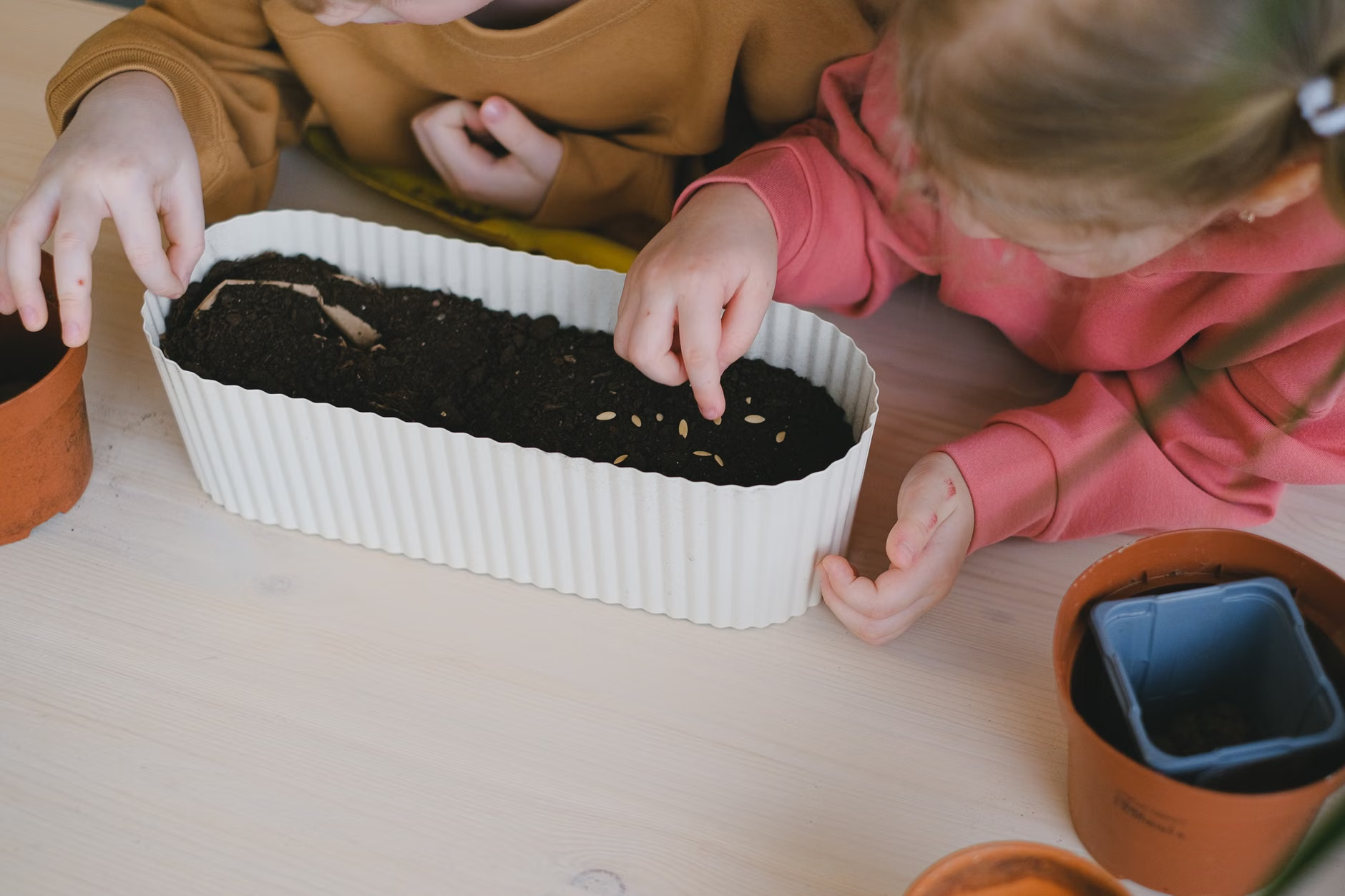
The most common conflict you will face is the “ownership” battle. “That’s *my* shovel,” or “I wanted to put the seed there.” This is where you, as the parent, must step back. Do not jump in to mediate immediately. Instead, observe from a distance.
If you see a conflict brewing, ask a neutral, open-ended question: “I see that you both want to plant in the same spot. How can you decide who goes first without hurting feelings?”
This is a fundamental shift in parenting. You are not the judge; you are the facilitator. By forcing them to provide the solution, you are building the neural pathways required for negotiation. Sometimes, they will decide to take turns. Sometimes, they will decide to plant two seeds side-by-side. Sometimes, they will argue until the sun goes down. And that is okay. The “natural consequence” is that the planting gets delayed. They learn that their inability to agree has a real-world cost.
If the conflict becomes physical or overly aggressive, that is your cue to pause the gardening session. “It seems like we are too frustrated to work as a team right now. Let’s take a break and try again when we are ready to listen to each other.” This teaches them that cooperation is a prerequisite for the privilege of working in the garden.
The Science of Patience and Delayed Gratification
Gardening is an exercise in delayed gratification, which is a major component of conflict resolution. When a child is impulsive, they are more likely to lash out during a disagreement. Gardening requires waiting—for the seed to sprout, for the leaves to grow, for the fruit to ripen.
Research published in the *Journal of Child and Family Studies* suggests that regular engagement with nature can significantly improve impulse control in children. When kids spend time gardening, they learn that if they tug on a sprout too hard, it breaks. If they don’t water it, it dies. This creates a physical manifestation of “action and consequence.”
When they bring this mindset into their social interactions, they are better equipped to pause before reacting. They learn that a conflict, like a garden, needs time and tending. You don’t solve a problem by yanking at it; you solve it by carefully working through the layers.

Handling Failure: When the Garden (or the Team) Suffers
Inevitably, a plant will die. Or a crop will fail. This is the ultimate test of your collaborative experiment. When the harvest is small or the plants look sickly, the instinct is to blame someone. “He didn’t water it enough!” or “She pulled out the wrong plant!”
This is your “teachable moment” goldmine. Instead of letting them point fingers, facilitate a “Root Cause Analysis.” Sit down and ask: “What happened here? What could we have done differently as a team to prevent this?”
This moves the conversation away from individual blame and toward system improvement. It teaches children that in the adult world, when a project fails, the goal isn’t to find a scapegoat; it’s to find a better process for next time. This is a high-level executive function skill that will serve them far better than knowing how to win an argument.
Practical Tips for Parents in Their 30s and 40s
You are likely balancing a demanding career, household management, and the desire to be an “involved” parent. You don’t have time for a full-scale farm. Keep it manageable. A few containers on a balcony or a single raised bed is more than enough.
Avoid the “Pinterest Trap.” Your garden doesn’t need to look like a professional landscape design. It needs to be a place where your kids can get their hands dirty and learn to work together. If the plants are messy, let them be messy. The messiness is where the learning happens.
Use technology to your advantage. If you want to track progress, use a shared app or a simple whiteboard in the kitchen. Let the kids update the status of the garden. This gives them a sense of ownership over the *process*, not just the *output*. If they see that they have successfully watered the plants for seven days in a row, they are more likely to feel a sense of shared accomplishment.

Common Pitfalls and How to Avoid Them
1. Over-management: The biggest mistake parents make is doing the work for the kids when they are too slow or “doing it wrong.” Resist this urge. If they plant the seeds too close together, let them. When the plants struggle, they will learn why the spacing instructions matter. Experience is the best teacher.
2. Focusing on the Harvest: If you make the size of the vegetable the goal, you set them up for disappointment. Make the *process* the goal. Celebrate the effort, the planning, and the teamwork. If the tomatoes are tiny, make a “tiny tomato salad” and celebrate the fact that you grew them together.
3. Ignoring the “Boredom Factor”: Gardening can be boring. If a child says they are bored, don’t rush to entertain them. Ask them, “What does the garden need right now?” This forces them to engage with the reality of the task. Boredom is often the precursor to creativity and problem-solving.
Structuring the Lessons for Different Ages
How you implement these lessons depends heavily on the age of your children. A four-year-old and a ten-year-old will have very different capacities for conflict resolution. Tailor your expectations accordingly.
For Toddlers and Preschoolers (Ages 3-5)
At this age, conflict is usually about physical objects. “Mine!” is the default setting. Use the garden to teach “turn-taking.” Use a physical timer. “When the timer goes off, it is your turn to use the trowel.” Make the garden a place of simple, physical movement.
For Early Elementary (Ages 6-9)
This is the “Golden Age” for collaborative gardening. They are capable of understanding cause and effect. You can start introducing the concept of “roles.” Use a whiteboard to map out who is doing what. If they have a disagreement, ask them to “write down” their proposed solution. This helps them organize their thoughts before they speak.
For Tweens (Ages 10-12)
Tweens are capable of more complex planning. Let them choose the crops. If they want to grow something difficult, let them research why it might fail. If they disagree on what to plant, they have to present a “case” to the other person. This is excellent practice for persuasion and compromise.
The Long-Term Impact on Social Skills
By the time your children are teenagers, you want them to be able to navigate disagreements without needing you to step in. You want them to have the internal tools to say, “I see your point, but I see it differently. How can we find a middle ground?”
This is not a skill that is taught in a classroom. It is learned in the trenches of daily life. By using the garden as a neutral, collaborative space, you are giving them years of practice in a low-stakes environment. When they hit the “real world” of high school group projects, workplace conflicts, and adult relationships, they will have a memory bank of experiences that taught them: we are better when we work together.
Summary and Encouragement
Conflict is not a sign that your parenting is failing; it is a sign that your children are growing. They are learning to assert their individuality, which is a necessary part of development. Our job as parents is not to eliminate conflict, but to guide them toward healthy ways of navigating it.
Collaborative gardening is a powerful, practical, and grounded way to do this. It replaces the “me vs. you” dynamic with a shared commitment to a living thing. It teaches patience, responsibility, and the art of negotiation. And at the end of the day, you get to eat what you grew together—a literal, delicious manifestation of your success as a team.
Start small. Don’t worry about being perfect. Just get outside, get your hands in the dirt, and let the garden do the heavy lifting for you.
For more on the developmental benefits of gardening for children, you can explore resources from the Royal Horticultural Society’s School Gardening program or the KidsGardening.org initiatives, which offer excellent guides on how to structure collaborative projects for families.
Frequently Asked Questions
1. What if my kids just end up fighting more in the garden?
It is perfectly normal for the garden to become a site of conflict initially. If the fighting is constant, pause the activity. Frame it not as a failure of the garden, but as a sign that the “team” needs a break to reset. The goal is to make the garden a “cooperation-only zone.” If they can’t cooperate, they lose access to the garden for the day. This creates a clear boundary: the privilege of the garden is tied to the ability to work together.
2. How do I handle a child who refuses to participate?
Don’t force it. If one child is disinterested, let them step away. Often, the child who is working will start having fun, and the other will naturally gravitate toward the activity out of curiosity. If they don’t, that’s fine too. You can’t force collaboration, but you can model it. Eventually, they will see that the collaborative work leads to better results (like bigger, healthier plants), and they will want to join in.
3. Does this really work for all ages?
It works for all ages, but the *level* of collaboration changes. For younger children, keep the tasks very short and highly structured. For older children, give them more autonomy over the “what” and “how” of the garden. The principle remains the same: use the garden as a third-party stakeholder that requires the kids to communicate and compromise to achieve a shared, positive outcome.