The “Third-Space” movement is gaining momentum because people in their 30s and 40s are realizing that expensive, exclusive club memberships often drain more energy than they provide, whereas community-centric hubs offer the flexible, low-pressure social connection that modern parenting and work-life balance actually require.
- Beyond Home and Work: The “third space” is a physical location that fosters social interaction without the rigid costs or exclusivity of private clubs.
- The Shift in Values: Busy adults are prioritizing accessibility, inclusivity, and family-friendliness over status-driven social venues.
- Practical Integration: Integrating these spaces into your routine can reduce social isolation while keeping your budget and schedule intact.
If you are in your 30s or 40s, you likely know the feeling of the “time crunch.” Between school drop-offs, professional deadlines, and the endless mental load of managing a household, the idea of maintaining a private club membership can feel like another item on an already overwhelming to-do list. The traditional “club” model—whether it’s a gym, a country club, or a networking group—demands a subscription fee and often a commitment to a specific schedule or social performance. But lately, there has been a noticeable shift in how we seek connection. We are moving away from gated social experiences and toward “third spaces.”
Defining the Third Space: What Is It, Really?
The term “third space” was coined by urban sociologist Ray Oldenburg in his 1989 book, The Great Good Place. He defined it as a social environment separate from the two primary spheres of life: the first space (home) and the second space (work). A true third space is a neutral ground where people can gather, interact, and relax without the pressure of being a “member” or the requirement to spend heavily.
Think about the classic examples: the local park, the public library, the neighborhood café, or the community garden. These aren’t venues where you go to be seen; they are venues where you go to exist in a community. For those of us juggling the complexities of mid-life, these spaces are becoming a lifeline. They don’t require an RSVP, they aren’t tied to a high monthly retainer, and they are usually designed to accommodate the realities of life—like having a stroller in tow or needing a spot to check an email between errands.

Why the Club Membership Model Is Faltering
For decades, the “club” was the gold standard for social status and networking. Whether it was a golf club or a co-working space with a velvet rope, these venues were designed to filter people. However, for the modern adult, this exclusivity has become a liability. When you are balancing a family, the last thing you want is a social environment that feels like a performance.
Private clubs often demand consistency. You are expected to show up, participate, and maintain a certain image. If you miss a few weeks because your child was sick or work was demanding, you might feel a sense of guilt or social “atrophy.” Third spaces, by contrast, are defined by their fluidity. You can show up once a month or every single day, and the space remains welcoming. It’s an “on-demand” social life that fits the erratic rhythm of modern adulthood.
| Feature | Private Clubs | Third Spaces |
|---|---|---|
| Barrier to Entry | High (Fees, Vetting) | Low (Public/Low Cost) |
| Expectation | Performance/Participation | Presence/Relaxation |
| Flexibility | Rigid Schedules | Highly Fluid |
| Inclusivity | Exclusive/Homogenous | Diverse/Community-based |
The Practical Benefits for Busy Parents
When you have children, your social life often suffers from a lack of “third-party compatibility.” Many adult-centric clubs are not built for kids, and many kid-centric spaces are not built for adult conversation. This is where the beauty of a well-designed community hub comes in.
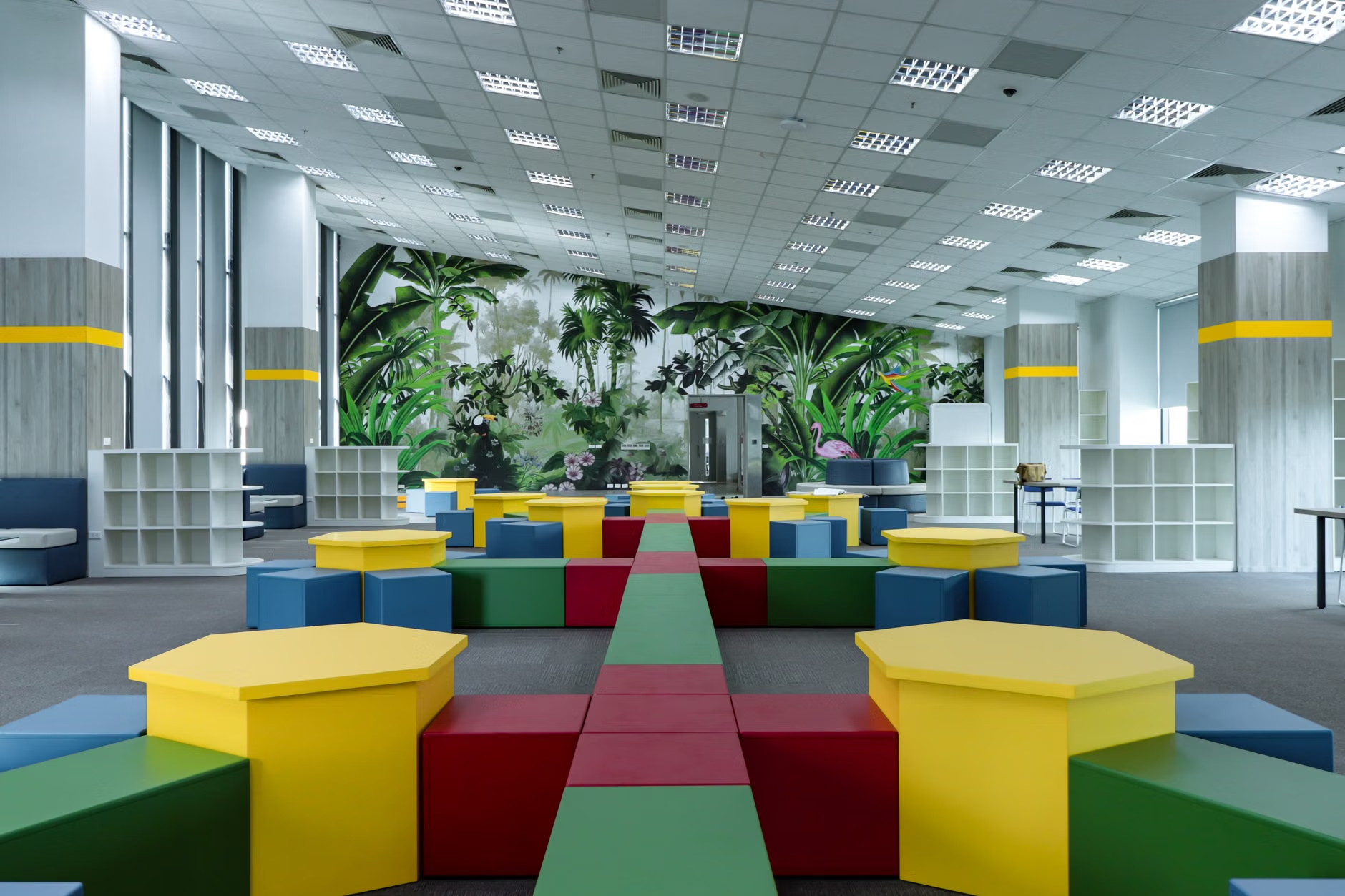
A good neighborhood hub—perhaps a library with a café or a shared community center—provides a “soft landing.” You can have a coffee, look at your phone, or chat with a neighbor, all while your children are engaged in a nearby area. This is not just convenient; it’s essential for mental health. The isolation of stay-at-home parenting or the exhaustion of working-parent life is mitigated by these small, low-stakes interactions. You aren’t “going out” for a night of social labor; you are “dropping by” for a moment of human connection.
How to Identify a Genuine Third Space in Your Neighborhood
Not every public space functions as a third space. A busy, loud chain coffee shop where everyone is wearing noise-canceling headphones and avoiding eye contact is technically a public space, but it lacks the community element that makes a third space valuable. To find the right spots, look for these markers:
- The “Regulars” Factor: Do you see the same people there at similar times? This indicates a community hub where relationships can actually form.
- Neutrality: Is the atmosphere welcoming to everyone? If the vibe is too curated or “cool,” it’s likely a status-driven space, not a community one.
- Accessibility: Can you walk there? Is it affordable? A third space should be an extension of your neighborhood, not a destination that requires a commute.
- Low Pressure: Does the staff or the environment encourage you to linger, or do they push for turnover? A true third space values your presence more than your transaction.
The Economic and Social Shift
There is a growing economic argument for the third space as well. In an era of inflation, the “subscription economy”—where we pay monthly for everything from streaming services to gym memberships—is reaching a saturation point. People are looking for ways to cut costs while maintaining their quality of life. By choosing a community-based hub over a private club, you are reclaiming your budget without sacrificing the social benefits of an “out-of-home” life.
Furthermore, there is a wider trend in urban planning. Cities are beginning to realize that “social infrastructure”—parks, public plazas, and community centers—is just as vital as physical infrastructure like roads and pipes. When a neighborhood has a strong, accessible third space, crime rates often drop, and the overall happiness of residents increases. It’s a virtuous cycle: when we spend time in public, we take care of the public space, which in turn takes care of us.

Common Pitfalls and How to Avoid Them
Even with the best intentions, it is easy to fall into the “membership trap” again. Here are a few things to watch out for:
The Trap of Over-Scheduling: Just because a space is free and accessible doesn’t mean you need to be there every day. Don’t turn your third space into a new “chore.” It should exist to serve your schedule, not dictate it.
The Digital Barrier: It is easy to bring your laptop to a community space and isolate yourself behind a screen. While this is fine for productivity, try to build in “analog” moments. Put the phone away for 15 minutes. Make eye contact. This is how you transition from being a “visitor” to a “regular.”
Expecting Instant Community: Community takes time. Don’t be discouraged if you go to a local park or library for three weeks and don’t make a best friend. These things are incremental. The value is in the opportunity for connection, not the guarantee of it.
Actionable Steps: Integrating Third Spaces This Week
If you want to start shifting your social life toward these community hubs, you don’t need a grand plan. Start small:
- Scout your 15-minute radius: Use a map app to find parks, libraries, or community centers within a 15-minute walk or drive.
- Test the vibe: Visit one of these spots during a “low stakes” time—like a Tuesday morning or a Saturday afternoon—to see how it feels.
- The “Regular” Protocol: Choose one spot and go there at the same time for three consecutive weeks. Familiarity is the precursor to community.
- Lower your social barrier: Bring a book or a craft. It gives you something to do if you are alone, but it also acts as a conversation starter if someone else is interested.
Reflecting on the Future of Social Connection
The move toward third spaces isn’t just a trend; it’s a recalibration. As we navigate the chaos of our 30s and 40s, we are learning that the most meaningful connections aren’t found in exclusive, high-cost environments. They are found in the overlooked corners of our neighborhoods, in the spaces that allow us to be ourselves without the need to impress or perform.
By stepping out of the club and into the community, you aren’t just saving money or time. You are participating in the quiet, necessary work of building a more connected, resilient life. It’s not about grand gestures or massive social circles; it’s about the simple, human comfort of knowing your neighbors and being a part of a place where you are known. That, ultimately, is the greatest luxury of all.
Frequently Asked Questions
1. Can a co-working space be considered a “third space”?
Generally, no. While they provide a space outside of home and work, they are usually transactional and exclusive to members. A true third space should be open, accessible, and not focused primarily on professional productivity.
2. What if I live in an area with very few public spaces?
This is a common challenge. If your neighborhood lacks traditional third spaces, look for “third-space-adjacent” options. This could be a local church group, a community garden, or even a local sports league that meets in public parks. Sometimes you have to help create the space by being the one who shows up consistently.
3. How do I balance “third space” time with my family’s needs?
The best way is to integrate your family into the third space. Look for hubs that have amenities for children. When the space works for the whole family, it stops being a “time-away-from-family” activity and becomes a shared community experience.
For further reading on the importance of social infrastructure, you can explore resources from the Project for Public Spaces, which provides extensive research on how community-centric urban design improves quality of life. Additionally, the American Library Association offers insights into how libraries are evolving into the modern-day “living rooms” of our neighborhoods.