- AI-literacy isn’t about teaching kids how to code, but teaching them to question the origin and intent of the media they consume.
- Focus on the “why” and “how” of generative media to demystify the technology, reducing its power to deceive or overwhelm.
- Establish a “verify-first” culture at home by encouraging children to treat AI output as a draft or a starting point, rather than objective truth.
The most effective way to help your children navigate the age of generative AI isn’t by restricting their access, but by changing how they perceive the content appearing on their screens. As parents in our 30s and 40s, we are the first generation to raise children in a world where the boundary between human-made and machine-made content is effectively invisible. If you’ve ever felt a slight pang of anxiety when your child shows you a “cool” image or a story written by a chatbot, you aren’t alone—you are simply recognizing that the digital landscape has fundamentally shifted.
Generative media—those AI-powered tools that create text, images, music, and video from simple prompts—is not going away. In fact, it is becoming the default layer of the internet. Teaching AI-literacy is no longer a niche skill for computer scientists; it is an essential pillar of modern parenting, as vital as teaching road safety or how to handle money.
Demystifying the “Magic” Behind the Screen
Children often perceive technology as magic. When a tablet produces an image of a space-traveling cat in seconds, it feels like a spell. Our job is to pull back the curtain. To teach AI-literacy, we must first help children understand that AI is not a “brain” or a “creative entity.” It is a pattern-recognition engine.
Think of it like a very advanced, high-speed collage artist. It doesn’t “know” what a cat is; it knows the statistical probability of which pixels usually appear next to other pixels when someone types the word “cat.” When you explain it this way, you shift the child’s perspective from “the computer made this perfect thing” to “the computer guessed what I wanted based on millions of other examples.”
This subtle shift is powerful. It teaches the child that the AI is an echo of existing data, not a source of objective truth. When children understand that AI is essentially “remixing” the past, they become naturally more skeptical of its output. They start to realize that if the data it was trained on is biased or incorrect, the output will inevitably be biased or incorrect, too.

The Four Pillars of AI-Literacy for Families
To make this manageable, I like to break down AI-literacy into four actionable pillars. You don’t need to be a tech expert to teach these; you just need to be a curious guide.
1. Identifying the Source
The first rule of the modern internet is “who made this?” Start asking your kids: “Do you think a person drew this, or did a computer build it?” Look for the tell-tale signs of generative art—the slightly wonky fingers, the impossible background textures, or the way eyes sometimes look a bit too glassy. By turning identification into a game of “spot the AI,” you train their eyes to look closer.
2. Understanding Bias and Hallucination
AI models often “hallucinate,” which is a fancy term for lying with absolute confidence. If your child uses an AI to help with homework, it might invent a historical figure or a scientific fact that sounds plausible but is entirely fabricated. Show them this in action. Ask the AI to write a story about a real historical event and then fact-check it together. Watching the AI get something wrong is the best lesson a child can have in why they must always verify information.
3. The Ethics of “Borrowing”
Generative AI models are trained on the work of real artists, writers, and photographers. This is a great opportunity to talk about intellectual property and respect for creators. Discuss how it feels to have your own drawings or stories “remixed” without permission. This helps foster empathy for human creators, which is a crucial counterweight to the “everything is free and instant” mindset of AI generation.
4. Human-in-the-Loop Creativity
Encourage your children to use AI as a tool for brainstorming rather than a tool for finishing. If they are writing a story, let them use AI to generate five different plot twists—but then insist they choose one, rewrite it, and add their own unique voice. The goal is to keep the human as the editor-in-chief, not the assistant.
Practical Strategies for Daily Conversations
You don’t need a formal “lesson plan.” The best conversations happen in the margins of daily life. When you are watching a video or browsing an app, take a moment to pause. Ask, “Why do you think this video was recommended to us?” or “Does this image look a bit too perfect to be real?”
| Situation | The “Traditional” Approach | The “AI-Literate” Approach |
|---|---|---|
| Homework Help | “Don’t use the computer for your essay.” | “Let’s use the AI to outline, then you write the draft and fact-check every point.” |
| Seeing a “Fake” Image | “That’s just a fake photo, ignore it.” | “Let’s look at the edges of the image. Why does the lighting look weird? How could we verify if this is real?” |
| Playing with AI Games | “Stop playing with that toy.” | “Let’s see what happens if we give it a weird prompt. Why do you think it responded that way?” |
By engaging with the technology rather than banning it, you keep the lines of communication open. If you ban it, you lose the ability to see how they are using it. If you participate, you become a mentor who can intervene when things get weird or confusing.

Common Mistakes Parents Make
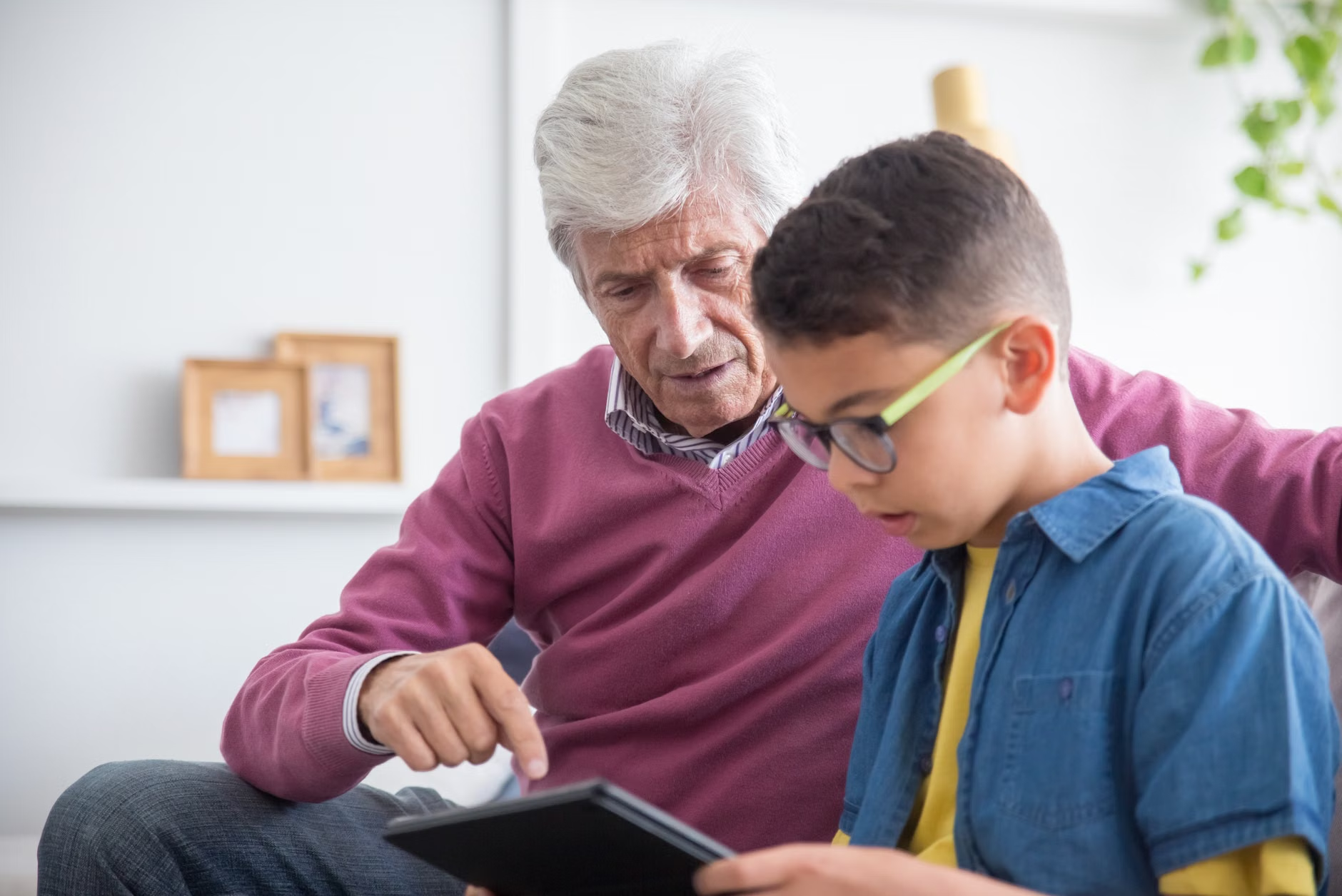
The most common mistake is assuming that “digital native” children are inherently tech-savvy. Just because a child can navigate a tablet interface better than you can, it does not mean they understand the underlying mechanics or the risks of generative media. They are experts at *using* the interface, but they are often novices at *interpreting* the output.
Another mistake is expressing fear. If you approach AI with a sense of dread, your children will mirror that anxiety. Instead, approach it with a sense of “healthy caution.” Treat it like teaching them to swim: you don’t keep them away from the water because it’s dangerous; you teach them how to float, how to tread water, and how to identify the deep end.
Finally, avoid the “black box” trap. Don’t let them treat the AI as an oracle that cannot be questioned. If they ask the AI a question, always follow up with, “How can we prove that’s true?” This simple question creates a habit of mind that will serve them for the rest of their lives, regardless of how the technology evolves.
When to Set Boundaries
While I advocate for engagement, there are times when boundaries are necessary. For younger children, the risks of AI are different than for teenagers. Younger kids might struggle to distinguish between a fantasy-generated character and a real person. For them, keep the AI usage strictly supervised and focused on creative play rather than information gathering.
For teenagers, the risk shifts toward social engineering, deepfakes, and the potential for AI to be used in bullying. Here, the conversation needs to be about digital ethics and the permanence of online actions. Discuss the reality that a deepfake of a friend can be just as damaging as a real photo, and that the intent behind the creation matters.
Set clear rules about when AI is allowed to be used. For example, “AI is for brainstorming and art inspiration, but never for completing assignments without attribution.” Make these rules collaborative. If they feel like they helped create the house rules, they are far more likely to follow them.
Building a Culture of Verification
We are living in an era where “seeing is believing” is no longer a viable strategy. We must transition to a culture of “verifying is believing.” This is a massive shift for our society, and it starts at the kitchen table. When you see a news story or a viral video that seems suspicious, talk about it with your kids. Show them the steps you take to verify the information—checking multiple sources, looking for the original context, and identifying the creator.
This is not about making them cynical; it’s about making them resilient. Cynicism is the belief that nothing is true, which is just as paralyzing as being easily fooled. Resilience is the ability to wade through a sea of information, identify the signal through the noise, and make informed decisions about what to trust.
Encourage your children to be “information detectives.” Give them the tools to investigate the digital world. If they find an interesting fact online, challenge them to find a second source that confirms it. If they find an image that looks “off,” challenge them to find the original image or the context it was pulled from. Turning the burden of proof into a game is one of the most effective ways to build lifelong media literacy.
The Evolution of the “Human Element”
As AI becomes more capable, the things that only humans can do become more valuable. Empathy, nuanced judgment, creative synthesis, and the ability to understand context are the skills your children will need to thrive in a future where basic content generation is commoditized. When you talk to your kids about AI, remind them that the goal is not to compete with the machine, but to use the machine to amplify their own unique human perspective.
If they use AI to write a story, ask them, “What part of this is actually *you*?” Encourage them to inject their own experiences, their own weird sense of humor, and their own unique observations into the output. The AI can provide the structure, but they must provide the soul. This is the ultimate defense against a world flooded with generic, machine-made content.
Moving Forward with Confidence
The pace of change in the world of generative AI is dizzying, and it’s natural to feel like you’re falling behind. But remember: you don’t need to be an expert in machine learning to be a great guide for your child. You just need to be present, curious, and committed to asking the right questions.
Parenting in the age of AI is really just an extension of the parenting we’ve always done. We’ve always had to teach our children how to distinguish between truth and lies, how to handle difficult social situations, and how to be responsible members of a community. AI just adds a new layer to those fundamental tasks. By keeping the conversation going, setting clear boundaries, and fostering a spirit of inquiry, you are giving your children the best possible foundation for whatever the future holds.
Stay curious, stay involved, and don’t be afraid to learn alongside your children. After all, we are all navigating this new digital frontier together.
Frequently Asked Questions
- At what age should I introduce AI tools to my child?
There is no universal age, but most experts suggest that children under 10 should only interact with AI under direct, one-on-one supervision, focusing on creative play. As they reach middle school, they can begin to explore AI for brainstorming, provided they have a strong foundation in digital ethics and verification. - How do I explain “deepfakes” to a teenager?
Explain it as a form of digital impersonation. Use the analogy of a high-tech mask—it looks like the person, but it isn’t them. Emphasize that just because a video shows someone saying or doing something, it doesn’t mean it actually happened. Discuss the potential for harm and the importance of never sharing or creating content that violates someone else’s privacy or dignity. - What should I do if I catch my child using AI to cheat on schoolwork?
Avoid a purely punitive response. Instead, use it as a “teachable moment.” Sit down and discuss *why* they felt the need to use the AI—was the assignment too hard? Were they overwhelmed? Then, show them how to use AI as a study aid rather than a replacement for their own work. Focus on the value of their own thinking and the long-term consequences of relying on shortcuts.
For further reading on digital safety and AI, you may want to explore resources from organizations like Common Sense Media, which provides age-appropriate guides on technology, and the International Society for Technology in Education (ISTE) for broader frameworks on digital literacy.