The most effective way to reduce the intensity of a difficult emotion—whether you are a toddler struggling with a toy or an adult navigating a high-pressure deadline—is to simply name it. This process, often called “affect labeling,” is the core mechanism behind the Emotional-Vocabulary Jar, a practical tool that turns abstract, overwhelming feelings into concrete, manageable concepts.
- Naming reduces reactivity: Research shows that labeling an emotion dampens the activity in the amygdala, the brain’s “fight or flight” center.
- Building the vocabulary: A limited emotional vocabulary often leads to “acting out” because the brain lacks the tools to describe the internal state.
- The Jar as a bridge: The physical act of writing or placing a slip into a jar creates a pause, providing the necessary space to transition from emotional reaction to logical response.
If you are in your 30s or 40s, your life is likely a juggling act of professional responsibilities, household management, and the constant, evolving needs of your children. We often talk about “emotional intelligence” as a vague, desirable trait, but in the trenches of daily life, it often feels like we are just trying to keep the peace. When a child screams because their toast was cut into triangles instead of squares, or when you find yourself snapping at your partner over an unwashed dish, the root cause is rarely the event itself. It is the inability to process the underlying emotion.
Why Our Brains Struggle with “Just Getting Over It”
There is a persistent myth that if we ignore an emotion, it will eventually dissipate. Psychology, however, suggests the opposite. When we suppress a feeling, we are essentially trying to hold a beach ball underwater; it takes constant effort, and the moment our attention slips, it erupts with more force. This is where the gap in our vocabulary becomes a problem.
Most of us operate with a very limited emotional toolkit. We know “happy,” “sad,” “angry,” and “tired.” But “angry” is a blunt instrument. It covers everything from being slightly annoyed at a traffic jam to feeling deeply betrayed by a colleague. By using only a few words to describe a vast spectrum of human experience, we lose the ability to address the specific nuance of the situation.
For children, this is even more pronounced. A toddler does not have the cognitive architecture to understand that they are feeling “frustrated because they lack the motor skills to complete a task.” They only know that the world feels wrong, and they have no words to describe it. By introducing the Emotional-Vocabulary Jar, we provide a physical, tangible way to expand that toolkit.
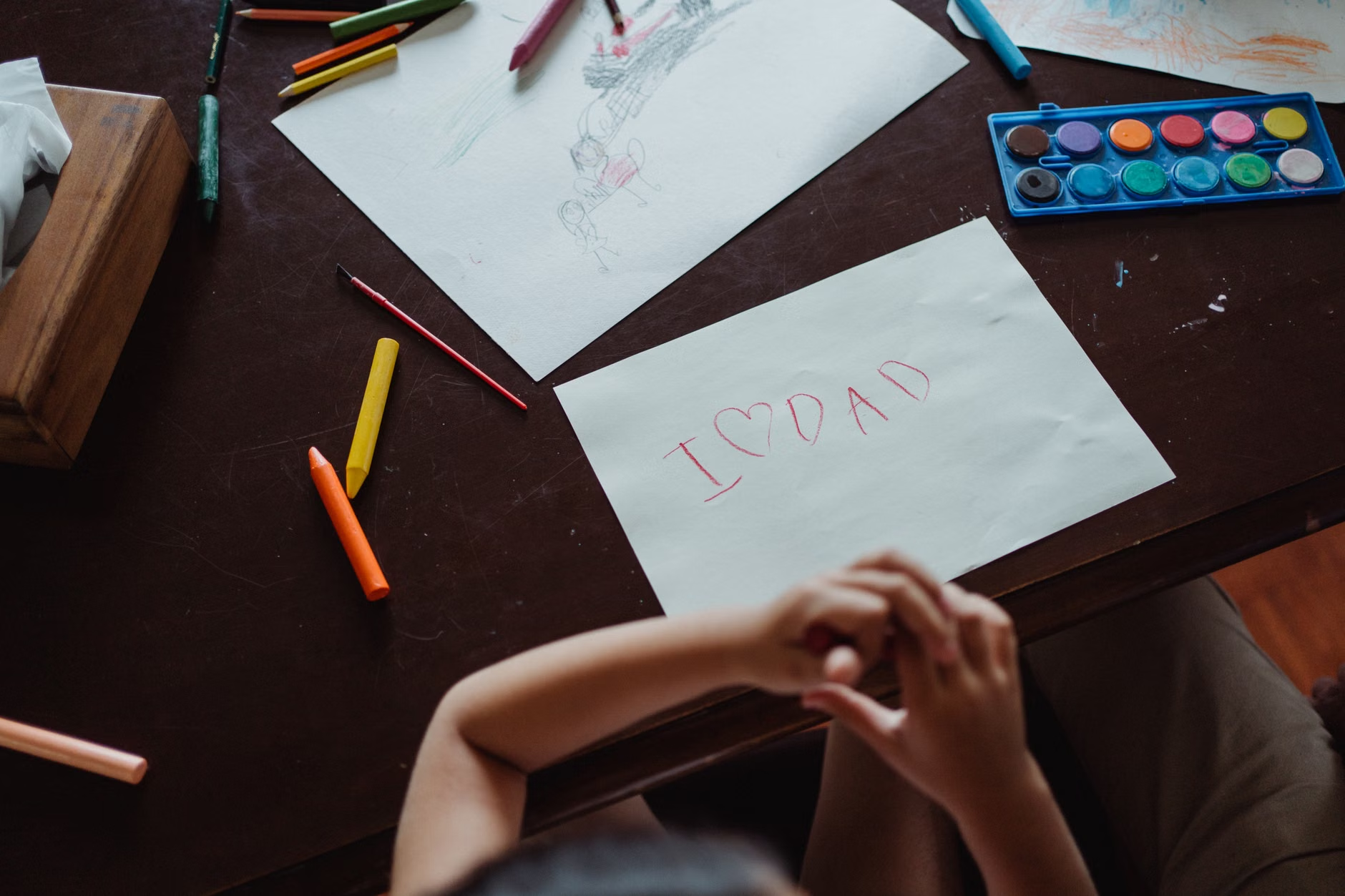
The Mechanics of the Emotional-Vocabulary Jar
The jar itself is not magic; it is a physical anchor for a psychological practice. The goal is to move from “I feel bad” to “I feel overwhelmed, which is a type of stress, which can be managed by taking a break.” Here is how you can implement this in your household, regardless of whether you are using it for your children or for your own personal growth.
Step 1: Curating the Vocabulary
You cannot identify what you cannot name. Spend time—perhaps during a quiet weekend morning—creating a list of emotions. Do not stop at the basics. Use a thesaurus or an “emotion wheel” to find specific, granular terms. For younger children, start with categories like “frustrated,” “disappointed,” “excited,” “lonely,” or “anxious.” For adults, you might include “overwhelmed,” “under-appreciated,” “inspired,” or “drained.”
Step 2: The Physical Setup
Find a clear glass jar. The transparency is important; it represents the idea that emotions are visible and understandable, not hidden or scary. Place the jar in a common area. Next to it, keep a stack of small, colorful slips of paper and a pen. The act of writing is a cognitive process that forces the brain to slow down and categorize the feeling.
Step 3: The “Label and Deposit” Routine
When you notice a “big” emotion rising—either in yourself or your child—the instruction is simple: “Let’s find the word for that.” Once you have identified the emotion, write it on a slip and drop it into the jar. If the child is too young to write, you write it for them. If you are doing this for yourself, treat it as a formal act of acknowledgment. By placing it in the jar, you are physically acknowledging the existence of the feeling without letting it dictate your actions.
| Stage | Action | Purpose |
|---|---|---|
| Recognition | Pause and identify the physical sensation. | Interrupt the “fight or flight” loop. |
| Labeling | Select the most accurate word from your list. | Engage the prefrontal cortex. |
| Deposition | Write it down and place it in the jar. | Create physical detachment from the feeling. |
| Reflection | Review the jar at the end of the week. | Identify patterns and triggers. |
Why This Matters for the 30-40 Demographic
In our 30s and 40s, we are often in a “sandwich” phase. We are caring for growing children while simultaneously navigating our own professional peaks and the aging of our parents. The sheer volume of decision-making can lead to “decision fatigue,” which makes us more susceptible to emotional outbursts. When you are tired, you have less bandwidth for emotional regulation.
Using the jar method isn’t just about teaching kids; it’s about modeling emotional literacy. If your child sees you feeling frustrated at a work email and saying, “I am feeling overwhelmed, so I am going to write that in my jar and take five minutes to breathe,” you are teaching them a vital life skill. You are showing them that emotions are not shameful things to be hidden, but data points that can be labeled, processed, and managed.
Common Pitfalls and How to Avoid Them
One of the biggest mistakes parents make is turning this into a “punishment” or a “shaming” tool. If you tell a child, “Go put your anger in the jar,” it sounds like you are telling them to hide their feelings or that their anger is a problem to be discarded. The language you use is critical.
Instead, frame it as a collaborative discovery. “I notice you are having a hard time. Let’s see if we can find the word for what is happening so we can figure out what you need.” The jar is a storage unit for *understanding*, not a trash can for *feelings*.
Another pitfall is the “empty jar syndrome.” If you set it up and never talk about it, it becomes just another piece of clutter. Make it a ritual. Perhaps on Sunday evenings, you empty the jar and talk about the feelings you collected. “Look, we had a lot of ‘frustration’ this week. What was happening on Tuesday that made us feel that way?” This turns the jar into an analytical tool, helping you identify recurring stressors in your household.
The Neuroscience Behind the Label
The effectiveness of this method is backed by studies in affective neuroscience. Researchers at UCLA, led by Matthew Lieberman, have consistently found that putting feelings into words—affect labeling—reduces the neural activity in the amygdala. The amygdala is the part of the brain that detects threats. When it is active, you feel the physical symptoms of stress: a racing heart, shallow breathing, and a narrowing of focus.
When you label the emotion, you are shifting the cognitive load from the limbic system (the emotional brain) to the prefrontal cortex (the logical, planning brain). You are literally using your intelligence to dampen your emotional reaction. This is not about “thinking your way out of feelings,” but about using your brain’s architecture to modulate the intensity of those feelings.

Practical Adaptations for Different Ages
If your children are very young, the “vocabulary” needs to be visual. Use color-coded cards. Red for “angry,” blue for “sad,” yellow for “anxious,” and green for “calm.” As they get older, you can introduce more complex concepts like “disappointed,” “overwhelmed,” “lonely,” or “excited.”
For your own personal use, consider keeping a digital version if you are on the move, though there is a specific benefit to the tactile nature of the physical jar. The act of writing by hand is slower than typing, which forces more reflection. If you have a high-stress job, keep a small notepad and a jar at your desk. Treat it as a professional tool for mental clarity. It is no different than keeping a project management board; it is simply management for your internal state.
Addressing the Skepticism
Some might argue that this feels too clinical or “therapeutic” for a household setting. It is worth noting that we are already doing this, just poorly. Every time we tell a child “don’t cry” or tell ourselves “just push through,” we are attempting to manage emotions. The jar method is simply a more intentional, evidence-based upgrade to the ineffective strategies we currently use.
It also provides a neutral ground. If you are in a conflict with a partner, it is hard to say, “I am hurt because you forgot to pick up the dry cleaning.” It sounds accusatory. But if you have already established a vocabulary, you can say, “I am feeling ‘unsupported’ right now, and I put that in the jar.” The focus shifts from the action (the dry cleaning) to the internal state (the feeling of being unsupported). This often de-escalates the conflict significantly.
Expanding the Toolkit: When the Jar Isn’t Enough
It is important to recognize that the Emotional-Vocabulary Jar is a tool for regulation, not a substitute for professional mental health support. If you or your family members are dealing with persistent, overwhelming anxiety or depression, the jar is merely a starting point for communication. It does not replace the need for therapy or clinical intervention. If you find that the jar is constantly full of “hopelessness” or “extreme fear,” treat those as serious signals that it is time to seek professional guidance.
Furthermore, do not expect immediate results. If you have spent years operating without a sophisticated emotional vocabulary, it will take time to build the habit. Start small. Perhaps aim for one label per day. The goal is consistency, not perfection. As you build this practice, you will notice that your baseline for “reactivity” begins to shift. You will start to catch yourself before the explosion occurs, simply because you have the word ready in your mind.
The Long-Term Impact on Family Dynamics
Over time, the Emotional-Vocabulary Jar changes the culture of a home. It moves the household from a place of reactions to a place of reflections. Children who learn to label their emotions early are better equipped to handle the complexities of adolescence and adult relationships. They learn that feelings are not permanent states of being, but temporary weather patterns that pass.
For parents in their 30s and 40s, this is a legacy of resilience. We are teaching our children—and reminding ourselves—that we have agency over our internal lives. We are not just at the mercy of our hormones, our stress, or our circumstances. We are the architects of our emotional responses, and that begins with the simple, humble act of naming what we feel.
Common Questions About the Jar Method
How do I start if my child is resistant to the idea?
Do not force it. Start by modeling it yourself. Leave the jar on the table and use it when you are feeling something. “I feel really frustrated that this bill is higher than I expected. I’m going to write ‘frustrated’ and put it in the jar.” Children learn by observation. Once they see that you are using it to manage your own feelings, they will naturally become curious and eventually want to participate.
Is this method effective for teenagers?
Teenagers are often resistant to “parenting tools,” but they respond well to anything that offers them autonomy. Frame the jar as a way to “clear their head” or “track their mental state” during a stressful school year. Do not monitor what they write—respect their privacy. The jar should be a safe space for them to acknowledge their feelings without fear of judgment or unwanted advice.
What if I don’t know the “right” word for a feeling?
There is no “right” word, only the word that feels most accurate to you. If you can’t find the exact word, describe the sensation. “I feel like a knot in my stomach.” That is a perfectly valid label. The goal is to articulate the internal experience, not to pass an English exam. The more you practice, the more nuanced your vocabulary will become over time.
The Emotional-Vocabulary Jar is a small, manageable intervention that yields significant results in emotional regulation. By slowing down to identify and label our feelings, we create the space necessary to respond rather than react. This practice, while simple, is a foundational element of building a resilient, communicative, and emotionally intelligent family environment.
For further reading on the science of affect labeling and emotional regulation, you may find these resources useful:
- UCLA Health: Understanding the Neuroscience of Emotional Regulation
- Greater Good Science Center at UC Berkeley: Tips for Emotional Intelligence
Remember, the goal is not to eliminate negative emotions—that is impossible and undesirable. The goal is to understand them, name them, and move through them with a bit more grace. Start with one jar, one slip of paper, and one word today.