The “third space” is not a luxury; it is a fundamental requirement for your mental health and social well-being that exists outside the rigid structures of your home (the first space) and your workplace (the second space).
- Definition: A third space is a neutral ground where you can gather, relax, and interact without the pressures of professional performance or domestic responsibility.
- The Problem: As we enter our 30s and 40s, the “time-poverty” trap of parenting and career growth often shrinks our social circles to just these two poles, leading to increased isolation.
- The Solution: You don’t need a formal club; reclaiming your mental space involves identifying low-cost, accessible venues—like libraries, parks, or hobby groups—that demand nothing from you but your presence.
Do you ever feel like your life is just a shuttle service between the office and the living room? If you are in your 30s or 40s, you likely know the drill: wake up, prep the kids for school, navigate a high-pressure workday, run errands, and collapse on the sofa, only to repeat the cycle tomorrow. In the middle of this, “hanging out” has become a scheduled event, often buried under a pile of calendar invites and “maybe next time” texts.
This isn’t just a sign of being busy. It is a sign that your “third space” has vanished. Ray Oldenburg, the sociologist who coined the term in the 1980s, argued that for a society to function, people need places that aren’t home or work. Without them, we lose the casual, low-stakes social friction that makes us feel like part of a community rather than just a cog in a machine.
Why the Third Space Disappeared from Your Calendar
It’s easy to blame the digital age for our isolation, but the erosion of the third space is more structural than that. For many of us, the shift happened gradually. In our 20s, the third space might have been a bar, a shared apartment, or a college quad. As we transitioned into our 30s, the “first space” (home) became an all-consuming project of maintenance, and the “second space” (work) became a digital tether that follows us home on our smartphones.
When you have children, the “third space” becomes particularly elusive. Parents often report a phenomenon known as “social shrinkage.” You stop going to the gym because you’re tired; you stop going to the café because you’re broke from childcare costs; you stop going to community events because they fall during the “witching hour” of dinner and bedtime routines.
The result is a subtle, creeping loneliness. We are connected to everyone via screens, but we aren’t physically present with anyone. We have “followers,” but we lack “regulars”—those people you nod to at the local library or the park, the ones who make you feel like you belong to a neighborhood, not just a property tax bracket.
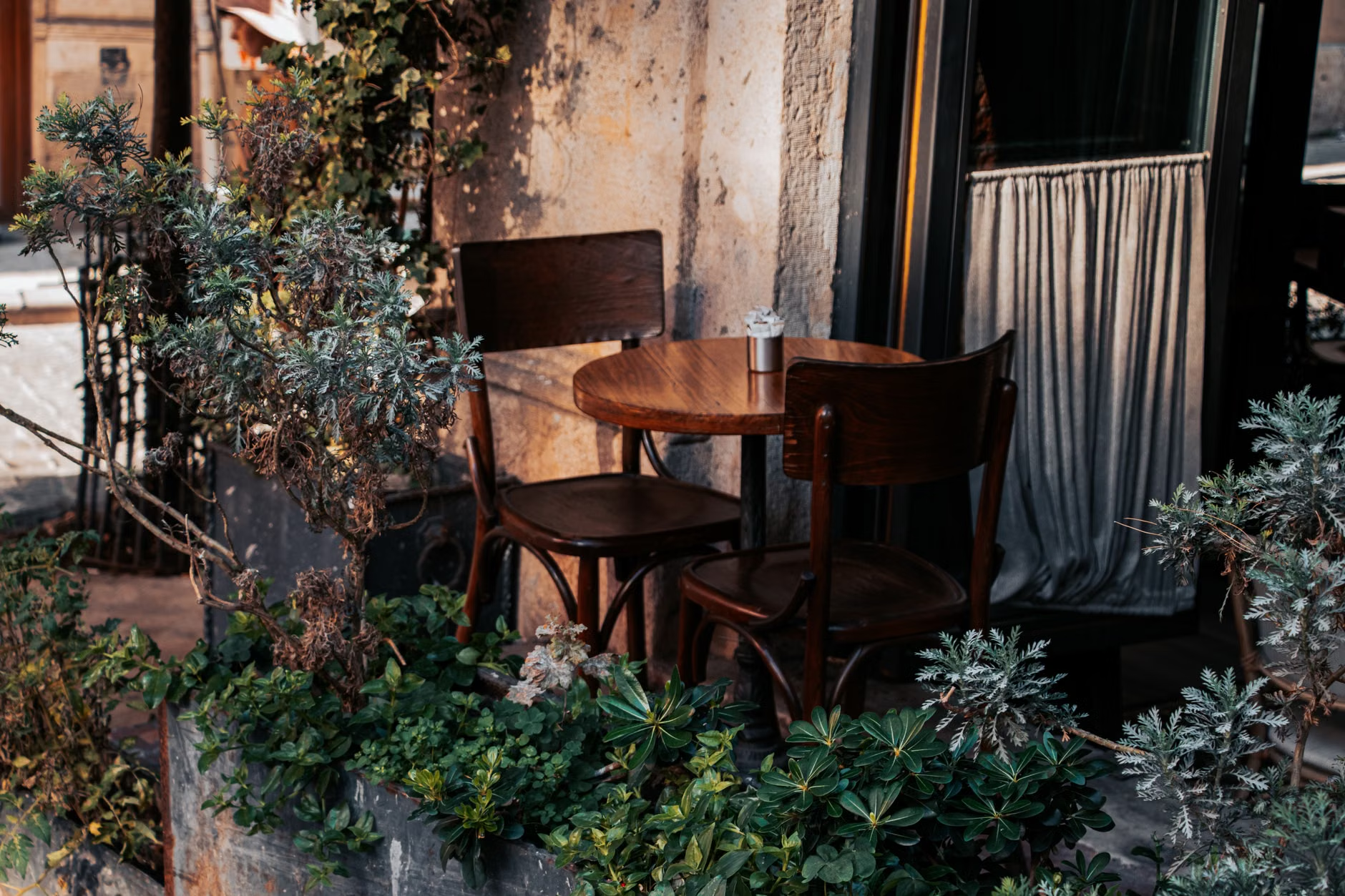
Defining the Anatomy of a True Third Space
Not every public place qualifies as a third space. A shopping mall, for instance, is designed to extract money from you; it is a commercial transaction space. A true third space, according to urban planning experts, needs to meet specific criteria to actually provide the benefits we are looking for.
If you are scouting for a place to integrate into your routine, look for these markers:
| Feature | Why it Matters |
|---|---|
| Neutrality | You aren’t the boss, and you aren’t the parent. You are just a person. |
| Low Barrier to Entry | It shouldn’t require a high membership fee or a reservation. |
| Accessibility | It needs to be geographically close enough to fit into your commute or daily errands. |
| Conversation-Friendly | The environment should allow for interaction, not just loud music or total silence. |
| The “Regular” Factor | You should be able to go there alone and eventually encounter familiar faces. |
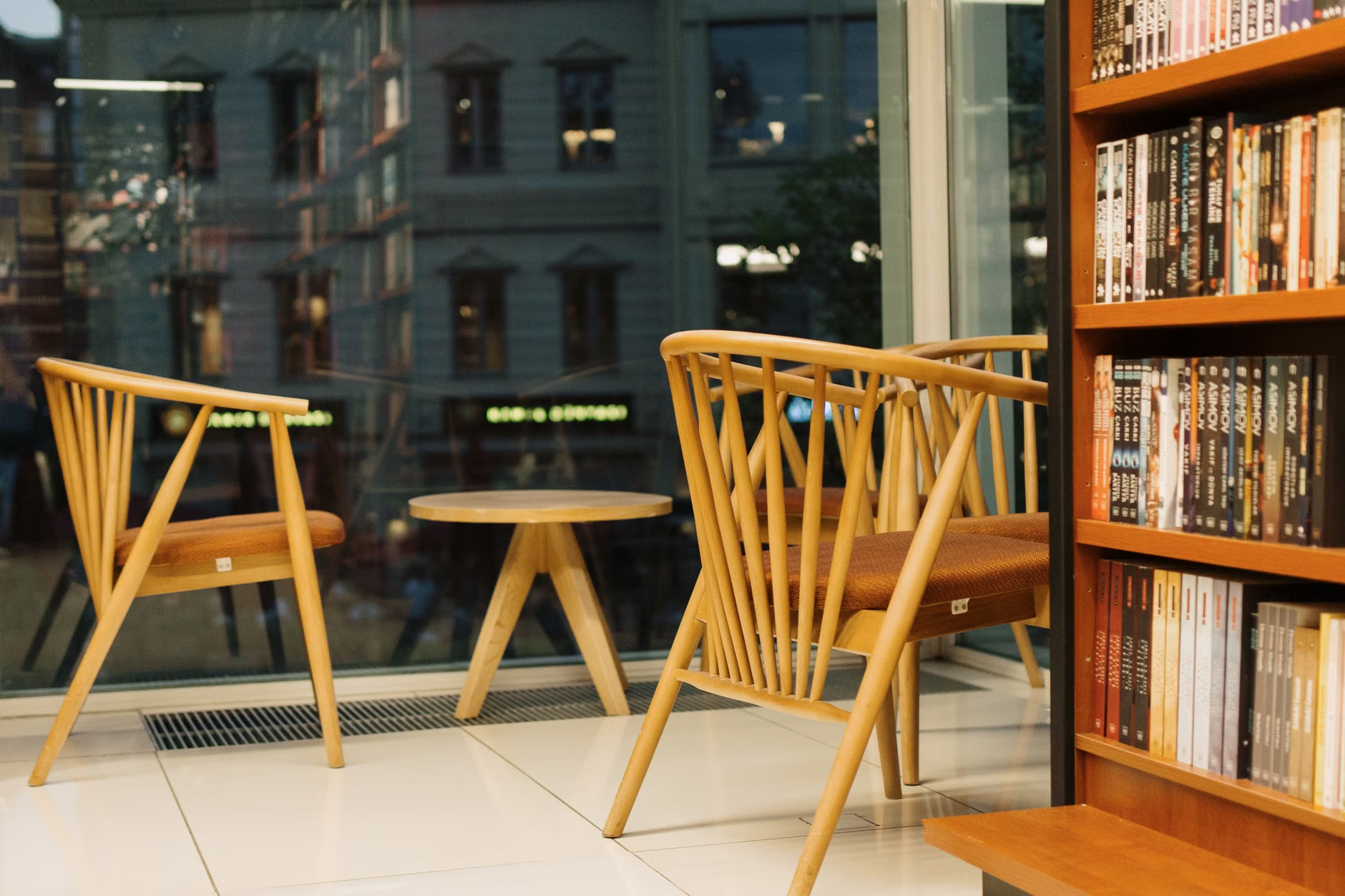
Think of your local public library. It costs nothing to enter. There is no expectation that you buy a coffee or a meal. It is quiet enough to think but public enough that you aren’t isolated. That is a textbook third space. Conversely, a high-end restaurant is not a third space; it is a destination. You go there for a specific purpose, you pay a premium, and you leave. The goal of the third space is not to “do” something, but to “be” somewhere.
The Mental Health Benefits of Low-Stakes Socializing
Why should you bother finding one of these places when you are already exhausted? The answer lies in the concept of “weak ties.” Sociologists have long argued that our closest friends (strong ties) provide emotional support, but our acquaintances (weak ties)—the librarian, the barista, the person who sits on the park bench near yours—provide something just as valuable: a sense of belonging to the world at large.
When you interact with a “weak tie,” you aren’t required to perform. You don’t have to be the “perfect employee” or the “patient parent.” You are just you. This low-stakes interaction acts as a pressure valve. It reminds you that your identity is not entirely wrapped up in your professional output or your domestic duties.
Research into urban loneliness suggests that even 15 minutes of “ambient social interaction”—simply being in the presence of other people in a shared, non-demanding space—can lower cortisol levels. It’s the difference between eating lunch at your desk and eating it on a park bench while other people walk by. The former keeps you in “work mode”; the latter nudges you back into “human mode.”

How to Reclaim Your Space: A Practical Strategy
If you’re ready to find a third space, don’t try to force it. The biggest mistake people make is treating it like a “to-do” list item. If you go to a place with the desperate intent to “make friends,” you will likely be disappointed. Instead, treat it like an experiment in curiosity.
1. Audit Your Daily Routes
Look at your commute or your weekend errand loop. Is there a place you pass by every day but never enter? A community center, a small park with a bench, a local bookstore, or a café that isn’t a chain? Identify three potential spots that are already on your path.
2. The “Regular” Strategy
Pick one of those spots and go there at the same time for three consecutive weeks. The secret to the third space is consistency. If you show up at the same coffee shop every Tuesday at 4:00 PM, you will eventually see the same people. You don’t need to strike up a conversation immediately. Just be there. The “nod” is the first step of community building.
3. Minimize the “Tech Interference”
This is the hardest part. When we go to a public space, our instinct is to bury our heads in our phones. If you are constantly looking at a screen, you are effectively building a wall around yourself. Try leaving the phone in your bag for just 20 minutes. Observe the room. Read a physical book. It makes you approachable and, more importantly, it makes you present.
4. Lower Your Expectations
The third space isn’t meant to solve your deepest problems. It’s meant to provide a buffer. If you go to a community garden and nobody talks to you, that’s fine. You still had a change of scenery, fresh air, and a break from the demands of the house. The benefit is in the possibility of connection, not the guaranteed result.
Common Pitfalls and How to Avoid Them
Even with good intentions, you might run into hurdles. Let’s address the most common reasons people abandon their search for a third space.
The “I’m Too Tired” Excuse: We often mistake physical exhaustion for a need to be alone. While you definitely need rest, isolating yourself in your “first space” can sometimes lead to a “cabin fever” effect where the walls feel like they are closing in. A third space doesn’t have to be active. It can be a place where you sit and do nothing. Sometimes, being tired in a public place is more restorative than being tired at home.
The “I Don’t Have Money” Barrier: This is a valid concern. Many modern social spaces are built around consumption—you have to buy a $6 latte to sit in a chair. If your budget is tight, look for public-funded spaces. Libraries, museums with free days, public parks, and community centers are explicitly designed to be non-commercial. They are the true backbone of the third space movement.
The “I Feel Awkward” Feeling: Going to a place alone can feel vulnerable in your 30s. We are conditioned to think that being alone in public is a sign of having no friends. Let go of that narrative. Being alone in public is a sign of self-sufficiency. It is a power move. Most people are far too occupied with their own lives to notice or judge you.
The Role of Digital Spaces: Are They Substitutes?
We often hear people say that online forums or social media groups serve as their “third space.” While digital communities can be incredible for niche interests or support, they lack the physical, sensory element of a real-world space. You cannot smell the coffee, feel the temperature of the room, or experience the spontaneous, non-verbal cues of a face-to-face interaction online.
Digital spaces are excellent “fourth spaces”—an extension of our social lives—but they cannot replace the physical need for human presence. The sensory input of being in a room with other human beings triggers a different part of the brain, one that is wired for collective safety and social grounding. If you spend all day online, your brain is still in a “high-alert” state. A physical third space acts as a sensory reset.
Evaluating Your Progress: A Simple Checklist
How do you know if you have successfully integrated a third space into your life? Don’t look for a “best friend.” Look for a change in your baseline stress level. Use this checklist to see if your chosen space is working for you:
- Do you look forward to going there? (Even if it’s just for 15 minutes.)
- Do you feel a sense of relief when you step through the door?
- Have you had at least one “low-stakes” interaction (a smile, a nod, a brief comment about the weather) in the last month?
- Does the space demand nothing from you? (No performance, no work, no parenting.)
If you can answer “yes” to these, you have found a goldmine. Protect that time. It is not “wasted” time; it is maintenance for your sanity.
Moving Forward: A Sustainable Approach
Reclaiming your life in your 30s and 40s is less about big, dramatic changes and more about small, consistent habits. You don’t need to join a club or start a movement. You just need to step out of the loop of work and home. Start small. Find a bench, a library, or a quiet corner. Go there with the intention of doing nothing at all. You might be surprised at how much that simple shift changes the way you view your week.
For more research on the importance of community infrastructure and urban design, you can look into the work of organizations like the Project for Public Spaces (pps.org) or studies on social isolation published by the World Health Organization (who.int) regarding the health impacts of social connectivity.
Take your time. There is no rush. Your third space will be waiting whenever you decide to step into it.
Frequently Asked Questions
Q: Can my gym be my third space?
A: It can, but only if you aren’t using it solely for a high-intensity workout. If you go to the gym to socialize, sit in the sauna, or chat in the locker room, it functions as a third space. If you go in with headphones on, crush a workout, and leave immediately, it’s a “second space” for your physical health. The key is the social and relaxing nature of the environment.
Q: I’m an introvert. Is a third space still for me?
A: Absolutely. In fact, it’s arguably more important for introverts. A third space allows you to be “alone together.” You get the benefits of being around people without the pressure of active, sustained conversation. A library or a quiet park bench is the perfect third space for someone who wants to be part of the world without being at the center of it.
Q: How do I handle the guilt of taking time for myself?
A: This is the most common hurdle for parents. Reframing the concept is key: you aren’t “taking time away” from your family; you are “investing in your mental health” so you can be a more present and patient person when you are at home. A regulated, calm, and socially connected parent is much more beneficial to a household than an exhausted, isolated one. It is not selfish; it is sustainable parenting.