The secret to a successful shared workspace isn’t just about having two chairs; it’s about creating a “co-regulation” environment where both your nervous system and your productivity can thrive simultaneously.
- Co-regulation is psychological: It uses the environment to signal safety and focus to the brain, which is essential when working in a high-traffic home environment.
- Zoning is non-negotiable: Even in small spaces, creating distinct physical and visual boundaries prevents “work-life bleed” and reduces cognitive load.
- Shared systems win: Successful shared desks rely on agreed-upon rituals for noise, lighting, and digital boundaries rather than just expensive gear.
If you are in your 30s or 40s, you likely know the specific, sharp frustration of trying to finalize a quarterly report while your partner is on a loud Zoom call, or worse, navigating the chaos of a “homeschooling-meets-remote-work” afternoon. The “co-regulation” desk setup is a concept borrowed from developmental psychology—the idea that we can soothe and regulate our internal state through our external environment and the presence of others. By applying this to a shared office space, you aren’t just organizing cables; you are designing a space that prevents the fight-or-flight response that often kicks in when work and family life collide.
Most of us approach a shared desk with a “space-saving” mentality. We shove two monitors together, share a power strip, and call it a day. But from a nervous system perspective, this is a disaster. When you are constantly in the peripheral vision of someone else—or worse, hearing their keyboard clacking rhythmically while you try to think—your brain is forced to process that extra sensory input. This is “cognitive load” in action.
In your 30s and 40s, your bandwidth is already stretched thin. You are juggling emails, school drop-offs, and the general mental load of managing a household. When your workspace is chaotic, your brain loses the ability to “switch off” the background noise of your partner’s or child’s activity. Co-regulation in the workspace is about creating a “safe container” for your attention. It’s not just about ergonomics; it’s about creating a boundary that says, “In this zone, I am protected from the noise of the rest of the house.”
The Architecture of a Co-Regulated Workspace
To build a desk that supports co-regulation, you need to think about four specific pillars: sensory control, physical boundaries, task visibility, and digital hygiene. Let’s break these down into actionable steps.
1. Sensory Control: Managing the Input
The biggest enemy of shared productivity is unexpected sensory input. If you are working and suddenly a bright light flickers or a loud sound happens, your amygdala—the part of the brain that manages your threat response—fires. To counter this, you need to normalize the sensory environment.
- Acoustic Buffers: If you cannot afford soundproof panels, use soft materials. A thick desk mat, a rug under the chairs, or even a bookshelf between the two work zones can absorb sound.
- Visual Anchors: Use desk lamps with warm-toned bulbs rather than harsh overhead lighting. When you work, turn on your lamp. It signals to your brain—and your family—that you are in “focus mode.”
- Noise-Canceling Rituals: Invest in high-quality noise-canceling headphones, but treat them as a “do not disturb” signal. When the headphones are on, it’s a non-verbal agreement that you are not to be interrupted unless it is an emergency.
2. Physical Boundaries: Creating Micro-Environments
You don’t need two separate rooms to have separate zones. The goal is to ensure that when you are sitting at your specific “spot,” you feel like you are in your own office. Use desk dividers or even carefully placed potted plants to create a visual break. This prevents you from constantly monitoring the other person’s body language, which is a major source of subconscious distraction.
| Feature | The Chaos Setup | The Co-Regulation Setup |
|---|---|---|
| Cables | Tangled, visible, and messy | Hidden in trays; one power hub per user |
| Lighting | Harsh overhead | Personalized task lamps |
| Boundaries | Open, eyes-on-each-other | Side-by-side with a small divider |
| Communication | Constant interrupting | Visual cues (headsets, lamps, notes) |
3. Task Visibility: Using External Brains
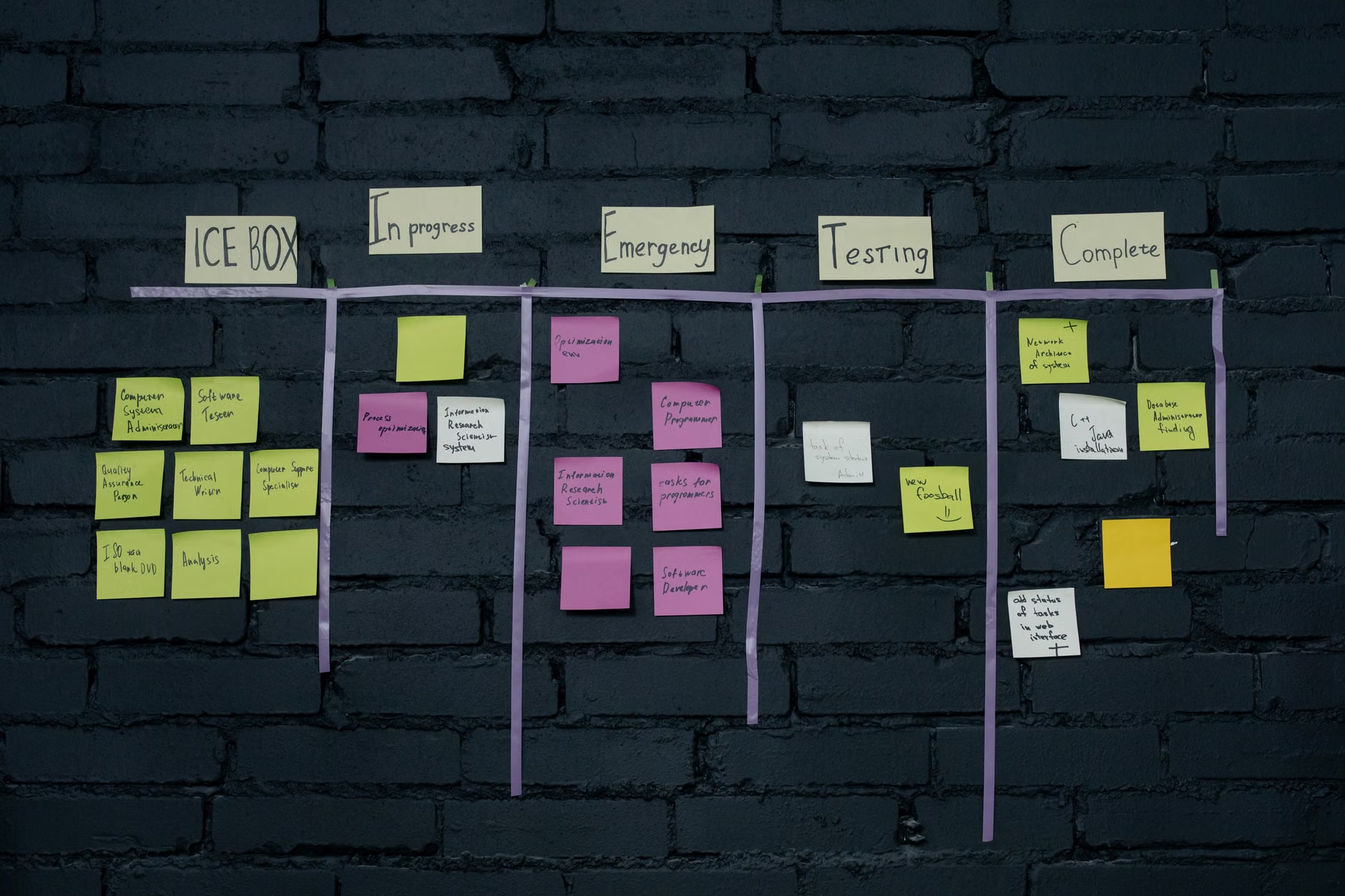
When you are sharing a space, you often feel the need to “check in” on your partner to see how they are doing. This is a form of social monitoring that drains your focus. Instead, use a shared visual board. A simple magnetic whiteboard or a corkboard placed on the wall between your desks can hold the “status” of your day.
For example, if you have a high-stakes call at 2:00 PM, put a sticky note on the board. This removes the need for you to verbally announce it and the need for your partner to remember it. It’s a low-friction way to keep everyone informed without breaking the flow of work.

Co-regulation isn’t just a hardware setup; it’s a set of social contracts. If you want to share a desk without resentment, you must have a “Start-of-Day” and “End-of-Day” ritual. This helps your brain transition from “parent/partner” to “worker” and back again.
The Start Ritual: Spend two minutes syncing up. What is the priority for the day? Are there any shared meetings that will conflict? This creates a sense of “we are in this together” rather than “we are fighting for the same outlet.”
The End Ritual: Clear the desk. This is crucial. If your desk is covered in papers or coffee mugs when you finish, you will start the next morning in a state of low-level stress. Resetting the space is a signal to your nervous system that the “work” phase is over. It’s a physical manifestation of closing the mental loop.
Many couples or roommates make the mistake of trying to make their setups identical. This is a trap. If one person is a creative who needs a large sprawling desk for physical sketching, and the other is a coder who needs a vertical monitor, don’t force them into the same desk dimensions. Optimize for the task, not for symmetry.
Another common mistake is neglecting power management. We live in an era where we have laptops, phones, tablets, and smartwatches all needing juice. If you are constantly reaching over each other to plug in a charger, you are creating unnecessary physical friction. Install a dedicated power strip for each person under their side of the desk. When your space is self-contained, your nervous system remains settled.
Advanced Tips for the High-Traffic Home
If your shared workspace is also in a high-traffic area, like a living room corner or a dining room, you need to lean into “mobile” co-regulation. This means creating a kit that can be packed away in five minutes. Use a designated “work box” where you keep your laptop, headset, and notebook. When the day is done, the box goes into a closet.
This is vital for parents. If your children see your office equipment left out on the dining table, they will inevitably touch it, move it, or try to “help.” By removing the equipment from sight, you are setting a clear boundary that the workspace—and the work itself—is not accessible during family time. This creates a psychological boundary that is just as important as a physical wall.
The Role of Data and Environment
Recent research in environmental psychology suggests that “nature-integrated” workspaces—even if it’s just a small plant or a view of a window—can significantly reduce cortisol levels. When sharing a desk, if one person gets the view of the window, the other might feel trapped. If possible, arrange your desks in a ‘L’ shape or facing away from the center of the room to ensure both people have a sense of openness. It’s a small change in geometry, but it makes a massive difference in how confined you feel during a long workday.
Furthermore, consider the “rhythm” of your work. If one person is on back-to-back calls and the other is doing deep-focus writing, you are naturally going to clash. In these instances, co-regulation means scheduling your “deep work” blocks at different times. If you can’t change your meeting schedules, utilize white noise machines. A simple fan or a dedicated white noise device can mask the sound of your partner’s voice, preventing your brain from trying to “decode” their conversation while you are trying to write.
Practical Checklist for Your Co-Regulation Setup
Before you go out and buy new gear, check your current setup against this list. Small tweaks often solve the biggest problems.
| Item | Checklist |
|---|---|
| Power | Is there a dedicated, easy-to-reach power strip for each person? |
| Lighting | Does each zone have its own controllable task light? |
| Sound | Are there soft surfaces (rugs, mats) to dampen echo? |
| Visuals | Is there a system (like a whiteboard) to track shared needs? |
| Equipment | Is there a place to store “work” items out of sight when finished? |
Final Thoughts on Sustaining the Setup
The goal of a co-regulation desk is to make your home office feel like a place where you can actually get things done without losing your mind. It’s a blend of physical organization and clear communication. You don’t need the most expensive standing desk or the latest dual-monitor arm to achieve this. You need a space that acknowledges your human need for focus, safety, and separation from the chaos of the household.
Remember, the setup is never “done.” As your family’s needs change, or as your workload shifts, your desk setup should evolve. Don’t be afraid to move the furniture around once a quarter. A fresh perspective can often reveal a better way to manage the flow of traffic and the needs of your nervous system. Keep it simple, keep it organized, and above all, keep the communication lines open with the person on the other side of the desk.
For more on ergonomics and office productivity, check these resources:
- OSHA: Computer Workstations eTool
- American Psychological Association: The Impact of Environment on Productivity
Frequently Asked Questions
What if my partner and I have completely different work styles?
That is actually an advantage. If one of you is a “messy” creative and the other is a “tidy” logic-driven worker, the key is to respect the boundary of the desk mat. Everything outside the desk mat is “neutral territory,” but everything inside the mat is your own personal domain. Respecting that personal space is the foundation of co-regulation.
The “stoplight” system is often helpful here. If you have a lamp or a sign on your desk, red means “I am in a meeting, do not interrupt,” and green means “I am working, but you can ask a quick question.” Teaching children this visual language helps them understand your boundaries without you having to be the “bad guy” who is always saying no.
Is it worth buying a dual-desk or two separate desks?
In most cases, two separate desks are better than one long dual-desk. Why? Because a dual-desk transmits vibrations. Every time your partner types, types aggressively, or leans on the desk, you feel it. Two separate desks—even if they are pushed right next to each other—decouple those vibrations and give you a much more stable, autonomous workspace.