The price you see on the grocery shelf might not be the same price the person behind you pays just ten minutes later. This isn’t a glitch in the system; it is the calculated rollout of dynamic pricing, a strategy long used by airlines and ride-sharing apps, now making its way into the aisles where we buy our milk, eggs, and diapers.
- Digital Transformation: Grocery stores are replacing paper tags with Electronic Shelf Labels (ESLs) that allow prices to be updated in seconds via centralized software.
- Demand-Driven Costs: Prices may rise during peak shopping hours (like Saturday mornings) and drop during slow periods or when items are nearing their expiration dates.
- Strategic Shopping: To avoid \”surge pricing,\” families need to shift their shopping windows, utilize store apps for price locking, and embrace data-tracking tools.
I remember the first time I noticed a price flicker. I was standing in the dairy aisle, debating between two brands of Greek yogurt. As I reached for the one on the left, the little digital screen beneath it blinked. The price jumped by twenty cents. I blinked back, wondering if the lack of sleep from a teething toddler was finally causing hallucinations. It wasn’t. It was my first encounter with a retail algorithm at work. For those of us in our 30s and 40s, managing a household budget is already a high-stakes game of Tetris. Now, the blocks are moving faster than ever.
What Exactly is Dynamic Pricing in a Grocery Context?
Dynamic pricing is a strategy where businesses adjust prices on the fly based on real-time data. In the past, changing prices in a grocery store was a labor-intensive nightmare. An employee had to walk around with a sticker gun or a stack of paper tags, manually swapping them out. Because of this \”menu cost,\” prices remained stable for weeks or months.
Today, the introduction of Electronic Shelf Labels (ESLs) has eliminated that barrier. These are small e-ink screens (similar to a Kindle display) connected to the store’s central computer system via Wi-Fi or Bluetooth. With a single click, a manager—or more likely, an AI algorithm—can change the price of every item in the store. This allows retailers to respond instantly to competitor price drops, inventory surpluses, or high-demand periods.
For a parent, this means the \”Saturday Morning Surcharge\” could become a reality. If the store knows that thousands of families shop between 9:00 AM and 11:00 AM on Saturdays, they might nudge the prices of high-volume staples up by 2% or 3%. Conversely, on a rainy Tuesday afternoon when the store is empty, those same items might be discounted to entice shoppers through the doors.
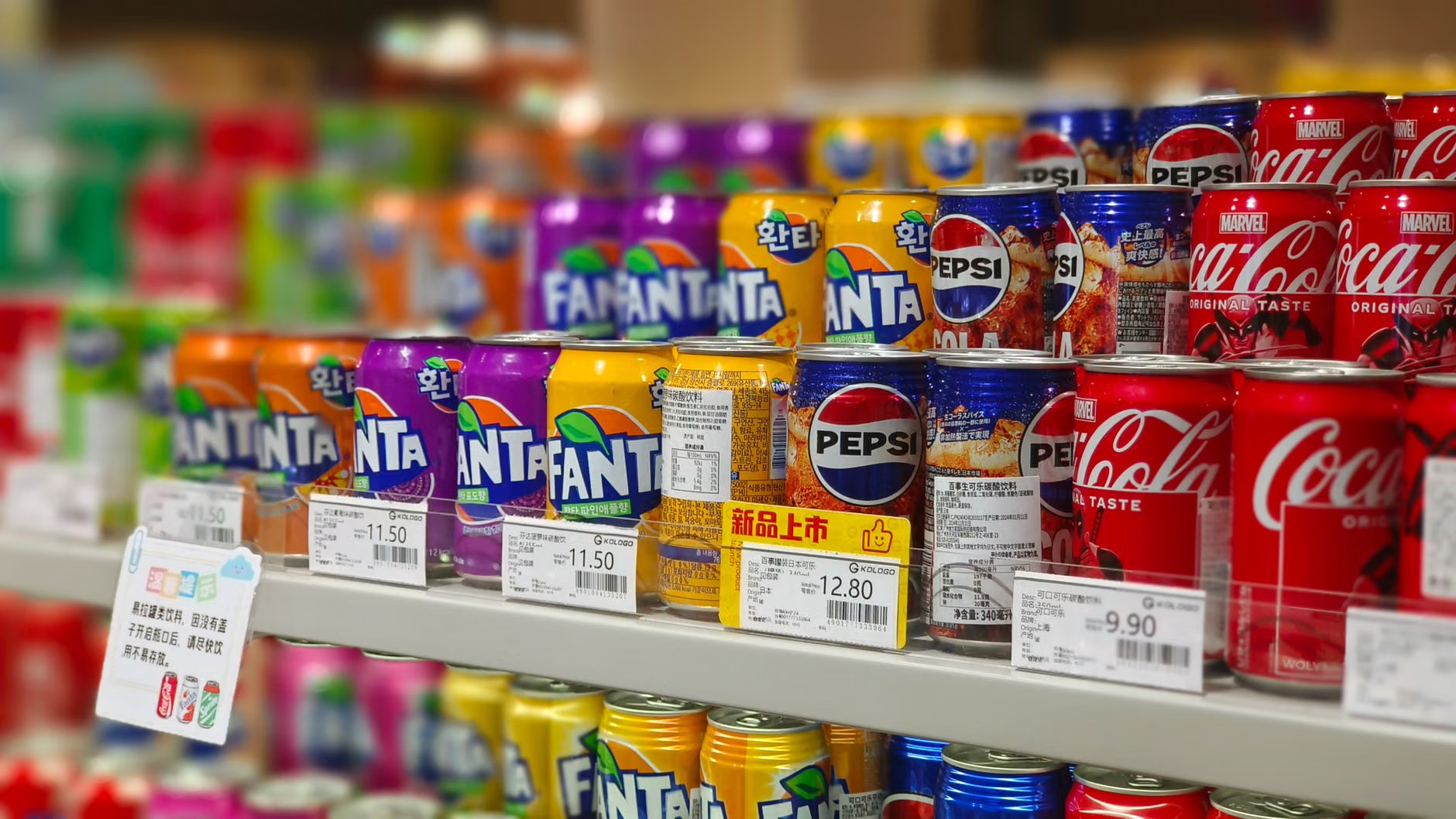
The Technology Driving the Change
The shift isn’t just about the screens on the shelves; it’s about the massive amount of data being processed in the background. Retailers are now using sophisticated AI models that ingest hundreds of variables. These include:
- Local Competitor Pricing: If the store across the street lowers the price of bananas, your store can match it within minutes.
- Inventory Levels: If there are 500 cartons of milk about to expire in three days, the system can automatically drop the price to clear the stock.
- Historical Sales Trends: The system knows exactly when you are most likely to buy certain items.
- Weather Patterns: Believe it or not, some systems are designed to raise the price of umbrellas when it starts to rain or increase the price of charcoal when a sunny weekend is forecasted.
This level of precision is designed to maximize the \”margin\”—the profit the store makes on every item. While retailers argue that this can lead to lower prices for consumers (by reducing food waste and managing stock more efficiently), the psychological burden falls on the shopper who no longer knows what a \”fair price\” looks like.
Why Retailers Are Racing to Adopt ESLs
You might have seen news about major retailers like Walmart, Kroger, and various European chains like Lidl and Aldi expanding their use of digital tags. From their perspective, the benefits are too large to ignore. Beyond the ability to change prices, ESLs reduce labor costs significantly. Employees who used to spend hours tagging shelves can now spend that time stocking or assisting customers.
Furthermore, these digital tags can display more than just prices. They can show QR codes for nutritional information, indicate which items are out of stock in the warehouse, or even flash a light to help \”personal shoppers\” (like those for Instacart) find items faster. For the retailer, it’s about total operational efficiency. For the parent at the end of a long workday, it’s another layer of complexity to navigate.
| Feature | Traditional Paper Tags | Dynamic Digital Tags (ESLs) |
|---|---|---|
| Price Update Speed | Hours or Days (Manual) | Seconds (Automated) |
| Accuracy | Prone to human error | High (Matches POS system) |
| Consumer Pricing | Static/Predictable | Fluctuates based on demand |
| Information Density | Price and Unit Price only | QR codes, stock alerts, promos |
| Waste Management | Difficult to track manually | Automatic discounts for expiring goods |
The Impact on the Family Budget
For those of us balancing a mortgage, childcare costs, and the general inflation of the last few years, grocery shopping is often the only \”flexible\” part of our budget. We can’t easily change our rent, but we can choose to buy cheaper cereal. Dynamic pricing makes this choice much harder because the baseline keeps moving.
The biggest risk to families is price creeping. This is when prices rise so subtly that you don’t notice the total bill increasing until you’re at the checkout. If every item in your cart is just 5 or 10 cents more expensive because you’re shopping at a \”peak time,\” that can add up to $10 or $20 per trip. Over a year, that’s a significant amount of money that could have gone into a college fund or a much-needed weekend getaway.
There is also the \”Poverty Premium\” to consider. Families with less flexible schedules—those who must shop on Saturday because they work two jobs during the week—are the ones most likely to be hit by peak-hour pricing. Meanwhile, those with flexible schedules can hunt for the \”trough\” prices on weekday mornings. This creates an unintended inequity in how we pay for basic necessities.

How to Outsmart the Algorithm: Practical Strategies
We aren’t defenseless in this new retail landscape. Just as stores use data to optimize their profits, we can use data to optimize our savings. It requires a slight shift in how we approach our weekly errands.
1. Master the Store App
Most major grocery chains now have apps that are essentially the \”remote control\” for their pricing. Often, the price listed in the app is the \”locked-in\” price. If you add an item to your digital cart or \”clip\” a digital coupon, many stores will honor that price even if the shelf tag changes by the time you reach the store. Additionally, apps often offer personalized discounts that the dynamic tags on the shelf don’t show to the general public.
2. Identify Your Store’s \”Price Rhythm\”
Every store has a rhythm. Generally, mid-week (Tuesday and Wednesday) is when many retailers update their weekly circulars and when foot traffic is lowest. If you can manage a quick trip after work on a Tuesday instead of the big Saturday morning haul, you are much more likely to encounter \”low-demand\” pricing. Pay attention to when your local store marks down items nearing their sell-by date; dynamic pricing often automates this, making the 4:00 PM window a goldmine for discounted meats and bakery items.
3. Use Third-Party Price Trackers
While most price trackers focus on Amazon (like CamelCamelCamel), new tools are emerging for grocery staples. Apps like Flipp or Basket allow you to compare prices across different local stores in real-time. If you see that your usual store has bumped up the price of your favorite coffee, you can quickly check if the competitor down the street is still holding at the old price.
4. Beware of the \”Impulse Surge\”
Retailers know that certain items are bought on impulse. Dynamic pricing algorithms may target these specifically. Snacks, seasonal treats, and end-cap displays are prime candidates for price fluctuations. Stick to your list. The more you deviate from your planned purchases, the more you expose yourself to the algorithm’s attempts to capture extra margin.
The Psychological Toll: Decision Fatigue
As parents, we already make thousands of decisions a day. What should they wear? Is that cough serious? Did I sign the permission slip? Adding \”Is this the best time to buy milk?\” to the list is exhausting. This is known as decision fatigue, and retailers can actually benefit from it. When we are tired, we stop comparing prices and just grab what we need, regardless of the cost.
To combat this, I’ve found that subscription services for non-perishables can be a lifesaver. By setting up a recurring order for things like toilet paper, laundry detergent, and diapers through a service with a price-match guarantee, you remove those items from the dynamic pricing game entirely. You get a consistent price, and more importantly, you get one less thing to think about.
Is There a Silver Lining?
It isn’t all bad news. One of the most significant advantages of dynamic pricing technology is the potential for reduced food waste. In the traditional model, if a store had too much steak, it might sit there until it went bad because nobody had time to manually re-tag it. With ESLs, the store can drop the price by 50% instantly when they see stock isn’t moving. For a savvy parent, this is an opportunity to stock the freezer at a fraction of the normal cost.
Furthermore, dynamic pricing can lead to hyper-personalization. In the near future, your store loyalty app might recognize that you are a loyal customer who always buys organic milk. To keep you coming back, the system might offer you a \”personal price\” that is lower than what is shown on the shelf tag. While this feels a bit \”Big Brother,\” it can result in genuine savings for families who stay loyal to a specific brand or store.
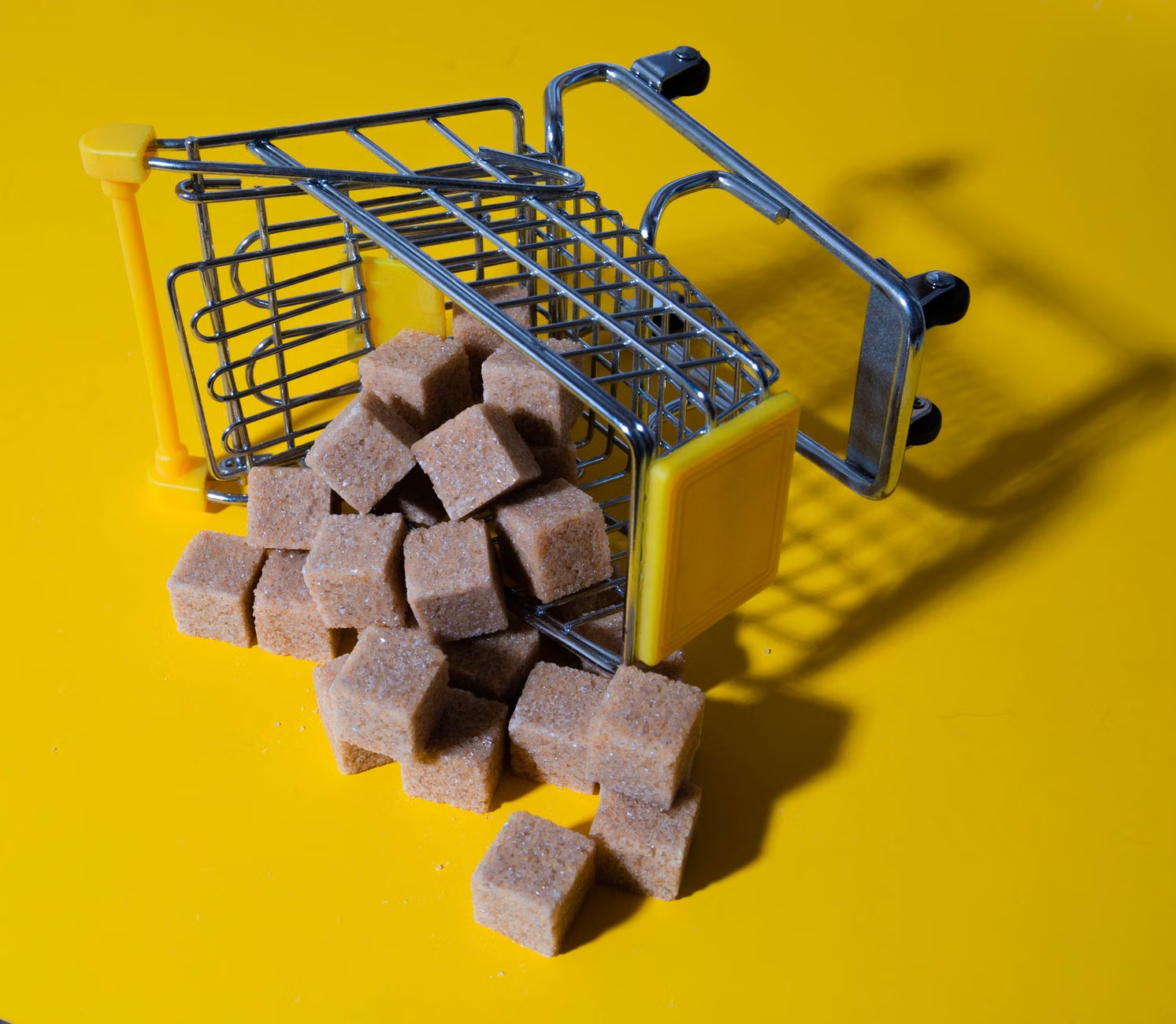
The Ethics of the Digital Tag
The conversation around dynamic pricing often touches on ethics. Is it \”price gouging\” if the price of water goes up during a heatwave? Most jurisdictions have laws against that during declared emergencies. However, in everyday life, the line is thinner. If a store raises the price of formula because they know parents are desperate, that’s a PR nightmare waiting to happen.
Consumer advocacy groups are already pushing for transparency laws. Some suggest that digital tags should be required to show the \”lowest price in the last 30 days\” (a rule already in effect for certain sales in the EU). This would allow shoppers to see if they are getting a genuine deal or if the price has been inflated for the weekend rush.
A Checklist for the Modern Shopper
Before you head out for your next grocery run, keep this checklist in mind to ensure you’re not overpaying due to an algorithm’s whim:
- Check the app before you leave: Screenshot the prices of high-ticket items.
- Avoid the \”Rush Hour\”: If possible, shop during the \”dead zones\” (Tuesday-Thursday, mid-morning or late evening).
- Scan the QR codes: If a shelf tag has a QR code, scan it. It often leads to a manufacturer’s coupon you wouldn’t find otherwise.
- Verify at the register: Ensure the price that scanned matches the price you saw on the shelf. With prices changing so fast, sync errors can happen.
- Look for the \”Red\” or \”Flashing\” tags: Many ESL systems use color or lights to indicate a stock-clearance discount.
The Future: Personalized Pricing and Beyond
We are currently in the \”early adopter\” phase of dynamic pricing in groceries. The next step is Personalized Pricing. Imagine walking down an aisle and, because your phone is in your pocket and connected to the store’s Wi-Fi, the digital tag changes specifically for you. This is already being tested in some high-end retail environments.
While it sounds like science fiction, the infrastructure is already being built. As parents, our best defense is staying informed and remaining flexible. The days of the \”reliable\” grocery price are fading, replaced by a fluid, data-driven marketplace. It’s a bit more work for us, but with the right tools, we can still keep the family budget under control.
Ultimately, the goal of the grocery store is to make a profit, but our goal is to provide for our families without breaking the bank. By understanding the \”why\” and \”how\” behind these digital tags, we can turn a potential budgeting hurdle into a tool for smarter, more efficient living.
For more information on consumer rights and retail trends, you can visit the Consumer Federation of America or check out the latest retail technology reports from Gartner Retail.
Frequently Asked Questions
1. Is dynamic pricing legal in grocery stores?
Yes, in most countries, retailers have the right to change their prices at any time, provided they do not engage in price-fixing with competitors or price gouging during a declared state of emergency. The price charged at the register must generally match the price displayed on the shelf at the time of purchase.
2. How can I tell if a store uses dynamic pricing?
The clearest sign is the presence of Electronic Shelf Labels (ESLs)—small digital screens instead of paper tags. If you see these, the store has the capability to change prices instantly. You may also notice that prices in the store’s app fluctuate more frequently than they used to.
3. Will dynamic pricing always make groceries more expensive?
Not necessarily. While it allows for \”surge pricing\” during busy times, it also enables stores to offer deep discounts on overstocked or near-expiry items more efficiently. Savvy shoppers who can be flexible with their timing and brand choices may actually find more opportunities to save.
In the end, while the flickering numbers on the shelf can be a bit unsettling, they are just another part of the digital world we live in. Stay sharp, use your phone as a tool, and don’t let the algorithm catch you off guard on a Saturday morning. You’ve got this.