The most effective way to manage your gear is to stop treating purchases as solutions to future problems and start treating them as tools for specific, practiced routines. This is the essence of the “Train-First” gear strategy: you don’t buy the equipment until you have established the habit, and you don’t upgrade until the current gear becomes a literal bottleneck to your progress.
- The Habit-First Rule: Never purchase high-end gear for a new hobby or responsibility until you have sustained the activity for at least 30 days using basic equipment.
- Multi-Purpose Over Specialization: Focus on modular, versatile items that serve at least three distinct functions in your daily life to reduce clutter and cognitive load.
- The “Bottleneck” Audit: Only replace or add gear when your current setup physically prevents you from reaching the next level of efficiency or safety.
If you are in your 30s or 40s, you likely know the specific sting of the “aspirational purchase.” You buy the high-end jogging stroller, the specialized camera, or the ergonomic home-office chair, convinced that this gear will be the catalyst for a more organized, active, or productive life. Then, six months later, it sits in the corner of your garage or home office, collecting dust—a silent, expensive monument to a routine that never quite took root.
This cycle isn’t just a waste of money; it’s a drain on your mental bandwidth. Every piece of unused equipment is a “clutter tax” on your brain, a constant, low-level reminder of something you intended to do but haven’t. The Train-First strategy flips this model on its head. Instead of buying your way into a new lifestyle, you build the lifestyle and let the gear catch up to your needs.
Why Your Current Gear Strategy Is Probably Backwards
Most of us operate under a “Gear-First” fallacy. We see a challenge—say, getting the kids to school on time or managing a fitness routine—and we immediately look for a product to solve it. We assume that if we have the right gear, the behavior will naturally follow. In reality, the behavior is what drives the need for the gear. When we lead with the gear, we often end up with items that are either overkill for our actual usage level or entirely unsuited to our unique daily rhythm.
Consider the “parenting commute.” Many parents buy a high-end, heavy-duty cargo bike or a top-tier SUV because they imagine a future of seamless, adventurous school runs. However, if they haven’t first practiced the route, managed the weather variables, and understood the actual storage constraints at their destination, they often find the gear is too bulky or cumbersome to be practical. The gear becomes a barrier rather than an enabler.
The Train-First strategy requires a shift in perspective. You are not a consumer; you are a technician of your own life. You are testing a system. When you approach gear as a secondary support rather than a primary solution, you become much more critical about what actually makes it into your home. You stop looking for “the best” and start looking for “the sufficient.”
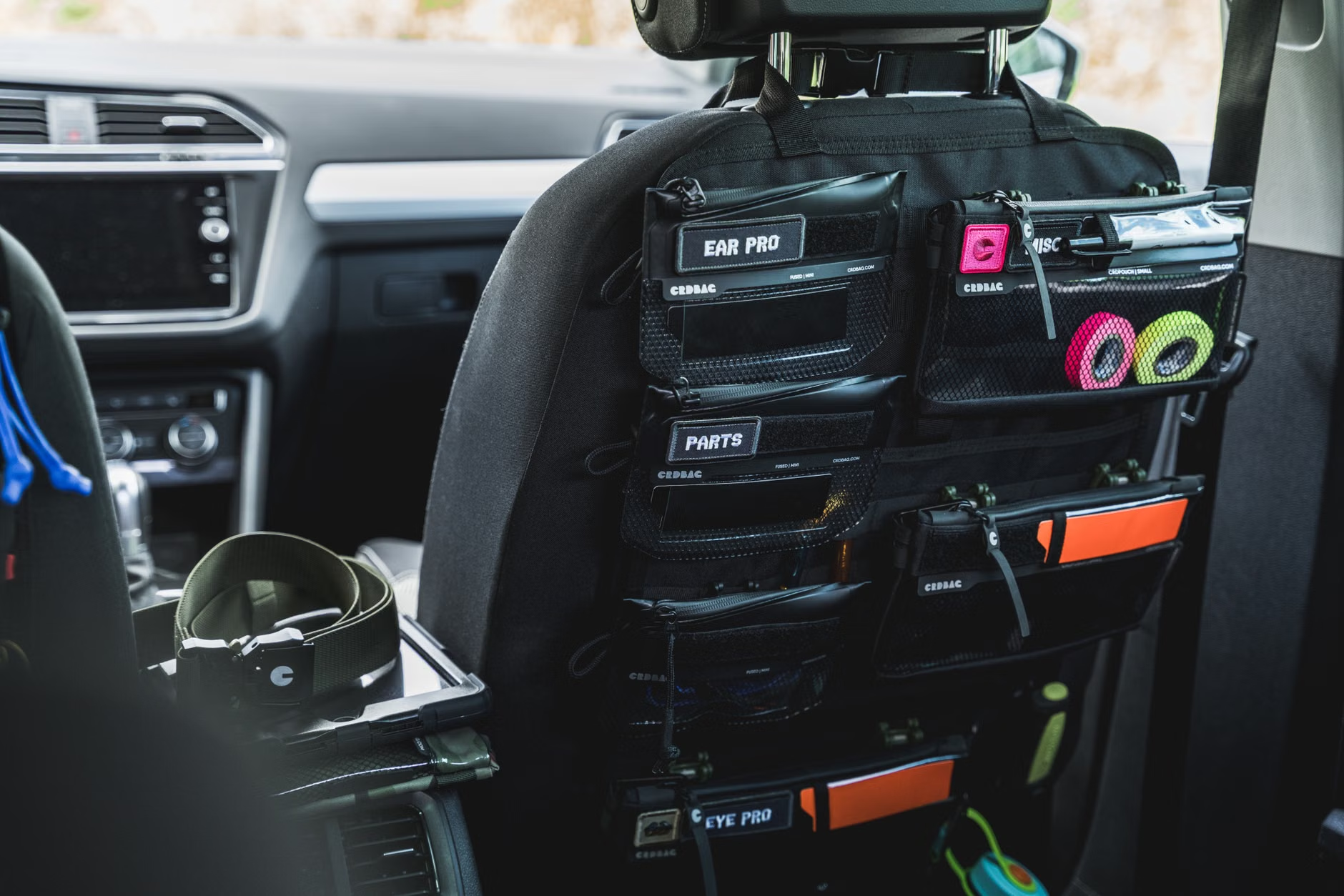
The Three Pillars of the Train-First Framework
To implement this, you need a system. The Train-First framework relies on three distinct phases: Observation, Minimum Viable Tooling (MVT), and Iterative Scaling. By following these, you ensure that every item you own earns its keep.
Phase 1: The Observation Period
Before you spend a single cent, spend two weeks observing your actual behavior. If you want to start a morning exercise routine, don’t buy the $200 shoes or the fitness watch yet. Use whatever you have. Wake up and perform the routine in your pajamas. Go for a walk in your current sneakers. The goal here is to identify exactly where you fail. Do you stop because you are bored? Because you are cold? Because you don’t have enough time?
If you fail because you don’t have enough time, no amount of expensive gear will fix that. If you fail because your feet hurt, then—and only then—do you have a data-driven justification for upgrading your footwear. By waiting, you’ve saved yourself from buying the wrong gear for the wrong problem.
Phase 2: Minimum Viable Tooling (MVT)
Once you have identified a recurring need, acquire the most basic, functional version of the tool required to meet that need. If you’ve committed to a new hobby, like gardening or cycling, rent or borrow equipment first. If that’s not possible, buy the “entry-level” version that is known for durability rather than features.
The beauty of MVT is that it forces you to learn the mechanics of the activity. When you use a basic tool, you learn exactly what is missing. You learn the difference between a “nice to have” and a “need to have.” If you use a basic water bottle for a month and realize it constantly leaks, you now know exactly what specification you need for your next purchase: a leak-proof seal. You aren’t guessing; you are specifying.
Phase 3: Iterative Scaling
Only after you have mastered the activity with your MVT do you look for an upgrade. At this stage, your purchase is an investment in your own consistency. If you have kept up your exercise routine for 90 days, you are no longer a “potential runner”; you are a runner. An upgrade is now a reward for your discipline and a way to remove a specific, identified bottleneck.
Comparative Analysis: The Cost of Gear-First vs. Train-First
It is helpful to look at how these strategies impact your household economy and mental space over a one-year period. The following table highlights the difference in approach.
| Factor | Gear-First Approach | Train-First Approach |
|---|---|---|
| Initial Spend | High (Upfront investment) | Low (Using existing or MVT items) |
| Clutter Impact | High (Accumulation of unused items) | Minimal (Items are curated) |
| Motivation | Extrinsic (Dependence on the “new” feeling) | Intrinsic (Built on habit and success) |
| Long-term Value | Low (Depreciating assets) | High (Tools that match capability) |
As you can see, the Train-First approach effectively acts as a filter. It prevents the impulsive acquisition of gear that serves as a temporary dopamine hit but lacks long-term utility. In your 30s and 40s, when time and space are often in short supply, this filter is one of the most effective ways to simplify your life.
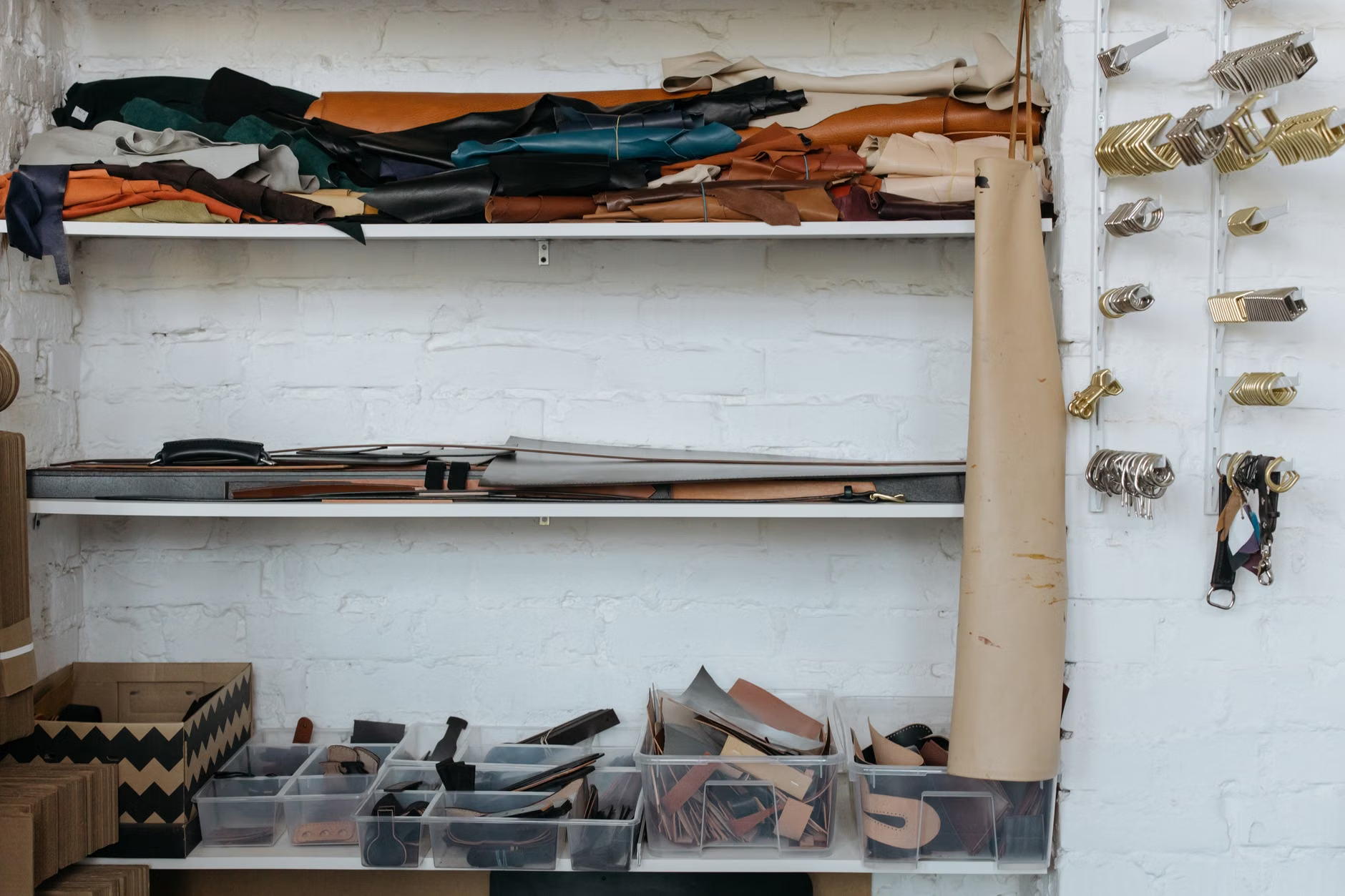
Common Pitfalls and How to Avoid Them
Even with the best intentions, the “Gear-First” temptation is powerful. Marketing is designed to make us feel like we are one purchase away from a better version of ourselves. Here are the common traps to watch out for.
The “Prosumer” Trap
We often tell ourselves, “I’ll just buy the professional version so I don’t have to upgrade later.” This is almost always a mistake. Professional-grade equipment is often heavier, more complex, and requires more maintenance than consumer-grade gear. Unless you are already a professional, the “pro” version will likely be more frustrating to use than a simpler, more approachable alternative. Always prioritize usability over theoretical ceiling.
The Feature-Creep Delusion
Modern gear is designed with excessive features to justify higher price points. When evaluating a potential purchase, ask yourself: “If I strip away all the bells and whistles, does this item still perform its core function better than what I currently have?” If the answer is no, you are paying for complexity, not utility. Complexity is the enemy of maintenance; the more features an item has, the more ways it can break.
The “Social Media Mirror” Effect
We see influencers with perfectly curated “gear kits”—the perfect travel bag, the perfect tech setup, the perfect kitchen gadgets. We feel a pressure to emulate that aesthetic. Remember that for an influencer, that gear is their job. It is a prop for their content. Your life is not a content production set. Your gear should serve your life, not your image.
Practical Application: The “Go-Bag” Audit
To put this into practice, try the “Go-Bag” audit. This applies to anything from a literal backpack for your commute to a “parenting kit” for weekend trips. Take everything out of your bag. Lay it on the floor. For every single item, ask yourself: “Have I used this in the last 30 days?”
If the answer is no, it doesn’t belong in the bag. If you have been carrying a specialized repair kit or a high-end camera lens “just in case,” you are carrying dead weight. If you haven’t needed it in a month, you likely won’t need it today. Remove it. Your future self will thank you for the lighter load and the reduced mental burden of managing unnecessary items.

The Psychology of “Enough”
At the heart of the Train-First strategy is the concept of “enough.” We often struggle with the idea that our current equipment is sufficient because we are conditioned to believe that “more” or “newer” equates to “better.” However, in a busy life, “better” is often defined by simplicity and accessibility.
When you have a piece of gear that you know inside and out—a knife you’ve sharpened yourself, a bag that fits perfectly under the seat in front of you, a stroller that folds in one second—you develop a level of mastery that no amount of expensive, unfamiliar gear can replicate. Mastery is the ultimate form of efficiency. It reduces the friction between you and your goals.
Furthermore, this strategy teaches our children a valuable lesson. If they see us constantly chasing the latest gear, they learn that happiness and success are things to be bought. If they see us using, maintaining, and mastering the tools we have, they learn the value of resourcefulness, patience, and intentionality. In a world of disposable consumerism, these are some of the most valuable traits you can model.
When to Break the Rules (The Exception Clause)
While the Train-First strategy is robust, there are times when it makes sense to invest in quality immediately. These exceptions usually fall into the category of “Safety and Health.” If you are starting a cycling hobby, don’t skimp on a helmet. If you are starting a hiking routine, don’t wear old, unsupportive shoes that will cause injury.
In these specific cases, the “cost” of the gear is an insurance policy against injury. However, even here, you don’t need the most expensive model. You need the most safety-compliant model. Research the safety standards, buy the item that meets them, and then proceed with the Training-First mindset for the rest of your kit.
Refining Your Personal Ecosystem
Over time, your gear should become an extension of your body and your habits. This is what we call an “ecosystem.” An ecosystem is a collection of tools that work together. For instance, if you have a specific system for organizing your child’s school paperwork, your “gear” might be a simple, color-coded file folder system. You don’t need a high-tech scanner if your system relies on physical paper. You need the gear that fits the system, not the other way around.
As you refine your ecosystem, pay attention to the “touchpoints.” These are the moments when you interact with your gear. If a touchpoint is annoying—like a zipper that sticks, a clasp that is hard to open with one hand, or a strap that digs into your shoulder—that is a signal. It’s not just a minor annoyance; it’s a failure in design for your specific lifestyle. When you replace that item, you aren’t just buying a new one; you are engineering a better touchpoint. This is the ultimate goal of the Train-First strategy: creating a life that feels smooth, intuitive, and remarkably free of unnecessary friction.
Summary and Moving Forward
The Train-First strategy is not about deprivation or living without. It is about living with intention. By prioritizing habits over hardware, you shift the focus from the act of consumption to the act of living. You become more resilient because you aren’t dependent on a specific piece of equipment to function. You become more efficient because your gear is curated, proven, and purposeful.
Start today by looking at one area of your life—your kitchen, your office, your hobby corner, or your car trunk. Identify one thing you bought but rarely use. Acknowledge it, perhaps donate it or sell it, and then commit to the next 30 days of “training” without it. You might find that you don’t miss it at all, or perhaps you will discover a much clearer idea of what you actually need to fill that gap. The goal is not to have the perfect gear; it is to have the perfect life, supported by the right tools.
Remember, the best gear is the gear that is already in your hands, working for you, not against you. Stay patient with your progress, keep your kit simple, and trust that your consistency will always be a better investment than your next online order.
Frequently Asked Questions
Q: How do I handle gifts or items I feel obligated to keep?
A: It is important to separate the sentimentality of a gift from the utility of the item. If an item doesn’t serve a purpose and is taking up space, it is a form of clutter. Consider storing sentimental items in a designated “memory box” rather than keeping them in your active-use areas. If the item is truly useless, passing it on to someone who might actually use it is a respectful way to honor the gift-giver’s intent.
Q: What if I need “pro” gear to actually learn the skill properly?
A: This is rarely true. Most skills are learned through repetition, not equipment quality. If you are learning to cook, a professional-grade knife won’t teach you knife skills; practice will. A basic, sharp chef’s knife is sufficient for 99% of home cooking. If you find that the lack of a specific feature is physically preventing you from practicing (e.g., a musical instrument that won’t stay in tune), then consider an upgrade—but only after you have proven your commitment to the practice.
Q: How do I stop the urge to “browse” for new gear?
A: Browsing is often a form of procrastination. We look for gear to feel like we are “doing” something about a problem without having to do the hard work of building the habit. When you feel the urge to browse, redirect that energy into the actual activity. Instead of looking for new running shoes, go for a 10-minute walk. Instead of looking for a new organization app, spend 10 minutes cleaning your desk. The satisfaction of the activity will always outweigh the temporary dopamine hit of the browse.
For further reading on intentional living and minimalist strategies, you can explore resources from the The Minimalists or check out research on cognitive load and decision fatigue from The American Psychological Association.