- Nature-play journaling moves beyond traditional “dear diary” entries by using the outdoors as a prompt for reflection.
- It helps parents in their 30s and 40s manage cognitive load by grounding them in the present moment through sensory observation.
- You don’t need artistic talent or hours of time; just 5-10 minutes of active observation with your children can yield measurable mental health benefits.
The most effective way to lower your daily cortisol levels isn’t necessarily a pricey retreat or a complicated meditation app; it’s the simple act of stepping outside and documenting what you see with your children. If you are in your 30s or 40s, you are likely navigating the “sandwich generation” crunch—balancing career demands, household management, and the constant, high-energy needs of growing children. Your brain is likely running a dozen tabs at once, and the idea of “finding time for yourself” often feels like just another item on a never-ending to-do list.
The “Nature-Play” journaling technique is different because it isn’t an isolated task. It is an integrated practice that combines the proven benefits of nature exposure with the reflective power of journaling. It turns the chaotic energy of a park visit or a backyard walk into a structured grounding exercise. By shifting your focus from the internal noise of your responsibilities to the external reality of the natural world, you create a buffer against burnout.
Why Your Brain Needs a “Nature Reset”
There is a growing body of research regarding Attention Restoration Theory (ART). Proposed by Rachel and Stephen Kaplan, this theory suggests that urban environments and digital screens deplete our cognitive resources. We are constantly using “directed attention”—the kind of focus required to answer emails, manage a household budget, or navigate traffic. This form of attention is finite and leads to mental fatigue.
Nature, however, engages “soft fascination.” This is the involuntary, effortless attention we pay to moving leaves, flowing water, or the patterns of clouds. When you engage in nature-play, you aren’t trying to solve a problem; you are simply witnessing the environment. For a parent, this is a critical survival tool. It provides a “cognitive rest” that allows your prefrontal cortex to recover from the exhaustion of daily decision-making.
When you combine this with journaling, you move from passive observation to active engagement. The act of writing down a observation—”The moss on this rock feels like velvet”—forces your brain to slow down and process sensory input. This transition from “doing” to “noticing” is where the stress relief happens.
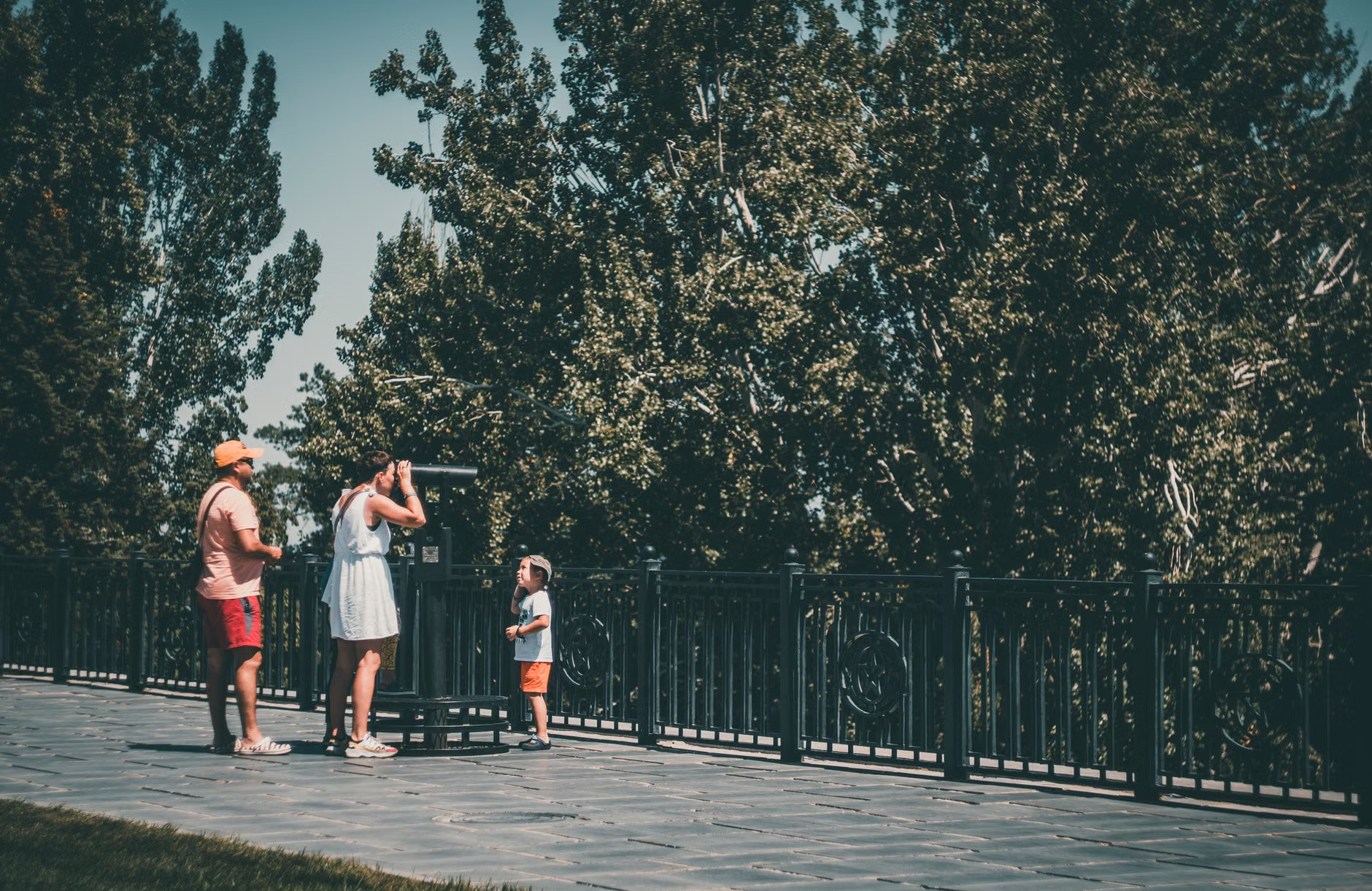
The Mechanics of Nature-Play Journaling
The beauty of this technique is that it requires almost zero preparation. You do not need a fancy moleskine or professional-grade watercolors. In fact, if your tools are too precious, you will be less likely to use them in the mud or on a bumpy park bench. You need a simple notebook and a pen that writes reliably. That’s it.
The technique works on a “Observe-Record-Reflect” cycle. Here is how to break it down:
1. The Observe Phase
Choose a location—it could be your backyard, a local park, or even a tree-lined street on your way to school drop-off. Don’t look for something “profound.” Look for something small. Is there a specific type of bird? How has the color of the leaves changed since last week? What does the air smell like after it rains? If you are with your children, ask them what they see. Their perspective will often be more creative and less filtered than your own.
2. The Record Phase
This is where the journaling happens. Keep it brief. You are not writing a memoir; you are logging a moment. Use bullet points if sentences feel like too much work. For example:
- Date: Tuesday, October 14th.
- Location: Oakwood Park.
- Observation: The wind is making the tall grass look like waves.
- Child’s comment: “The grass is dancing because it’s happy.”
3. The Reflect Phase
This is the “so-what” step. Ask yourself one question: How does this observation relate to my current state of mind? If the grass is “dancing,” maybe you need to allow yourself more movement. If the tree is standing firm against the wind, maybe you need to focus on your own resilience. This creates a bridge between the natural world and your personal life, making the stress of your day feel like a small part of a much larger, more stable ecosystem.
Overcoming the “I Don’t Have Time” Barrier
Let’s address the elephant in the room: you are busy. The common mistake people make when starting a journaling practice is treating it like a “sit-down-at-a-desk” event. For parents, this is a recipe for failure. If you wait until the house is quiet to journal, you will likely be too exhausted to do it.
Nature-play journaling is meant to be “grab-and-go.” Keep your journal in the glove compartment of your car or in your backpack alongside the snacks and spare clothes. When you have five minutes while the kids are playing on the swings, pull it out. If you only have one minute, just write down one word that describes the environment. The consistency of the practice matters more than the volume of your entries.

Comparison Table: Traditional Journaling vs. Nature-Play Journaling
| Feature | Traditional Journaling | Nature-Play Journaling |
|---|---|---|
| Focus | Internal thoughts and events | External sensory environment |
| Setting | Quiet, indoor, sedentary | Outdoor, active, dynamic |
| Mental Load | Can lead to rumination | Promotes cognitive restoration |
| Accessibility | Requires “protected” time | Fits into existing routines |
Common Pitfalls and How to Avoid Them
Even with the best intentions, you might find yourself hitting walls. Here is how to navigate the common roadblocks that parents face when trying to implement a new habit.
The “I’m Not Artistic” Trap
Many people avoid nature journaling because they think they need to draw beautiful botanical illustrations. Let go of that expectation immediately. If you want to draw, draw. If you want to use stick figures or just write words, that is perfectly fine. The journal is for your eyes only. Its purpose is to capture a memory or a sensation, not to be displayed in a gallery. If you find yourself obsessing over the “quality” of your entries, you are missing the point. The goal is the process, not the product.
The “Kids are Too Distracting” Myth
If you try to journal while your kids are running around, you might feel like you can’t focus. Instead of trying to find a quiet moment, involve them. Ask them to dictate a “nature observation” to you. Kids are naturally curious and often notice things adults overlook—the way a bug moves, the texture of tree bark, or the sound of the wind in the leaves. By writing down what they say, you are not only practicing mindfulness but also teaching them to appreciate the world around them. It becomes a shared ritual, not a chore that separates you from them.
The “All or Nothing” Mentality
We often feel that if we can’t do it every single day, we might as well not do it at all. This is the death of many good habits. If you miss a week, don’t sweat it. Nature doesn’t judge you for missing a sunset. Pick it back up whenever you can. The goal is to create a tool you can rely on when you need it, not to add another item to your “to-do” list that makes you feel guilty for missing.

Deepening the Connection: Advanced Tips
Once you have the basics down, you can start to experiment with different ways to deepen your practice. These aren’t necessary for the core benefits, but they can make the habit more engaging as you progress.
Use Your Senses
When you are stuck in a mental loop, use the 5-4-3-2-1 technique within your journal. Write down:
- 5 things you can see.
- 4 things you can feel (the texture of the bench, the temperature of the air).
- 3 things you can hear (birds, distant traffic, your child’s laughter).
- 2 things you can smell.
- 1 thing you can taste (or a pleasant memory of a taste).
This is a grounding technique used in therapy to pull people out of anxiety spirals. Writing it down makes it concrete.
Seasonal Tracking
Start a “phenology” section in your journal. Phenology is the study of cyclic and seasonal natural phenomena. Note when the first flowers bloom in your neighborhood, when the birds migrate, or when the leaves turn color. This gives you a sense of the “rhythm” of the year, which is a powerful antidote to the feeling that life is just an endless, repetitive loop of work and chores. It reminds you that change is a natural and expected part of life.
The “Nature-Play” Kit
If you find that having a dedicated “kit” helps, keep it simple. A small pouch with a pen, a pencil, and maybe a small magnifying glass is enough. You don’t need expensive gear. A magnifying glass can turn a boring patch of dirt into a fascinating alien landscape for you and your kids. It changes your perspective from “I’m just waiting for them to finish playing” to “I’m exploring a world with them.”
Implications for Long-Term Mental Wellbeing
The cumulative effect of this practice is not just a collection of notes in a notebook; it is a neurological re-training. By repeatedly choosing to engage with the natural world, you are training your brain to seek out “soft fascination” as a way to decompress. You are building a mental habit of looking for beauty or interest in your immediate surroundings, which is a powerful counter to the negativity bias that often plagues us when we are stressed.
Furthermore, this practice models a healthy way of dealing with stress for your children. They see you taking a moment to breathe, to observe, and to reflect. You are teaching them that it is okay to pause, that nature is a place of comfort, and that their observations matter. This is a gift that will serve them long after they have forgotten the specific things you wrote down in your journal.
Be patient with yourself. Some days will be more productive than others. Some days you will feel a profound connection to the world, and some days you will just be trying to get through the afternoon. Both are perfectly fine. The “Nature-Play” journaling technique is a tool for life, not a test you have to pass. Use it when you need it, adapt it to your own style, and allow yourself the grace to be imperfect.
Frequently Asked Questions
1. Do I need to be in a forest or a wild area for this to work?
Absolutely not. The benefits come from the “soft fascination” of nature, which exists everywhere. A small city park, a tree-lined street, or even a window box with a few plants can provide enough stimuli to trigger that restorative effect. The key is the act of focused observation, not the scale of the landscape.
2. What if my children are too young to “journal” with me?
If they are toddlers or infants, you are the observer for both of you. You can describe what you are seeing to them—”Look at that robin, it’s looking for a worm”—which helps with their language development and keeps you grounded. If they are older, they can have their own small notebook. The goal is to share the experience of noticing, not to have them produce a formal entry.
3. How often should I do this to see actual results?
There is no “dosage” for mindfulness. Even doing this once a week is better than not doing it at all. The goal is to build a habit that feels supportive, not demanding. Start with once a week—perhaps on a weekend walk—and see how it makes you feel. If you find it helpful, you can increase the frequency, but keep the sessions short and low-pressure.
For further reading on the psychological benefits of nature, you can explore the American Psychological Association’s research on nature and mental health or look into the concept of nature prescriptions currently being studied by medical professionals globally.