- Tantrums are not defiance; they are the result of an underdeveloped prefrontal cortex struggling to process overwhelming sensory or emotional input.
- Labeling emotions (e.g., “You look frustrated”) acts as a neurological “brake” by moving the child’s processing from the amygdala to the prefrontal cortex.
- Building an “Emotional-Vocabulary Toolkit” requires consistent, low-pressure modeling of feelings during neutral moments, not just during high-stress meltdowns.
The most effective way to end a toddler tantrum isn’t to stop the behavior, but to provide the missing language for the internal storm your child is experiencing. When a two-year-old throws themselves onto the floor because their toast was cut into a triangle instead of a square, they aren’t being “difficult.” They are experiencing a physiological disconnect: their limbic system—the emotional center of the brain—is firing at full capacity, while their prefrontal cortex—the part responsible for logic, reason, and impulse control—is still under construction.
For parents in our 30s and 40s, juggling professional deadlines and household management, these outbursts often feel like personal failures or logistical inconveniences. However, shifting your perspective from “How do I make them stop?” to “What are they trying to express?” transforms the tantrum from a battle of wills into a teaching opportunity. This is where the emotional-vocabulary toolkit becomes your most valuable asset.

Why Your Toddler Needs a “Feeling Dictionary”
Children are born with the capacity for raw emotion—fear, joy, anger, and sadness—but they lack the cognitive architecture to categorize these sensations. Think of it as having a massive, complex software program running on a computer with very little RAM. When the system becomes overloaded, it crashes. For a toddler, that crash is a tantrum.
Research in developmental psychology, particularly studies on “affect labeling,” suggests that putting feelings into words can decrease activity in the amygdala, the brain’s “alarm system.” When you give a child a word for what they are feeling, you are effectively handing them a tool to regulate their nervous system. You aren’t just teaching them vocabulary; you are helping them build the neural pathways necessary for emotional regulation.
If you don’t provide these words, the child is left with only physical actions to communicate their internal state. Kicking, screaming, and biting are the default “languages” of a toddler who hasn’t yet learned that “I feel frustrated” is a more effective way to get their needs met. By expanding their emotional vocabulary, you increase the “bandwidth” they have to process difficult situations before they reach the point of a total meltdown.
The Components of an Emotional-Vocabulary Toolkit
You don’t need expensive gadgets to build this toolkit. In fact, the most effective tools are ones you can implement in your daily routine without adding extra chores to your already busy schedule. The goal is to move from a narrow focus on “happy/sad” to a nuanced understanding of internal states.
1. The Visual Reference Library
Toddlers are visual learners. An emotion chart or a set of “feeling cards” serves as a physical reference point. When a child is in the middle of a tantrum, their language centers often go offline. Pointing to a picture of an angry face can be far more effective than asking, “Why are you screaming?”
2. The “Feeling Wheel” or Mirror Exercises
Modeling is the cornerstone of development. Use a mirror to make exaggerated expressions—surprise, worry, excitement, frustration—and name them clearly. When you play this as a game during a calm moment, you are building the child’s ability to recognize these expressions on themselves and others. It’s like practicing a sport before the big game; you don’t want to be teaching these skills for the first time while your child is already mid-meltdown.

3. The “Emotion-First” Narrative
Start narrating your own emotional life in front of your child. Instead of saying, “I’m busy,” try, “I feel a bit overwhelmed because I have a lot of work to do today.” This demonstrates that all feelings are temporary, manageable, and expressible. It also normalizes the idea that adults, too, have big feelings that need to be navigated.
Step-by-Step Strategy: From Meltdown to Regulation
When a tantrum hits, the goal is to “co-regulate.” You are essentially acting as an external prefrontal cortex for your child until their own system comes back online. Follow this sequence to de-escalate effectively:
| Step | Action | Why it works |
|---|---|---|
| 1. Stay Neutral | Maintain a calm, low voice and neutral facial expression. | Your calm nervous system signals safety to their mirror neurons. |
| 2. Validate | “I see you are feeling [Emotion]. It’s hard when [Situation].” | Validation stops the child from having to “scream louder” to be heard. |
| 3. Wait | Give them space to feel the emotion without rushing to “fix” it. | Processing takes time; rushing prevents the brain from learning. |
| 4. Reconnect | Offer a hug or a quiet transition once the physical storm passes. | Reinforces that your relationship is stable regardless of the behavior. |
The most common mistake parents make is trying to “logic” their way out of a tantrum. Attempting to explain why the toast can’t be a square while your child is screaming is futile. The brain is in “fight or flight” mode; the logical parts are temporarily shut down. Wait until the storm passes before you discuss the “rules” of the house.
Hidden Variables: Why Some Days are Harder Than Others
Even with a robust emotional-vocabulary toolkit, some days will be harder than others. It is crucial to recognize the “HALT” factors: Hungry, Angry, Lonely, or Tired. A child who has missed their nap or had a long day at daycare has significantly less “emotional fuel” to draw from. On these days, your expectations for their self-regulation should be lower.
Another often-overlooked factor is sensory overload. In our modern, high-stimulation environments, toddlers are often bombarded by noise, bright lights, and transitions. Sometimes, a “tantrum” is actually a sensory processing overload. If you notice your child tends to melt down in crowded stores or loud environments, the solution isn’t more vocabulary—it’s sensory reduction, such as leaving the area or finding a quiet corner.
Integrating the Toolkit into Busy Parenthood
You don’t need a dedicated hour of “emotional training.” Instead, weave these habits into the mundane moments of the day:
- Bedtime Reflection: Use the last five minutes of the day to talk about the “big feelings” from the day. “Did you feel frustrated when the blocks fell over? That was a big feeling.”
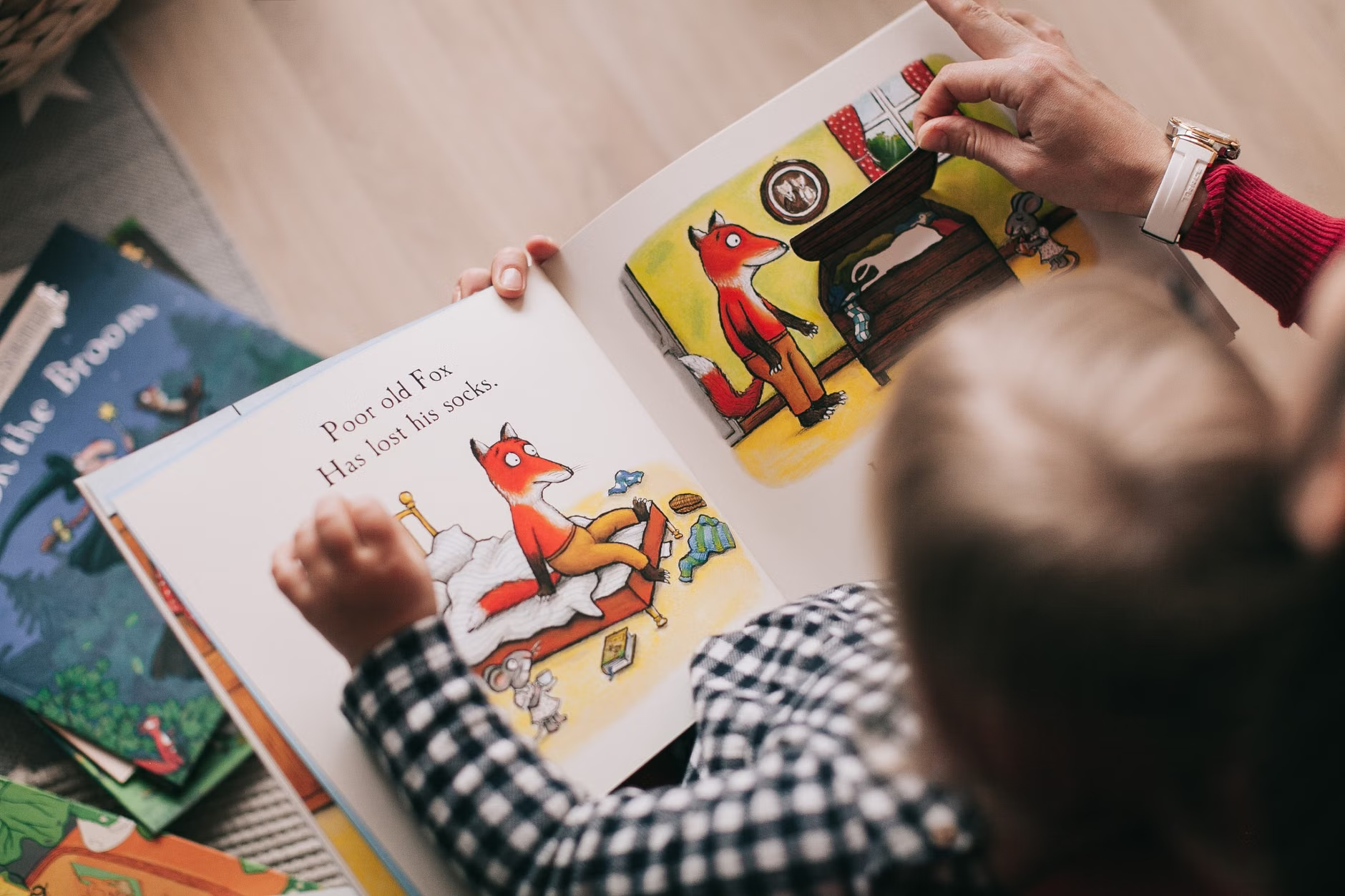
- Book Selection: Choose books that focus on characters experiencing complex emotions. When reading, pause and ask, “How do you think Rabbit feels right now?”
- The “Pause” Button: When you feel your own frustration rising, label it. “I am feeling frustrated because I am tired. I need to take a deep breath.” This is the highest form of modeling.
Remember that this is a marathon, not a sprint. Your child will not suddenly become a master of emotional regulation because you read a book or bought an emotion chart. It is about the cumulative effect of hundreds of small, consistent interactions. Over time, you will notice that the length and intensity of the meltdowns decrease, not because the child feels less, but because they have the tools to express it.
Addressing Common Misconceptions
There is a persistent myth that validating a child’s emotions will “encourage” the tantrum. This is fundamentally incorrect. Validating an emotion is not the same as validating a behavior. You can say, “It is okay to feel angry that the TV is off (Validating the emotion), but it is not okay to hit the wall (Setting the boundary).” By separating the feeling from the action, you teach the child that they are allowed to have feelings, but they are still responsible for their choices.
Another misconception is that you are “coddling” the child. In reality, you are teaching them executive function. Executive function—the ability to plan, focus, and manage emotions—is the greatest predictor of long-term success, far more so than academic performance in early childhood. By teaching them to label their emotions, you are giving them the keys to a more successful, stable future.
Next Steps for Your Family
Start by observing your child’s triggers this week. Keep a simple mental note: What situations consistently lead to the longest meltdowns? Is it transitions? Is it being told “no”? Is it being overstimulated? Once you identify the pattern, choose one or two emotion words to introduce during a calm time before that trigger occurs. For example, if you know transitions from park to car are difficult, start talking about “feeling sad to leave” while you are still at the park.
The goal isn’t to create a perfectly behaved child who never experiences big feelings. The goal is to raise a human being who understands their own internal world and feels safe enough to share it with you, even when it’s messy. Your patience and your persistence are the most powerful tools in this kit. Keep modeling, keep naming, and keep showing up. The rest will follow.
Frequently Asked Questions
1. At what age should I start teaching emotional vocabulary?
You can start as early as 12 to 18 months. Even if they aren’t speaking in full sentences yet, toddlers understand far more than they can express. Using simple words like “happy,” “sad,” and “mad” consistently helps them bridge the gap between feeling and cognition.
2. What if my child refuses to use the words I give them?
That is completely normal. The goal isn’t for them to repeat the words immediately; the goal is for them to hear you label their experience. Over time, they will internalize these labels. Do not force them to say “I am frustrated”; simply offer it as a gift: “You seem frustrated.” If they reject it, move on. The seed is still planted.
3. Does this approach work for neurodivergent children?
Yes, but with modifications. For children with autism or sensory processing differences, visual supports like picture boards are often essential, as auditory processing can be difficult during high stress. Focus heavily on visual cues and sensory regulation techniques, as these are often the primary barriers to emotional expression for neurodivergent children.
For further reading on child development and emotional regulation, you can explore resources from the Center on the Developing Child at Harvard University, which provides evidence-based information on how early experiences shape brain architecture.