The most effective way to break your phone addiction isn’t to buy a “dumb phone” or disappear into the woods for a week; it is to transform your existing device into a tool that serves your life rather than demands your attention.
Key Takeaways
- Digital Minimalism is about utility, not absence: It focuses on intentional usage, where apps are installed only if they provide a clear, measurable benefit to your daily goals.
- The “One-Screen” Rule: By removing all non-essential apps from your home screen and disabling all non-human notifications, you can reduce daily screen time by up to 30% without changing your lifestyle.
- Friction is your friend: Adding “digital friction”—such as moving social media apps into deep folders or requiring a password for browsers—prevents the reflexive “boredom scrolling” that consumes hours of your day.
If you are in your 30s or 40s, your relationship with technology is likely defined by a constant, low-grade hum of anxiety. You are juggling career demands, parenting responsibilities, and the relentless ping of social media updates. You aren’t “addicted” in a clinical sense; you are simply over-stimulated. When you finally have five minutes of peace, your thumb automatically drifts to the Instagram or news icon. That isn’t a failure of willpower; it is a failure of system design.
Minimalist-Tech is the methodology of redesigning your digital environment to favor focus over stimulation. It acknowledges that you need your smartphone for banking, navigation, and coordinating family logistics, but it rejects the idea that your device should dictate your emotional state.
Why Your Current Relationship with Tech is Designed to Fail
Modern apps are engineered using “variable reward schedules.” This is the same psychology used in slot machines. When you pull down to refresh your feed, you don’t know what you’re going to get—a photo of a friend, a political outrage, or an advertisement. This unpredictability creates a dopamine loop that keeps you checking even when you have nothing to gain.
For parents in their 30s, this is particularly damaging. You are often physically present with your children but mentally fragmented by the “notification economy.” Research from the Journal of Experimental Psychology suggests that even the mere presence of a smartphone reduces available cognitive capacity—a phenomenon researchers call “brain drain.” Essentially, your phone is taking up processing power in your brain, even when it is locked and face down on the table.
To combat this, you need to shift from being a passive consumer of digital content to an active architect of your digital space. This process requires a three-step audit of your current digital life.
Step 1: The “Utility Audit” of Your Apps
Most of us have 50 to 100 apps installed. If you look at your screen time report, you will likely find that 80% of your time is spent in three to five apps. The rest are “digital zombies”—apps that you use once a month but that send you notifications daily.
The Action Plan: Go through your phone and delete every app that you haven’t opened in the last 14 days. If you find yourself thinking, “But I might need this one day,” delete it anyway. You can always re-download it. If an app doesn’t serve a clear utility—like banking, maps, or essential communication—it is likely serving as a distraction.
Step 2: Eliminating the “Notification Noise”
Notifications are interruptions that others have scheduled for your time. Every time your phone pings, your heart rate spikes slightly, and your focus is shattered. It takes an average of 23 minutes to return to a state of “deep work” after an interruption.
The Decision Rule: Disable all notifications except for direct human contact. That means:
- Keep: Phone calls, SMS, and messaging apps (WhatsApp/Signal) from real people.
- Remove: News alerts, social media “likes” or “comments,” game notifications, and shopping reminders.
- The “Human-Only” Filter: If the notification doesn’t involve a real person trying to reach you in real-time, it should not be allowed to interrupt your day.
Building “Digital Friction” into Your Workflow
Minimalist-Tech isn’t just about what you remove; it is about how you make the “bad” habits harder to perform. We often scroll because it is the path of least resistance. To stop the habit, you must increase the friction.
The “Deep Folder” Strategy
Your home screen should only contain “tools”—Calendar, Maps, Notes, Camera, and Phone. Move all social media and news apps into a folder on the third or fourth page of your phone. By forcing yourself to swipe three times and search for the folder, you introduce a two-second pause. Those two seconds are often enough for your prefrontal cortex to say, “Wait, why am I opening this?”
Grayscale Mode: The Ultimate Anti-Dopamine Hack
Color is a major driver of smartphone addiction. The red notification bubbles and vibrant app icons are designed to grab your eye. Most smartphones now allow you to turn your display to Grayscale (Black and White). When your screen is in grayscale, the “slot machine” appeal of your apps drops significantly. It makes your phone look like a boring, functional tool, which is exactly what it should be.
| Strategy | Difficulty | Effectiveness | Best For |
|---|---|---|---|
| Grayscale Mode | Easy | High | Reducing visual stimulation |
| Deleting Social Apps | Medium | Very High | Eliminating “doomscrolling” |
| Notification Purge | Easy | Medium | Improving focus during work |
| Physical Phone Storage | Hard | Maximum | Deep focus/Parenting time |
The table above shows that while deleting social apps is the most effective, it is also the hardest for most people to maintain. If you aren’t ready to delete Instagram or X (Twitter), start with Grayscale mode. It is a “low-regret” experiment that you can reverse in seconds if it doesn’t work for you.
Parenting in the Age of Distraction
For parents, the biggest challenge is the “split attention” problem. You are at the park with your kids, but your phone is in your pocket. Every time you feel a vibration, you check it. Your child notices. Even if you don’t realize it, your child is learning that a digital notification is more important than their conversation.
The “Phone-Free Zone” Rule: Designate specific times and areas as phone-free. A common mistake is trying to be “present” while your phone is sitting next to you. Even if it is face down, your brain is subconsciously monitoring it. Put your phone in a drawer or a charger in a different room when you are in “parenting mode.”
This isn’t just for the kids; it is for your own mental recovery. If you spend your playtime scrolling, you aren’t actually resting. You are just switching tasks. True rest—the kind that restores your patience and energy—requires you to be fully disengaged from the digital world.
The Hidden Costs of “Digital Convenience”
We often justify our screen time by saying we are “staying informed” or “staying connected.” But we need to look at the hidden costs. The cost of checking the news for 10 minutes every hour isn’t just 10 minutes—it is the loss of your ability to think deeply about a single topic. The cost of “staying connected” on social media is the erosion of your ability to have a quiet, internal dialogue with yourself.
Many people in their 30s and 40s report a feeling of “time poverty.” They feel like they have no time for hobbies, reading, or exercise. Yet, the average person spends over three hours a day on their phone. That is 21 hours a week. If you reclaimed even one-third of that time through Minimalist-Tech, you would have seven extra hours a week to dedicate to your health, your family, or your personal development.
Common Pitfalls to Avoid
- The “All or Nothing” Trap: You don’t need to quit technology entirely. If you try to go “cold turkey,” you will likely fail and binge-scroll for hours to compensate. Start by removing one app per day.
- The “Replacement” Mistake: If you delete your social media apps but don’t have a plan for what to do with your hands and your time, you will inevitably reinstall them. Have a “low-tech” alternative ready: a physical book, a notepad, or even just a walk outside.
- Ignoring the “Why”: Minimalist-Tech is not about discipline; it is about values. Ask yourself: “What am I trying to achieve with this time?” If the answer is “to avoid boredom,” you are using the phone as an anesthetic, not a tool.

How to Start Your Digital Detox Today
You don’t need a formal program or an expensive app to start this. You just need to commit to a 24-hour experiment. Tomorrow, try these three things:
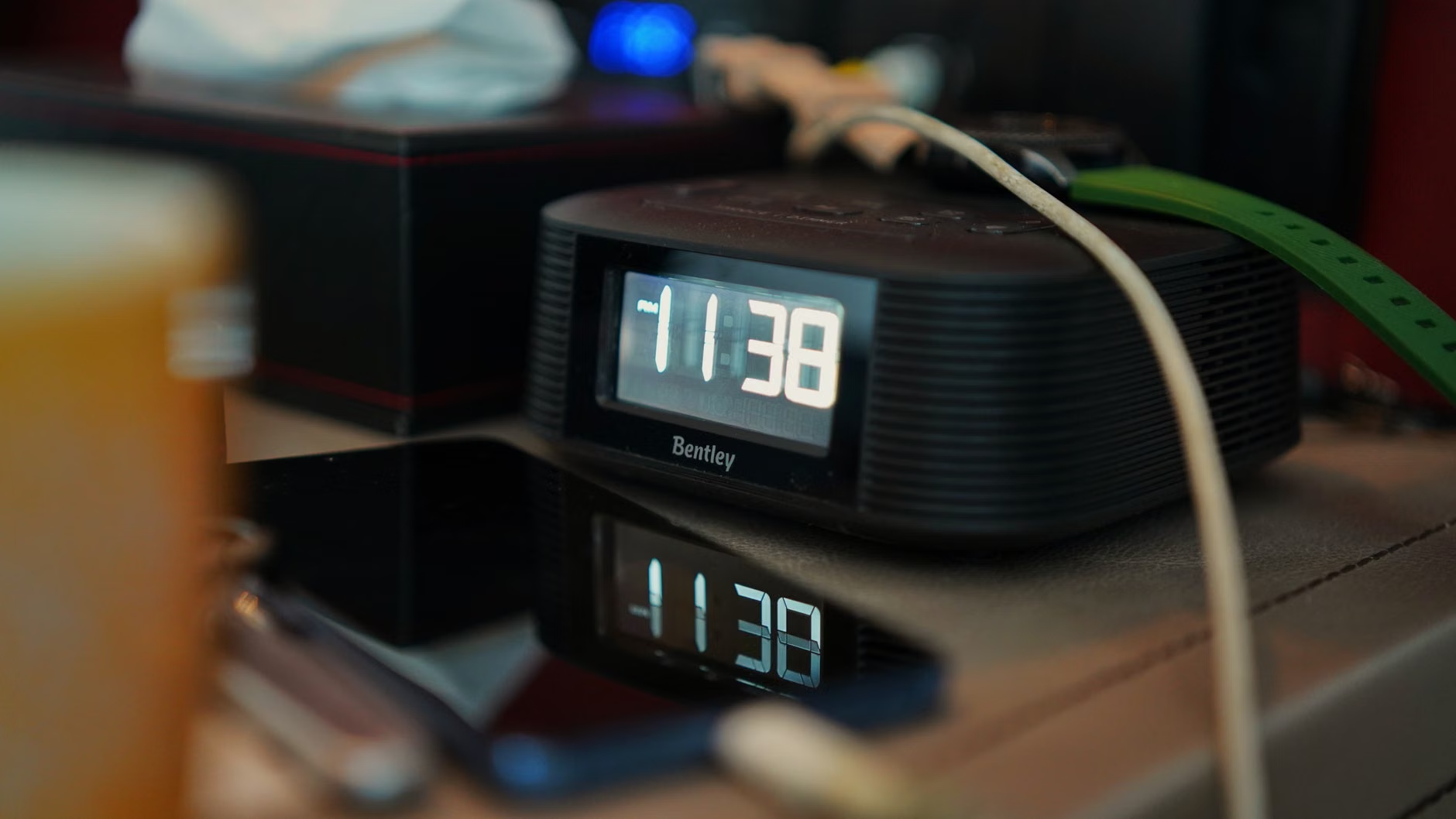
- Charge your phone outside the bedroom tonight. Buy a cheap, non-digital alarm clock. This prevents you from starting your day with a flood of information before you’ve even had a cup of coffee.
- Disable all notifications except for calls and text messages. If it isn’t an emergency, it can wait until you are sitting at your desk.
- Clear your home screen. Leave only the essentials. If you have to search for an app to open it, you will naturally use it less.
The goal is not to be a Luddite. It is to be the master of your own attention. In a world that profits from your distraction, your focus is your most valuable asset. Protect it with the same vigilance you would use to protect your bank account or your physical health.
For further reading on the intersection of technology and human psychology, I recommend exploring the resources provided by the Center for Humane Technology, which provides excellent insights into how design choices influence our behavior.
Frequently Asked Questions
You don’t have to delete your accounts, but you should delete the apps from your phone. Using social media through a mobile browser is inherently more “friction-heavy,” which discourages mindless scrolling while still allowing you to check in when you actually need to.
2. What if I miss an important work update?
Most “important” work updates are not urgent. If something is truly life-or-death, someone will call you. If it is just a project update, it can wait until you are logged into your computer. Setting this boundary actually makes you more productive because it forces you to prioritize deep, uninterrupted work over reactive communication.
3. How do I handle the “FOMO” (Fear Of Missing Out) when I stop checking my phone?
FOMO is almost always an illusion. When you stop checking your phone, you will find that you aren’t actually missing anything essential. You will miss memes, trending debates, and random updates, but you will gain clarity, peace, and the ability to focus on your real-world relationships. The “fear” is just a symptom of the withdrawal from the dopamine loop.
Final thought: You are not a machine, and you were not designed to process thousands of bits of information every day. Start small, be consistent, and prioritize your own peace over the constant demands of the digital world.