- The “Rotation” Advantage: Swapping books every 4–6 weeks keeps your child’s interest high and prevents your home from becoming an unmanageable library.
- The 80/20 Rule: Keep 20% of your child’s “all-time favorites” permanently accessible, and rotate the remaining 80% to maintain novelty and engagement.
- Cost Efficiency: By utilizing local libraries or neighborhood book swaps instead of constant new purchases, you can save hundreds of dollars annually while supporting community literacy.
If your home looks anything like mine used to, you are probably familiar with the “Book Avalanche.” It happens when children’s books migrate from shelves to the floor, under the sofa, and into the dark corners of closets. We buy books with the best intentions—to foster a love of reading—but often, the sheer volume of choices leads to decision paralysis. Your child grabs the same three books, while the other fifty gather dust.
The “Parent-Child Book Rotation” isn’t a complex pedagogical theory; it is a logistical system designed to treat your home library like a curated boutique rather than a warehouse. By restricting the number of books available at any given time, you increase their perceived value and encourage deeper engagement with each story.

Why Your Home Library Needs a “Less is More” Approach
In our 30s and 40s, we are constantly balancing the desire to provide “enrichment” for our children with the reality of living in a finite space. We often fall into the trap of thinking that more books equal more literacy. However, cognitive research suggests that too many choices can actually hinder focus. When a shelf is overflowing, a child often lacks the executive function to choose, leading to the “I’m bored” syndrome even when surrounded by hundreds of stories.
The core philosophy of a rotation system is scarcity creates interest. When you limit the selection to 10–15 books at a time, your child is forced to look at the covers, flip through the pages, and potentially discover a book they previously ignored. This is the same principle used by high-end toy libraries and Montessori classrooms to maintain a calm, focused learning environment.
The Hidden Costs of Accumulation
Beyond the physical clutter, there is a “mental load” cost. Every book that is not being read is an object that needs to be cleaned, organized, and navigated around. If you are struggling with home management, viewing your book collection as a dynamic, changing set of assets rather than a permanent fixture is a mental shift that pays dividends in reduced cleaning time and improved mental clarity.
Step-by-Step: How to Implement Your Rotation System
Implementing a rotation system doesn’t require a degree in library science. It requires three bins, a bit of shelf space, and a monthly commitment.
Step 1: The Great Purge and Categorization
First, gather every children’s book in your house. Yes, even the ones under the bed. Sort them into three piles:
- The Core Collection (The 20%): These are the books your child asks for daily. They are the “classics” in your household. These stay on the main shelf permanently.
- The Seasonal/Growth Pile: These are books that are currently a bit too advanced or specific to a season (e.g., holiday books, nature books). These go into storage.
- The “Maybe” Pile: If a book hasn’t been touched in six months, it’s time to donate it or pass it on. If it’s damaged beyond repair, recycle it.
Step 2: Setting Up the “Rotation Bin”
Use a plastic or fabric bin to house the books currently not in circulation. Label this clearly. The goal is for this bin to be hidden away—in a closet, under a bed, or in the garage. Out of sight means out of mind, which is exactly what we want to create the “newness” when they eventually reappear.
Step 3: The Monthly Refresh
Set a calendar reminder for the first Saturday of each month. During this time, take the currently accessible books and move them into the storage bin. Then, pull a fresh batch from the storage bin to place on the shelves. This simple act of “refreshing” often feels like a mini-Christmas for young children, as they “rediscover” books they had forgotten existed.
Comparing Library Access vs. Ownership
One of the most common questions is: “Should I buy books or borrow them?” The answer depends on your usage frequency and your child’s personality. Here is a breakdown of how to decide which route is best for your family.
| Feature | Owning (Rotation) | Library Borrowing |
|---|---|---|
| Cost | High initial investment. | Free or very low cost. |
| Availability | Immediate access at home. | Dependent on stock/waitlists. |
| Sustainability | Requires storage space. | Zero storage footprint. |
| Best For | Books read repeatedly. | Testing new authors/genres. |
Decision Criteria: If your child is in a phase where they want to read the same story 50 times in a row, buy it. If they are in a “curious explorer” phase where they want to learn about space, dinosaurs, and bugs in one week, use the library. The most successful home libraries utilize a hybrid model: own the “comfort” books, borrow the “learning” books.
Common Mistakes and How to Avoid Them
Even with the best intentions, parents often trip over a few common hurdles. Let’s look at how to avoid them.
1. The “Sentimental Trap”
Many of us hold onto books because *we* loved them as children. However, a book is a tool, not a family heirloom. If your child shows no interest in your childhood copy of a specific story, it is not a reflection on them—it is just a mismatch of interests. Keep only one small box of true sentimental classics and let the rest go to a new home where they will be read.
2. Forcing the Rotation
If your child is deeply attached to a specific book, do not remove it just because it is time to rotate. The goal of the system is to foster a love of reading, not to follow a rigid schedule. If a book is a “staple,” it stays. The rotation is for the “variable” books that are currently taking up space without adding value.
3. Ignoring Display Quality
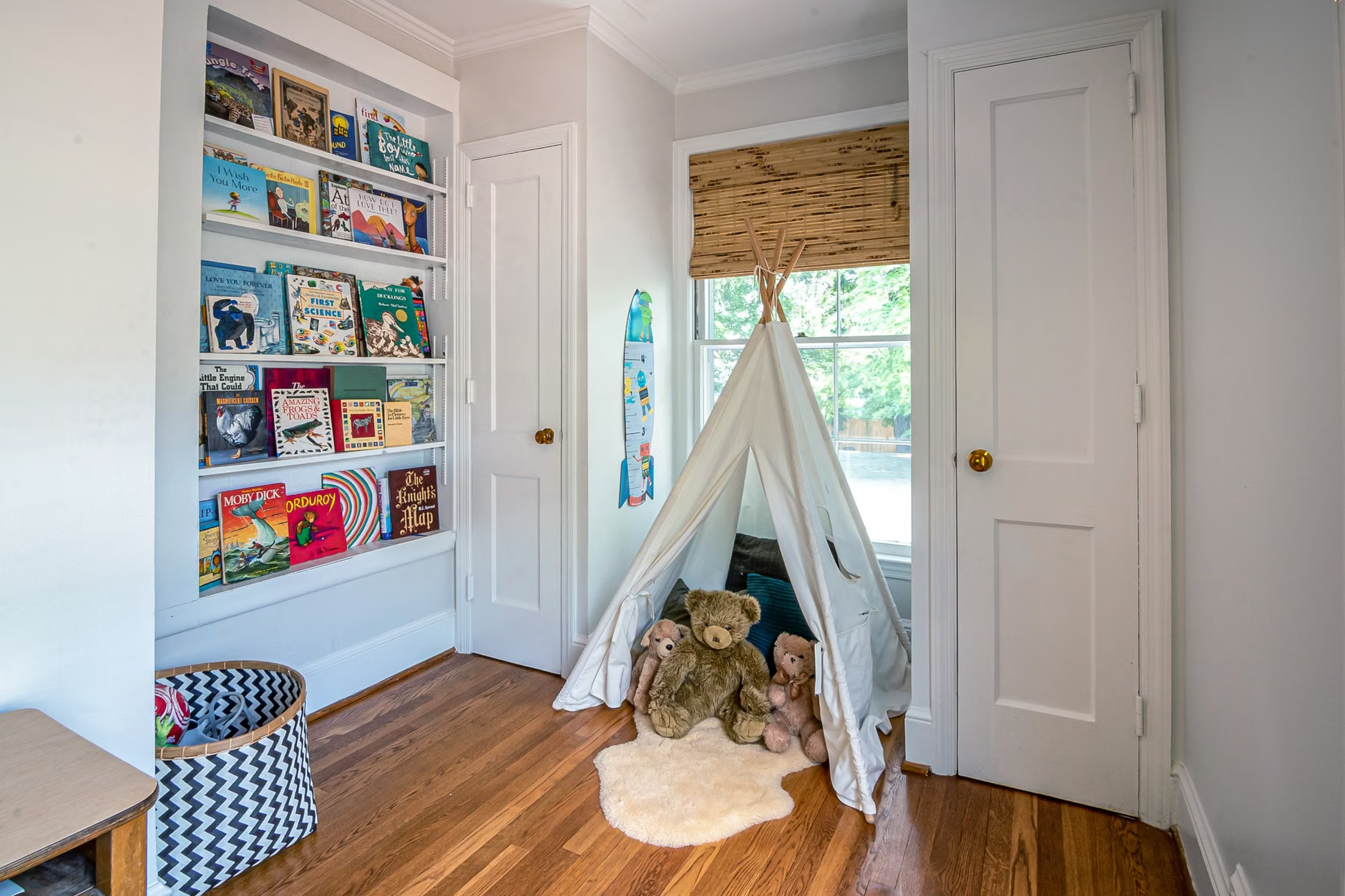
Most of us store books with only the spines visible. For children who aren’t yet reading fluently, the spine is meaningless. If possible, try to use a forward-facing shelf or a simple ledge. Being able to see the cover art is one of the biggest drivers of reading engagement. If you don’t have space for a display shelf, use a simple basket where books can be placed cover-up.

The Psychological Benefits of a Curated Environment
There is a growing body of research regarding the “minimalist home” and its impact on childhood development. A study published in the journal Infant Behavior and Development (Dauch et al., 2018) suggested that children with fewer toys in their environment engaged in longer periods of play and were more creative. While the study focused on toys, the application to books is identical. When the environment is less cluttered, the child is less distracted by the “noise” of too many objects and can settle into the “deep work” of reading.
For parents in their 30s and 40s, this also provides a sense of control. When you manage your physical environment, you reduce the background anxiety that comes from living in a perpetually messy space. A “rotated” bookshelf looks clean, intentional, and inviting, rather than chaotic and overwhelming.
Advanced Tips for Long-Term Success
Once you’ve mastered the monthly rotation, you can start incorporating more advanced strategies to keep the interest alive.
The “Community Swap”
If you have friends with children of similar ages, organize a book swap. This is essentially a “rotation” that costs zero dollars. Every three months, swap a box of 20 books with a friend. You get “new” books, they get “new” books, and everyone saves money. It’s a sustainable, community-focused way to keep the library fresh.
Connecting Books to Life Events
Use your rotation to bridge the gap between literature and real life. If you know you have a dentist appointment coming up, rotate in a few books about visiting the dentist. If you are going on a beach vacation, pull out your sea-themed books. By aligning your home library with your life events, you make books a “living” resource rather than a static one.
Digital Integration
If you are struggling with space, consider a digital component. Services like Libby or Hoopla allow you to borrow digital books or audiobooks from your local library for free. While physical books are superior for tactile engagement, audiobooks are an excellent way to introduce more complex vocabulary and narrative structures without adding a single inch to your bookshelf.
Final Thoughts: A Sustainable Path Forward
The “Parent-Child” book rotation is ultimately about intentionality. It is about recognizing that your home is a living space, not a library branch. By curating what is available, you honor the books you have, respect the space you live in, and—most importantly—give your children the gift of a focused, engaging, and ever-changing literary environment.
Start small. You don’t need to overhaul your entire house this weekend. Start with one shelf or one bin. The goal is to create a rhythm that works for your specific family, not to achieve a Pinterest-perfect aesthetic. If you find yourself enjoying the process of “discovering” books with your child again, you’re doing it right.
Frequently Asked Questions
Q: What should I do if my child gets upset when I rotate their books?
A: This is common. The best approach is to involve them in the process. Make “book rotation day” a fun event where you both decide which books go into the “rest” bin and which ones come out. Giving them agency helps them understand that the books aren’t disappearing forever; they are just taking a break.
Q: How many books should be in the “active” rotation?
A: There is no magic number, but a good rule of thumb for toddlers and preschoolers is 10–15 books. This is enough to provide variety without being overwhelming. If you have older children, you can increase this number, but focus on quality over quantity.
Q: Is it okay to keep books that are “too old” for my child?
A: Absolutely. It is perfectly fine to have a few books that are slightly above their level. These can be used for shared reading where you read the text and they look at the illustrations. However, if these books are consistently ignored, move them to the storage bin until your child reaches the appropriate age.
Useful Resources:
Association for Library Service to Children (ALSC) – Excellent for finding age-appropriate reading lists.
Reading Rockets – A comprehensive guide to supporting literacy at home.