- Luggage Geometry Matters: Trains require vertical mobility; choose luggage that fits in narrow overhead racks or between seats rather than bulky suitcases.
- Modular Packing is Mandatory: Use packing cubes to create a ‘station-ready’ bag that keeps essentials accessible without unpacking your entire suitcase on a moving train.
- The ‘Platform-to-Seat’ Workflow: Your gear setup should allow one parent to handle luggage while the other manages children, prioritizing hands-free bags like cross-body slings or backpacks.
The most liberating realization for parents in their 30s and 40s is that the airport is not the only gateway to a vacation. While air travel is often positioned as the default, the “Rail-First” movement—prioritizing train travel over short-haul flights—is not just about reducing carbon footprints. It is about reclaiming your sanity. By trading the high-stress, high-security theater of an airport for the fluid, seat-to-station experience of rail, you gain back hours of time and a significantly lower cortisol level. However, train travel requires a different logistical mindset. You aren’t checking bags; you are carrying them. You aren’t sitting in a sterile terminal; you are navigating platforms.
The Physics of Rail-First Gear: Why Weight and Shape Define Your Trip
The primary difference between air and rail travel is the “last mile” of your journey. On a plane, your heavy luggage is handled by ground crews. On a train, you are the porter. If you have a child in one hand and a suitcase in the other, you are already at a disadvantage. The secret to a successful rail trip is minimizing your footprint—literally.
Most modern high-speed trains, such as the Eurostar in Europe, the Shinkansen in Japan, or the Amtrak Acela in the U.S., have specific storage constraints. Overhead racks are often narrower than airline bins, and the space between seats is limited. If your suitcase is too deep, it won’t fit in the overhead rack. If it is too wide, it won’t fit in the luggage alcove at the end of the carriage. The rule of thumb for the rail-first traveler is “The 22-Inch Limit.” Any suitcase larger than 22 inches (56cm) becomes a liability during boarding and alighting.
When selecting your gear, prioritize “verticality.” A vertical-opening suitcase or a high-capacity, structured backpack allows you to access items without laying your entire bag flat in the middle of a narrow aisle. This is a common mistake: travelers who bring traditional clamshell suitcases often find themselves blocking the entire carriage doorway while trying to reach a snack or a tablet for a child. A vertical-access bag allows you to keep your gear contained to your immediate seat footprint.
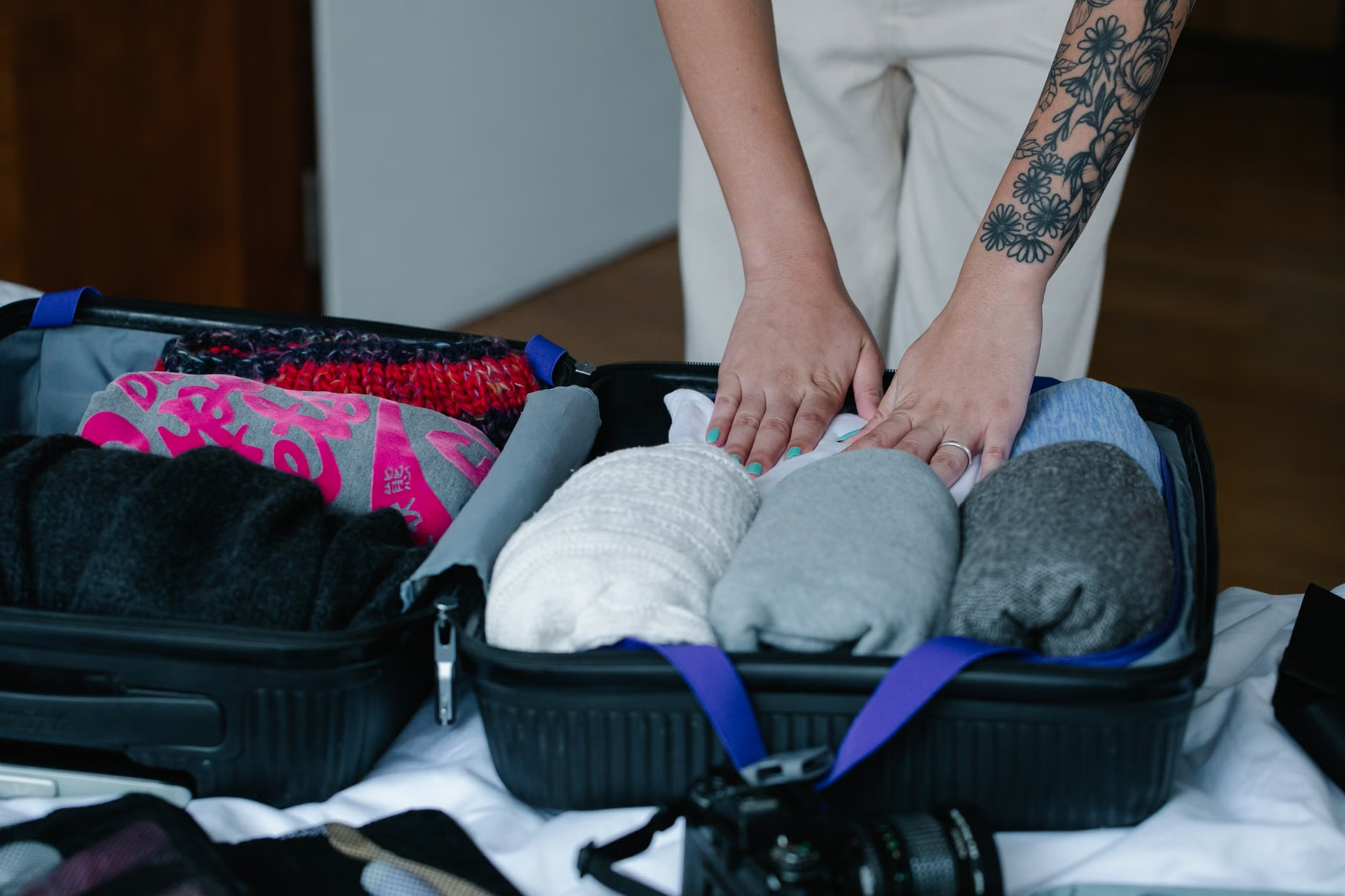
Modular Packing: Creating the ‘Station-Ready’ Kit
The biggest friction point in rail travel is the transition from the station platform to the train seat. You have roughly two to three minutes to board, navigate the aisle, find your seats, and stow your bags. If your “entertainment” gear or “snacks” are buried at the bottom of a large suitcase, you are going to have a rough start to your journey.
Implement a “Station-Ready” modular system. This involves using three distinct layers of packing:
- The Core: Your main luggage (stowed in the rack or alcove).
- The Transition Bag: A medium-sized backpack that stays at your feet, containing items needed for the duration of the trip (chargers, snacks, tablets, headphones).
- The Sling/Waist Bag: A small, cross-body bag for the “essentials of the essentials”—passports, tickets, phone, and hand sanitizer.
By compartmentalizing, you never need to open your main suitcase while on the train. When you arrive at your destination, you aren’t scrambling to repack. You simply grab your main bag and your transition bag. The efficiency gain here is not just about speed; it is about reducing the mental load. You aren’t searching for a lost pair of headphones while the train is pulling into the station; you know exactly where they are because they are in the ‘Transition’ module.
The Tech Setup: Managing Digital Entropy
On a train, you are your own entertainment director. Unlike a plane, there is no centralized seat-back screen system on most regional or intercity trains. You must provide the hardware. The common mistake here is bringing loose devices that clutter the tray table. A tray table on a train is often smaller and less stable than an airline table, and it is prone to vibrations.
Invest in a magnetic or foldable tablet stand. These stands take up almost zero space when folded and provide a secure, upright viewing angle for children. Pair this with a multi-port wall charger that supports GaN (Gallium Nitride) technology. GaN chargers are significantly smaller and lighter than traditional silicon chargers but can output enough power to charge a laptop, a tablet, and a phone simultaneously from a single outlet. Since many older train carriages have limited power outlets, having one high-output charger is a strategic advantage.

Regarding audio, prioritize active noise-canceling (ANC) headphones for both parents and children. Trains generate a constant, low-frequency rumble that contributes significantly to travel fatigue. ANC technology effectively masks this, allowing you to listen to audio at a lower, safer volume. For children, ensure the headphones have a volume-limiting feature to protect their hearing during longer trips.
Hydration and Nutrition: Moving Beyond the Buffet Car
While many high-speed trains have a cafe car, relying on it for every meal is a recipe for disaster. The queues are often long, the options can be limited, and the prices are marked up. A “Rail-First” family treats the train like a picnic space. The key is bringing a high-quality, insulated water bottle that fits into the standard cup holder of your train seat.
Common mistake: Bringing glass or flimsy plastic bottles that leak or sweat condensation onto your electronics. A vacuum-insulated stainless steel bottle is the gold standard. It keeps water cold for 12+ hours and eliminates the need to constantly buy single-use plastic bottles at the station. For snacks, use reusable, stackable silicone containers. These are infinitely better than crinkly plastic bags, which are noisy and messy to manage in a shared, quiet space like a train carriage.

When planning your “train pantry,” aim for low-crumb, high-satiety foods. Think nuts, dried fruit, protein bars, or pre-cut fruit. Avoid anything that requires a knife or significant assembly. Remember, you are in a moving vehicle; the goal is to minimize spills and cleanup requirements.
Strategic Seating: The Hidden Variable of Success
Not all seats are created equal. When booking, many travelers simply pick the first available option. However, most rail operators provide a seat map. Use it. For families, look for the following configurations:
| Seat Type | Best For | Trade-off |
|---|---|---|
| Table Seats | Families needing space for activities/eating. | Limited legroom; you are facing strangers. |
| Airline-Style | Privacy and legroom. | Less space for communal activities. |
| End-of-Carriage | Quick access to bathrooms/exits. | Higher foot traffic and noise. |
The “Table Seat” is the holy grail for a family of four, but it comes with a social trade-off. If you are traveling on a busy route, you will be sharing that table with two other people. If you prefer privacy, choose the “Airline-Style” rows. However, for parents with younger children, the table is essential for coloring, playing card games, or holding tablets. The trade-off is worth it for the utility it provides during a three-to-four-hour journey.
The Psychology of the ‘Rail-First’ Mindset
Transitioning to rail travel requires a shift in how you view the “journey” versus the “destination.” In a car, you are in control of the schedule, but you are also responsible for the driving. On a plane, you are a passenger in a high-stress, regulated environment. On a train, you are a traveler in a space that allows for movement. You can get up, walk to the next car, stretch your legs, or visit the cafe.
This freedom is both a blessing and a responsibility. The most successful rail-first parents recognize that the “trip” starts the moment they step onto the platform. Instead of trying to maintain the same rigid routines you have at home, lean into the flexibility of the train. If the kids are restless, take a walk through the carriages. Use the extra space to engage in activities that wouldn’t be possible in a cramped car or an airplane seat. This mindset shift—viewing the travel time as part of the vacation rather than an obstacle to it—is the most effective “gear” you can pack.
Logistical Troubleshooting: What to Do When Things Go Wrong
Even with the best preparation, rail travel can throw curveballs: delays, platform changes, or seat booking errors. The most important tool in your arsenal is the official rail operator app. Download it before you leave home. Enable push notifications for your specific route. Rail apps are often the first to report platform changes or delays, sometimes minutes before they appear on the station boards.
If you encounter a seat dispute—a common occurrence where someone is in your reserved seat—keep the interaction calm and factual. Have your digital or physical ticket ready to show. In most cases, it is a simple misunderstanding. If the train is overbooked, don’t waste energy arguing with the passenger; politely ask the conductor (who usually walks the aisles) for assistance. They have the authority to move people or assign seats in unreserved carriages.
Finally, always carry a small “emergency kit” in your transition bag: a portable power bank, basic first aid (band-aids, pain relief), and wet wipes. While you can usually find these in a station shop, having them ready prevents you from having to leave your family or your luggage to go shopping during a tight transfer.
Why Rail-First is the Sustainable Parenting Choice
Beyond the convenience, choosing the train has a profound impact on the environment. According to the International Energy Agency (IEA), rail travel is one of the most energy-efficient modes of transport, emitting significantly less CO2 per passenger kilometer than short-haul flights or private cars. For parents in their 30s and 40s, this is often a factor in their travel decisions. You are not just teaching your children about a destination; you are showing them a way to travel that respects the planet. This adds a layer of purpose to your trip that goes beyond the vacation itself.
Moreover, the “Rail-First” approach allows you to travel center-to-center. You arrive in the heart of the city, often steps away from your hotel or a major transit hub. This eliminates the need for expensive, high-stress airport transfers (taxis, shuttles, or long-distance trains). When you factor in the cost of those transfers, the price difference between a flight and a train ticket often narrows significantly, if not vanishes entirely.
Final Thoughts for the Modern Traveler
The “Rail-First” strategy is not about being a purist. It is about choosing the mode of transport that maximizes your quality of life. By focusing on vertical luggage, modular packing, and tech-ready setups, you transform the train from a simple vehicle into a mobile living room. Start small: try a rail-first trip for a weekend getaway before committing to a long-distance cross-country journey. Once you experience the lack of security lines, the ability to walk around, and the center-to-center arrival, you will find it very difficult to go back to the airport.
The key is preparation. Pack light, pack modularly, and keep your essentials accessible. The train is waiting, and the journey is finally yours to enjoy.
Frequently Asked Questions
Q: How do I handle luggage if the train is crowded?
A: Always aim to be on the platform 15-20 minutes before departure. This gives you the best chance to secure space in the overhead racks or the luggage alcoves. If the racks are full, look for the space behind the seats in a “back-to-back” configuration, which is often underutilized.
Q: Are there specific apps I should use for international rail travel?
A: Yes. For Europe, the “Trainline” or “Omio” apps are excellent for comparing routes and prices across different operators. For specific national networks, always download the official carrier’s app (e.g., SNCF for France, DB Navigator for Germany) as they provide the most accurate, real-time platform and delay information.
Q: What is the best way to keep children occupied without a screen?
A: While tablets are great, consider a “travel activity kit” containing magnetic drawing boards (no mess), sticker books, and card games. Because you have more space on a train than on a plane, you can also bring small board games or books that are slightly bulkier than what you would normally carry.
Sources:
– International Energy Agency (IEA), “The Future of Rail” report: iea.org/reports/the-future-of-rail
– Union Internationale des Chemins de fer (UIC) sustainability data: uic.org