Key Takeaways
- Hyper-local exploration requires only 30 minutes of pre-walk research to turn a mundane neighborhood stroll into an engaging historical scavenger hunt.
- Primary sources like local library archives and digital map overlays (like Sanborn Fire Insurance maps) provide more accurate, “untold” stories than generic tourism guides.
- The 3-to-1 Rule: For every hour of walking, limit your planned stops to three main points of interest to maintain a relaxed pace suitable for families with children.
The most fascinating history isn’t always found in grand museums or crowded tourist districts; it is usually hidden right beneath the pavement of your own neighborhood. If you are in your 30s or 40s, balancing the demands of a career and parenting, the “hyper-local” history walk offers a low-cost, high-reward way to reclaim your weekends without the stress of long-distance travel. By shifting your focus from “destination” to “discovery,” you can turn a routine Sunday afternoon into an educational adventure for your kids and a mental reset for yourself.
Why Hyper-Local Exploration Wins Over Traditional Weekend Trips
When we think of a “weekend adventure,” we often default to the logistics of travel: packing bags, checking flight prices, or navigating highway traffic. This creates a high barrier to entry. If you are already managing a household, the last thing you want is another logistical project. Hyper-local history walking removes the friction. It is about “slow travel” in its purest form—observing the layers of time in your immediate vicinity.
Why does this matter? Because cities are living documents. Every Victorian-era storefront that now houses a modern café, or every empty lot that was once a vibrant community hub, tells a story about economic shifts, architecture, and social change. Engaging with this helps you feel more connected to your community, turning a place you simply “live in” into a place you “understand.”
The Psychology of the Local Observer
Research into urban psychology suggests that “environmental mastery”—knowing the ins and outs of your surroundings—significantly reduces stress levels. When you walk with a purpose, your brain shifts from “autopilot” mode to “exploration” mode. This shift is critical for parents. You aren’t just walking to tire out the kids; you are participating in a shared experience that builds narrative around your home life.
Consider the difference between a standard walk and a history-focused walk:
| Feature | Standard Walk | Hyper-Local History Walk |
|---|---|---|
| Goal | Exercise or errands | Discovery and storytelling |
| Mental State | Passive (autopilot) | Active (curiosity-driven) |
| Outcome | Physical movement | Connection and knowledge |
Building Your Toolkit: Where to Find the “Real” History
You don’t need a degree in history to start. You just need to know which archives to tap into. Most people make the mistake of searching Google for “history of [Neighborhood Name].” This usually returns generic tourism blogs. To get the “hyper-local” details, you need to look at primary or semi-primary sources.

1. Digital Map Archives
Sites like Historic Map Works or the Library of Congress digital collections allow you to overlay historical maps onto current satellite views. Look for “Sanborn Fire Insurance Maps” if you are in North America. These were incredibly detailed maps created for insurance companies, documenting every building material, window placement, and business type in a neighborhood. Seeing that your local dry cleaner was a blacksmith shop in 1910 changes how you view the building.
2. The Local Library’s Vertical Files
Most local libraries have “vertical files”—collections of newspaper clippings, photographs, and pamphlets about specific streets or events. Before you head out, call or email your local librarian. Ask if they have any digitized collections. This is a goldmine for anecdotes, such as which local house was a speakeasy during Prohibition or why a specific street is named after a long-forgotten local hero.
3. Real Estate History Sites
Even if you aren’t buying, sites like Zillow (in the US) or Rightmove (in the UK) often list the year a building was constructed. While not a historical deep dive, this gives you a “timeline anchor.” If you see a cluster of houses built in 1925, you can deduce the neighborhood’s expansion period. This allows you to explain to your children, “See these houses? They were all built right after the First World War when people were moving out of the city center.”
Step-by-Step: Planning Your First Route
The goal is to keep the preparation under 30 minutes. If it takes longer, you are over-researching. Follow this framework to structure your walk:
Step 1: Choose a “Micro-Geography”
Do not try to cover the whole neighborhood. Pick a radius of four to five blocks. This ensures you can stop frequently without the kids getting exhausted. The smaller the area, the more “depth” you can find.
Step 2: Identify Three Anchors
Don’t overwhelm yourself. Find three specific points of interest. These could be:
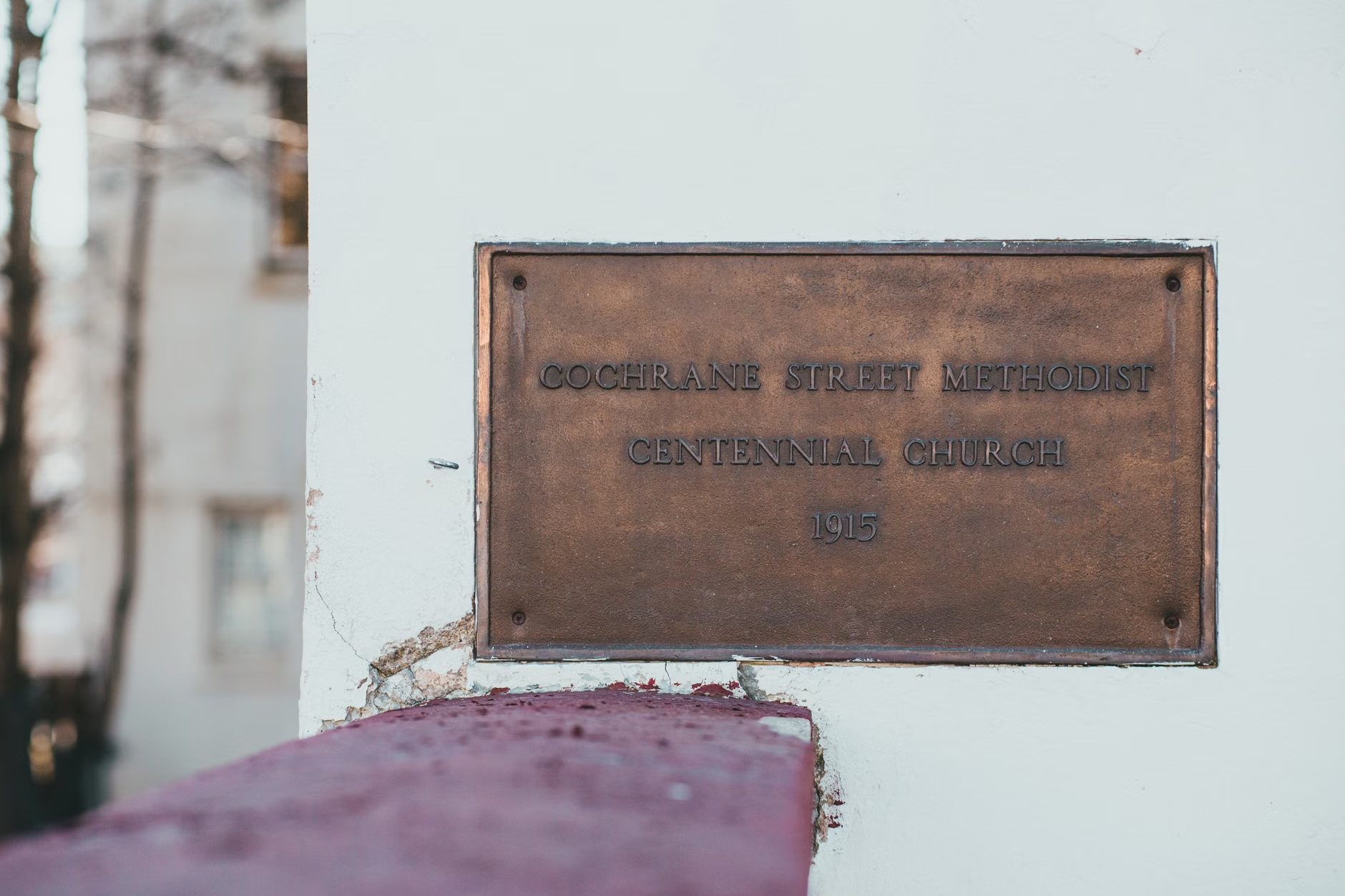
- An old cornerstone with a date etched in it.
- A building that clearly changed its function (e.g., a church turned into an apartment complex).
- A local park with a plaque explaining its namesake.
Having these three anchors gives your walk a narrative arc: Beginning, Middle, and End.
Step 3: The “What If” Game
To keep children engaged, use the “What If” prompt. “What if we were here in 1950? What would this store sell?” Encourage them to look for clues—old brickwork, ghost signs (faded advertisements painted on the sides of buildings), or unusual architectural details like gargoyles or decorative ironwork.
Common Pitfalls and How to Avoid Them
Even the best-laid plans can go sideways. Here is how to handle the most common issues parents face during these walks.
The “Boredom” Trap
If your children are young, they won’t care about the historical significance of a brick wall. They care about stories. Instead of saying, “This building was constructed in 1892,” say, “Do you see that mark on the stone? That’s where a horse-drawn carriage used to park. Can you imagine a horse waiting right here while the owner bought groceries?”
The “Over-Reliance on Digital” Mistake
Don’t stare at your phone the whole time. Use your research to inform your eyes, not to replace them. The point is to be in the space. If you find yourself reading a Wikipedia page for 10 minutes, you have lost the plot. The history should be a prompt for conversation, not a lecture.
Ignoring the “Hidden” Layers
Don’t just look at the grand buildings. Some of the best history is in the infrastructure. Look at the manhole covers, the street lamps, or the curb styles. In many cities, these are stamped with the year of installation or the foundry that made them. These tiny, overlooked details connect the present infrastructure to the industrial past of your area.
Advanced Techniques: Creating Your Own “Living Map”
Once you’ve done a few walks, you might want to level up. You can create a “Living Map” of your neighborhood. This doesn’t need to be professional. It can be a simple digital map using Google My Maps, where you pin photos you’ve taken of historical markers, interesting architecture, or “ghost signs.”
This serves two purposes:
- It creates a repository of memories for your family.
- It helps you notice patterns. You might realize that all the oldest houses are on the north side of the hill, which might suggest something about the area’s original geography or flood plains.
This level of engagement transforms you from a casual walker into a local historian of your own life.
The Financial and Social Trade-offs
While hyper-local walking is essentially free, there are “hidden” costs to consider. Time is your primary investment. In a world where we are pressured to be productive, spending two hours walking in a circle might feel “unproductive.” You must consciously reframe this. This is not “wasted time”; it is “community building” and “cognitive maintenance.”
Another factor is the “gentrification lens.” When looking at historical neighborhoods, you will inevitably encounter the history of displacement and change. This is a valuable, if sometimes difficult, conversation to have with older children. It teaches them that history isn’t just about buildings; it is about people, policies, and the way cities evolve over time.
Why This Matters for Your 30s and 40s
At this stage in life, we are often caught in the “sandwich” of responsibility—caring for children and managing a career. We tend to live in a state of perpetual transition, always looking toward the next milestone. Hyper-local history walking is a practice of “anchoring.” It forces you to slow down and acknowledge that the place you are standing has a past that existed long before your current stress and will continue long after.
This is not just about “having fun on a weekend.” It is about cultivating a sense of place. When you feel rooted in your environment, you are more likely to participate in community events, support local businesses, and advocate for your neighborhood. It turns the abstract concept of “community” into something tangible.
Actionable Steps for This Weekend
- Pick a street you walk on every day.
- Visit a local library or online archive and spend 20 minutes finding one fact about that street.
- Go for a walk this weekend with the sole purpose of finding the physical evidence of that fact.
- Document it. Take a photo or keep a note.
The beauty of the hyper-local walk is that it never truly ends. There is always another street, another building, or another hidden layer to peel back. It is a hobby that grows with you, requiring nothing more than a pair of comfortable shoes and a bit of curiosity. Start small, keep it light, and don’t be afraid to let the neighborhood tell its own story.
Frequently Asked Questions
1. What if my neighborhood is very modern and doesn’t have “history”?
Every place has history. If your neighborhood is a newer development, look into what was there before. Was it farmland? A factory? A forest? Researching the “pre-development” history of your land can be just as fascinating as looking at old architecture. Check local government planning archives or historical aerial photography sites to see the land transformation.
2. How do I keep my kids interested in a walk that isn’t a playground trip?
Turn it into a game of “detective.” Give them a specific mission: “Find the oldest date on a building,” or “Find three things that look like they belong in the past.” When children feel they have a role to play, they are much more engaged. Also, tie the walk to a reward, like stopping for a specific treat at a local bakery you pass along the way.
3. Are there any apps that help with this type of exploration?
Yes, but use them as supplements. HistoryPin allows users to pin historical photos to specific locations, and many cities have their own “Heritage Trail” apps. However, these are often curated by tourism boards. For a truly hyper-local experience, combining your own research from local archives with a simple map app will always yield more interesting and personal results than a generic “top 10” list app.
For further research on local history techniques, visit the National Archives (US) for general methodology or your specific national library’s digital collections portal.