The single most common reason children struggle to focus during home-schooling isn’t lack of motivation or curriculum difficulty—it is a sensory environment that constantly triggers their nervous system to multitask.
- Sensory Load is Cumulative: A space that feels “fine” for 10 minutes can become overwhelming after an hour because the brain cannot filter out persistent background stimuli like humming appliances or visual clutter.
- The 3-Zone Rule: You must separate your physical space into “Deep Focus,” “Active Learning,” and “Restorative” zones to prevent sensory crossover that kills productivity.
- Audit, Don’t Just Declutter: A clean room isn’t necessarily a sensory-neutral room; you must evaluate light temperature, auditory consistency, and ergonomic tactile feedback to truly lower the cognitive load.
If you have ever found yourself saying, “I don’t understand why they can’t just finish this math worksheet,” you might be looking at the wrong variable. We often treat home-schooling like a miniature version of a classroom, but in a classroom, the environment is professionally engineered to be “boring” in all the right ways. Your kitchen table, by contrast, is a sensory battlefield.
It is where you eat, where you pay bills, where the refrigerator hums, and where the light shifts from morning sun to overhead glare. Your child is fighting a constant, silent battle against these inputs. A sensory audit is the process of identifying these hidden drains on their cognitive battery.
What is a Sensory Audit and Why Does It Matter?
A sensory audit is a deliberate, step-by-step assessment of your learning space through the lens of the five primary senses. For a child in their developmental years, the brain is constantly scanning the environment for threats or interesting distractions. When you introduce complex academic tasks, the brain is already operating at high capacity.
If the environment is “noisy”—not just auditorily, but visually and tactilely—the child’s brain has to allocate a significant portion of its processing power just to ignore the environment. This is known as Cognitive Load Theory. When the sensory load is too high, there is simply no “RAM” left for algebra or history.
Why does this matter for parents in their 30s and 40s? Because you are likely juggling your own remote work or household management. You need your child to be self-regulated. By lowering the sensory input, you aren’t just making them “happier”; you are physically changing their brain’s ability to enter a flow state.
Step 1: The Visual Audit (The “Clutter-Stress” Factor)
Visual noise is the most overlooked distraction. We often think “organized” means “everything is in a drawer,” but even closed drawers can create visual anxiety if they are overstuffed or if the room is filled with too many competing colors and textures.
The Diagnosis: Look at your child’s desk from their eye level. What do they see? If they see a wall covered in posters, a window with shifting shadows, and a bookshelf with hundreds of titles, they are staring at a “visual buffet” that their brain wants to explore instead of their book.
The Fix:
- The 180-Degree Rule: If they are facing a wall, ensure that wall is a neutral color or covered by a single, solid-colored partition.
- Limit the “Active” Items: Only the materials for the current subject should be on the desk. Everything else goes into a “closed-storage” bin out of their sight.
- Lighting Consistency: Avoid “flickering” light sources. If you use LED bulbs, ensure they are high-quality, flicker-free, and set to a “cool” white (around 4000K-5000K) for active work, and “warm” (2700K-3000K) only for reading or relaxation.
Step 2: The Auditory Audit (The Hidden Hum)
We often assume that silence is the best environment for learning. In reality, unpredictable noise is the enemy. A silent room is fine, but a room with the “white noise” of a refrigerator, a neighbor’s lawnmower, or the distant sound of a television in another room is actually more distracting than a controlled sound environment.
The Common Mistake: Many parents try to “fix” noise by playing music. However, music with lyrics or complex rhythms forces the language center of the brain to stay active. This is a massive drain on focus.
The Action Plan:
- The “Hum” Test: Spend three minutes in your child’s chair with your eyes closed. What sounds do you hear? If you hear a mechanical hum, that is a constant sensory stressor.
- Introduce “Brown Noise”: Unlike white noise (which can be harsh), brown noise is deeper and more soothing. It acts as a “sonic blanket” that hides the unpredictable sounds of the house.
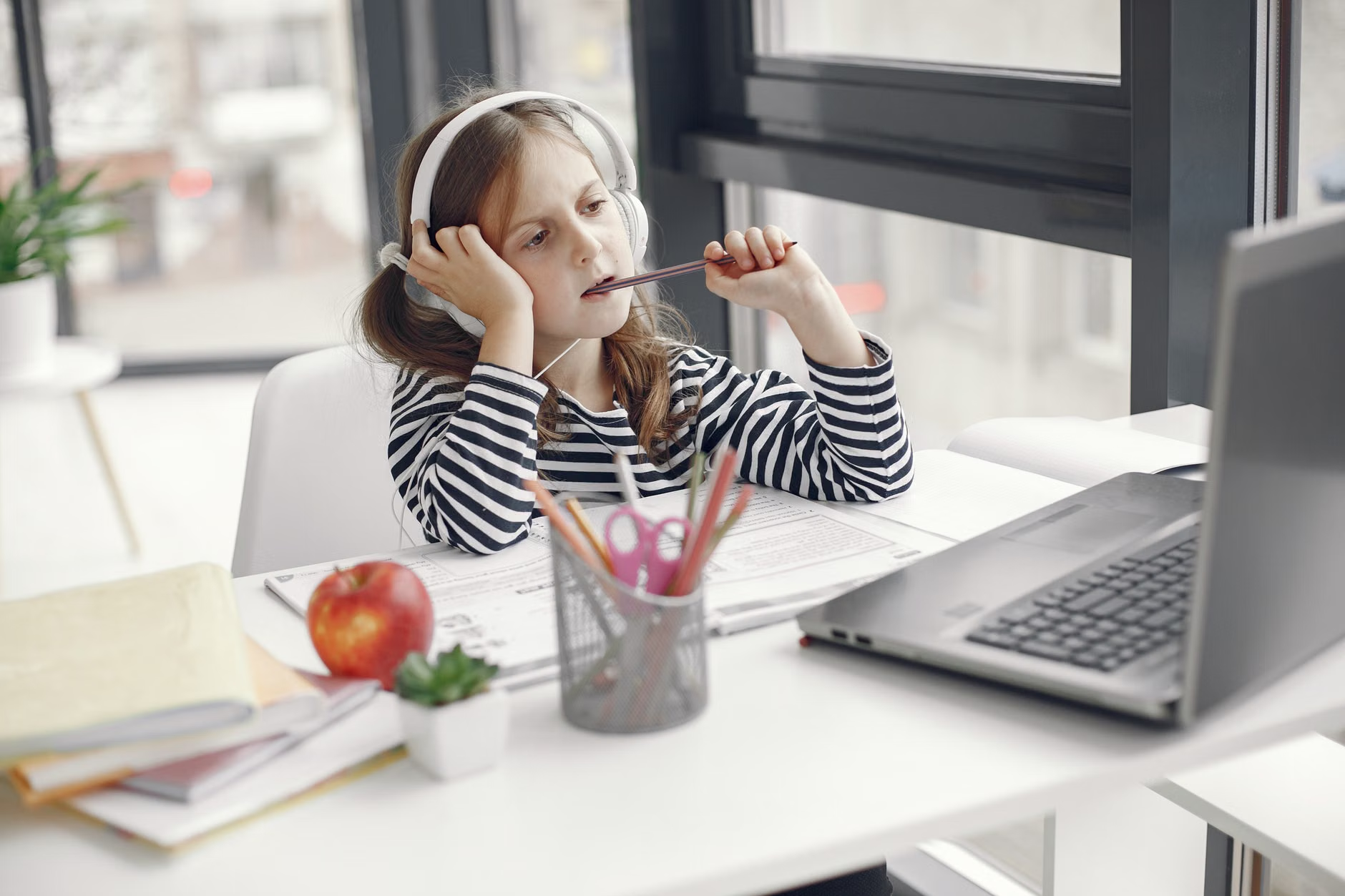
- Noise-Canceling Gear: If your home is naturally noisy, invest in high-quality, passive noise-isolating headphones. They don’t need to play music; the goal is to lower the decibel level of the environment.
Step 3: The Tactile and Ergonomic Audit
If a child is physically uncomfortable, their brain will prioritize “survival” (adjusting their body) over “cognition” (learning the material). We often see children “fidgeting,” but what we are actually seeing is a sensory-seeking behavior to compensate for poor ergonomics.
The Decision Criteria:
| Symptom | Likely Sensory Cause | Action |
|---|---|---|
| Slouching/Slumping | Lack of core support | Use a footrest so feet are flat; ensure chair height allows 90-degree elbows. |
| Constant Fidgeting | Need for tactile input | Introduce a “fidget tool” that is quiet and non-visual (e.g., a stress ball). |
| Avoiding writing | Poor pencil grip/pressure | Check if the pencil is too thin or the surface is too hard; try a foam grip. |
When you evaluate these, remember that the goal is to make the environment “invisible.” If they are thinking about how their chair feels, they aren’t thinking about their lesson.
The “Zone” Philosophy: Why One Desk Isn’t Enough
One of the biggest mistakes in home-schooling is the “all-in-one” desk. If a child does their creative writing, their difficult math, and their snack time at the exact same physical spot, the brain loses its ability to “switch modes.”
The brain relies on environmental cues to signal what type of work is happening. If you want a child to focus, you need to create a Deep Focus Zone. This should be as stripped-down as possible. No toys, no snacks, no decor. When they move to this space, the brain understands: “This is for output.”
Conversely, create an Active Learning Zone (perhaps a standing desk or a different corner) for tasks like reading, audio lessons, or research. This separation of “space” equals a separation of “effort.”
Common Pitfalls and How to Pivot
Many parents fear that by making the environment “sensory-neutral,” they are making it “sterile” or “boring.” This is a misconception. Boring is good for focus. You can add the “fun” back in during break times or in the “Restorative Zone.”
A major hidden cost of a poorly audited space is Decision Fatigue. Every time your child looks at a pile of markers on their desk, they are making a micro-decision: “Should I use those? No, I should do math. But those markers are cool.” That tiny friction adds up to a massive loss of energy by the end of the morning.
The “End-of-Day Reset”: The most important ritual you can implement is the five-minute reset. At the end of the school day, the environment must be cleared. If you leave the “clutter” of the day out, the child wakes up the next morning to a space that is already demanding their attention.
The Role of Lighting: More Than Just Visibility
Lighting is the most powerful tool in your sensory-audit kit, yet it is the least understood. The color temperature of light (measured in Kelvin) affects the secretion of melatonin and cortisol. For active learning, you want to mimic the “cool” light of midday, which keeps the brain alert. For creative, reflective work, a warmer light can be more conducive to “big-picture” thinking.
If you are using a standard room lamp, consider swapping the bulb for a smart bulb that allows you to change the temperature. This is a low-cost, high-impact change. During a difficult math unit, shift the light to a crisp white. During a literature session, shift it to a soft, warm glow. This subtle environmental shift acts as a Pavlovian cue for the brain to change gears.
Practical Next Steps for Your Audit
Start by doing a “Sensory Walkthrough” this weekend. Do not move furniture yet. Just walk through the space with a notepad. Write down every light source, every sound, and every item that catches your eye. Ask your child to do the same. You will be surprised by what they find distracting. They might point to a ticking clock you stopped hearing years ago, or a specific smell from the kitchen that makes them hungry.
Once you have your list, prioritize the “high-impact” items. Noise is usually the highest priority, followed by lighting, then visual clutter. Do not try to change everything at once. Pick one area to “audit” each week.
Finally, remember that this is an iterative process. What works for your child in September might not work in January as their needs evolve. A sensory audit is not a one-time project; it is a maintenance routine. By taking control of the environment, you are giving your child the greatest gift of all: the ability to focus in a world that is constantly trying to pull them away.
Frequently Asked Questions
1. Does this mean I need to strip the room of all personality?
Not at all. The goal is to separate “focus” from “personality.” Keep the posters, art, and personal items in a dedicated “Restorative Zone” or a different part of the room that is out of their direct line of sight when they are working. You can have a cozy, personal space without it being a distraction during study hours.
2. What if we only have one room for everything?
If you live in a small space, use “portable sensory boundaries.” This can be as simple as a folding screen, a desk mat that is only brought out during school time, or even a specific chair that is only used for lessons. The key is that the “schooling” objects must be put away when the work is done to signal to the brain that the sensory load is over.
3. How do I know if the sensory audit is working?
The most objective measure is the “Time-to-Task” duration. If it currently takes your child 15 minutes to settle into a task, and after your audit it takes 5 minutes, you have succeeded. Also, monitor their frustration levels. A successful sensory audit should result in fewer “I can’t do this” moments, as the child’s brain has more capacity to handle the actual academic challenge.
Further Reading and Official Resources:
For more on the science of environment and learning, refer to the Journal of Environmental Psychology regarding classroom design and cognitive load. You can also explore resources from the International Society for Technology in Education (ISTE) for best practices in creating modern, flexible learning environments. Always cross-reference advice with your child’s specific educational needs if they have a formal diagnosis like ADHD or sensory processing sensitivities.