The most effective way to stop constant sibling bickering is to stop acting as the judge and start acting as the facilitator, shifting the responsibility of conflict resolution from your shoulders to theirs.
- The Mediator Shift: Stop assigning blame; instead, use the Sibling-Mediation Conflict Matrix to guide children through identifying their own needs and compromises.
- The 2×2 Framework: Categorize conflicts by ‘Urgency’ and ‘Impact’ to decide when to intervene, when to coach, and when to let them resolve it independently.
- Sustainable Habits: By teaching children the “I-Message” and “Negotiation Loop,” you reduce your daily refereeing duties by up to 70% within three months.
If you have more than one child, you likely know the specific, high-pitched sound of a sibling dispute escalating in the other room. It usually starts with a minor disagreement over a toy, evolves into a shout about fairness, and ends with you being summoned to render a verdict. In your 30s and 40s, balancing professional responsibilities, household management, and personal well-being, this cycle isn’t just annoying—it’s a major drain on your limited cognitive bandwidth.
The problem isn’t that they are fighting; fighting is a natural, albeit exhausting, part of social development. The problem is that we, as parents, often default to the “judge” role. We listen to both sides, weigh the evidence, and issue a ruling. While this stops the immediate noise, it teaches your children absolutely nothing about how to resolve their own differences. In fact, it often makes them more reliant on you to solve their problems, creating a perpetual cycle of dependency.
Understanding the Sibling-Mediation Conflict Matrix

The Sibling-Mediation Conflict Matrix is a decision-making tool designed to help you categorize conflicts and determine your level of involvement. It moves you away from the “knee-jerk reaction” of punishing or arbitrating. The matrix is built on two axes: Impact (the severity of the issue) and Capacity (the children’s ability to handle the situation themselves).
When a fight breaks out, you don’t need to jump in immediately. Instead, take five seconds to plot the conflict on the matrix. This brief pause is your most powerful tool. It changes your energy from reactive to intentional. By observing first, you allow the children the space to potentially self-correct—a skill they will need throughout their adult lives.
The matrix functions by asking: Does this require immediate emergency intervention (like physical safety), or is this a social-emotional learning opportunity? Most conflicts in the home fall into the latter category, yet we treat them like the former. Let’s break down how this looks in practice.
Quadrant 1: High Impact, Low Capacity (The Intervention Zone)
This is where physical safety is at risk. If someone is being hurt, or if the conflict involves a power imbalance that is causing significant psychological distress, you must step in. This is not the time for negotiation; this is the time for de-escalation. Your primary goal here is to restore physical safety and calm the nervous system of everyone involved. You aren’t “judging” here; you are “securing.”
Quadrant 2: Low Impact, Low Capacity (The Coaching Zone)
This is the “sweet spot” for growth. Your children are arguing over a shared screen or a specific toy, but everyone is safe. They don’t have the emotional regulation skills to solve it alone yet. Your role is to sit nearby—not between them—and offer prompts. You are the coach on the sidelines, not the player on the field. You ask questions that force them to look at each other, not at you.
Quadrant 3: High Impact, High Capacity (The Facilitation Zone)
When the stakes are high, but your children have matured enough to handle the conversation, your role is to facilitate a formal negotiation. You provide the structure—the “how”—while they provide the content—the “what.” This might be about shared space, chores, or long-term resource allocation. You act as the record-keeper or the time-keeper, ensuring both sides feel heard without you taking a side.
Quadrant 4: Low Impact, High Capacity (The Observation Zone)
This is the ultimate goal. The children are bickering about something minor, and they have the capability to resolve it. Do nothing. Literally. Go to another room. If you intervene here, you are actually preventing them from practicing the very skills they need. Your presence, even as a mediator, can sometimes be an incentive for them to “perform” their grievance for your benefit.
Implementing the Strategy: A Step-by-Step Guide
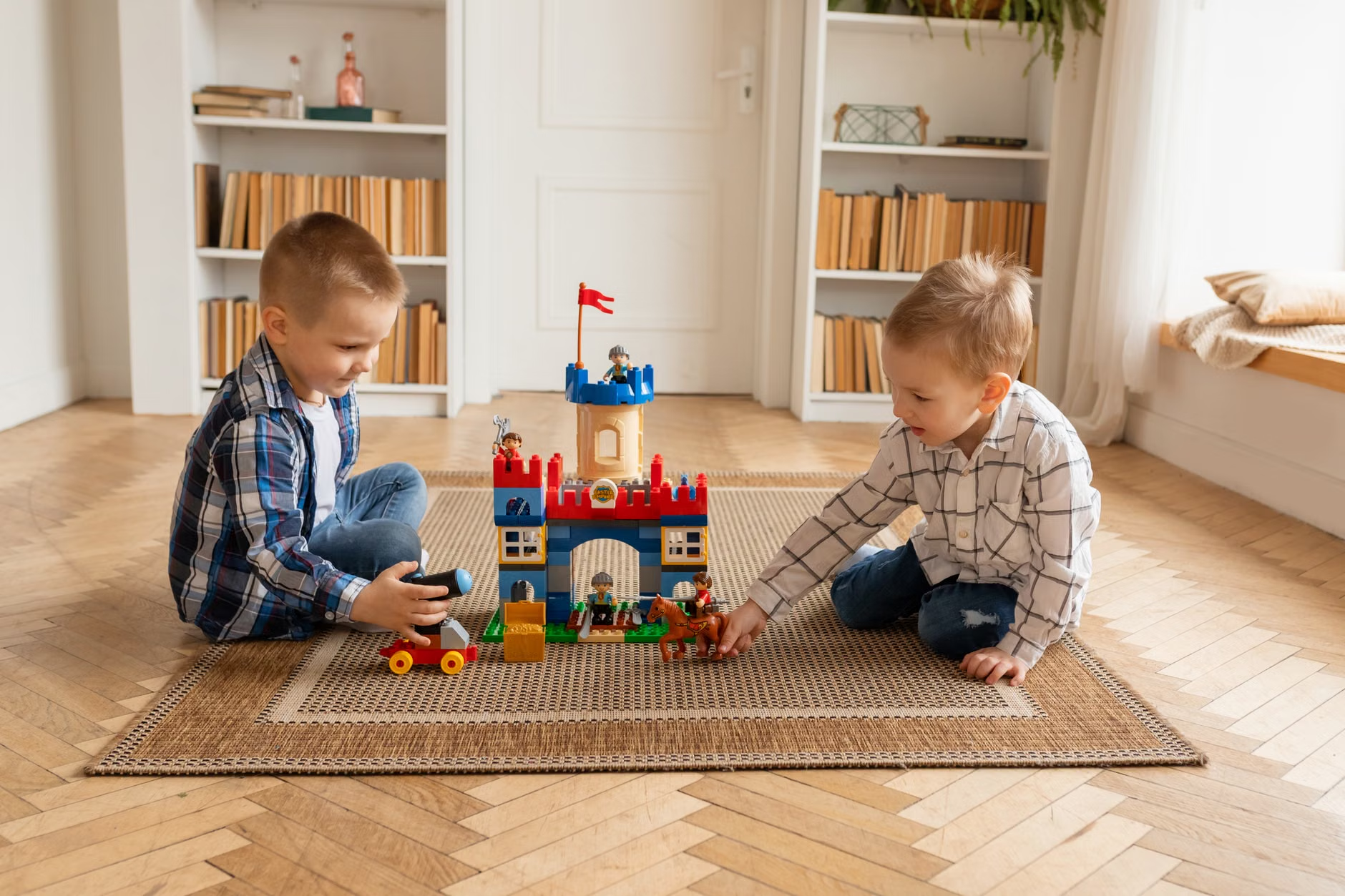
Transitioning to this model requires a change in your own communication habits. When you do enter a conflict, stop asking “Who started it?” or “What happened?” These questions immediately put the children in defensive positions. Instead, use these steps to facilitate resolution.
- The Neutral Reset: Get down to their eye level. Do not loom over them. Use a calm, low-pitched voice. The goal is to lower the temperature, not to increase the intensity.
- The “I-Message” Prompt: Ask each child to state their need using an “I” statement. For example, “I feel frustrated when the building blocks are taken away because I was in the middle of my tower.” This shifts the focus from attacking the other person to expressing a personal need.
- The Needs Assessment: Once both sides have spoken, ask, “What is the goal here?” Often, you will find that the conflict isn’t actually about the toy, but about a deeper desire for attention or autonomy.
- The Collaborative Solution: Do not offer the solution. Ask, “What are three ways you two can solve this so you both feel okay?” If they say “I don’t know,” give them options: “Could you take turns, could you set a timer, or could you find a different way to play together?”
The most common mistake parents make is forcing an immediate compromise that feels “fair” to us but doesn’t feel fair to them. If you impose a 10-minute timer, but the child doesn’t agree with that timeline, they will simply wait for you to leave before starting the fight again. The solution must be owned by them to be effective.
The Hidden Variables of Sibling Dynamics
In your 30s and 40s, it is easy to view sibling rivalry as a nuisance. However, research in child development suggests that these conflicts are actually the primary training ground for social negotiation. According to studies on sibling relationships, children who are guided through conflict resolution rather than just punished for it develop better empathy and perspective-taking skills as they enter adolescence.
One overlooked variable is the “parental projection” factor. We often react to sibling fights based on our own childhood experiences. If you were the younger sibling who always felt overshadowed, you might instinctively protect the younger child. If you were the older one who was forced to be “the responsible one,” you might be harsher on your eldest. Recognizing these biases is essential. Ask yourself: “Am I reacting to what is happening right now, or am I reacting to a memory from my own childhood?”
Another hidden cost of constant intervention is the “victim-aggressor” label. When we consistently intervene, we accidentally cement these roles. One child becomes “the bully” and the other “the victim.” This label can follow them for years, affecting their self-esteem and how they interact with peers at school. By using the Sibling-Mediation Conflict Matrix, you remain neutral, preventing these labels from taking root.
Comparison of Mediation Styles
To help you decide which approach is best for your family’s current needs, consider the following table. Not every conflict requires the same level of energy.
| Mediation Style | When to Use | Parental Effort | Long-term Outcome |
|---|---|---|---|
| The Arbitrator | Physical danger or extreme exhaustion. | High | Low. Creates dependency. |
| The Coach | Non-violent, recurring disagreements. | Moderate | High. Builds skills. |
| The Observer | Low-stakes, minor bickering. | None | Highest. Builds independence. |
The “Arbitrator” style should be your absolute last resort. If you find yourself in this column more than 20% of the time, it is time to pivot to the “Coach” style. The goal is to move your children towards the “Observer” category, where they can manage their own social climate.
Addressing Common Misconceptions
One common misconception is that “non-intervention” means “indifference.” This is false. There is a world of difference between ignoring your children and consciously deciding to give them space. If you ignore them, you are signaling that you don’t care. If you observe them, you are signaling that you trust them. The difference is in your body language and your follow-up.
Another misconception is that mediation must happen in the moment. It doesn’t. If the conflict was intense and you are too frustrated to mediate effectively, it is perfectly acceptable to say: “We are all too upset to talk about this right now. We will discuss this at dinner.” This gives everyone a chance to regulate their emotions. A cool-down period is not a failure; it is a strategic pause.
Finally, avoid the “fairness trap.” We often think that fairness means equality—everyone gets the same thing. But in reality, fairness is about meeting individual needs. One child might need more quiet time, while another might need more physical activity. Treating them exactly the same often leads to more resentment because it ignores their unique developmental stages and temperaments.
Creating a Sustainable Environment

To make the Sibling-Mediation Conflict Matrix part of your household culture, start by introducing the concept during a “calm time”—not during a fight. Explain the matrix to your children. Use a physical piece of paper and draw the four quadrants. Ask them, “When do you think I should step in, and when do you think you can handle it?”
Children are often surprisingly self-aware when they aren’t in the heat of a conflict. They might tell you, “I want you to help when he breaks my stuff, but I don’t want you to help when we are just arguing about the TV remote.” This conversation builds trust and sets clear expectations for your future interactions.
Consistency is key. If you decide that you are going to move into the “Observer” zone for a specific type of conflict, you must stay there. If you break your own rule because the noise becomes too much, your children will quickly learn that they just need to escalate the noise level to get you to intervene. This is a classic “intermittent reinforcement” trap that keeps the bad behavior alive.
Refining Your Approach: Troubleshooting Edge Cases
What if one child is consistently the “instigator”? It is tempting to label them as such, but consider the underlying cause. Is this child seeking connection? Are they bored? Do they struggle with self-regulation? Instead of focusing on the behavior, focus on the need. Often, the “instigator” is the child who feels the least connected to the family dynamic at that moment.
What if the children are at drastically different ages? The matrix still applies, but your “coaching” will look different. For a toddler, coaching involves physical redirection. For a pre-teen, it involves Socratic questioning. Never expect the older child to “just be the bigger person.” This is a fast track to resentment. Treat them as individuals with their own distinct needs, regardless of their birth order.
If you find that the conflicts are happening at the same time every day—like before school or right before dinner—this is a systemic issue, not a behavioral one. The “hangry” factor or the “transition stress” factor is likely the real culprit. In these cases, the solution isn’t mediation; it’s changing the schedule or ensuring they have a snack. Solve the system, and you’ll solve the conflict.
Practical Next Steps for Your Family
You don’t need to change everything overnight. Start by observing your reactions for one week. Keep a simple tally: How many times did you act as the “Judge” versus the “Coach”? The data might surprise you. Once you have a baseline, try to reduce your “Judge” interventions by one each day.
Remember that your goal isn’t to eliminate conflict. Conflict is a healthy part of growing up. Your goal is to change the nature of the conflict from a destructive power struggle into a constructive learning experience. By using the Sibling-Mediation Conflict Matrix, you are giving your children the tools to negotiate, empathize, and compromise—skills that will serve them far better than knowing who “won” the argument over a toy.
Be patient with yourself. You are unlearning years of reactive parenting. There will be days when you jump in too quickly, and there will be days when you stay out too long. That’s okay. The goal is progress, not perfection. Keep the matrix in mind, keep your cool, and keep the focus on building their long-term social competence.
For more deep dives on child development and conflict resolution, you can refer to resources from organizations like the American Psychological Association on healthy sibling dynamics or the ZERO TO THREE network for age-appropriate behavioral expectations.
Frequently Asked Questions
1. What if my children are physically fighting? Does the matrix still apply?
Yes, but it moves immediately to the “Intervention Zone.” Physical safety is the priority. Once everyone is safe and calm, you can move to the “Coaching Zone” to discuss what led to the physical altercation and how to handle those emotions differently next time.
2. Should I treat all my children the same when mediating?
No. Fairness does not mean sameness. Your mediation should be tailored to each child’s developmental level, temperament, and the specific needs they are expressing in that moment. Treating them differently is often the most “fair” approach.
3. How long does it take for this approach to show results?
If you are consistent, you can expect to see a shift in your children’s ability to self-regulate within 4 to 8 weeks. Remember that the goal is not to stop the fighting entirely, but to change how they handle it when it happens.
The path to a calmer household starts with the decision to step back. By becoming a facilitator rather than a judge, you aren’t just buying yourself some peace and quiet; you are giving your children the ultimate toolkit for their future relationships. Take a deep breath, trust the process, and let them find their way.