The most effective way to reclaim your mental clarity over the weekend is not to simply “put the phone away,” but to replace the dopamine-loop of digital consumption with high-friction, low-stimulation analog activities.
- Replace, don’t just subtract: You cannot successfully “do nothing” on a screen-free weekend; you must have a pre-planned physical activity to replace the urge to scroll.
- The “Friction” Rule: Place your devices in a locked drawer or a dedicated charging station in a different room to increase the physical effort required to check them, which reduces impulsive usage.
- Batch your digital life: If you must check work emails or logistics, do it in one 30-minute block at a designated time, rather than letting “checking” permeate the entire 48-hour period.
If you are in your 30s or 40s, you likely remember a time before the constant ping of notifications. Yet, today, the boundary between “being a parent,” “managing a home,” and “staying connected to the world” has vanished. You might find yourself standing in a park with your child, but instead of watching them climb, you are reflexively checking an email or doom-scrolling through news headlines. This isn’t a failure of willpower; it is a response to how these devices are engineered.
Why the “Digital Default” is Hurting Your Ability to Recharge
The human brain, especially one juggling the cognitive load of a 30-something professional and parent, requires “default mode network” (DMN) activation to truly rest. When you are scrolling—even if you are just looking at “relaxing” content—your brain is in a state of high-alert processing. You are constantly evaluating information, reacting to social cues, or processing work-related triggers. This prevents the neurological “reset” that a weekend is supposed to provide.
Research from the Journal of Social and Clinical Psychology has consistently shown that limiting social media usage to 30 minutes a day leads to significant reductions in loneliness and depression. For a parent, this is critical. If your brain is constantly split between the physical reality of a messy kitchen or a child’s tantrum and the digital reality of curated social media lives or work Slack channels, you are never fully present in either.
The “Analog-Weekend” isn’t about being a Luddite. It is about creating a deliberate, high-contrast environment where your brain can move from the “active-processing” state required by your job to the “receptive-restorative” state required for long-term health. The goal is to lower your cortisol levels by reducing the number of micro-decisions you make about incoming digital information.

Step-by-Step: Implementing the Protocol
To make this stick, you need a protocol, not a vague intention. If you just tell yourself “I’ll use my phone less,” you will inevitably fail because the phone is the path of least resistance. You need to build a system of “digital friction.”
Step 1: The Friday Evening “Shutdown” Ritual
Friday at 6:00 PM is your hard deadline. Your work devices—laptop, tablet, work-phone—should be physically placed in a bag or drawer. If you use your primary phone for both work and personal life, delete your email and work messaging apps from your home screen, or use “Focus Modes” (on iOS or Android) to completely silence work notifications until Monday morning.
Step 2: The Physical “Charging Station”
Create a dedicated space in your home, preferably not in the bedroom or living room, where all devices live for the weekend. This is their home. When you are not using them for a specific, time-bound task (like looking up a recipe or a map), they stay there. This creates physical distance between you and the stimulus.
Step 3: Pre-loading your “Analog Queue”
The biggest mistake people make during a detox is not having a replacement activity. When you reach for your phone out of boredom, your brain is looking for a hit of novelty. If you don’t have an alternative, you will return to the phone. Build a “queue” on Thursday night:
- Physical Media: Have a book or magazine ready on the coffee table.
- Projects: Have a physical task waiting (e.g., a craft, home repair, or organizing a drawer).
- Movement: Know exactly where you are going for a walk or a bike ride, and check the weather beforehand so you don’t need the phone to “check the forecast” later.
The Economics of Attention: Why Your Time is a Finite Resource
In our 30s and 40s, we often treat our time as an infinite resource that can be multi-tasked. We watch a show while scrolling, or we “listen” to our kids while checking a notification. This is cognitive fragmentation. Every time you switch your attention, you pay a “switching cost.”
Consider the following comparison of weekend energy states:
| Activity | Cognitive Load | Restorative Potential |
|---|---|---|
| Doom-scrolling/Social Media | High | Zero |
| Passive TV/Streaming | Moderate | Low |
| Analog Hobby (Reading/Crafting) | Low (Flow State) | High |
| Physical Exercise (No screen) | Low/Moderate | High |
The table above illustrates a fundamental truth: not all leisure is equal. If you spend your Saturday “relaxing” by scrolling, you are not resting. You are engaging in low-value, high-stimulation work. The “Analog-Weekend” forces you into the bottom two categories of the table, which are the only ones that actually allow the prefrontal cortex to recover from the stresses of the work week.

Common Pitfalls and How to Overcome Them
The most common reason people abandon a detox is the “fear of missing out” or the anxiety that something urgent will happen. Here is how to handle those edge cases:
The “Emergency” Fallacy
We often keep our phones on us because “what if there’s an emergency?” This is a cognitive bias. Most emergencies do not require your immediate digital intervention. If you are worried, tell your inner circle (spouse, parents, babysitter) that you are going “offline” and provide them with a landline or a secondary way to reach you if something truly critical occurs. You will find that 99% of your notifications are not emergencies.
The “I Need My Phone for Maps” Problem
If you are going out for a day trip, you clearly need navigation. The solution is to use the phone as a tool, not an entertainment device. Load the map before you leave the house, turn on the navigation, and then put the phone in your bag. Do not carry it in your hand. If you need to stop for coffee, stop at a place you see, rather than checking Google Reviews for the “highest-rated” one. Embrace the serendipity of the analog world.
The “Boredom” Threshold
The first few hours of an Analog-Weekend are always the hardest. You will feel an itch in your pocket. You will feel a phantom vibration. This is the physiological withdrawal from dopamine. Do not give in. The boredom you feel is the sound of your brain trying to reorganize itself. If you push through the first two hours, the rest of the weekend usually becomes significantly more peaceful.
The Role of Family Dynamics
If you have children, the Analog-Weekend is a gift, not a punishment. Children are hyper-attuned to our attention. When we are on our phones, they know it. They may act out to try to reclaim our focus. By implementing a “no-phone” rule for the family during certain hours (like meal times or park visits), you are not just helping yourself; you are modeling a healthier relationship with technology for your children.
Start small. Don’t try to go from 0 to 100. Start with “Saturday Morning Analog.” From 8:00 AM to 12:00 PM, no one in the house touches a screen. Make breakfast together, go to the park, or read books. Once you see the difference in the quality of your family interactions, the “Analog-Weekend” will stop feeling like a restriction and start feeling like a luxury.
Strategic Planning for the Week Ahead
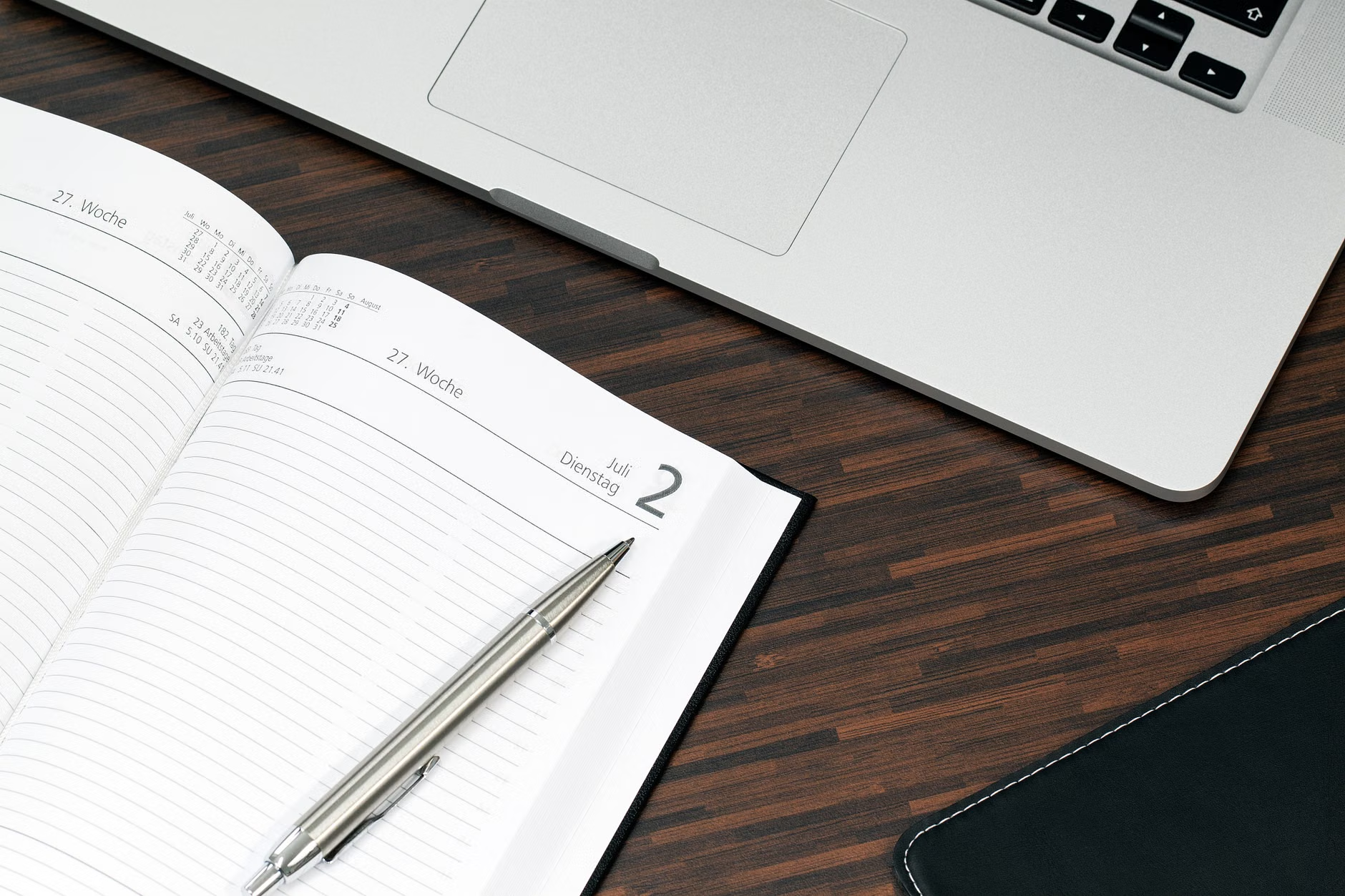
The weekend starts on Thursday. If you wait until Saturday morning to decide what to do, you will end up back on your phone because you are bored and unprepared. Use a physical planner. Write down one major goal for the weekend that involves zero screens. It could be something as simple as “Finish reading Chapter 5” or “Plant the herbs in the garden.”
When you have a concrete, physical objective, you have a reason to stay off the screen. If you have nothing to do, the vacuum will be filled by the screen. It is a law of physics for the modern age. If you want to change your weekend, you must change your preparation.
Advanced Tactics: The “Weekend-Only” Device
For those who find it impossible to leave their phone behind (perhaps due to being on-call or needing it for family logistics), consider a “Weekend Phone.” This is a cheap, older smartphone with no social media, no email, and no browser. It only has phone and text capabilities. You can forward your calls to this device and leave your “real” phone in a locked cabinet. This is the ultimate “friction” strategy. It ensures you are reachable for emergencies but completely disables the distraction loop.
Another tactic is the “Scheduled Sync.” If you have a hobby that requires a phone—like photography—set a rule that you will only use the phone for that specific task, and you will “sync” your photos to the cloud only at a set time on Sunday evening. This creates a boundary around the tool, turning it back into a servant rather than a master.
The Hidden Cost of “Always-On”
We need to talk about the “hidden cost” of being always-on. It’s not just about losing time; it’s about losing the capacity for deep thought. In your 30s and 40s, you are likely in the most productive years of your career. Deep, uninterrupted work is the currency of your success. If your brain is constantly being fragmented by weekend digital noise, you are not actually resting; you are effectively training your brain to be distractible. By reclaiming your weekend, you are not just getting “rest”—you are actively training your capacity to focus, which will pay dividends in your work life come Monday morning.
The science of “Attention Restoration Theory” (ART) suggests that environments with “soft fascination”—like nature, art, or quiet contemplation—allow the brain to recover its attention resources. Digital screens, conversely, are designed for “hard fascination.” They demand your attention through movement, notifications, and algorithm-driven content. They are the antithesis of restoration. If you want to be more productive, more creative, and more present, you must spend more time in environments of soft fascination.
Final Recommendations for Implementation
To succeed, do not aim for perfection. If you slip up and check a notification, don’t abandon the entire protocol. Simply put the phone back in its place and return to your activity. The goal is not a “pure” analog experience, but a significant reduction in digital noise.
Start this weekend. Choose one block of time—perhaps Saturday morning—to be completely analog. Prepare your environment, inform your family, and lean into the boredom. You will find that the quiet you discover is not empty; it is full of the clarity you didn’t know you were missing. Your brain is a tool that needs maintenance. Give it the weekend off.
For further reading on the impact of digital media on the brain, consult official resources from organizations like the American Psychological Association regarding the impact of technology on mental health and focus.
Frequently Asked Questions
1. What if I feel anxious about not checking my messages?
Anxiety is a common symptom of digital withdrawal. Remind yourself that you have set an expectation with your contacts that you are offline. If the anxiety persists, write down the specific fear (e.g., “I might miss a work email”). Then, look at the reality: is there anything you could actually do about that email on a Saturday? If not, the anxiety is merely a habit, not a necessity. The feeling will pass once you engage in a physical task.
2. How do I handle the “I need my phone for the camera” dilemma?
This is a classic trap. If you find yourself taking 50 photos of your kids and then checking notifications, you are using the camera as an excuse to be on the phone. Consider buying a dedicated digital camera or a film camera for the weekend. If you must use your phone, turn on “Airplane Mode” before you start taking photos. This prevents notifications from popping up and pulling you into the digital void.
3. Is an Analog-Weekend realistic for someone with a high-pressure job?
It is more realistic for you than for anyone else. High-pressure jobs require high-functioning cognitive resources. If you never disconnect, your “baseline” stress level rises, and your ability to handle that pressure actually decreases. Treat your Analog-Weekend as a “performance maintenance” protocol. You are not “taking time off”; you are “servicing the engine” so that you can continue to perform at a high level during the week.
Note: This content is for informational purposes and does not constitute medical or psychological advice. If you are experiencing severe digital addiction or mental health distress, please consult a qualified healthcare professional.