The most important takeaway for any parent is that “brain training” games are not a magic bullet for academic success, but they can function as a useful, low-stakes practice ground for developing self-regulation, working memory, and cognitive flexibility—provided you choose the right ones and participate alongside your child.
- The “Near Transfer” Trap: Most games only improve performance in that specific game; look for activities that mirror real-world habits like planning, organizing, and emotional control.
- The Social Factor: Research suggests that children derive more cognitive benefit from games played with a caregiver or peer than from solitary screen time.
- Consistency over Intensity: Short, 15-minute bursts of focused gameplay are significantly more effective for neuroplasticity than long, exhaustive sessions that lead to burnout.
If you have ever spent a Tuesday evening trying to convince your seven-year-old to finish their homework instead of staring at the wall, you have encountered the mystery of executive function. It is that invisible set of mental processes—like a CEO in the brain—that helps us plan, focus, remember instructions, and juggle multiple tasks. You likely see it when your child struggles to follow a three-step instruction or loses their shoes for the fifth time in a week. As parents in our 30s and 40s, we are constantly bombarded with apps and educational games promising to “boost your child’s IQ” or “optimize brain development.” But does the science actually back up the marketing?
What Exactly Is Executive Functioning (And Why Is It Not Just ‘Being Good’)?
Executive function (EF) is not a single skill; it is a suite of cognitive processes that allow us to manage our behavior. Think of it as the air traffic control system of the brain. It filters out distractions, keeps information in our mental “working memory,” and allows us to switch gears when the situation changes. When your child is throwing a tantrum because they cannot find their favorite toy, they are not necessarily being “naughty”—they are experiencing an executive function bottleneck. They cannot yet regulate their emotional response or hold the goal (finding the toy) in their mind while navigating the frustration of the search.
There are three core components of executive function that experts generally agree upon:
- Working Memory: The ability to hold information in your head and use it (like remembering a phone number while you reach for a pen).
- Inhibitory Control: The ability to suppress an impulsive urge or a dominant response (like stopping yourself from grabbing a cookie before dinner).
- Cognitive Flexibility: The ability to shift perspective or adapt to new rules (like realizing your usual route to school is closed and quickly finding an alternative).
For a parent, understanding this is a game-changer. It shifts your perspective from “my child is being difficult” to “my child’s air traffic control system is still under construction.” The good news? Much like a muscle, these systems can be strengthened through repetition, challenge, and engagement.
The Promise vs. The Reality: Can You Really ‘Train’ a Brain?
We need to address the elephant in the digital room: the “brain training” industry. A decade ago, there was a gold rush of apps claiming to make children smarter. Many of these have since been debunked or faced legal scrutiny for overpromising results. The core issue is something researchers call “far transfer.” If you train a child to play a game where they tap a screen when a blue dot appears, they will get very good at tapping blue dots. They will not, however, suddenly become better at organizing their backpack or remembering to brush their teeth.
The “near transfer” is where the value lies. If a game requires a child to hold a sequence of colors in their head (working memory) or inhibit an impulse to push a button too early (inhibitory control), that is a direct exercise of the skill. To make this actually helpful for your life, you need to bridge the gap between the screen and the real world. A game that teaches a child to wait their turn is only useful if you then praise them for waiting their turn at the dinner table or during a board game.
Common Mistake: Treating these games as a “set it and forget it” babysitter. If you hand your child a tablet to play an “EF game” while you do laundry, the cognitive benefits are significantly lower than if you are involved. The “Executive Function” part of the brain is highly social. We learn to regulate ourselves by watching how others regulate themselves.
How to Select Games That Actually Build Skills
Not all games are created equal. When you are looking for an app, a board game, or an activity, look for these three markers of quality. If a game does not have these, it is likely just entertainment, not training.
| Feature | What to Look For | Why It Matters |
|---|---|---|
| Progressive Difficulty | Levels that get harder as the child succeeds. | If it is too easy, they are bored; if it is too hard, they shut down. You want the “Zone of Proximal Development.” |
| Feedback Loops | Instant, clear indicators of success or failure. | The brain needs to know exactly what it did right to reinforce the neural pathway. |
| Goal Orientation | A clear, reachable objective that requires planning. | Helps the child practice “holding the goal in mind,” which is the essence of working memory. |
If you are looking at digital apps, search for titles that emphasize “working memory training” or “impulse control” rather than generic “smart” or “brain power” branding. Look for developers who cite peer-reviewed studies. Websites like Common Sense Media are excellent for vetting these, as they provide reviews from a developmental perspective rather than a marketing one.

Integrating Executive Function Training Into Your Daily Routine
You do not need a $100 app subscription to improve your child’s executive function. In fact, some of the best training happens in the “analog” world. Here is how you can build these skills during the chaotic, everyday moments of parenting.
1. The “Wait-Time” Strategy (Inhibitory Control)
This is the most common frustration for parents. How do you get a child to stop and think before they act? Introduce “Stop-and-Think” games. When you are playing a game like “Red Light, Green Light,” you are actively training the inhibitory control system. In a digital context, look for games that have “penalty” mechanics for acting too quickly. In real life, ask your child to “count to three” before answering a question. This tiny delay builds the neural “brake” they need to control impulses.
2. The “Sequencing” Habit (Working Memory)
Children often fail to follow directions because they forget the second or third step. Practice this through “Multi-Step Missions.” Instead of saying “Go clean your room,” try “Please pick up the blocks, put them in the bin, and then bring me your dirty socks.” If they struggle, break it down: “What was the first thing? What was the second?” This forces them to consciously hold the sequence in their working memory.
3. The “Adapt-the-Rules” Method (Cognitive Flexibility)
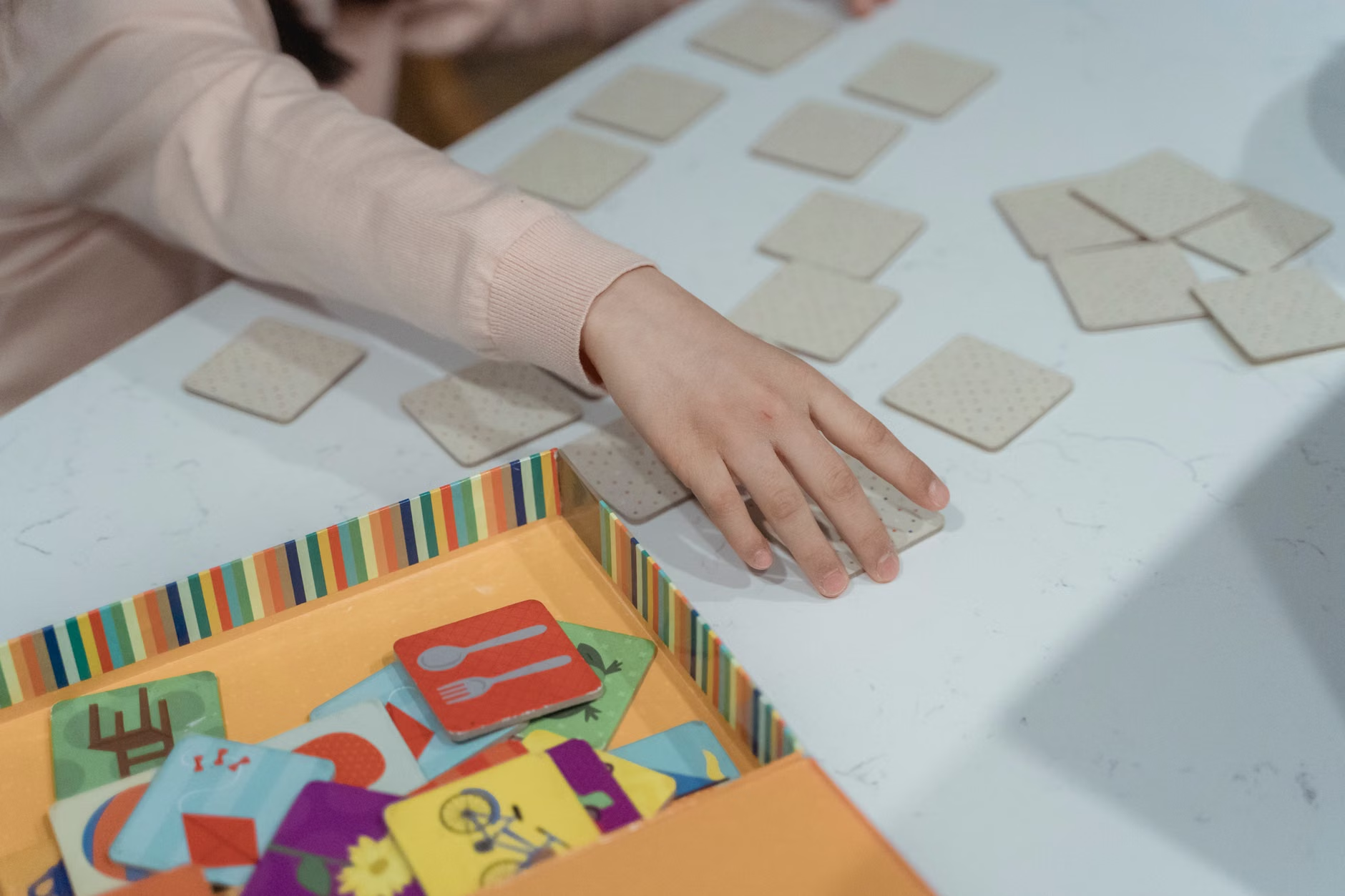
Kids love rules, but they often get stuck when rules change. Play a standard board game, but halfway through, change the rules slightly. For example, in a card-matching game, announce: “For the next round, we aren’t matching colors; we are matching shapes.” This is a perfect, low-stakes way to practice cognitive flexibility. It forces the brain to dump the old “rule set” and upload a new one, which is exactly the skill they need to transition from playing to doing homework.
The Hidden Costs and Trade-offs
We must talk about the “screen time” trade-off. While some games can be beneficial, they are still screens. The blue light, the dopamine hits, and the sedentary nature of digital gaming are real variables to manage. If you are using digital tools for executive function training, limit these to 15–20 minute sessions. Anything longer often leads to “cognitive fatigue,” where the child’s brain stops learning and starts just reacting to stimuli.
Another overlooked variable is the “frustration threshold.” If a child is already exhausted, playing a high-intensity cognitive game is counterproductive. You are trying to build the brain’s capacity, not push it into a state of stress. If you notice your child becoming irritable or losing their temper during a game, that is a clear sign that the “Executive Function” system is overloaded. Stop the game. The brain learns best when it is in a state of “relaxed alertness.”
Step-by-Step Implementation for Busy Parents
If you want to start today, do not overcomplicate it. You are not a lab technician, and you do not need to be. Follow this simple framework:
- Identify the Gap: Choose one specific area of struggle. Is it impulsivity? Forgetfulness? Difficulty with transitions? Do not try to fix everything at once.
- Choose the Tool: Pick one game (digital or physical) that targets that specific skill. If it is impulsivity, pick a game that requires waiting. If it is working memory, pick a game that requires remembering sequences.
- The 15-Minute Rule: Commit to 15 minutes of play, 3–4 times a week. Consistency beats intensity every single time.
- The “Bridge” Conversation: After the game, ask, “How did you know when to wait?” or “What helped you remember the pattern?” This forces the brain to reflect on the strategy, which is the most important part of the learning process.
- Reward the Process, Not the Win: If your child loses a game but manages to stay calm, praise the calmness, not the result. “I saw you get frustrated when you lost, but you took a breath and kept playing. That is huge.”
Why Your Involvement Changes Everything
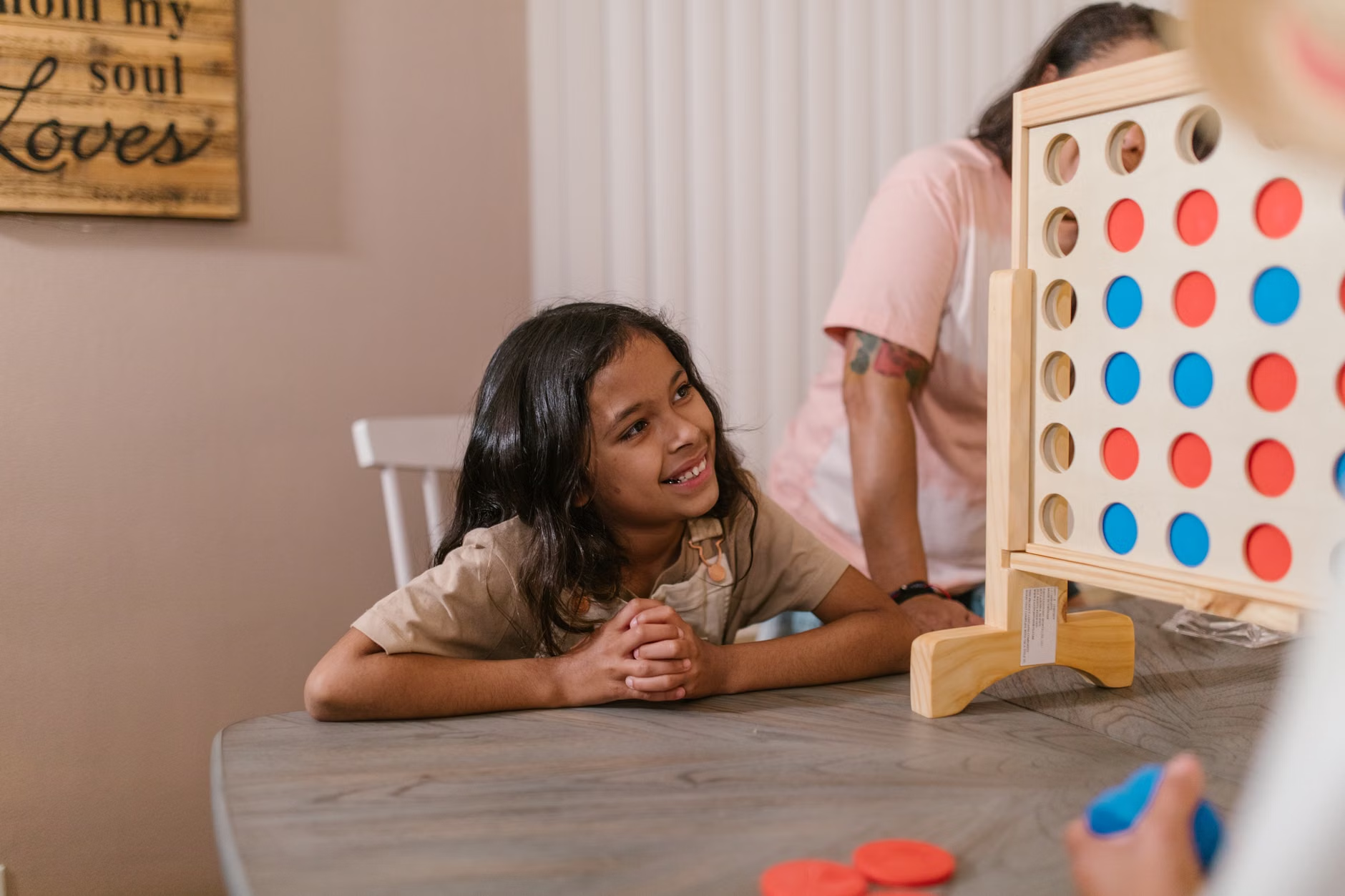
The most important insight in this entire field is that the “executive” in executive function is often the parent. When your child is young, you are their external executive function. You provide the structure, the reminders, and the emotional regulation. As they grow, they begin to internalize these processes. By playing alongside them, you are modeling how to approach a challenge. When you play a game and say, “Oh, I messed that up, let me think about how to do it differently next time,” you are teaching them cognitive flexibility in real-time.
Do not be fooled by apps that promise to “fix” your child. There is no shortcut. But there is a path. By selecting games that challenge the core components of EF and by engaging with your child during those sessions, you are doing something far more valuable than boosting a test score: you are helping them build the internal architecture they need to navigate the world with confidence.
Frequently Asked Questions
1. How do I know if an app is genuinely targeting executive function or just using it as a marketing buzzword?
Look for the “mechanism of action.” A genuine EF game will make you stop, think, or plan. A marketing-heavy game will just have flashy graphics and generic “learning” labels. If you can play the game without thinking, it is not training your brain. Check the developer’s website for links to studies or educational frameworks. If they don’t have them, be skeptical.
2. Is there a specific age when these games become most effective?
Executive function starts developing in early childhood and continues well into the mid-20s. However, the most “plastic” period for these skills is between ages 4 and 12. During this time, the brain is highly receptive to practice. For younger children, physical games (like Simon Says) are far superior to digital ones. As they enter pre-teen years, logic-based strategy games become more appropriate.
3. My child gets extremely upset when they lose a game. Should I let them win to keep the peace?
Absolutely not. Losing is a core part of building inhibitory control and emotional regulation. If you let them win, you are denying them the opportunity to practice the “brake” mechanism when they feel frustration. Instead, validate their feelings—”I know it’s frustrating to lose”—but encourage them to finish the game anyway. If the game is consistently causing meltdowns, it is too difficult; choose a simpler game, but don’t lower the standard of the outcome.
For further reading on the science of child development and cognitive training, you can refer to the Harvard University Center on the Developing Child, which provides the gold-standard research on executive function in children.