- A micro-sabbatical is a structured 48-hour period of “deep work” or “deep rest” specifically designed to break the cycle of home-project paralysis.
- Success depends on the “Rule of Three”: limit yourself to three high-impact tasks, clear your calendar, and abandon multitasking entirely.
- Burnout occurs when home projects lack a defined “done” state; using a micro-sabbatical creates a artificial deadline that forces decision-making and completion.
If you are in your 30s or 40s, your home is likely a graveyard of half-finished projects. That gallery wall you started hanging three months ago? The garage organization project that stalled after the first bin was labeled? Or perhaps the digital decluttering of family photos that has been sitting on your desktop since 2022? You are not lazy; you are suffering from the “constant partial attention” syndrome that defines modern parenting and professional life.
The solution isn’t to work harder or wake up at 4:00 AM. The solution is a micro-sabbatical—a concentrated, 48-hour window of time where you treat a personal project with the same professional rigor you apply to your career. By condensing your effort, you stop the “project bleed” that drains your energy across weeks or months.
Why Your Home Projects Are Failing (And It’s Not Your Fault)
The primary reason home projects fail is the lack of “bounded time.” In a professional environment, you have deadlines, team accountability, and clear deliverables. At home, the project is competing with laundry, childcare, meal prep, and the general exhaustion of existing. When a task has no deadline, it expands to fill the available time—or more accurately, it stays in a state of perpetual incompletion.
This creates a phenomenon called “Zeigarnik Effect,” where our brains experience psychological tension when we leave tasks unfinished. That lingering mental weight of the “unfinished gallery wall” consumes cognitive bandwidth even when you aren’t working on it. Over time, this results in project burnout: you eventually stop seeing the unfinished task, or you start feeling guilty every time you walk past it.
A micro-sabbatical changes the architecture of your time. Instead of trying to find two hours a week for six weeks—which is prone to interruptions and loss of momentum—you dedicate one single weekend (or a 48-hour block) to a singular focus. This creates a “flow state” that is impossible to achieve in 30-minute increments.

The Anatomy of a 48-Hour Micro-Sabbatical
To pull this off, you need to stop treating your home like a place to relax and start treating it like a “sprint” environment. Here is how to structure your 48 hours to ensure you actually finish what you start.
Step 1: The “Pre-Game” Audit (Friday Night)
Do not wait until Saturday morning to decide what you are doing. If you wake up on Saturday and spend two hours deciding what to work on, you have already failed. On Friday night, spend exactly 60 minutes doing a “Project Triage.”
- List every open project.
- Select only ONE. If it is too big, break it down until the outcome can be achieved in 48 hours. If the project is “Renovate the Kitchen,” that is not a micro-sabbatical. That is a renovation. Change the goal to “Organize the Kitchen Pantry” or “Paint the Kitchen Island.”
- Procure all materials. If you need screws, paint, or software, buy them on Friday. The “I need to run to the store” excuse is the death of productivity.
Step 2: Clear the “Cognitive Debris” (Saturday Morning)
Saturday is for the heavy lifting. You must treat this like an off-site work retreat. If you have children, this requires negotiation. You need a partner, a grandparent, or a planned activity that removes the need for you to be “on-call” for 4 to 6 hours at a time. This is not selfish; it is a necessity for mental health. If you are constantly interrupted, you will never reach the state of “deep work” required to finish the task.
Step 3: The “Done” Definition (Sunday Afternoon)
Most people fail because they do not define “done.” Is the project done when the wall is painted? Or when the furniture is moved back? Define the success criteria before you start. Once you hit that definition, you are finished. Resist the urge to add “scope creep”—the temptation to start a second project because you feel “on a roll.”
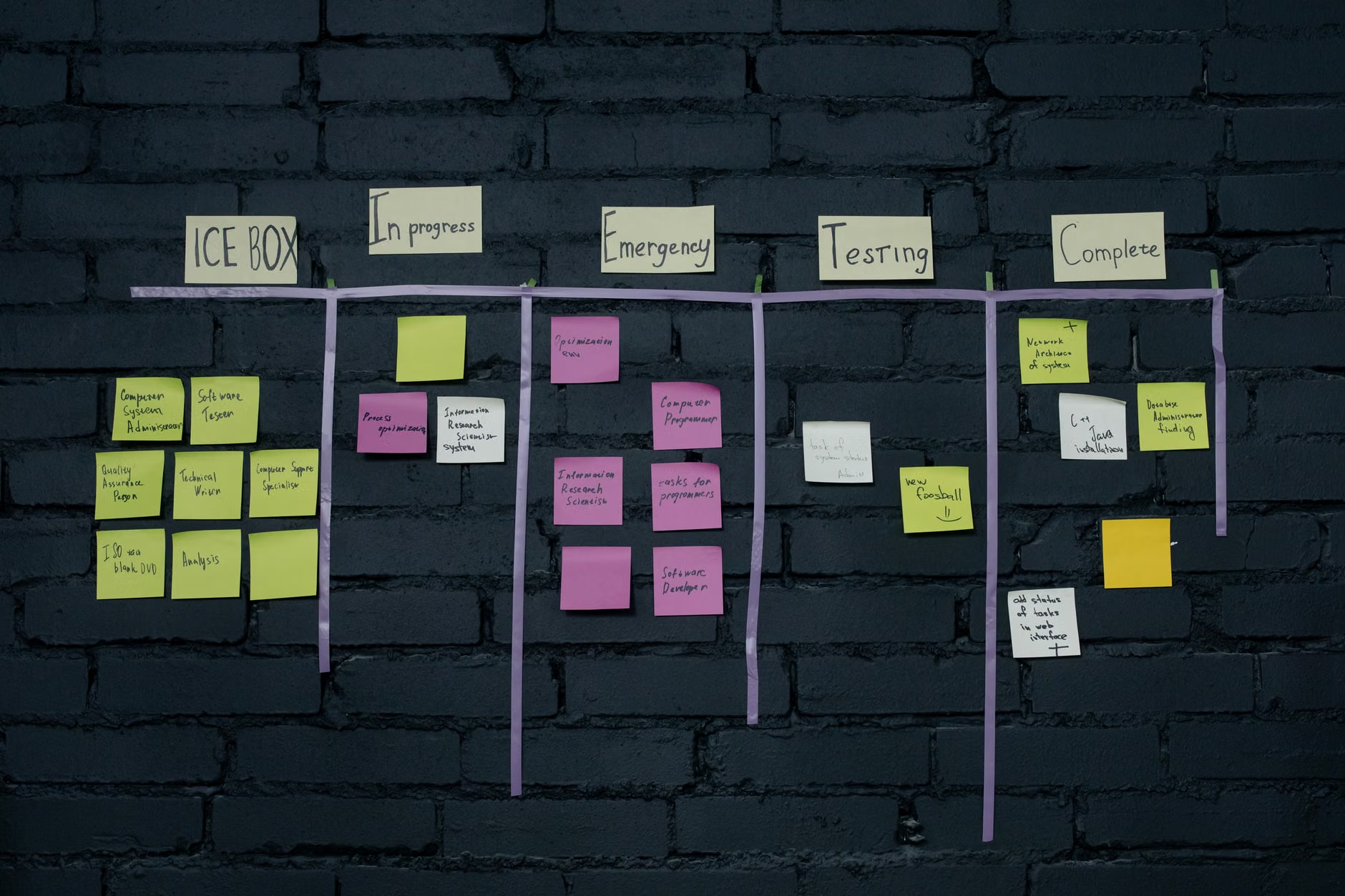
Comparing Project Management Styles: The “Drip” vs. The “Sprint”
Many of us are conditioned to work in “drip” mode—doing a little bit whenever we find a spare moment. While this works for maintenance (like cleaning the dishes), it is disastrous for creative or structural projects. The following table highlights why the “Sprint” method (Micro-Sabbatical) is superior for project completion.
| Feature | The “Drip” Method (Ongoing) | The “Sprint” (Micro-Sabbatical) |
|---|---|---|
| Cognitive Load | High (constant reminder) | Low (focused, then finished) |
| Setup Costs | Repeated (every session) | One-time |
| Risk of Abandonment | High (loss of momentum) | Low (defined deadline) |
| Best For | Daily chores | Complex, non-recurring tasks |
The “Drip” method is essentially a form of multi-tasking. Research in cognitive psychology consistently shows that switching between tasks—or even switching between “leisure” and “productive” modes—incurs a “switching cost.” By grouping your effort into a 48-hour block, you eliminate the mental energy lost during these transitions.
Avoiding the Hidden Traps of the Micro-Sabbatical
Even with the best intentions, you might stumble. Here are the most common pitfalls I’ve observed and how to navigate them.
Trap 1: The “While I’m At It” Syndrome
This is the most common way to sabotage a micro-sabbatical. You are painting the kitchen island, and suddenly you think, “While I’m at it, I should also organize the spice rack.” Stop. Scope creep is the enemy of completion. If you start a new task, you will finish neither. Stick to the original objective. If you have extra time, use it to rest, not to add more work.
Trap 2: Ignoring the “Integration” Phase
A project is not finished until the mess is gone. Many people finish the task but leave the tools out, the drop cloths on the floor, and the trash in the corner. If you do this, you haven’t finished the project; you’ve just created a new, different kind of mess. Allocate the last two hours of your 48-hour block exclusively to cleanup. If you don’t clean up, the project isn’t “done.”
Trap 3: The “Hero” Complex
Trying to do a 48-hour sprint while also being the primary caregiver for a toddler or managing a sick pet is a recipe for disaster. If your life circumstances don’t allow for a 48-hour block, adjust the scale. A “Micro-Sabbatical” can be a 12-hour block (e.g., Saturday from 8:00 AM to 8:00 PM). The length matters less than the boundary. Keep the boundary firm, even if the timeframe is shorter.
Real-World Application: A Sample Schedule
Let’s look at a hypothetical scenario. You want to digitize your family’s physical photo collection. This is a massive, daunting task. Here is how you tackle it in a 48-hour micro-sabbatical.
| Time Block | Focus |
|---|---|
| Friday Night | Gather photos, set up scanner/software, test connection. |
| Saturday AM | Batch 1: Scanning (Focus on volume, not quality control). |
| Saturday PM | Batch 2: Scanning & Metadata tagging. |
| Sunday AM | Digital organization and cloud backup. |
| Sunday PM | Cleanup, storage, and victory dinner. |
Note how this schedule doesn’t just say “scan photos.” It breaks the project into distinct, manageable phases. By Sunday afternoon, you have a concrete, finished outcome: a digital archive. You no longer have the mental burden of the physical boxes of photos sitting in your closet.

The Psychology of “Done”
Why does this feel so good? In our late 30s and 40s, we are constantly bombarded with “open loops.” We have unfinished emails, unfinished house tasks, and unfinished plans for our children’s future. Our brains are designed to close loops, but our modern lives are designed to keep them open. When you complete a micro-sabbatical, you are giving your brain a rare hit of dopamine associated with completion.
This is not just about a clean house or an organized digital folder. It is about reclaiming your agency. When you look at a room you have neglected for months, you feel a subtle, constant sense of failure. When you finish the project, you replace that feeling with a sense of competence. This “competence loop” is essential for long-term mental health. It proves to yourself that you are still the person who can initiate and finish things, regardless of the chaos of your external circumstances.
There is also an economic argument here. How much money do we waste by starting projects and then abandoning them? We buy the paint, then the paint dries out. We buy the software subscription, then forget to use it. We buy the organizer, then it becomes clutter itself. By focusing your energy into a 48-hour sprint, you are essentially protecting your investment. You are ensuring that the resources you spent actually yield a result.
Advanced Tactics for the Busy Parent
If you are a parent, the “48-hour block” might sound like a fantasy. Let’s get real about how to negotiate this. You are not asking for a favor; you are asking for a resource allocation. Your partner is likely just as overwhelmed as you are. Propose a trade: a “Micro-Sabbatical Swap.”
You take 48 hours for your project, and they take 48 hours for theirs. This creates a mutual incentive to make the time work. It also removes the guilt. If you are both doing it, you are both supporting each other’s need for individual identity outside of parenting and work.
Another tactic is the “Low-Stimulus Environment.” If you are working on a project, turn off your phone notifications. Use a “Focus” mode on your computer. If you are doing a physical project, put on noise-canceling headphones. We often think that we need to be available for our families 100% of the time, but the truth is that a parent who is present, calm, and fulfilled is better than a parent who is physically present but mentally distracted by the “unfinished” project in the back of their mind.
When to Pivot and When to Quit
Sometimes, midway through a micro-sabbatical, you realize the project isn’t worth it. Maybe the furniture you are restoring is damaged beyond repair, or the digital decluttering is revealing that you don’t actually care about the photos. That is not a failure; that is a data point.
If you decide to quit, do not just stop. “Quit” with intention. Say to yourself, “I am stopping this project because it no longer serves my goals.” Then, dispose of the materials immediately. This is the “active closure” step. If you just leave it, it remains an open loop. If you actively decide to end it and clear the space, you have successfully closed the loop.
The Long-Term Impact on Your Mental Bandwidth
Over a year, if you execute one micro-sabbatical every two months, you will have completed six major projects that would have otherwise lingered for years. This is massive. It changes the way you view your home. Instead of a place where things go to die, your home becomes a place where things get done. This shifts your internal narrative from “I’m always behind” to “I’m in control of my space.”
It is important to remember that this is a practice, not a miracle. You will still have bad weeks. You will still have projects that stall. But by having a framework—a way to “reset” your environment—you are giving yourself the tools to recover when things get out of hand. You are no longer at the mercy of your to-do list; you are the one deciding when, where, and how you will tackle it.
Start small. Don’t pick the biggest, most expensive project for your first micro-sabbatical. Pick something that has been bugging you for a long time but is relatively simple to execute. The goal is to build the “muscle” of finishing. Once you have that muscle, you can move on to the larger, more complex challenges.
Finally, remember that the most successful projects are the ones that serve your life, not the ones that look perfect on social media. If you are organizing your pantry, do it in a way that makes your Tuesday morning breakfast run smoother, not in a way that looks like a high-end design magazine. Function over form is the golden rule of home-project recovery.
Frequently Asked Questions
Q: What if I don’t have a full 48 hours? Can I break it up?
A: While a single 48-hour block is ideal for flow, you can adapt the principle into a “48-hour window” spread across two weekends. The critical requirement is that the project must be completed within a maximum of 14 days. If it takes longer, it loses the “sprint” momentum and reverts to a standard, prone-to-failure project.
Q: Is it okay to do a micro-sabbatical with my partner?
A: Only if you are both working on the same project with clearly defined roles. If you are both working on different projects in the same space, you will likely distract each other. If you want to do it together, treat it like a professional collaboration: define roles, set a deadline, and keep the communication focused on the output.
Q: How do I handle the guilt of taking time away from my family for a personal project?
A: Reframe the narrative. You are not “taking time away”; you are “investing in your mental state.” A parent who is less stressed because they have finished a long-standing project is a more present and patient parent. Communicate this clearly to your family: “I am doing this so I can be more relaxed and present with you next week.”
For further reading on the science of project completion and the psychology of environment design, you can explore resources from the Harvard Business Review regarding time management or look into the concept of “Cognitive Load Theory” via educational psychology journals. Keep your projects bounded, your goals clear, and your weekends sacred.