The most effective way to help your toddler through a meltdown isn’t to correct their behavior or force them to “calm down,” but to become their external nervous system until they can build their own.
- Co-regulation is biological, not behavioral: You are not just teaching them to be good; you are literally syncing your calm heart rate and breathing to theirs to lower their stress hormones.
- The “Pause” is your primary tool: Before you react to a tantrum, take three deliberate breaths; your own physiological state is the single biggest predictor of how quickly your child will recover.
- Don’t teach during the storm: Trying to reason with a toddler in the middle of a meltdown is biologically impossible because their prefrontal cortex (the logic center) is offline.
If you have ever spent forty minutes trying to convince a two-year-old that a broken cracker is still, in fact, edible, you know the specific brand of exhaustion that comes with modern parenting. We often approach these moments like project managers: we identify the problem (the cracker), propose a solution (eat the cracker), and expect a logical outcome (the child stops crying). When that doesn’t happen, we feel like we’re failing.
The reality is that your toddler isn’t being difficult; they are being neurologically immature. Their “upstairs brain”—the part responsible for logic, impulse control, and perspective—is still under construction. When they are overwhelmed, they are operating entirely from their “downstairs brain,” which is pure, unfiltered survival instinct. They aren’t choosing to be irrational; they are physiologically unable to be anything else.
What Exactly Is Co-Regulation?
Co-regulation is the process by which a regulated nervous system helps to regulate a dysregulated one. Think of it like a musician tuning an instrument. If your child is a violin that has gone completely out of tune because of a sensory overload or a transition, they cannot tune themselves. They need a “reference pitch.” If you are the calm, steady, and present adult, you become that reference pitch.
Research from the Journal of Developmental & Behavioral Pediatrics highlights that children do not develop self-regulation in isolation. It is a social process. By staying calm, maintaining a steady tone, and offering physical presence, you signal to your child’s brain that they are safe. Once their brain registers safety, the fight-or-flight response subsides, and their nervous system begins to mirror yours.

Why Your Current Strategy Might Be Backfiring
Many of us were raised with the idea that feelings should be managed quickly—usually through distraction or redirection. “Look at that bird!” or “Don’t cry, you’re a big boy now.” While these tactics might stop the noise for a moment, they miss a critical developmental opportunity. They send the message that the child’s big, scary emotions are an inconvenience that needs to be suppressed.
When you suppress a child’s emotion, you aren’t teaching them to regulate; you are teaching them to hide. Over time, this leads to a lack of emotional literacy. A child who learns to navigate their “big feelings” with your support is a child who eventually learns to self-soothe. A child who is consistently told to “hush” or “stop it” grows into an adult who feels anxious whenever they experience intense emotions because they never learned that emotions are temporary states that pass.
The Physiology of the “Storm”: Why You Can’t Reason with a Toddler
Imagine your toddler’s brain as a house. The “downstairs” is the kitchen and the furnace—the limbic system, where fear, hunger, and anger live. The “upstairs” is the home office—the prefrontal cortex, where language, logic, and planning happen. During a tantrum, the fire alarm in the kitchen is blaring. The entire house is filled with smoke. You cannot go to the home office and ask them to write a report on why they shouldn’t throw their shoes.
Your job is to put out the fire. You don’t do that by lecturing them on the rules of footwear. You do it by being a calm presence—a “safety anchor”—until the smoke clears. Once the nervous system returns to baseline, *then* you can talk about why we wear shoes inside or outside.
Practical Steps to Implementing Co-Regulation
Implementing this isn’t about being a perfect, zen-like parent every second of the day. It is about having a toolkit for when the inevitable happens. Here is how you can apply co-regulation in real-time:
1. The Physiological Reset (The “Me First” Phase)
Before you engage with your child, check your own state. Are your shoulders tight? Is your jaw clenched? Is your heart rate climbing? If you are dysregulated, you cannot regulate someone else. Take a deep, audible breath. Drop your shoulders. This sends a signal to your own body that you are safe, which in turn allows you to be a stable anchor for your child.
2. The “Attunement” Phase
Once you are calm, move into your child’s space. You don’t need to say much. Often, words are just noise during a meltdown. Use your body language. Get down to their level. Offer a gentle touch, like a hand on their back, if they are receptive. If they are thrashing, stay close but give them space. Your physical presence acts as a buffer between them and the overwhelming feeling they are experiencing.
3. Validating the Emotion, Not the Behavior
Once the peak of the storm has passed, use simple, short sentences to label their feelings. “You are really frustrated that the block tower fell.” This helps them build the neural pathways between their feelings and their language. Note: Do not say “but.” Don’t say, “You’re frustrated, but it’s just blocks.” That invalidates the feeling. Just acknowledge the feeling. Let it sit.

Common Mistakes Parents Make with Co-Regulation
Even with the best intentions, it is easy to fall into traps. Here are the most common pitfalls and how to avoid them:
| Common Mistake | Why It Fails | The Correction |
|---|---|---|
| Lecturing during the tantrum | The child’s logic center is offline. | Wait until they are calm to discuss rules. |
| Forcing an apology | It teaches compliance, not empathy. | Model empathy instead. |
| Taking it personally | It triggers your own fight-or-flight. | Remind yourself: “They are having a hard time, not giving me a hard time.” |
The “Invisible” Variable: Sensory Overload
One overlooked factor in toddler behavior is sensory input. We often assume a meltdown is about the “no” we just gave them, but it might actually be about the fact that they are tired, hungry, or the room is too loud. If you find that your child is having frequent meltdowns, keep a “sensory log” for a few days. Does it happen at the same time? In the same place? Is there a particular noise or light level involved? Sometimes, the best way to co-regulate is to change the environment—dim the lights, turn off the music, or move to a quieter room.
Building Resilience Through “Quiet Play”
Co-regulation isn’t just for crises. You can build your child’s capacity for self-regulation during calm times through what we call “quiet play.” This is any activity that requires focus and engagement without over-stimulating the nervous system. Think of building blocks, sorting colors, or drawing with crayons. When you sit with them during these times, you are modeling focus and calm. You are essentially “training” their nervous system to enjoy a regulated state.
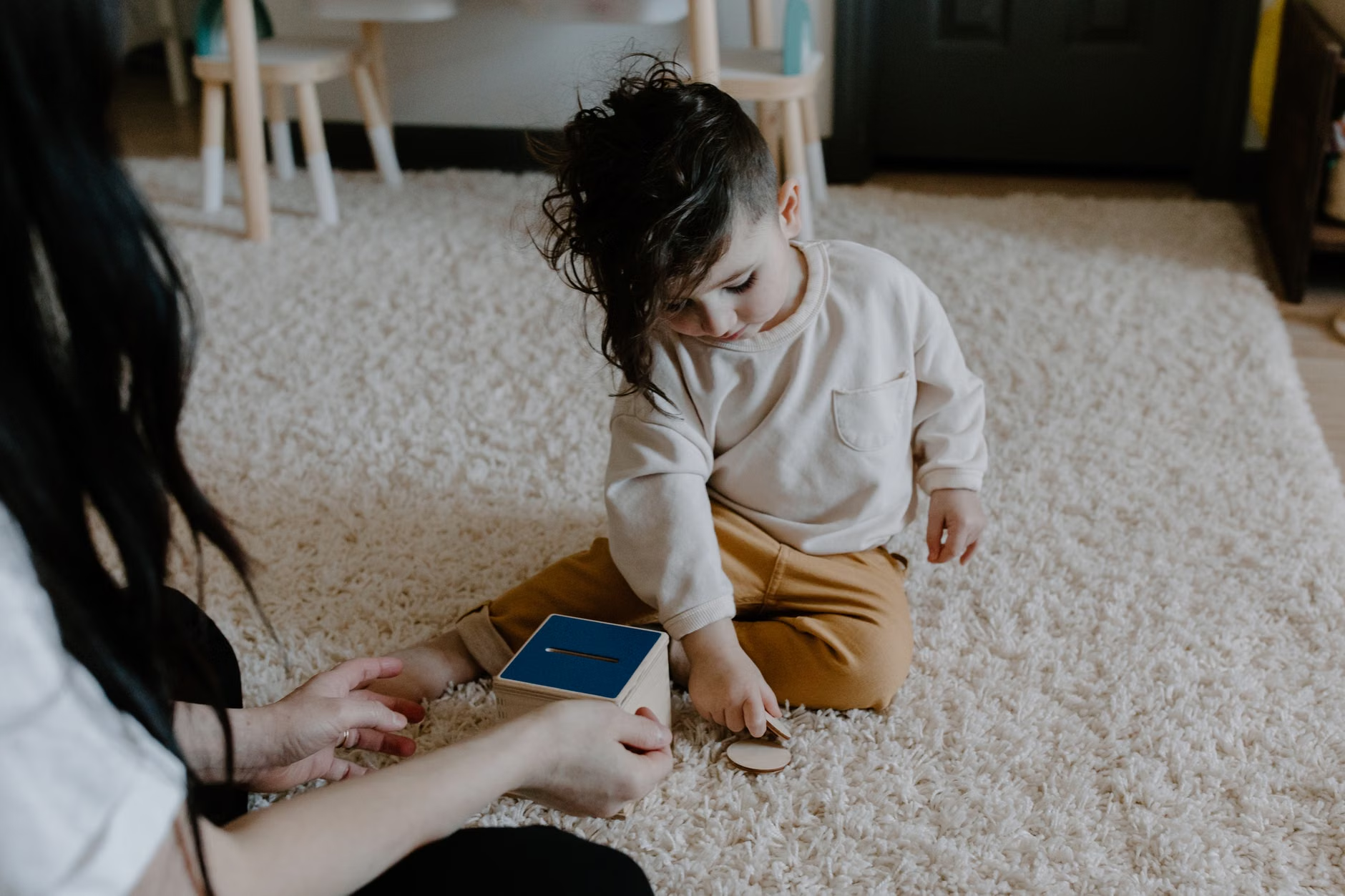
This is a long game. You are not going to see a transformation overnight. But by choosing to stay regulated when your child is falling apart, you are building a foundation of trust and emotional safety that will pay dividends when they are teenagers and face much larger, more complex challenges than a broken cracker.
The Realistic Timeline: When Do They Learn to Self-Regulate?
It is important to manage your expectations. A toddler cannot be expected to self-regulate consistently until they are much older. Self-regulation is a skill that evolves throughout childhood and well into adolescence. According to developmental psychologists, while you will see glimmers of self-regulation in the preschool years, the ability to manage intense emotions independently is a work in progress that takes years.
Do not judge your parenting success by how quickly your child stops crying. Judge it by how consistently you are able to hold the space for them to process their feelings. If you can stay present, calm, and supportive, you are doing the hard, essential work of parenting.
Actionable Steps for Your Next “Storm”
The next time your toddler starts to escalate, try this sequence:
- Pause: Stop what you are doing. Take three deep breaths.
- Scan: Look at your child. Are they in danger? If not, stay put.
- Anchor: Get to their level. Offer a “safe touch” or simply stay within their line of sight.
- Label: Use one or two words to acknowledge the struggle. “You’re sad.” “That was scary.”
- Wait: Let the emotion move through them. Don’t rush to “fix” it. Just be there.
This is not about being a pushover. You can hold boundaries while being warm. You can say, “I can’t let you hit me, but I can see you are very angry,” while gently blocking their hand. You are being firm on the behavior and soft on the person. That is the gold standard of modern parenting.
The Hidden Cost of “Fixing”
There is a hidden cost to the “fix-it” mentality. When we constantly rush to stop our children’s negative emotions, we are implicitly telling them that negative emotions are “bad” or “wrong.” This can create a fragile child who becomes an adult with a low threshold for discomfort. If they never learn to sit with frustration, they will struggle to persist when tasks get hard at school or work. By allowing them to experience the full arc of their emotions—with you as their anchor—you are actually teaching them resilience.
You are showing them that they can feel something painful, that it will be intense, and that they will survive it. That is the most important lesson you can teach them, and it is one they will carry for the rest of their lives.
Conclusion: The Long-Term View
Co-regulation is a shift in perspective. It moves us away from the idea of “managing” our children and toward the idea of “partnering” with them. It acknowledges that parenting is a physiological, biological relationship. When you stay calm, you aren’t just surviving the day; you are shaping the way your child experiences the world. You are teaching them, through your own nervous system, that they are capable of handling their big feelings and that they are never, ever alone in the storm.
Take it one tantrum at a time. You will lose your cool sometimes—that is part of being human. When you do, apologize to your child. “I lost my cool, and I’m sorry. I’m going to take a breath and try again.” That is just as much a part of co-regulation as staying calm in the first place. You are teaching them that even in the middle of a mistake, we can pause, reset, and reconnect.
Frequently Asked Questions
1. Does co-regulation mean I have to let my child do whatever they want?
Not at all. Co-regulation is about your emotional delivery, not your boundaries. You can firmly hold a boundary (e.g., “It is time to leave the park”) while being a calm, supportive presence for the frustration that follows. You are providing the structure, but you are also providing the emotional space for them to process their feelings about that structure.
2. What if I can’t stay calm? Does that mean I’m failing?
Absolutely not. You are a human being, not a robot. If you feel your own frustration spiking, the best thing you can do is “tag out” if there is another caregiver present, or tell your child, “I’m feeling very frustrated right now, so I’m going to take a moment to breathe so I can help you better.” This models healthy self-regulation for your child in real-time.
3. How long does it take for a child to start self-regulating?
It is a developmental arc, not a switch. You will likely see small, inconsistent improvements throughout the toddler years. By the time they reach age 5 or 6, they will have more language and cognitive tools to self-regulate, but they will still rely on you for co-regulation during periods of high stress, illness, or major life changes. It is a long-term investment in their emotional intelligence.
For further reading on the science of attachment and nervous system regulation, see the resources provided by the Center on the Developing Child at Harvard University.