The most important takeaway for any parent planning a vacation is that the “slow-transit” rail experience isn’t just about reaching a destination; it is about reclaiming the hours often lost to airport security, gate-side waiting, and the physical exhaustion of modern air travel.
- Cost Efficiency: When factoring in luggage fees, airport transfers, and the cost of meals at airports, coastal rail travel is often 20-30% cheaper for families of four than budget air travel.
- The “Door-to-City” Advantage: Coastal trains drop you in the city center, eliminating the “last mile” cost and stress of expensive airport shuttles or ride-shares.
- Psychological Restoration: The shift from high-speed, high-stress transit to slow-paced rail allows parents to engage in “low-arousal” activities like reading or playing games, significantly lowering cortisol levels before the vacation even begins.
If you are in your 30s or 40s, your relationship with travel has likely evolved. Gone are the days of sprinting through terminals to catch a budget flight, only to arrive at your destination with a toddler screaming in your ear and your back aching from a heavy carry-on. You are looking for something more—a way to travel that feels like a vacation from the moment you leave your driveway.
Slow-transit coastal rail is currently trending not just because it’s “aesthetic,” but because it solves the fundamental logistical failures of air travel for families. Let’s break down why this is the smartest move for your next getaway.
Why Coastal Rail Changes the Math for Family Travel
When we look at the logistics of a family trip, we often fall into the “travel time trap.” We assume that because a flight takes two hours and a train takes six, the flight is automatically superior. This is a common mistake. You have to account for the “total transit time.”
For a flight, you need to arrive at the airport two hours early, navigate security, board, wait for takeoff, land, taxi, and then spend another hour retrieving bags and getting to the city center. A six-hour train ride often requires only 15 minutes of “arrival time,” and you land right in the heart of your destination. The total “active transit” time is often nearly identical, but the quality of that time is vastly different.
| Factor | Budget Airline | Coastal Rail |
|---|---|---|
| Security/Check-in | High stress, 2+ hours | Minimal, 15 minutes |
| Luggage Limits | Strict, expensive fees | Generous, no liquid restrictions |
| Space/Comfort | Cramped, no movement | Spacious, walking allowed |
| Destination Access | Suburban airports, expensive transit | City center hubs |
The table above illustrates the hidden “tax” on air travel. For a family, those luggage fees and airport shuttle costs add up quickly. By choosing rail, you aren’t just buying a ticket; you are buying the ability to bring your own snacks, move around with your children, and actually see the landscape—which, along the coast, is often spectacular.
The Psychology of “Slow-Transit” for Busy Parents
In our 30s and 40s, we are constantly “on.” We manage work, school drop-offs, household maintenance, and social obligations. When we finally get a break, we often try to cram too much into our travel plans, leading to burnout. Slow-transit rail is an antidote to this.
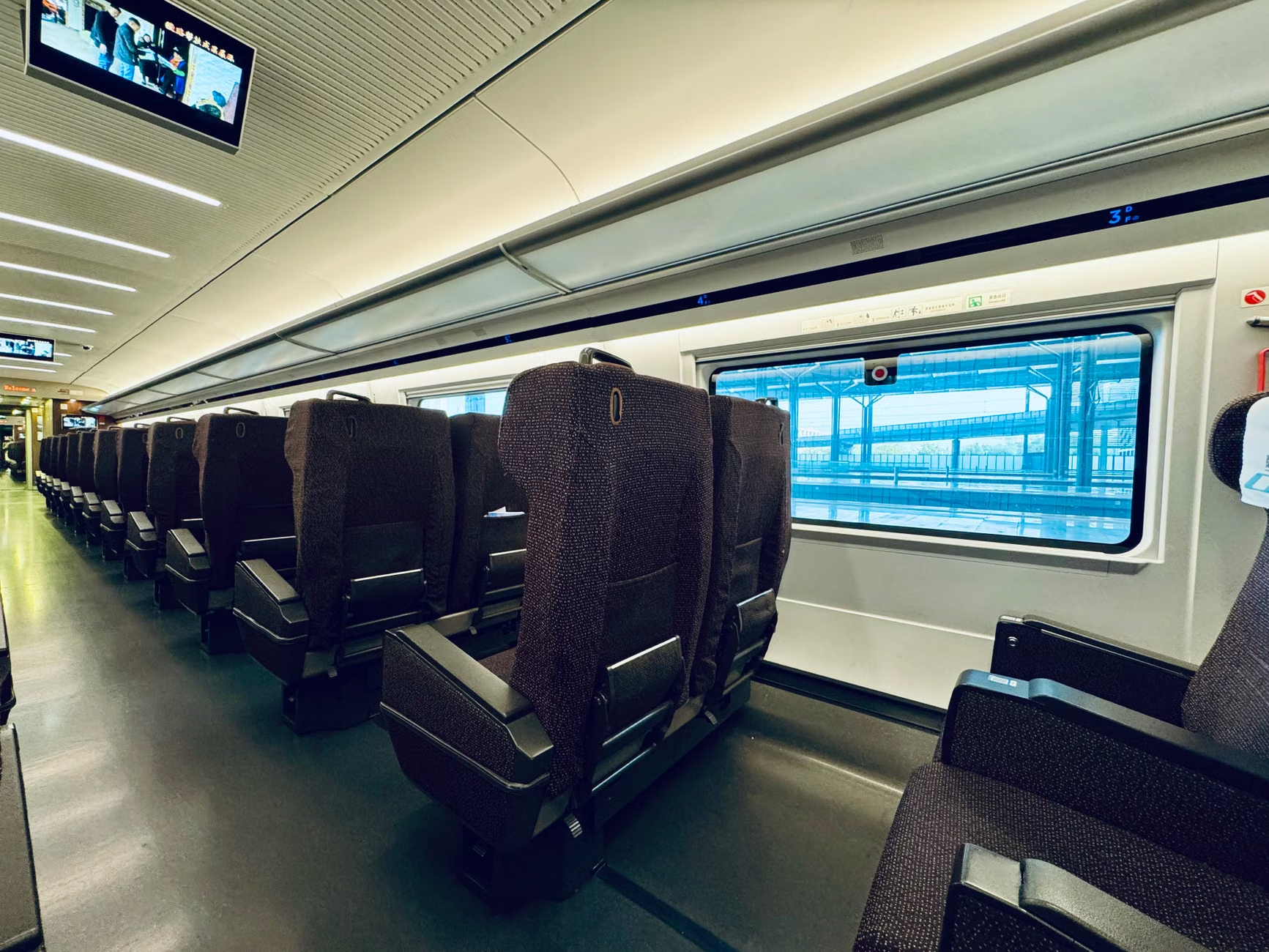
Research into travel psychology suggests that the environment in which we travel significantly impacts our mood upon arrival. Airplanes are high-stress environments—confined spaces, loud noises, and constant monitoring by cabin crew. Trains, by contrast, offer a “moving living room” experience. You can spread out. You can lay out a coloring book for your child without hitting the passenger in front of you. You can walk to the cafe car to stretch your legs.
This allows for what psychologists call “low-arousal” activity. Instead of the high-stress adrenaline spikes of air travel, you spend your time in a state of relaxed engagement. For parents, this is the difference between arriving at your hotel feeling “done” and arriving feeling refreshed and ready to explore.
Choosing the Right Route: What to Look For
Not all rail routes are created equal. When planning a coastal rail trip, you should prioritize routes that offer “scenic corridors.” In Europe, this might be the Cinque Terre line in Italy or the coastal routes in Portugal. In the US, the Amtrak Pacific Surfliner is a prime example of a route designed for the passenger experience rather than just speed.
The “Scenic Corridor” Checklist
- Window Orientation: Does the train hug the coastline? Check route maps to ensure your seat or the train’s path offers views of the water rather than the back of industrial buildings.
- Frequency of Stops: A train that stops every 10 minutes is a commuter train, not a “slow-transit” experience. Look for regional express lines that offer a balance between speed and scenery.
- Onboard Amenities: Does the train offer a cafe car? For a trip longer than three hours, access to food and drink is essential for keeping kids happy.
A common mistake is booking the fastest train available. When you prioritize speed, you are effectively choosing to look at a tunnel wall for three hours. Always look for the “scenic” or “regional” designation. They are usually cheaper and significantly more enjoyable.

Practical Tips for a Smooth Rail Journey
Traveling by rail with children requires a different set of preparations than flying. You have more freedom, but you also have more responsibility for your own entertainment.
1. Pack a “Transit Kit”: Unlike flying, you don’t have to worry about liquid limits. Pack a small cooler with sandwiches, fruit, and drinks. This saves you from the inflated prices of the cafe car and ensures you have food your children will actually eat.
2. Seat Selection Strategy: If possible, book “table seats.” These are the seats facing each other with a table in between. This is the holy grail of family travel. It provides a dedicated surface for drawing, playing card games, or eating, and it keeps the family unit contained and occupied.
3. The “Power” Factor: Most modern coastal trains are equipped with power outlets. Bring a multi-port USB charger. This ensures that everyone’s devices stay charged, but more importantly, it means you can power a portable DVD player or a tablet for the kids without worrying about battery life.
4. Managing Luggage: While trains are generous with luggage, remember that you are the one moving it. Unlike planes where you check your bags, you will be hauling your suitcases onto the train. Pack using the “one-bag-per-person” rule. If you can’t carry it up three steps, don’t bring it.
Common Misconceptions About Coastal Rail
There is a persistent myth that trains are “unreliable” or “dirty.” While this may have been true of some aging infrastructure in the past, modern coastal lines in many parts of the world have undergone significant upgrades. In countries like Japan, Spain, and parts of the UK, the rail experience is cleaner and more punctual than the airport experience.
Another misconception is that it takes “too long.” We need to redefine what “long” means. If a flight takes 4 hours (including prep and post-flight) and a train takes 6 hours, you are only spending 2 extra hours. But in those 2 extra hours, you have removed the stress of liquid restrictions, the physical discomfort of the cabin, and the logistical nightmare of airport transfers. You are essentially paying 2 hours of time for a massive gain in mental well-being.
When Should You Choose Air Travel Instead?
As much as we love rail, it isn’t always the right choice. If your journey involves crossing an ocean, air travel is the only practical option. Additionally, if you are on a very tight timeline—for instance, if you have a multi-leg journey where every hour counts—the speed of a flight might be necessary.
However, for regional travel (under 8 hours), the train is almost always the superior choice for families. The decision rule is simple: If the total transit time for the train is under 8 hours, and the scenery is a factor, choose the train. If the journey requires multiple transfers or exceeds 10 hours, look at the trade-off. Is the extra time worth the comfort? Usually, for parents, the answer is yes.
Strategic Planning: The “Stop-Over” Technique
One of the best-kept secrets of rail travel is the “stop-over.” Many rail passes or long-distance tickets allow you to break your journey at no extra cost. Instead of a 6-hour slog, turn it into two 3-hour segments with an overnight stay in a coastal town you otherwise would have ignored.
This transforms a travel day into part of the vacation itself. You get to see two places for the price of one, and you keep the kids from getting restless. It’s a strategy that turns a logistical hurdle into an adventure.
Final Thoughts: Reclaiming Your Time
The shift toward slow-transit rail is more than just a trend; it’s a recalibration of how we value our time. When you choose to travel by rail, you are choosing to prioritize the experience of the journey over the destination. You are giving yourself and your children space to breathe, to look out the window at the ocean, and to connect without the artificial barriers of modern air travel.
The next time you plan a trip, look at the map. Look for the lines that hug the coast. Calculate the time not by the clock, but by the quality of the experience. You might find that the best part of your vacation happens before you even arrive.
For more information on specific regional rail passes and route planning, I highly recommend checking out The Man in Seat 61, which remains the gold standard for rail travel advice globally, or the official site of your destination’s national rail operator (such as Trenitalia for Italy or Renfe for Spain).
Frequently Asked Questions
1. Is rail travel actually cheaper than budget airlines for a family?
Often, yes. While a base flight ticket might look cheaper, once you add seat selection, checked bags, and the cost of the train or taxi to get from the airport to the city center, the flight becomes much more expensive. Trains usually include a generous luggage allowance and arrive in the city center, saving you those “last mile” costs.
2. What should I do if my child gets restless on a long train ride?
The beauty of a train is that you can move. Unlike a plane, you aren’t confined to your seat. Take a walk to the cafe car, look out the window at the scenery, or bring a “travel-only” toy bag that they only get to open on the train. The change of scenery is often enough to reset a child’s mood.
3. How do I know if a specific train route is scenic?
Look for routes described as “Regional” or “Intercity” rather than “High-Speed.” High-speed lines are designed to avoid obstacles and often travel through tunnels or boring industrial areas. Regional lines are designed to connect towns and often follow the natural geography of the coast, offering the best views.