- Grid volatility is rising: By 2026, the convergence of high AI-driven data center demand and the transition to intermittent renewable energy sources will increase the frequency of “peak load” warnings.
- Financial impact: Expect “time-of-use” pricing to become the standard rather than the exception; shifting high-energy chores like laundry and dishwashing to off-peak hours is no longer optional for budget management.
- Reliability shifts: Localized outages may become more frequent as grids struggle to balance capacity; investing in basic home energy resilience (like portable power stations or smart monitoring) is becoming a practical necessity for families.
If you have noticed your electricity bill creeping upward or seen more frequent notices from your utility provider about “peak demand hours,” you aren’t imagining things. We are entering a period where the global energy grid is undergoing its most significant stress test in decades. As we approach 2026, experts are pointing toward a “perfect storm” of factors—the rapid scaling of AI data centers, the electrification of transportation, and the retirement of aging fossil-fuel plants—that will force every household to rethink how they consume power.
For those of us balancing work, school runs, and the ever-increasing cost of living, the energy grid isn’t just an abstract utility; it’s a monthly line item that is becoming harder to predict. Understanding these 2026 warnings isn’t about fear-mongering; it’s about shifting from being a passive consumer to an active manager of your home’s energy footprint.

The Anatomy of a 2026 Grid Warning: Why Now?
To understand why 2026 is being flagged as a critical year, we have to look at the “Triple Threat” currently facing utility operators worldwide. First, there is the exponential growth of energy-hungry infrastructure. Data centers, which power everything from your streaming services to the generative AI tools we use daily, consume massive amounts of electricity around the clock. Unlike residential demand, which peaks in the evening, these centers demand high, consistent loads that leave little room for error.
Second, we are seeing the “electrification of everything.” From electric vehicles (EVs) to heat pumps replacing traditional gas furnaces, the demand on our local distribution networks is rising faster than the infrastructure can be upgraded. Think of your local grid as a highway: if you add 20% more cars without widening the lanes, you don’t just get traffic—you get gridlock. In energy terms, that gridlock manifests as voltage instability or, in extreme cases, controlled load shedding.
Third, the transition to renewables introduces a new variable: intermittency. While wind and solar are cheaper than ever, they don’t produce power on a fixed schedule. Until large-scale grid storage (utility-scale batteries) catches up with generation capacity, we are going to see more moments where supply cannot meet demand during “dunkelflaute”—a German term for periods of low wind and low sun. By 2026, this lack of buffer capacity will make peak warnings a regular part of the seasonal cycle.
How Your Household Budget Will Change
The most immediate impact you will feel by 2026 is the death of the “flat-rate” electricity plan. If you are currently on a plan where you pay the same rate regardless of when you use your dryer or dishwasher, prepare for that to change. Utilities are moving rapidly toward dynamic pricing models, also known as Time-of-Use (TOU) pricing.
In a TOU model, electricity is priced like an airline ticket or an Uber ride. During peak hours—typically late afternoon to early evening when people get home from work and turn on their AC or heat—prices can spike to three or four times the normal rate. If you run your dishwasher at 6:00 PM in 2026, you might be paying a premium that you wouldn’t have even noticed in 2023.
The Strategy: You need to start “load shifting.” This means treating your appliances like smart devices. Many modern dishwashers, washing machines, and even EV chargers have “delay start” functions. By setting these to run after 10:00 PM or during the early morning hours, you are not just saving money; you are actively helping the grid maintain stability. If you have an EV, this is even more critical. Charging an EV during peak hours is the equivalent of running a small factory in your garage; doing it overnight is the standard for long-term budget stability.
The Reality of Reliability: When the Grid Struggles
Grid warnings in 2026 will likely come in two flavors: price warnings and reliability warnings. Price warnings are the “please conserve energy to save money” requests. Reliability warnings are the “we are at risk of a localized blackout” alerts. While most of us in developed nations are used to the power simply “being there,” we are seeing a shift where local distribution transformers—the grey canisters you see on utility poles—are becoming the weak link.
When everyone in a neighborhood gets an EV and switches to heat pumps at the same time, those local transformers can overheat. This is a localized issue that won’t necessarily be solved by a national energy grid upgrade. It’s a “last mile” problem. For families, this means the risk is moving from a massive regional grid failure to a localized, neighborhood-specific outage caused by transformer stress.
What to look for: If you live in an area with a lot of new EV adoption or high-density housing, pay attention to the age of your local infrastructure. If you notice your lights dimming slightly when a neighbor turns on a heavy appliance, or if you experience “brownouts” (a partial drop in voltage), your local grid is already signaling it is at capacity. In these cases, having a small, reliable backup system—even just a high-capacity portable power station—is a smart insurance policy for keeping your router, phones, and essential medical devices running.
Actionable Steps: Preparing Your Home for the Next 24 Months
You don’t need to go “off-grid” to be prepared. In fact, most of the best actions are low-tech and low-cost. The goal is to make your home energy-efficient enough that it doesn’t become a burden on the grid during peak times.
1. Conduct a “Phantom Load” Audit
Devices left in standby mode—gaming consoles, older televisions, smart home hubs—can account for up to 10% of a home’s electricity usage. By 2026, this “vampire power” will be a bigger contributor to your bill than you might think. Use smart power strips that cut power to peripheral devices when the main device (like your TV) is turned off. It’s a one-time setup that pays for itself in months.
2. Optimize Your HVAC for the Grid
Heating and cooling are the largest energy consumers in almost every home. By 2026, smart thermostats that can automatically adjust based on utility demand-response signals will be standard. If your utility offers a rebate for a smart thermostat, take it. These devices don’t just save you money; they help the utility “pre-cool” or “pre-heat” your home before a peak event, effectively using your home’s thermal mass as a battery.
3. Consider Energy Resilience
If you live in a region prone to extreme weather or grid instability, look into modular battery storage. Unlike massive, expensive whole-home systems, modular batteries allow you to start small. You can power your home office and internet during a short outage for a fraction of the cost of a full-scale installation. This provides peace of mind without the massive capital expenditure.
| Strategy | Cost | Impact |
|---|---|---|
| Time-of-Use Load Shifting | Free | High (Direct bill reduction) |
| Smart Thermostat | Low-Medium | Medium (Long-term efficiency) |
| Portable Power Station | Medium-High | High (Reliability/Backup) |
The Overlooked Variable: The “Social” Grid
There is one aspect of the 2026 energy conversation that rarely makes the headlines: the concept of the “social grid.” As utilities struggle to manage peak demand, they are increasingly looking to their customers to act as “virtual power plants.” Through programs like “demand response,” utilities pay homeowners to reduce their usage during critical grid moments. This is a complete reversal of the traditional utility relationship.
Instead of just being a customer who pays a bill, you become a participant in the grid’s stability. By 2026, many homeowners will be earning credits on their utility bills simply by allowing their smart appliances to be throttled slightly during peak events. If you have the opportunity to sign up for these programs, do it. It’s a rare instance where the utility is actually paying you to be more efficient.
Common Misconceptions About Energy Independence
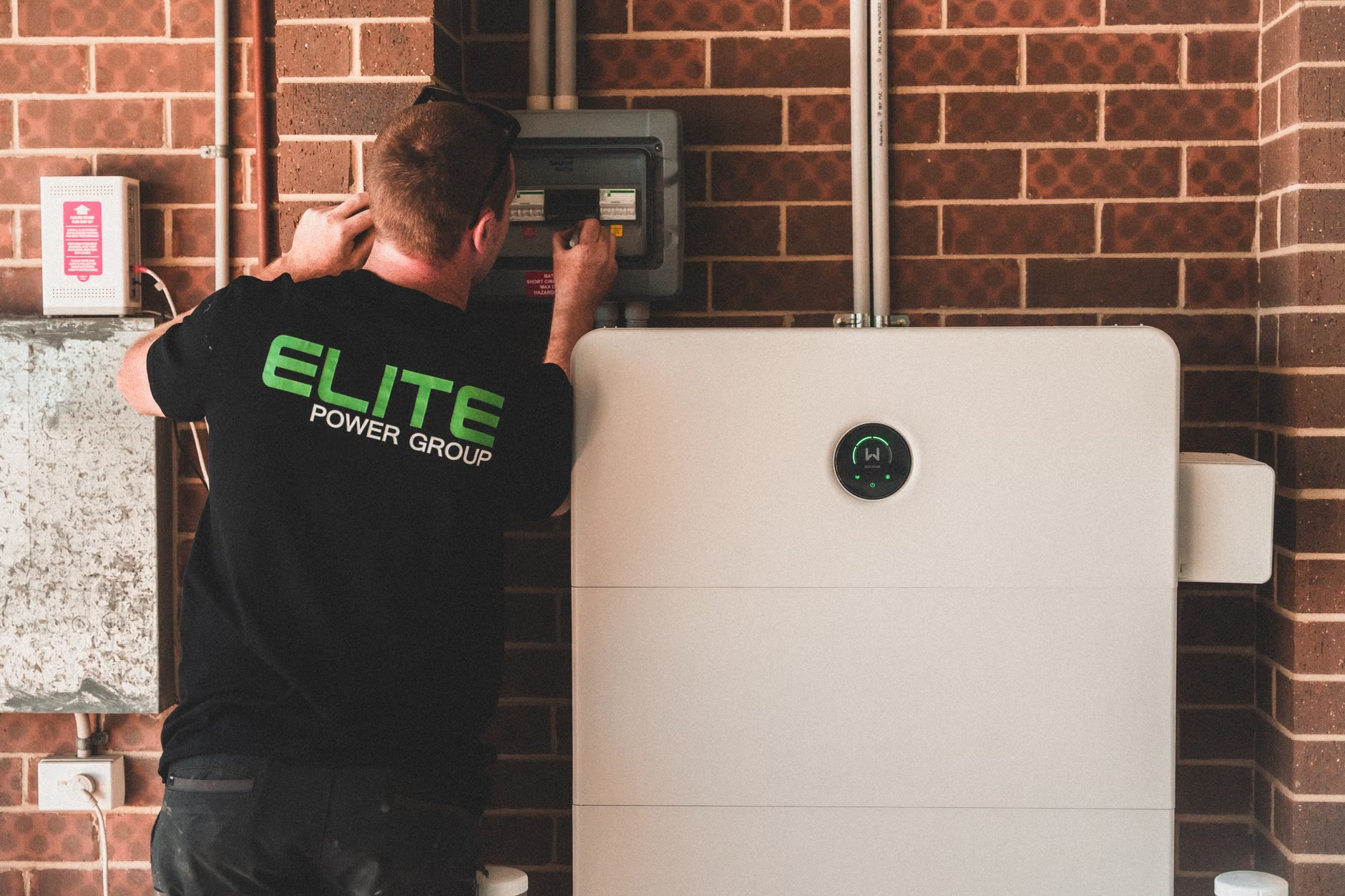
There is a persistent myth that “going solar” makes you immune to grid warnings. While solar panels are fantastic for reducing your bill, they generally do not provide power during a grid outage unless you have a battery backup system. Without a battery, your solar inverter is programmed to shut down during a blackout to prevent “back-feeding” electricity into the grid, which could electrocute utility workers trying to fix the lines.
Another misconception is that the grid will “collapse.” The reality is much more mundane: it will become more expensive and more selective. The grid isn’t going to disappear, but the era of cheap, reliable, unlimited power at the flip of a switch is evolving. The future is one of “managed consumption.” The households that thrive in 2026 will be those that treat energy as a limited resource rather than a background utility.
As we look toward 2026, the most important takeaway is that you have more agency than you think. You don’t need to be an engineer to manage your home’s energy. Start by checking your utility provider’s website for “time-of-use” rates or “demand response” programs. These are your first lines of defense against rising costs.
Secondly, keep an eye on your local infrastructure. If you’re planning a major renovation, like adding an EV charger or a heat pump, talk to your electrician about the capacity of your main panel. Upgrading your service early is much cheaper than doing it after a transformer failure in your neighborhood.
Finally, remember that these grid warnings are a signal of a massive, necessary transition. We are moving from a system built on burning carbon to one built on electrons. It’s a messy, expensive, and sometimes frustrating process, but it’s a transition that will ultimately lead to a more resilient, localized, and sustainable energy future. For now, focus on the small, daily shifts that put you in control of your budget and your home’s reliability. Stay informed, adjust your habits, and keep your household running smoothly—no matter what the grid does.
Frequently Asked Questions
Q: Will my electricity bill definitely increase in 2026?
A: While base rates are subject to utility regulations, the shift to Time-of-Use (TOU) pricing means that if you continue to use energy during peak hours, your bill will likely increase even if your total usage remains the same. Shifting your high-energy habits to off-peak hours is the primary way to mitigate these cost increases.
Q: What is a “demand response” program and should I join one?
A: A demand response program is an agreement where you allow your utility to slightly reduce your energy consumption (usually via smart devices like a thermostat or EV charger) during extreme grid stress in exchange for bill credits or cash payments. If you are comfortable with minor, temporary adjustments to your climate control or charging schedule, these programs are an excellent way to lower your costs.
Q: Is it worth buying a home battery now, or should I wait until 2026?
A: Home battery technology is evolving rapidly, and prices are generally trending downward. If you are experiencing frequent, short-duration outages or live in a region with high peak-hour electricity costs, the investment may already be worth it. If your primary goal is just to have backup power, a portable power station is often a more cost-effective entry point than a permanent, whole-home battery installation.
Official Resources for Further Tracking:
For North American readers, the North American Electric Reliability Corporation (NERC) provides regular seasonal assessments of grid reliability. For European readers, ENTSO-E offers detailed data on continental grid stability and demand trends. Checking these sources once a quarter will give you a clearer picture of your specific region’s grid health.
North American Electric Reliability Corporation (NERC) – Reliability Assessments
ENTSO-E – European Network of Transmission System Operators for Electricity