The most effective way to improve your child’s focus during home-schooling is not by forcing discipline, but by conducting a “sensory-audit” to strip away environmental triggers that cause cognitive overload. Most parents assume that a lack of concentration is a behavioral issue, but in reality, it is often a physiological response to an environment that is either too stimulating or too sterile.
- Visual noise is a primary distraction: Reducing items in the direct line of sight can increase task-persistence by up to 30% for children prone to distraction.
- Auditory buffering is a necessity: Using white noise machines or noise-canceling headphones is not just for loud environments; it creates a consistent “audio-bubble” that signals the brain to transition into work mode.
- The “Zone” approach: Separating physical space into “active learning” and “quiet output” zones prevents the brain from associating the same chair with both frustration and relaxation.
If you have ever found yourself hovering over your child, begging them to “just focus,” you have likely experienced the frustration of a mismatch between the environment and the task at hand. When we talk about a sensory-audit, we aren’t suggesting a complete home renovation. Instead, we are talking about a systematic look at the five senses—sight, sound, touch, smell, and proprioception (the body’s sense of movement)—to see what is silently draining your child’s battery before they even open a textbook.
Understanding the Mechanics of Cognitive Load
Cognitive load theory suggests that our brains have a limited capacity for processing information. In a home-schooling setting, that capacity is shared between the academic task and the environment. If your child is sitting in a room with flickering fluorescent lights, a background hum from an appliance, and a cluttered desk, a significant portion of their brainpower is being spent processing those ambient signals rather than the math problem in front of them.
For parents in their 30s and 40s, we are often balancing our own work-from-home demands with our child’s education. This creates a secondary layer of sensory stress: the “parental-presence” factor. If you are typing on a keyboard nearby, your child is subconsciously monitoring your rhythm, which further depletes their focus. A sensory-audit allows you to map out these leaks in focus and plug them with small, high-impact changes.
The Visual Audit: Less is More
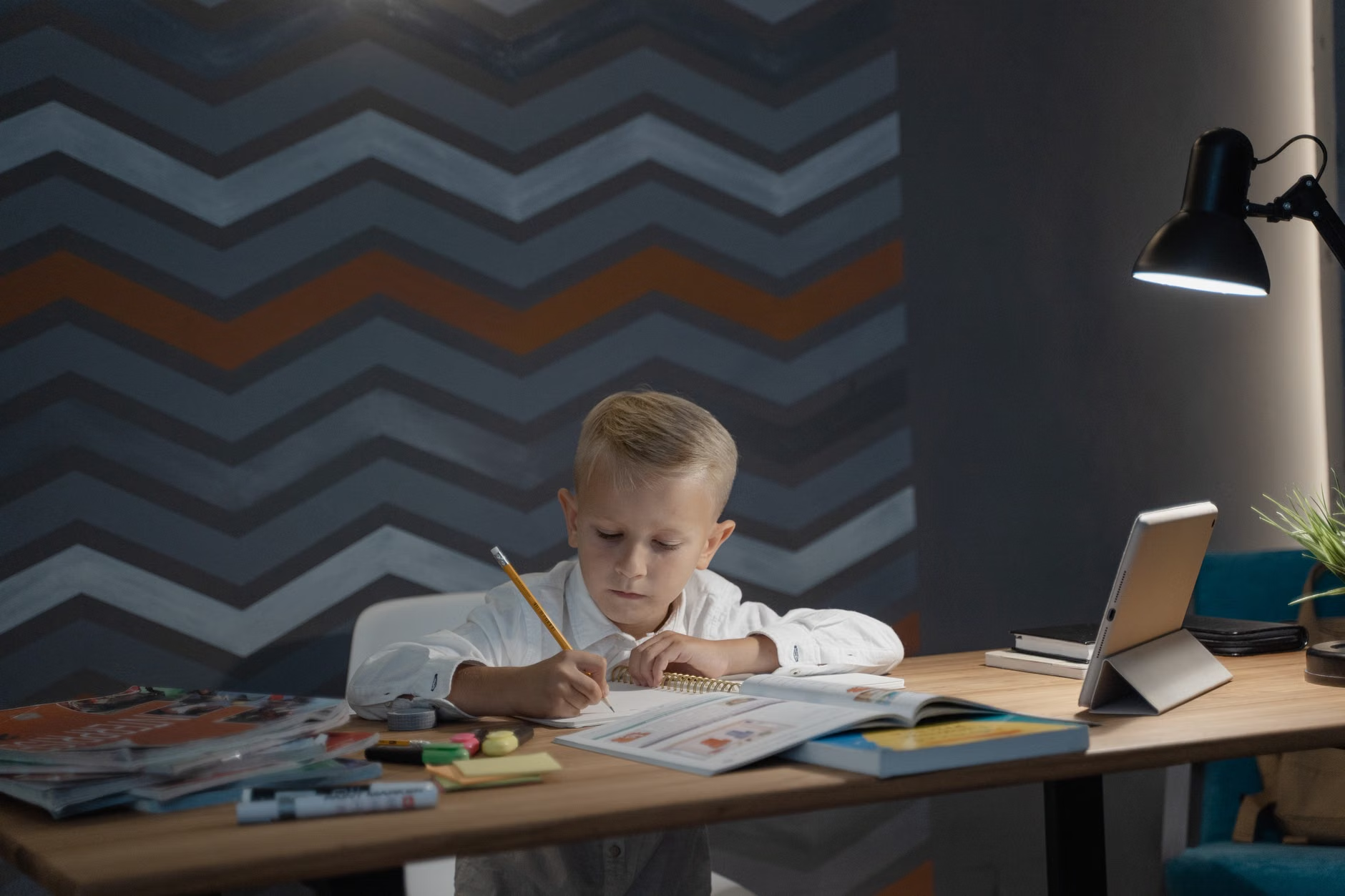
Look at your child’s workspace from their eye level. What do you see? If you see a bookshelf overflowing with colorful toys, a wall full of bright posters, and a desk covered in loose papers, you are looking at a “visual-noise” minefield. The brain is hard-wired to scan for movement and novelty. When a child is trying to read, a bright poster in their peripheral vision is a constant, low-level interruption.
Actionable Step: Implement the “Neutral-Zone” rule. Within the child’s direct field of vision—roughly a 120-degree arc in front of them—the environment should be neutral. Use solid-colored desk mats, store supplies in opaque bins rather than clear ones, and move decorative items to the space behind them. It is not about making the room boring; it is about making the work the most interesting thing in the room.
The Auditory Environment: The Invisible Barrier
Auditory input is perhaps the most overlooked factor in the home-schooling audit. Many homes have “rhythmic noise”—the sound of the dishwasher, the distant television, the hum of an HVAC system, or the clicking of a parent’s mouse. While you may have learned to “tune these out” as an adult, children often lack the neurological maturity to filter out non-essential background noise.
When conducting your audit, sit in your child’s chair for ten minutes while the house is “operating.” Do you hear the refrigerator compressor kick on? Is there a clock ticking? These sounds, while seemingly benign, can trigger an autonomic nervous system response that increases cortisol levels, leading to irritability and a shorter attention span.
Comparison Table: Auditory Management Strategies
| Strategy | Best Used For | Potential Downside |
|---|---|---|
| Active Noise Cancelling (ANC) Headphones | High-traffic homes with constant interruptions | Can cause ear fatigue over long periods |
| White/Brown Noise Machine | Masking intermittent, unpredictable sounds | May take a few days for the child to adjust |
| Soft Background Instrumental | Children who find total silence intimidating | Can become a distraction if the music has lyrics |
If you choose to use noise-canceling headphones, ensure they are comfortable for long-term wear. Many children find the pressure of over-ear headphones to be a sensory trigger in itself. If they resist headphones, a white noise machine placed near the door of the room is often a more passive and acceptable solution.
Proprioception and Movement: The Need for “Heavy Work”
One of the biggest mistakes in designing home-schooling spaces is prioritizing a “perfect” posture. We often push for the ergonomic chair and the upright back. However, for many children, especially those who are kinesthetic learners, sitting perfectly still is an active, energy-draining task. If they are spending all their focus on keeping their body still, they have nothing left for the lesson.
Proprioception refers to the body’s ability to know where it is in space. Providing “heavy work” or sensory input can actually stabilize the nervous system and increase focus. This might look like a weighted lap pad, a chair with a resistance band tied to the legs for “fidget kicking,” or allowing the child to work while kneeling or standing at a higher counter.
The Decision Rule: If your child is constantly wiggling, don’t correct the posture; change the input. Ask yourself: “Are they wiggling because they are bored, or are they wiggling because their nervous system needs input to stay alert?” If they are wiggling while actively engaged in a task, they need more sensory feedback, not less.
Tactile Comfort and the “Scratch Factor”
We often forget that clothing and desk materials play a massive role in a child’s ability to focus. A sweater with an itchy tag, a desk surface that feels “sticky” or cold, or even the feeling of a pencil that is too thin can be enough to distract a child. During your audit, check the tactile elements of the space.
Is the chair material breathable? If they are sitting on a plastic chair in a warm room, they may be dealing with the physical discomfort of sweating, which creates a subconscious urge to move or leave the space. Simple fixes, like a soft seat cushion or a desk mat that provides a warmer tactile experience, can make a significant difference. Remember, the goal is to make the environment “invisible”—when an environment is perfectly tuned, you don’t notice it at all.
The Hidden Cost of Lighting: Beyond Visibility
Lighting is not just about being able to see the page; it is about the color temperature and the frequency of the light source. LED lights with a high blue-light spectrum can increase alertness, which might be helpful for a morning math session, but can lead to “crashed” focus by early afternoon. Conversely, warm, yellow-toned lights can be soothing but may induce lethargy.
If your home-schooling space relies on overhead lighting, consider adding a task lamp that allows you to adjust the temperature. A cooler, brighter light for focused analytical work and a warmer, softer light for reading or creative tasks can help anchor the child’s brain to the specific type of work they are doing.
Managing the Parent-Child Sensory Loop
As a parent, you are a sensory input. If you are stressed, moving quickly, or talking on the phone, your child is picking up on those cues. One of the most effective, yet rarely discussed, parts of a sensory-audit is the “Parental-Buffer Zone.”
If you are working in the same room, try to establish a visual signal for when you are “off-limits.” A simple pair of headphones on your head can act as a signal that you are in deep work. This reduces the child’s anxiety about interrupting you and allows them to settle into their own space without constantly monitoring your availability. This creates a psychological boundary that mirrors the physical boundary you have established with the room’s layout.
Advanced Troubleshooting: When the Audit Seems to Fail
If you have implemented the changes above and your child is still struggling, it is time to look at the “environmental rhythm.” Sometimes the issue isn’t the space itself, but the timing of the sensory input. For example, if your child has a high need for physical movement, a 30-minute block of sedentary work followed by a 5-minute “heavy work” break (like push-ups or carrying heavy books) can reset their sensory threshold.
Another overlooked variable is the “after-school” transition. If your child comes directly from a high-stimulation environment (like a sports practice or a crowded school day) into a home-school session, their nervous system might be in a state of “fight or flight.” Providing a 15-minute “sensory-down” period—where they sit in a dim, quiet space with no demands—can act as a buffer before starting work.
Implementing the Audit: A Step-by-Step Approach
Do not try to overhaul everything at once. Pick one area—perhaps the visual environment—and test it for one week. Keep a simple log: did the child ask for fewer breaks? Did they finish their tasks faster? Data, even if it is just your own observation, is the only way to know if your changes are working. If you change everything at once, you will never know which factor was the one that actually helped.
Start with the “three-day rule.” Any change to an environment takes about three days for a child to adjust to. Do not abandon a strategy on day one because they seem “bored” or “off.” Give the new sensory environment time to become the new baseline.
The Long-Term Perspective
The goal of a sensory-audit is not to create a perfectly sterile environment, but to build a space that respects your child’s unique neurological needs. As they grow, these needs will change. A child who needs a standing desk today might prefer a quiet, enclosed corner next year. By teaching them to identify what makes them feel focused or distracted, you are giving them a skill that will serve them long after they have outgrown their home-schooling years.
Ultimately, a successful home-schooling space is one where the child feels safe, regulated, and capable. By removing the environmental friction that causes unnecessary stress, you are clearing the path for them to engage with the material in a meaningful, lasting way. Stay patient with the process—the goal is progress, not perfection.
Frequently Asked Questions
Q: Should I completely remove all posters and decorations from the study room?
A: Not necessarily. The goal is to remove distractions from the immediate field of vision. You can keep decorations, but place them on the wall behind the child or in an area that is not in their direct line of sight while they are working.
Q: How do I know if my child needs more sensory input or less?
A: Observe their behavior during a task. If they are seeking movement (fidgeting, kicking legs, rocking), they likely need more proprioceptive input, like a resistance band on their chair or a weighted lap pad. If they are easily startled, distracted by small sounds, or seem overwhelmed by light, they likely need less input, such as noise-canceling headphones or softer lighting.
Q: Is it okay to change the study space layout frequently?
A: While consistency is generally helpful, some children benefit from a “reset” every few months. However, avoid changing the layout during a period of high academic stress. If you need to make changes, do so during a break or a weekend so they can acclimate before resuming their regular schedule.
For further reading on sensory processing and educational environments, you may find these resources helpful:
CDC: Child Development and Behavioral Health
Understood.org: Resources for Learning and Thinking Differences