The most effective way to improve your child’s concentration at home isn’t by enforcing stricter rules, but by auditing the sensory environment of their study space to eliminate invisible distractions.
- Sensory overload is a leading cause of task avoidance: By controlling light, sound, and visual clutter, you can physically lower your child’s cortisol levels during study time.
- The “Three-Zone” approach: Distinguish between active learning, deep focus, and relaxation to prevent cognitive fatigue.
- Personalization vs. Distraction: Small, tactile sensory inputs (like a stress ball or textured mat) can actually improve focus, whereas visual clutter (posters, loose papers) significantly degrades it.
If you have ever found yourself hovering over your child while they struggle through a math worksheet, only to realize the real problem wasn’t the math—it was the buzzing fluorescent light, the sibling playing in the next room, or the mountain of craft supplies on the desk—you aren’t alone. As parents in our 30s and 40s, we are often managing our own work-from-home lives while trying to facilitate our children’s education. We treat the “study space” as a static object: a desk and a chair. But a study space is a dynamic sensory ecosystem.
Why Your Current Setup Might Be Working Against You
When we design a workspace for a child, we often prioritize aesthetics or “school-like” efficiency. We buy the bright posters, the colorful organizers, and the high-tech gadgets. However, research into sensory processing suggests that for many children, these elements act as “sensory noise.”
Sensory processing refers to how the brain receives, organizes, and responds to sensory input. When a child’s environment is too stimulating, their brain spends energy filtering out background noise, flickering lights, or visual clutter rather than focusing on the task at hand. This is often misinterpreted as “laziness” or “lack of motivation.” If the brain is busy managing the environment, it has less bandwidth for executive functions—like planning, memory, and impulse control.
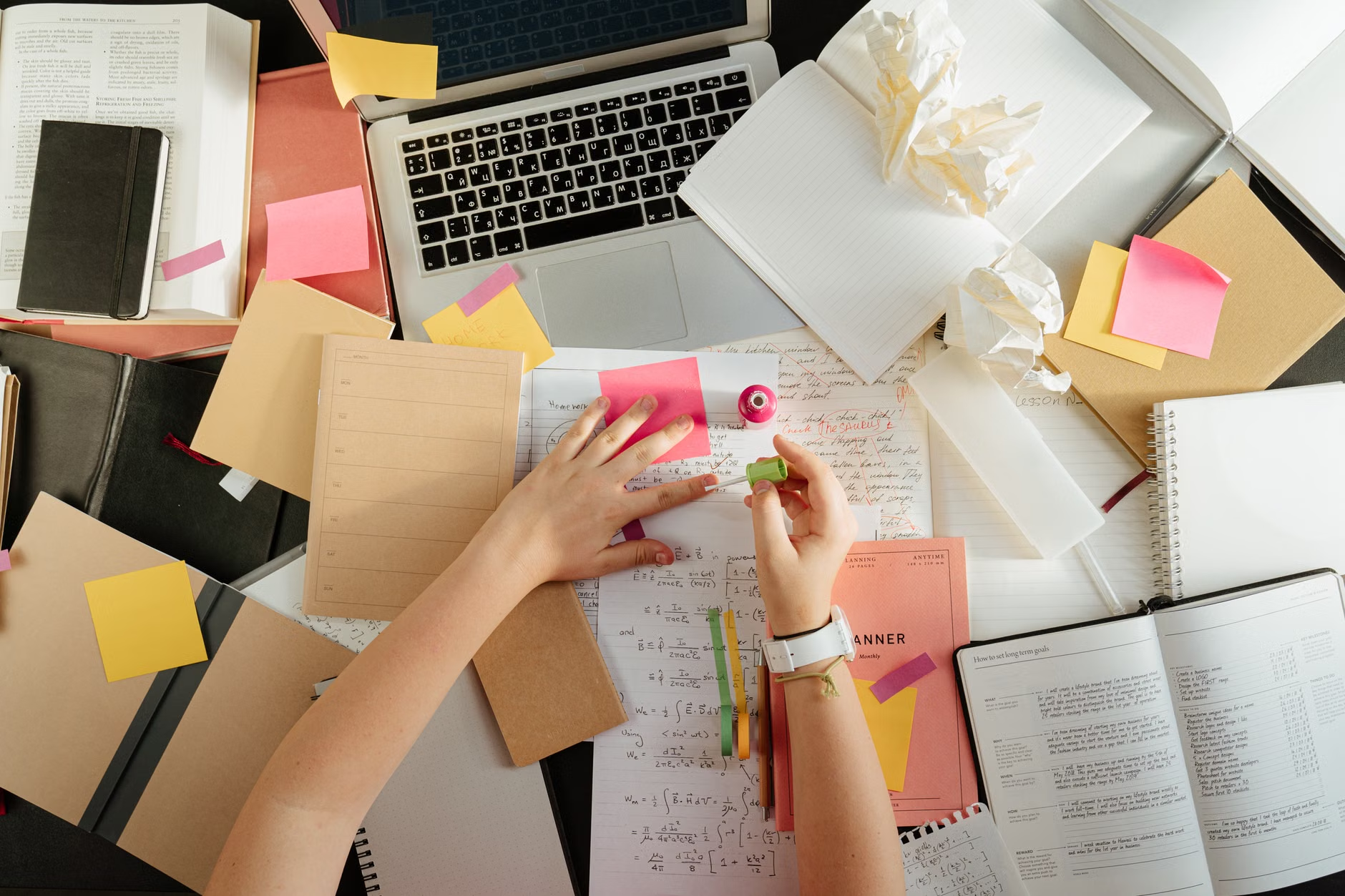
Consider the “Cognitive Load Theory.” Every piece of information in the visual field competes for attention. If a child’s desk is covered in stickers, pens, and loose papers, their brain is constantly processing that visual input. By performing a sensory audit, you are essentially reducing the “background noise” of their workspace, freeing up cognitive capacity for the actual learning task.
The Step-by-Step Sensory Audit
Conducting a sensory audit doesn’t require a renovation. It requires a systematic observation of the space through your child’s perspective. Follow these four steps to audit and optimize your home-schooling environment.
Step 1: The Auditory Scan
Sit in your child’s chair for 10 minutes during their typical study time. Do not look at your phone. Just listen. What do you hear? Is it the hum of the refrigerator? The muffled sound of a television? The rhythmic tapping of a neighbor’s foot? These sounds, while seemingly innocuous, can trigger a stress response in sensitive children.
Action: If the space is noisy, introduce “white noise” or “pink noise.” Unlike music with lyrics, which competes with the language centers of the brain, consistent white noise creates an auditory barrier that masks sudden, distracting sounds. Noise-canceling headphones are a gold-standard investment, but even a simple desk-top fan can provide the necessary sound dampening.
Step 2: The Visual Clutter Assessment
Look at the desk from the child’s eye level. Is there a view of a busy hallway or a window with high-traffic activity? Are there too many bright colors or complex patterns in their peripheral vision? A common mistake is placing a desk facing a window with a lot of outdoor movement. While natural light is excellent, the visual stimulation of pedestrians or vehicles is a major distractor.
Action: Use the “Desk-Edge Rule.” If the area within 12 inches of the edge of the desk contains more than three items (not counting the task at hand), it is likely too cluttered. Move extra supplies to a nearby shelf or a drawer. Keep the desktop surface clear of everything except what is needed for the current subject.
Step 3: The Tactile and Ergonomic Check
Physical comfort is the foundation of mental focus. If a child’s feet are dangling, their body is constantly fighting gravity to remain stable, which drains energy. If the chair is too hard or the desk is the wrong height, they will constantly shift, creating “micro-movements” that distract from learning.
Action: Ensure the “90-90-90” rule: feet flat on the floor (or a footrest), knees at 90 degrees, and elbows at 90 degrees on the desk surface. If a child is a “fidgeter,” don’t try to stop the movement. Instead, give them an appropriate outlet, such as a textured sensory strip under the desk or a silent stress ball. This allows them to regulate their nervous system without disrupting their work.
Step 4: The Lighting Balance
Overhead fluorescent lighting is notoriously hard on the eyes and can cause low-level anxiety in some individuals. If you can, supplement with a warm-toned desk lamp (around 3000K). This creates a “focus pool”—a visual cue that signals to the brain that the area inside the light is for work and the area outside is for rest.
The Three-Zone Framework: Separating Tasks
One of the biggest mistakes in home-schooling is expecting one desk to handle every type of work. Research into environmental psychology suggests that our brains associate certain physical spaces with specific mental states. If you eat, play games, and do difficult math homework at the same desk, the brain becomes confused about what “mode” it should be in.
To fix this, implement the “Three-Zone Framework.” You don’t need a massive house to do this; you just need to redefine how you use existing furniture.
| Zone | Purpose | Sensory Requirement |
|---|---|---|
| The Focus Zone | Deep concentration, writing, math. | Minimalist, quiet, warm light. |
| The Active Zone | Creative projects, reading, discussion. | Flexible, natural light, background music. |
| The Reset Zone | Breaks, snacks, emotional regulation. | Comfortable, visual distance, no school items. |
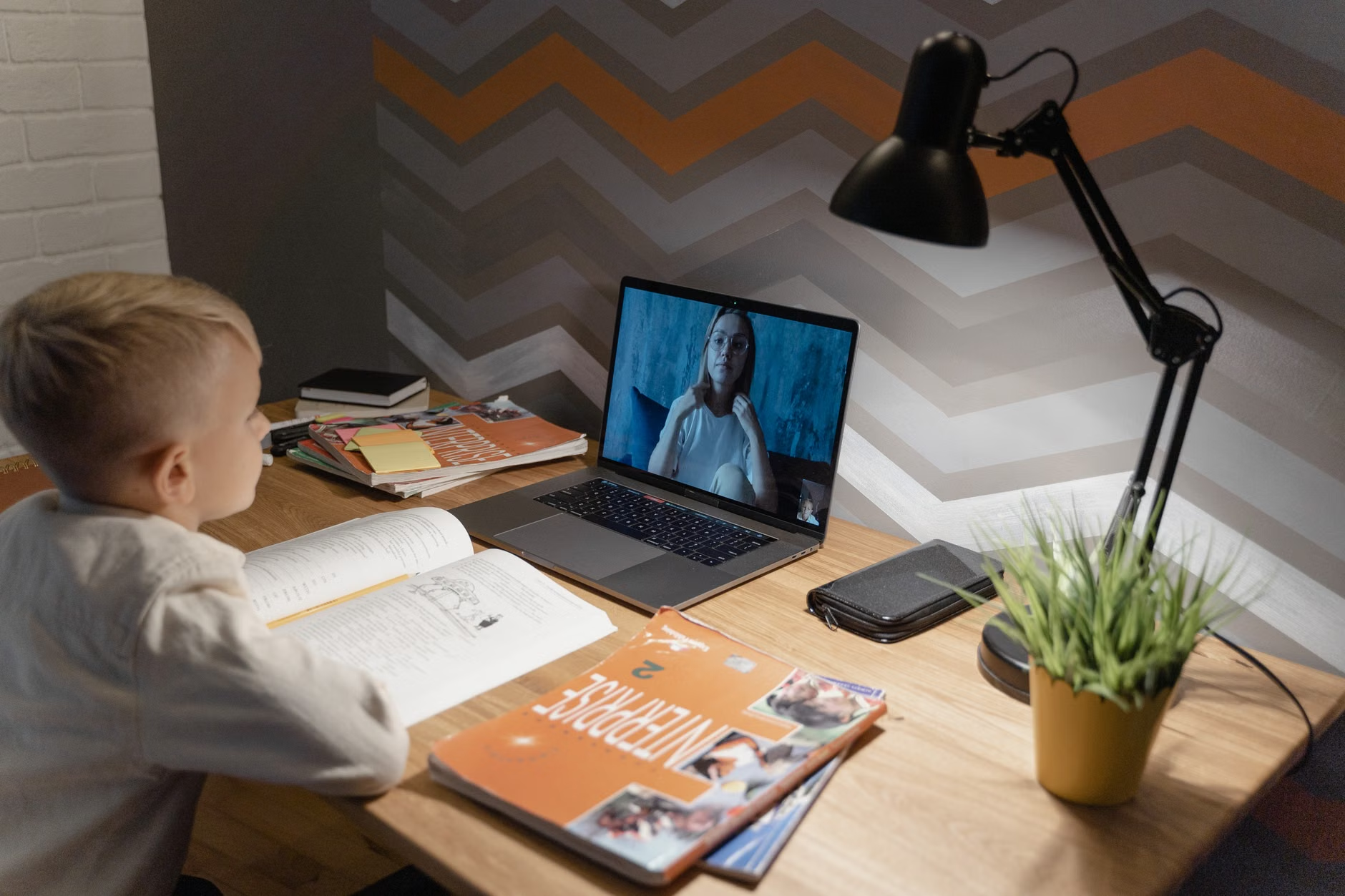
The Focus Zone should be the most rigid. No toys, no phones, no snacks. The Active Zone can be a common area like the kitchen table, where communication is encouraged. The Reset Zone is crucial—it should be a place where the child can go to “decompress” for 5–10 minutes without being reminded of their unfinished tasks. This separation helps the child psychologically switch gears, which is often the hardest part of home-based learning.
Common Misconceptions About Productive Spaces
We often fall for “productivity myths” that are actually counterproductive for children. Let’s address the most common ones.
“A Busy Desk Means a Busy Mind”
Many parents believe that keeping every resource—dictionaries, calculators, pens, markers, glue—on the desk makes the child more efficient. In reality, this is “decision fatigue.” If the child has to navigate a cluttered desk to find a pencil, they lose their train of thought. Keep tools in a “caddy” that is stored away and only brought out when needed.
“Absolute Silence is Best”
While chaos is bad, absolute, vacuum-like silence can also be distracting. In a quiet house, every tiny sound (like a distant car or a ticking clock) becomes amplified. A bit of “neutral” background noise—like a fan or low-volume instrumental music—acts as a sensory buffer, smoothing out the peaks of sudden, distracting noises.
“The ‘Perfect’ Chair is the Expensive One”
You do not need a high-end ergonomic office chair. You need a chair that fits. For younger children, a simple stool with a sturdy footrest is often better than an adjustable office chair that they can spin in. If the child is spinning, they are seeking vestibular input—they are bored or over-stimulated. Instead of a “better” chair, they need a short movement break.
Advanced Troubleshooting: When the Audit Isn’t Enough
If you have optimized the sensory environment and your child is still struggling, consider the “Internal Sensory Audit.” Sometimes, the distraction isn’t in the room; it’s in the body. Hunger, thirst, or sleep deprivation are the ultimate sensory distractors. A child who is slightly dehydrated or has low blood sugar will have a significantly lower threshold for sensory irritation.
Before every study session, implement a “Body Check”:
- Hydration: A glass of water.
- Glucose: A protein-rich snack (not high sugar, which causes a spike and crash).
- The 5-Minute “Wiggle”: A quick burst of physical activity to burn off excess energy before sitting down.
These are not just “good habits”; they are biological requirements for the brain to engage in high-level cognitive work. If you skip these, you are trying to drive a car with no fuel. No amount of interior design will fix a lack of fuel.
The Hidden Cost of “Multitasking” Spaces
We live in an age where we are constantly multitasking, and we often project this onto our children. We think, “They can do their homework while listening to a podcast.” While some individuals can focus with background stimulation, most children require a “single-tasking” environment to develop deep focus. The cost of multitasking is not just lower quality of work; it is the erosion of the child’s ability to sustain attention over time.
When you allow a child to keep their phone or tablet next to their desk while they study, the “sensory pull” of a notification is nearly impossible for a developing brain to ignore. Even if they don’t look at it, the brain is using energy to *inhibit* the impulse to look at it. This is called “inhibitory control,” and it is a finite resource. By removing the device from the room entirely, you are effectively giving your child a larger “battery” of focus to spend on their work.
Creating a Sustainable Routine
A sensory audit is not a one-time event. As your child grows, their sensory needs will change. A middle-schooler might find a desk lamp that was once comforting to be too dim, or they might prefer total silence over white noise. Re-evaluate the space every three to six months.
Involve your child in the process. Ask them, “Does this light feel too bright?” or “Do you find yourself looking at the window too much?” When they have agency over their environment, they are more likely to take responsibility for their focus. This is a critical life skill—teaching them to recognize what they need to be productive is a lesson they will carry into university and their professional careers.
The goal is not to create a sterile, hospital-like environment. It is to create a “low-friction” environment where the path of least resistance is to focus. When the environment supports the task, the constant friction between parent and child—the “why aren’t you working?” arguments—naturally begins to subside.
Final Thoughts and Next Actions
Your child’s workspace is a tool for their success, not just a place to store books. By performing a sensory audit, you are removing the invisible barriers to their concentration. Start by clearing the desk, checking the lighting, and managing the auditory environment. Remember that the best environment is one that is tailored to the individual, not to a generic idea of what a study space “should” look like.
If you take only one action today, make it the “Desk-Edge Rule” clear-out. You will likely be surprised at how much more quickly your child settles into their work once the visual noise is gone.
Official Resources and Further Reading:
- For a deeper dive into how environment affects learning, the Edutopia library offers extensive research on classroom and home learning environments.
- The Understood.org website provides excellent, practical checklists for creating sensory-friendly environments for children with different learning needs.
Frequently Asked Questions
1. My child refuses to study without music. Is this a sensory issue?
It can be a “sensory seeking” behavior. Some children use music to drown out internal thoughts or environmental noise. If the music has lyrics, it will compete with their language centers. Try replacing pop or rap music with instrumental, lo-fi, or “binaural beats” playlists. These provide the sensory input they crave without the cognitive load of processing language.
2. How often should I re-evaluate the study space?
Every school term, or every 3–4 months. As children hit growth spurts, their physical needs change (desk height, chair comfort). Furthermore, as the complexity of their schoolwork increases, their need for a “low-distraction” environment often becomes more acute. Use the start of a new term as a natural trigger to “audit” the space.
3. What if we don’t have a separate room for a “Focus Zone”?
You don’t need a separate room. You need a “sensory boundary.” This can be a folding screen, a specific desk mat that is only placed down during study time, or even a specific pair of noise-canceling headphones that acts as a “do not disturb” signal to the rest of the household. The goal is to create a clear psychological signal that the “Focus Zone” is active.