The secret to a successful city break in your 30s and 40s is not how much you pack into your itinerary, but how little friction you experience between your front door and your destination. By swapping short-haul flights for high-speed rail, you eliminate the “airport tax”—the hours spent in security lines, boarding gates, and transit—and replace it with a transition period that actually feels like part of your holiday.
- The 4-Hour Rule: Rail travel becomes significantly more efficient than flying when the city center-to-city center travel time is under four hours, accounting for total transit and airport wait times.
- Productive Transitions: Trains allow for genuine downtime, working, or playing with children, unlike the cramped, high-stress environment of commercial aviation.
- The “Doorstep” Advantage: Arriving at a central station rather than an airport terminal saves an average of 60 to 90 minutes of transit time and significant taxi or shuttle costs.
Why the “Weekend-Rail” Strategy Changes Everything
If you are in your 30s or 40s, you likely remember the era of “budget” air travel as a thrill. Today, it often feels like a logistical chore. Between the liquids restrictions, the mandatory two-hour arrival windows, and the physical toll of navigating massive airport terminals, a two-day trip can leave you more exhausted than when you left. The “Weekend-Rail” strategy is a shift in mindset: you stop viewing travel time as “lost time” and start viewing it as an extension of your weekend.
When you choose the train, you move from the periphery of a city to its heart. Consider the math: a 60-minute flight might be fast on paper, but when you factor in traveling to the airport (45 mins), arriving early (120 mins), boarding/deboarding (30 mins), and reaching the city center from the airport (45 mins), your “one-hour flight” has consumed nearly five hours of your life. Rail travel, by contrast, drops you in the city center. You simply step off the platform and into the culture.
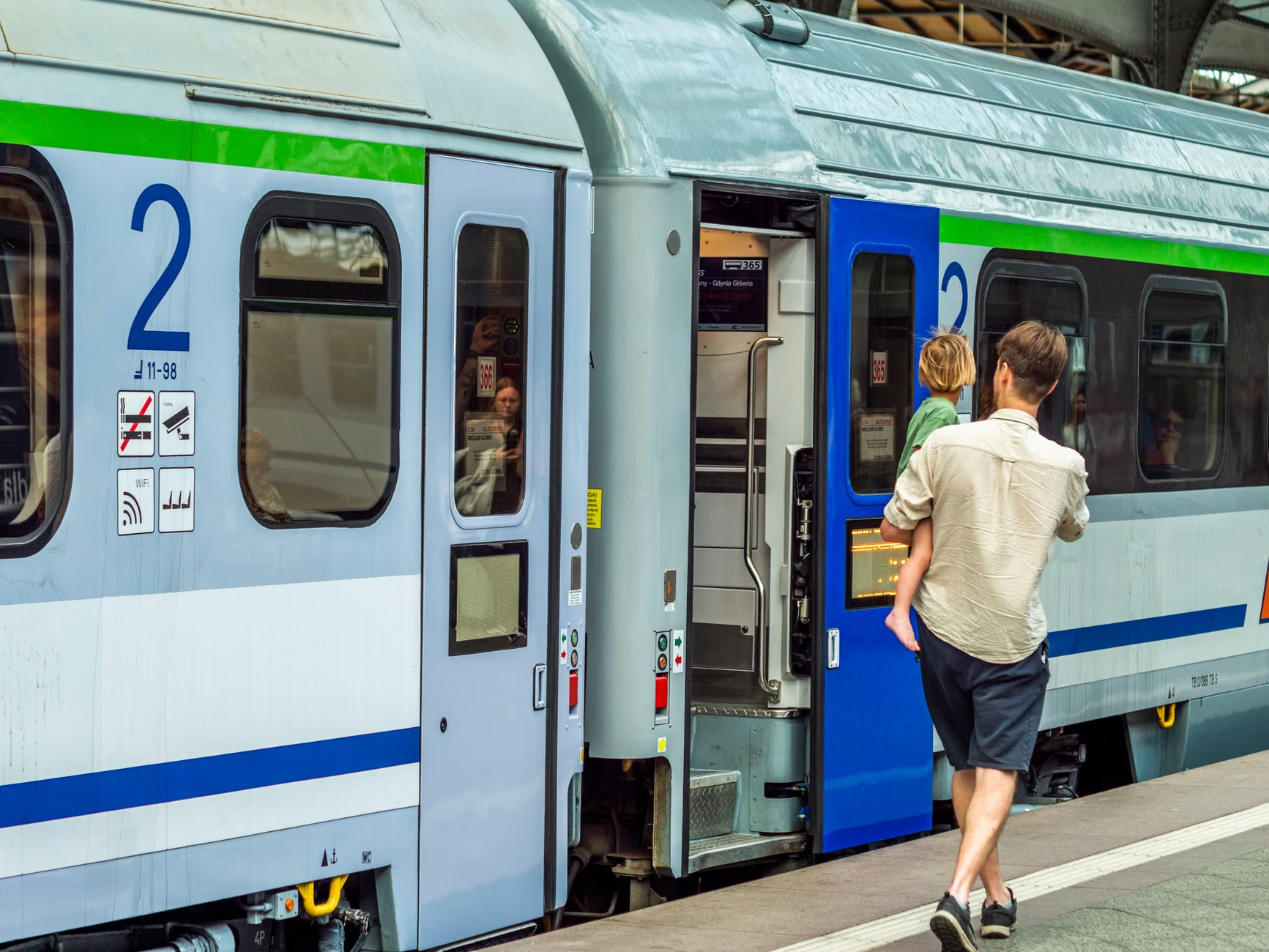
Understanding the “Total Time” Equation
To implement this strategy, you must stop looking at flight times and start looking at “Total Door-to-Door Time.” Most regional airports are located on the outskirts of metropolitan areas. Even if a flight is shorter, the cumulative time spent in transit creates a “fragmented weekend.” You end up with a Friday night lost to logistics and a Sunday afternoon cut short by the need to return to the airport early.
Rail travel provides a “continuous” experience. If you are traveling with a partner or children, the ability to walk around, access a restroom without waiting for the seatbelt sign to turn off, and share a meal at a table makes the travel portion of your trip a bonding experience rather than a series of hurdles to overcome. This is the primary reason why seasoned travelers in their mid-career transition toward rail whenever possible.
Choosing the Right Route: The 4-Hour Threshold
Not every journey is ideal for the rail. The “Weekend-Rail” strategy relies on a specific threshold: if the travel time is four hours or less, the train is almost always the superior choice. Beyond four hours, you start to see diminishing returns on comfort versus time lost. However, this is not a hard law; it is a guideline based on the trade-off between the quality of the journey and the duration of the trip.
When evaluating a potential destination, create a simple comparison table to see if the rail option is viable. Look past the ticket price and look at the “hidden costs” of flying—such as airport parking, checked bag fees, and the cost of the train or taxi from the airport to the city center.
| Factor | Short-Haul Flight | High-Speed Rail |
|---|---|---|
| Arrival Time | 2 Hours before departure | 15-20 Minutes before departure |
| Luggage | Strict limits/fees | Generous, no liquid restrictions |
| Environment | Cramped, noisy | Spacious, desk space, power |
| Arrival Point | Suburbs/Outskirts | City Center |
This table illustrates why the rail option is often the “hidden” winner. Even if the train ticket appears slightly more expensive at first glance, the lack of ancillary costs (like airport transfers) often brings the total price to parity or lower. For a family of four, the cost of airport shuttle tickets alone can exceed the price of a rail upgrade to a more comfortable carriage.

Practical Steps to Execute Your Weekend-Rail Getaway
Executing this strategy requires a change in how you pack and plan. Because you aren’t dealing with the rigid security protocols of airports, you have more flexibility, but you also have more responsibility for your own luggage. Here is how to prep for a seamless transition.
1. Master the “Station-First” Booking
Always check the destination station’s location before booking your hotel. The goal is to arrive at the station and be within walking distance or a short, direct transit ride to your accommodation. If your hotel is near the central station, you eliminate the need for taxis entirely. This saves you from the stress of navigating unfamiliar public transport systems or waiting for ride-shares in a crowded city.
2. The “Station-to-Hotel” Luggage Strategy
If you arrive before check-in time, do not haul your suitcases through the city. Most major rail stations have secure luggage lockers or left-luggage offices. Use them. Drop your bags, grab a coffee, and start your city break immediately. This is a massive improvement over flying, where you are often tethered to your luggage until you can reach your accommodation, which might be an hour away from the airport.
3. Digital Preparation
Download the national or regional rail apps for the country you are visiting. Do not rely on third-party aggregators if possible; booking directly with the operator (e.g., SNCF in France, DB in Germany, Amtrak in the US) ensures you receive real-time notifications about platform changes or delays. Keep your digital tickets in your phone’s wallet app for instant access.
Addressing Common Misconceptions and Trade-offs
A common critique of the “Weekend-Rail” strategy is that it is “too slow.” It is important to redefine what “slow” means here. If “fast” means spending three hours in security and boarding lines to save 30 minutes of travel time, then “fast” is actually inefficient. The misconception is that all travel time is negative. In reality, on a train, the time you spend traveling is time you can spend reading, catching up on emails, or talking to your family without the constant interruptions of in-flight announcements or turbulence.
Another trade-off to consider is the “flexibility vs. cost” dynamic. Rail tickets, especially in Europe or Japan, often operate on a tiered pricing system similar to airlines. If you book well in advance, you can secure significant discounts. If you wait until the last minute, prices can spike. The key is to treat your weekend rail ticket like a flight—book it as soon as you have your dates confirmed.
Warning: Avoid the “intermodal trap.” Do not attempt to combine a flight and a train unless you have a massive buffer. If your flight is delayed, your non-refundable rail ticket is likely lost. Stick to a “pure” rail strategy for the entire journey from your home region to your destination to ensure you are covered by the carrier’s delay policies.

The Psychological Benefit: Why This Matters
For those in their 30s and 40s, the “mental load” is often the biggest barrier to travel. We are managing careers, households, and perhaps children. The administrative burden of flying—checking in, managing digital boarding passes, worrying about liquid allowances, and monitoring airport security wait times—is a massive cognitive drain. The Weekend-Rail strategy removes this layer of complexity.
When you walk onto a train, you are essentially “there.” The transition is smooth, the environment is predictable, and the stress levels are significantly lower. This allows you to arrive at your destination with your “holiday energy” intact. You aren’t recovering from the journey; you are ready to begin the experience. For parents, this is especially valuable. A child who can move around a train carriage is a much happier traveler than one strapped into a seat for two hours of a flight.
Refining Your Travel Decision Criteria
To decide if a destination is right for a rail trip, use the “Three-Point Check”:
- Connectivity: Is the train route direct? A direct, three-hour train journey is infinitely better than a two-hour train journey that requires two transfers.
- Comfort: Does the rail operator offer dedicated “quiet zones” or family carriages? Check the operator’s website to see what amenities are available.
- Destination Proximity: Is the city center accessible from the station via walking or a direct metro line?
If the answer to all three is “yes,” you have a prime candidate for a stress-free weekend. If the answer is “no,” you may need to reconsider if the destination is worth the added complexity of a flight or a car rental.
Ultimately, the goal is to reclaim your leisure time. By choosing the rail, you are choosing to prioritize your well-being over the illusion of speed. You are choosing to see the landscape change outside your window rather than staring at the back of a seat. You are choosing to arrive ready to explore, not ready to collapse.
Frequently Asked Questions
1. Is rail travel really cheaper than flying for short trips?
Often, yes, when you account for the “hidden costs.” Once you calculate the cost of getting to and from the airport, checked baggage fees, and the cost of food inside the airport, the rail ticket often comes out as the more economical option. Use a price comparison tool that includes airport transfer costs to get an accurate picture.
2. How do I handle delays or cancellations when traveling by rail?
Rail operators are generally more flexible than airlines. If you miss a train, many tickets (depending on the fare class) allow you to board the next available train. Always check the fare conditions before booking. Unlike airlines, where a missed connection can ruin an entire itinerary, rail networks usually have high-frequency service, meaning another train is often arriving within the hour.
3. What if I am traveling with young children?
Rail travel is vastly superior for families. You have more space to move, easier access to toilets, and often dedicated family areas. Most modern trains also have power outlets at every seat, allowing you to keep devices charged for entertainment. Pack light, bring snacks, and utilize the extra space to make the journey part of the fun rather than a hurdle.
For more information on planning your next rail trip, you can consult official resources like Eurail for European travel or the Amtrak website for North American routes. These sites provide comprehensive guides on route planning, station facilities, and ticket classes to help you tailor your journey to your specific needs.
The next time you are planning a weekend escape, resist the urge to book the first flight that appears in your search results. Look at a map, find a rail line, and consider the quality of the journey as much as the destination. You might find that the best part of your weekend is the time you spend getting there.