The most effective way to reduce a child’s tantrums and improve their social resilience is to move them beyond the basic binary of “happy” and “sad” by teaching them specific emotional labels.
- Precision reduces frustration: Children who can label their feelings as “frustrated” versus “overwhelmed” show significantly lower levels of physical aggression because they can communicate their needs instead of acting them out.
- The “Name it to Tame it” effect: Using a specific word for an emotion activates the prefrontal cortex, helping to dampen the reactivity of the amygdala, the brain’s emotional alarm system.
- Modeling is the primary curriculum: You don’t need a degree in psychology; simply narrating your own complex feelings—such as saying, “I’m feeling a bit discouraged because this project didn’t go as planned”—builds a broader vocabulary for your child.
Why “Happy” and “Sad” Aren’t Enough for Emotional Growth
We often ask children, “How was your day?” or “Are you happy?” and accept the simple answer provided. While this feels like a standard conversation, it inadvertently limits a child’s ability to process their internal landscape. If a child only has two or three buckets to put their feelings into, they are forced to categorize complex experiences—like feeling left out, feeling nervous, or feeling pride—into the same narrow boxes. When a child feels “bad” but can’t explain why, that energy has nowhere to go except into a meltdown.
In our 30s and 40s, we are balancing the demands of modern work, social expectations, and the constant input of digital life. We know that when we are “stressed,” it’s often a cocktail of fatigue, deadline pressure, and a lack of control. If we can distinguish between those, we can manage them. For a child in their early school years—roughly ages 4 to 8—this is the foundational period for building that same mental toolkit. Research in developmental psychology, particularly studies on “affect labeling,” suggests that the ability to identify and describe one’s own emotions is a cornerstone of emotional intelligence (EQ).
When a child lacks the vocabulary to describe their inner state, they experience what psychologists call “emotional granularity.” Those with low granularity experience life in broad, sweeping strokes: everything is either “good” or “terrible.” Those with high granularity can parse out the nuances: they can feel “nervous” about a test but “excited” about the recess game afterward. This nuance is exactly what helps them navigate social conflicts at school, where a misunderstanding with a friend isn’t just “mean” (the only word they might have), but perhaps “thoughtless” or “accidental.”
The Science of “Name It to Tame It”
The concept of “Name it to Tame it,” popularized by psychiatrist Dr. Dan Siegel, is not just a catchy phrase; it is a neurological strategy. When a child is in the throes of a strong emotion, the emotional center of their brain (the amygdala) is essentially hijacked. They are in “fight or flight” mode. By encouraging them to label the feeling, we are forcing the brain to shift gears from the reactive, emotional brain to the logical, linguistic brain (the prefrontal cortex).
Think of it like this: if you are trying to organize a messy room, you first have to sort the items into bins. If you don’t have bins, you just have a pile. Labeling an emotion is like creating a bin. Once the “frustration” is in its own bin, it is no longer a chaotic pile of “I hate everything.” It becomes a manageable, singular feeling that can be addressed.
How to identify the “Missing Words” in your child’s vocabulary
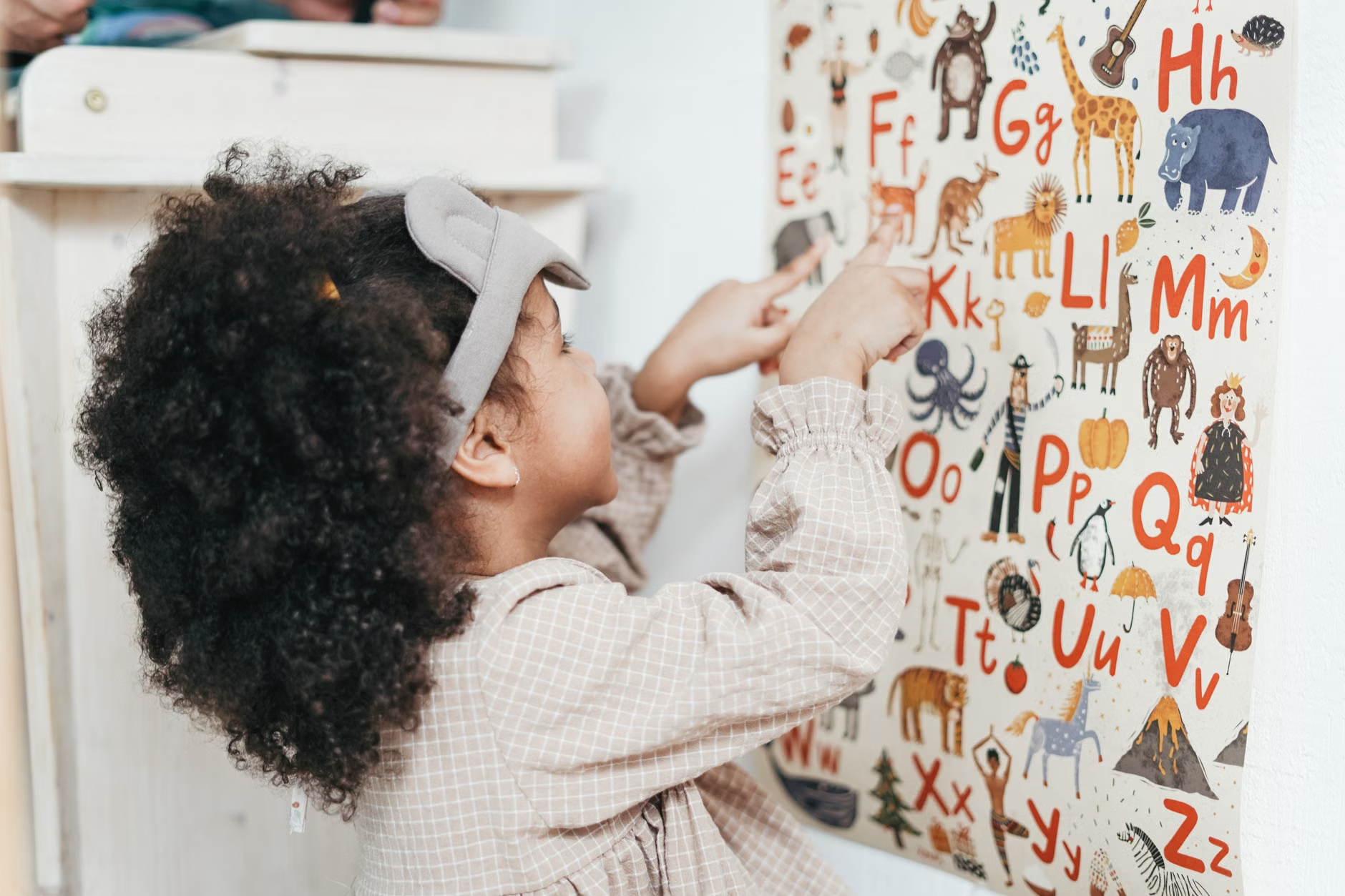
Most children learn “happy,” “sad,” “angry,” and “scared” by age three. By age five or six, they should be expanding into more specific territory. If your child seems to cycle through the same three labels, it is time to introduce a more sophisticated lexicon. We aren’t looking to turn them into poets, but rather to give them the tools to describe their reality with accuracy.
| Basic Label | The “Nuanced” Upgrade | When to Use It |
|---|---|---|
| Angry | Frustrated, Irritated, Jealous | When they can’t get a toy to work or feel sidelined. |
| Sad | Disappointed, Lonely, Hurt | When a playdate is canceled or a friend says something unkind. |
| Scared | Nervous, Worried, Uncertain | Before a new activity or a school performance. |
The goal is to help your child identify the condition under which they feel a certain way. If they say, “I’m angry,” you might ask, “Are you angry, or are you feeling disappointed that we have to stop playing?” This subtle shift encourages them to evaluate their own internal state rather than just reacting to the intensity of the feeling.
Practical Strategies for Daily Integration
You don’t need a formal “lesson plan” to build emotional vocabulary. In fact, the most effective learning happens in the micro-moments of everyday life. If you turn this into a chore, the child will tune it out. If you turn it into a part of your family’s shared language, it becomes second nature.
1. Narrate your own emotional state
Children are master observers. They watch how you handle stress, disappointment, and joy. If you hide your emotions, they don’t learn how to process them. Instead, try narrating your own experiences in a way that is age-appropriate. You don’t need to burden them with adult problems, but you can share the *feeling*.
For example: “I’m feeling a bit overwhelmed because I have a lot of work to finish before the weekend, so I’m going to take five minutes to breathe before we start dinner.” This does two things: it models the vocabulary (overwhelmed) and it models the regulation strategy (taking a break).
2. Use the “Emotion Wheel” approach
Visual aids are incredibly helpful for early schoolers. You can find “emotion wheels” or charts online that display faces with different expressions labeled with specific words. Instead of asking, “How do you feel?” (which is a massive, open-ended question that is hard to answer), try saying, “You look like you’re having a tough moment. Do you feel frustrated, or maybe a bit disappointed?” This gives them a multiple-choice option, which is much easier to process than an essay question.

3. Leverage storytelling and media
When you are reading books or watching a show together, pause when a character experiences a strong emotion. Ask your child, “Why do you think they look like that?” or “Do you think they are feeling scared, or maybe just surprised?” This allows them to practice identifying and labeling emotions in a safe, third-party context. It is much easier to analyze someone else’s feelings than one’s own.
Common Pitfalls and How to Avoid Them
Even with the best intentions, it is easy to fall into traps that can actually hinder emotional development. Here are three common mistakes parents often make and how to correct them.
- The “Invalidation” trap: Telling a child, “Don’t be sad, it’s not a big deal,” effectively tells them that their emotional experience is wrong or unimportant. Instead, validate the feeling first: “I can see you’re really disappointed that we can’t go to the park.” Once they feel heard, they are much more open to moving on.
- The “Fix-it” impulse: We want our children to be happy, so we rush to solve the source of their unhappiness. If they are frustrated with a puzzle, we might just do it for them. This denies them the opportunity to sit with the feeling of frustration and learn how to self-regulate. Instead, support them through the feeling: “I see you’re getting frustrated with those pieces. That’s tough. Do you want to take a break, or should we look at the edges together?”
- Assuming “Good” is the only goal: Some parents unintentionally praise only “positive” emotions and discourage “negative” ones. This teaches children that being sad or angry is “bad.” It is crucial to frame all emotions as valid and useful. Anger can be a signal that a boundary has been crossed; sadness can be a signal that something matters to us.
Creating a Supportive Home Environment
Building emotional vocabulary is a long-term investment. It won’t happen overnight, and there will be days when your child is too dysregulated to use their words. That is normal. The goal is to create a culture in your home where feelings are discussed as naturally as the weather.
Consider setting up a “calm-down corner” or a “cozy zone” in your home. This shouldn’t be a place for punishment, but a place for reflection. Keep a few books about emotions there, or a small mirror where they can practice making different faces. When they are feeling overwhelmed, you can suggest, “Would you like to go to the cozy zone for a few minutes to reset?”

This approach moves the focus from “behaving well” to “understanding oneself.” When a child understands what they are feeling, they are less likely to act out in ways that are disruptive or harmful. They gain a sense of agency over their own internal state. This is the ultimate goal of parenting: not to prevent all negative emotions, but to give our children the tools to navigate them with grace and self-awareness.
Remember that this is a skill like any other. Just as they learn to read and write, they are learning to read and write their own emotions. It requires practice, patience, and a lot of repetition. There will be times when you forget to model this, or when you lose your own cool. That’s okay. You can always apologize and pivot: “I’m sorry I raised my voice. I was feeling really stressed, and I didn’t handle it very well. Let’s try that again.” This level of transparency is arguably the most powerful lesson you can teach.
For further reading on the development of emotional intelligence in children, the Zero to Three organization provides excellent resources on early childhood social-emotional development. Their guides often break down how children process information at different stages of their growth, which can be a great help for parents in their 30s and 40s looking for evidence-based strategies.
Frequently Asked Questions
1. My child is 4 years old and still has major meltdowns. Is this normal?
Yes, it is completely normal. At age four, the brain’s emotional regulation centers are still developing. Meltdowns are often a sign of being overstimulated or unable to express needs. By consistently labeling their emotions during calmer moments, you provide them with the vocabulary they will eventually use to prevent those meltdowns before they reach a boiling point.
2. Should I push my child to talk about their feelings if they don’t want to?
No, forced conversation rarely works. If your child is resistant, try simply labeling it for them: “You seem pretty frustrated right now. I’m going to give you some space, but I’m here if you want to talk later.” This shows you are observant and supportive without being intrusive, which often makes them more willing to open up on their own terms.
3. How can I tell if my child’s emotional struggles are something more than just typical development?
If you notice that your child’s emotional outbursts are consistently interfering with their ability to function in school, make friends, or participate in daily activities, it may be worth consulting a pediatrician or a child development specialist. While emotional learning is a process, persistent, extreme difficulty in regulation can sometimes point to deeper sensory or developmental needs that require professional support.
Start small. Pick one new emotion word this week—like “frustrated” or “disappointed”—and look for opportunities to use it in context. You aren’t just teaching them words; you are giving them the keys to a more stable, self-aware life. And that is perhaps the most valuable thing you can offer them as they grow.