Starting in 2026, the European Union’s Carbon Border Adjustment Mechanism (CBAM) will move from its reporting phase into full financial implementation, effectively acting as a “carbon tax” on imported goods—and your family’s next smartphone, laptop, or kitchen appliance will likely carry the price tag of those emissions.
- Price Increases are Inevitable: Products manufactured in regions with lax carbon regulations will face levies, likely pushing retail prices up for non-EU consumers as global markets adjust.
- The “Green Premium”: Expect a shift where energy-efficient and low-carbon-manufactured electronics become the new standard, potentially making older, carbon-heavy models obsolete or harder to repair.
- Strategic Upgrading: With costs rising, the “buy-it-for-life” approach—prioritizing repairability and longevity over frequent device cycles—will become a financial necessity rather than just an environmental preference.
If you have spent the last few years trying to balance the tech needs of a growing family with a tightening household budget, the term “Carbon Border Adjustment Mechanism” might sound like another piece of bureaucratic jargon that doesn’t affect your living room. However, by 2026, this policy will be a significant driver of consumer electronics pricing. Understanding this now allows you to shift your spending habits before the market fully absorbs these new costs.
What is the Carbon Border Adjustment Mechanism (CBAM)?
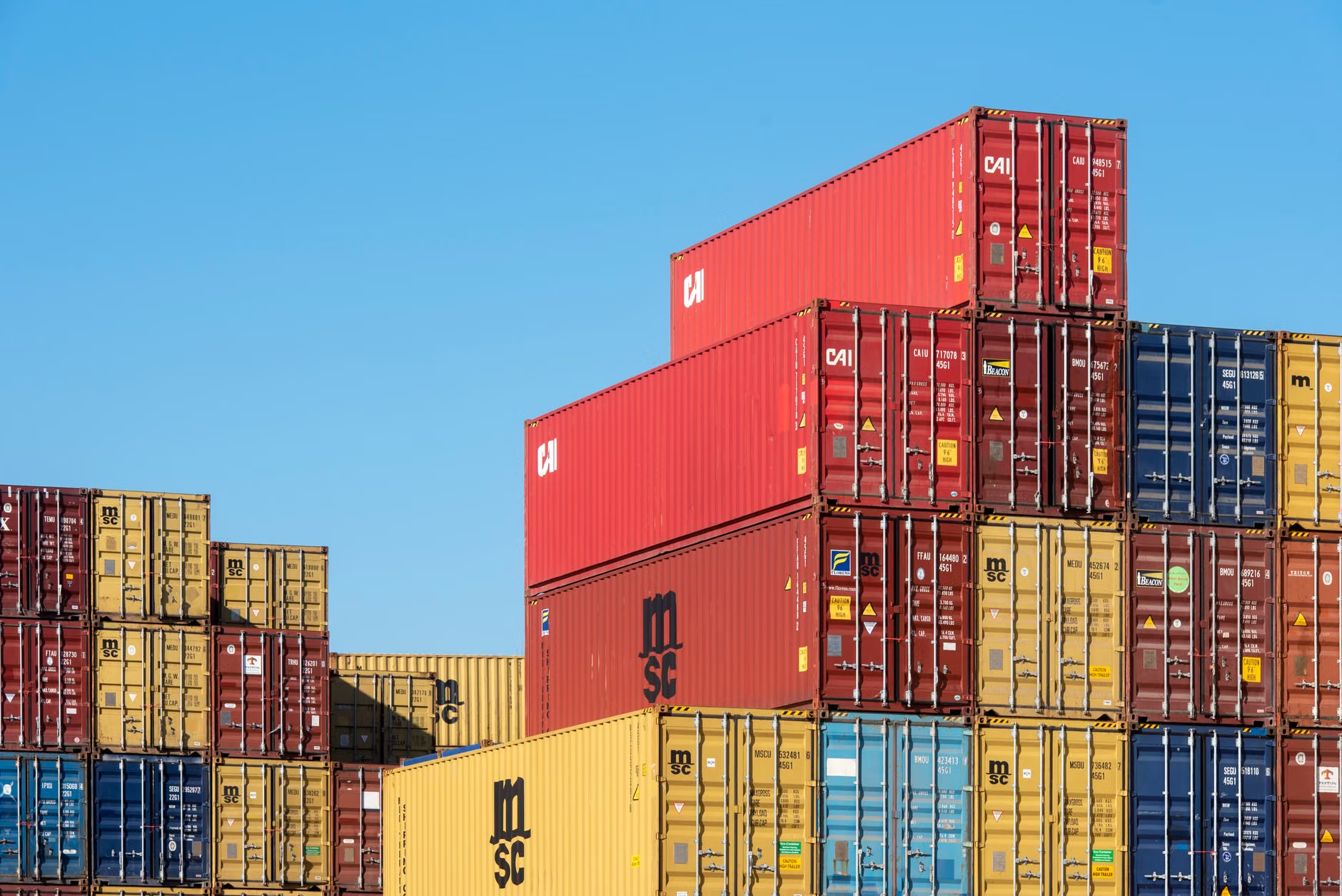
At its simplest, CBAM is a policy designed to prevent “carbon leakage.” This occurs when companies move production to countries with weaker environmental regulations to avoid the costs of carbon emissions. By imposing a levy on the carbon content of imported goods—specifically those like steel, aluminum, electricity, and hydrogen—the EU is ensuring that products entering its market pay a price equivalent to what they would have paid if they were manufactured within the EU’s strict Emissions Trading System (ETS).
While this is an EU regulation, its impact is global. Why? Because manufacturers do not usually create separate production lines for different continents. If a global tech giant has to clean up its supply chain or pay a carbon tax to sell in Europe, it will often standardize those processes globally. Furthermore, other nations are currently developing their own versions of carbon border taxes to protect their domestic industries and meet climate targets, creating a “domino effect” of carbon pricing across the globe.

Why This Matters for Your Family Electronics
You might wonder: “I’m not buying industrial steel or raw aluminum, so why does this affect my household?” The answer lies in the embedded carbon of your devices. Every smartphone, tablet, laptop, and refrigerator is built using significant amounts of aluminum, steel, and energy-intensive semiconductors.
When a manufacturer produces a laptop, the “carbon debt” is accumulated during the mining of minerals, the smelting of metals, and the assembly process. Under the new global regulatory environment, that debt has a price. If that price isn’t paid at the factory, it is paid at the border. Ultimately, it is passed down to the consumer at the checkout counter.
For a family in their 30s or 40s, this means the era of “cheap, disposable tech” is coming to a close. We have grown accustomed to replacing devices every 18 to 24 months. As these carbon costs are internalized, the retail price of entry-level electronics—which rely on thinner margins and often cheaper, more carbon-intensive manufacturing processes—will see the most significant percentage increases.
The Real-Life Cost Comparison
Let’s look at a hypothetical scenario to understand the potential impact on your household budget. Consider the purchase of a new energy-efficient refrigerator. These appliances are heavy in steel and aluminum.
| Factor | Traditional Manufacturing (Pre-2026) | Low-Carbon Manufacturing (Post-2026) |
|---|---|---|
| Material Source | High-carbon coal-powered smelting | Renewable energy smelting |
| Carbon Levy | $0 (Absorbed by low regulation) | Significant (Paid via carbon tax) |
| Retail Price Impact | Baseline | Estimated 5%–12% increase |
| Longevity | Planned obsolescence | High durability/Repairable |
This table illustrates a critical trade-off. While the “Low-Carbon” option may have a higher upfront cost, it is often designed to last longer. The traditional model may become more expensive due to the tax, without offering any added value in terms of durability or performance. The lesson here is that as carbon taxes take hold, the “cheapest” option on the shelf may actually become the most expensive one over a three-year period.
So, how do we adjust our habits? The goal isn’t to stop buying technology, but to become more strategic. The following steps can help you mitigate the financial sting of the 2026 shift.
1. Prioritize Repairability Over Replacement
In recent years, the “Right to Repair” movement has gained momentum. Devices that are modular and easy to fix are becoming increasingly valuable. When you are in the market for a new laptop or smartphone, check if the battery is replaceable or if the RAM can be upgraded. If you can extend the life of a device by two years, you effectively bypass the carbon-tax-inflated price of a new replacement.
2. The “Refurbished” Strategy
Purchasing refurbished or “open-box” electronics is already a savvy way to save money, but it will become an even more powerful tool after 2026. By choosing a device that has already been manufactured, you are essentially avoiding the “new carbon” tax associated with brand-new units. Look for certified pre-owned programs from major manufacturers, which often come with warranties comparable to new products.
3. Watch the Energy Labeling
Beyond the carbon tax on the manufacturing process, we are also seeing stricter energy efficiency standards for the *use* phase of appliances. An appliance that is “cheap” to buy but expensive to run will be a double burden by 2026. Look for high energy-star ratings. Even if the sticker price is slightly higher, the long-term utility savings will help offset the inflation caused by carbon border adjustments.
Common Misconceptions About Carbon Pricing
There is a prevailing myth that carbon taxes will simply make everything “too expensive” and that we will all be forced to downgrade our quality of life. This is a misunderstanding of how markets adapt. While prices will rise, competition will also intensify. Manufacturers that can innovate to reduce their carbon footprint will gain a market advantage because they will be subject to lower levies.
Another misconception is that this is only an issue for “luxury” goods. In reality, the carbon intensity of basic electronics—like home routers, smart light bulbs, and vacuum cleaners—is often higher relative to their price than high-end computing equipment. This means the most significant price hikes might hit the everyday “utility” items in your home.

The Hidden Variable: The “Green Premium” in Supply Chains
One overlooked factor is the complexity of global supply chains. A single smartphone contains components sourced from dozens of different countries. Calculating the carbon footprint of such a device is a logistical nightmare. Because of this, many manufacturers will adopt a “worst-case scenario” pricing model to account for the potential carbon levies they might have to pay.
This means you might see price increases even on products that are relatively carbon-efficient. Companies are essentially hedging their bets. As a consumer, this makes it vital to look past the marketing. A “green” label on a box doesn’t always mean the product is truly low-carbon; look for third-party certifications or documented environmental disclosures.
Actionable Steps for Your 2026 Planning
If you are planning to upgrade your home office or kitchen, consider the following timeline:
- 2024–2025: Audit your current household electronics. If you have appliances nearing the end of their life (e.g., a 7-year-old dishwasher), consider replacing them *before* the full impact of 2026 pricing sets in.
- 2026 and Beyond: Shift your buying behavior to emphasize longevity. If you must buy new, prioritize brands that have transparent, verified sustainability reports. Avoid “fast-tech”—the extremely cheap, non-branded electronics found on some online marketplaces—as these will likely be the first to face significant price spikes due to their high-carbon, low-efficiency manufacturing processes.
The transition to a carbon-conscious economy is not meant to punish the consumer, but it does require a change in perspective. We are moving from a model of “disposable consumption” to one of “value-based investment.” While the initial adjustment might feel like a hit to the wallet, the long-term result should be more durable, efficient, and better-made products that don’t need to be replaced as often.
Ultimately, the most effective way to manage these incoming costs is to become a more informed shopper. Don’t just look at the price tag; look at the expected lifespan and energy consumption of the product. By treating your electronic purchases as long-term assets rather than short-term conveniences, you can protect your budget and your peace of mind.
Frequently Asked Questions
1. Will all electronics see a price hike, or just specific types?
While all electronics involve carbon in their production, the impact of CBAM will be most pronounced on products that rely heavily on steel, aluminum, and electricity-intensive manufacturing processes. Larger appliances like refrigerators, washing machines, and HVAC systems will likely see faster and more significant price adjustments than smaller, low-material items like basic wearables.
2. Is there a way to tell if a product will be hit by the carbon tax before I buy it?
Look for the country of origin and the company’s sustainability reporting. Manufacturers that have already transitioned to renewable energy or have clear, third-party verified carbon-reduction targets are less likely to be hit by the highest tiers of carbon levies. Avoid products from regions or manufacturers that lack transparency regarding their energy sources.
3. Should I rush to buy new electronics now?
Not necessarily. Rushing to buy can lead to poor decision-making and purchasing outdated technology. If you have an immediate need, buy now. However, if your current devices are still functional, there is no need to panic-buy. The best approach is to transition toward a “repair and maintain” mindset, which will serve you better in the long run than trying to beat the market with premature upgrades.
Official Sources for Further Reading: