Starting in 2026, the cost of manufacturing electronics in regions with lax carbon regulations will effectively rise as the European Union’s Carbon Border Adjustment Mechanism (CBAM) shifts from its transitional phase into full implementation, directly impacting global consumer prices.
Key Takeaways
- Price Adjustments: The CBAM acts as a carbon tariff, meaning electronics imported into the EU from high-emission manufacturing zones will face higher costs, likely passed on to consumers.
- Supply Chain Shifts: Manufacturers are already moving production to renewable-energy-heavy regions to avoid these levies, which may cause temporary shortages or product design changes.
- Long-term Value: While initial prices may rise, the push for “greener” electronics encourages better product longevity and repairability, potentially saving you money over a longer 5-10 year lifecycle.
What is the Carbon Border Adjustment Mechanism (CBAM)?
If you have been noticing that your tech-savvy friends are suddenly talking about “carbon leakage” and “border taxes,” they are referring to the EU’s ambitious climate policy. At its core, the Carbon Border Adjustment Mechanism (CBAM) is a trade policy tool designed to put a fair price on the carbon emitted during the production of carbon-intensive goods that enter the European Union.
Think of it as an “equalizer.” If a company manufactures a laptop in a country where environmental regulations are loose and carbon-heavy energy is cheap, they could previously sell that laptop in Europe at a lower price than a company manufacturing in the EU, where factories must pay for their carbon emissions under the Emissions Trading System (ETS). The CBAM removes this competitive advantage by forcing importers to pay the same carbon cost as local European manufacturers.
While the regulation currently focuses on heavy industries like iron, steel, cement, and aluminum, the scope is expected to expand. Since electronics are heavily reliant on these materials, the downstream impact on your smartphone, tablet, or home appliance is inevitable. By 2026, the “transitional phase”—where companies only had to report emissions—ends, and the “definitive phase” begins, requiring actual payments.

Why This Matters for Your Household Budget
You might be wondering: “I live outside the EU, why should I care?” The answer lies in the global nature of supply chains. Most major electronics manufacturers, from Apple and Samsung to niche appliance brands, operate on a global scale. If a manufacturer has to pay a carbon tax to sell their goods in the EU, they rarely absorb that cost individually. Instead, they often adjust their global pricing strategy to maintain margins.
For a family in their 30s or 40s, this means that the “inflation” you see in electronics might not just be due to chip shortages or logistics issues anymore. It will be baked into the structural cost of production. If a smartphone requires high-grade aluminum and steel, and those materials are now subject to a carbon tax, the final assembly cost rises. Across millions of units, this adds up to significant changes in MSRP (Manufacturer’s Suggested Retail Price).
Consider the “hidden cost of carbon.” We are moving toward a period where the environmental footprint of a device is a line item in its financial cost. Understanding this helps you make smarter decisions about when to upgrade your family’s tech. Instead of chasing the latest model every year, the rising cost of carbon-intensive production makes high-quality, long-lasting hardware a much better financial investment.
The Shift in Manufacturing: Where Your Tech Comes From
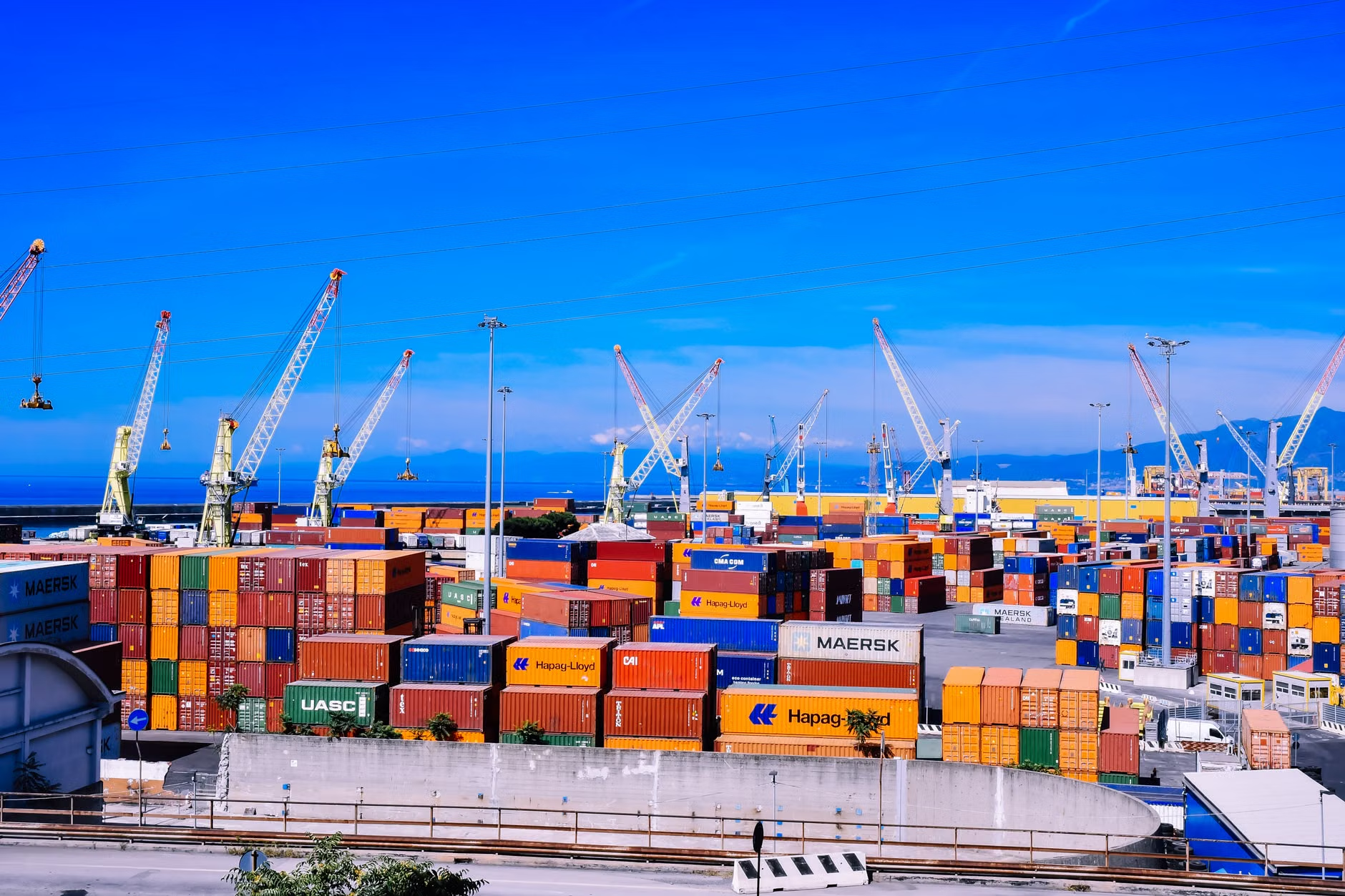
To avoid the CBAM, major tech companies are scrambling to relocate their supply chains or, at the very least, transition their factories to renewable energy. This is a massive logistical undertaking. For the consumer, this could lead to a “two-tier” market for electronics.
In the first tier, you have “low-carbon” certified devices. These are manufactured in regions utilizing solar, wind, or hydroelectric power. These products will likely carry a premium price tag but might also be built with better materials to justify the cost. In the second tier, you have older, cheaper manufacturing methods that will be hit hard by the carbon tax, leading to higher prices without the benefit of better quality.
This shift is not just about where the factory is located; it is about the “embedded carbon” of every component. A circuit board, a battery, and a screen all have distinct carbon footprints. Manufacturers are now auditing their entire tier-two and tier-three suppliers. If a supplier in a remote region cannot prove their carbon usage, the lead manufacturer will drop them to avoid the CBAM penalty. This creates a ripple effect, sometimes causing production delays or supply chain bottlenecks that you might experience as a “backordered” item at your local electronics retailer.
How to Strategize Your Tech Purchases Through 2026
With the 2026 deadline approaching, your approach to buying household electronics should shift from “impulse upgrade” to “strategic investment.” Here is how you can prepare your finances and your home.
1. Prioritize Repairability over “Shiny New”
As carbon taxes make new materials more expensive, the cost of manufacturing new hardware will climb. Conversely, the value of maintaining what you already have will increase. Look for brands that offer long-term software support and easy access to spare parts. A device that lasts five years instead of two is now mathematically superior in the face of rising carbon-adjusted costs.
2. The “Refurbished” Advantage
Refurbished electronics are effectively “carbon-neutral” in the context of the CBAM because the manufacturing emission has already been accounted for in the past. Buying quality refurbished tech from reputable sellers is not just an eco-friendly choice; it is a hedge against the price inflation coming for new units. As taxes increase the price of new hardware, the secondary market will likely become even more competitive and valuable.
3. Watch for “Carbon-Efficiency” Labels
Just as we have energy-star ratings for appliances, look for companies that publish transparent “Environmental Product Declarations” (EPDs). If a company is already preparing for the 2026 CBAM, they will likely be vocal about their lower carbon footprint. These companies are generally safer bets for long-term reliability because they have already optimized their supply chain, making them less susceptible to sudden price hikes when the tax kicks in fully.
| Purchase Strategy | Impact on Household Budget | Best For… |
|---|---|---|
| Buying New (Flagship) | High; premium pricing due to carbon taxes. | Professional users needing peak performance. |
| Refurbished/Second-Hand | Low; avoids new carbon-tax premiums. | Families, students, and budget-conscious buyers. |
| Long-term Maintenance | Minimal; cost of parts vs. full replacement. | Those wanting to maximize current device lifespan. |
The table above clarifies the trade-offs. The “Flagship” route is increasingly becoming a luxury expense. If you are buying a smartphone for a teenager or a secondary laptop for home use, the “Refurbished” route is no longer just a “cheap” option—it is the financially savvy choice to avoid the systemic price increases caused by carbon border adjustments.
Common Misconceptions About the Carbon Tax
There is a lot of misinformation circulating about how these taxes work. One common myth is that the tax is a direct “hidden” fee added at the checkout counter. In reality, it is a cost incurred by the importer or the manufacturer. It is a cost of doing business, much like logistics or labor.
Another misconception is that the tax will only affect “cheap” electronics. Actually, high-end electronics often use more complex, energy-intensive materials like rare-earth magnets and high-grade specialized alloys, which could potentially be more carbon-intensive to produce than simpler, mass-market components. Therefore, high-end tech might see some of the most aggressive price adjustments.
Finally, do not assume that this will lead to a decrease in product quality. Many companies are using this transition as an opportunity to innovate, using recycled aluminum or bio-based plastics. These innovations can lead to more durable products, which is a massive net positive for the average family budget if you are willing to look past the initial price tag.

Moving Forward: A Practical Checklist for Families
As we approach 2026, don’t panic, but do be proactive. Here is your checklist for staying ahead of the curve:
- Audit your household tech: List all devices that are nearing their end-of-life. If you need a replacement, consider whether you can buy it now versus waiting until 2026.
- Check the manufacturer’s sustainability report: Large tech companies have dedicated pages for their “Carbon Neutrality” goals. If they aren’t talking about it, they are likely behind the curve and more vulnerable to price hikes.
- Prioritize modularity: If you are buying a PC or a home appliance, look for models where individual components (like a battery or a motherboard) can be replaced. This is the ultimate hedge against future price increases.
- Budget for “Green” premiums: Accept that the cost of doing business in a sustainable world will be reflected in the price. Factor this into your annual savings goals.
The goal of the CBAM is not to make life more expensive, but to force the global economy to account for the true cost of production. While the transition will be bumpy and likely result in higher price points for many consumer goods, it also signals a shift toward a more sustainable and durable technological future. By adjusting your habits now—prioritizing longevity, exploring the refurbished market, and being a conscious consumer—you can navigate these changes without breaking your household budget.
For more information on the official implementation of the Carbon Border Adjustment Mechanism, you can visit the European Commission’s official portal. Keeping an eye on these regulatory updates is a simple way to stay ahead of the next wave of price changes in the tech industry.
Frequently Asked Questions
1. Will this tax apply to electronics manufactured in the US or Japan?
The CBAM is designed to be “country-neutral,” meaning it applies to the carbon intensity of the product, not its origin. If a product is manufactured in a country with high environmental standards that match or exceed the EU’s, the tax may be reduced or eliminated. However, if the manufacturing process itself is carbon-intensive, the tax will likely apply regardless of the country of origin.
2. Should I buy my electronics before 2026?
If you are planning a major purchase, such as a high-end laptop or a home appliance, and the current model satisfies your needs, there is no downside to buying before 2026. As the definitive phase of the CBAM kicks in, manufacturers will be passing on the costs of carbon compliance, which will inevitably push base prices higher across the board.
3. Does this mean all electronics will become more expensive?
Not necessarily. While the tax adds a cost, it also incentivizes competition. Companies that innovate to reduce their carbon footprint will gain a competitive advantage and may be able to keep their prices stable. Furthermore, as the market for sustainable materials scales, the cost of these materials might drop, potentially offsetting some of the initial price increases caused by the tax.
Ultimately, the best way to handle the 2026 carbon-border impact is to view your electronics as investments rather than disposable goods. By choosing quality over quantity and supporting companies with transparent, sustainable supply chains, you are not just protecting your wallet—you are participating in a necessary shift toward more responsible manufacturing. Stay curious, stay informed, and keep your tech running as long as you can.