The most critical step to surviving wildfire season with an air purifier isn’t buying the most expensive unit—it is proactively managing your filter’s saturation before the smoke actually arrives. If you wait until you smell smoke in your living room to check your filter, you have already missed the window for effective protection.
- The Pre-Season Swap: Replace your HEPA filters 2–4 weeks before your region’s typical wildfire season begins, regardless of what the “filter life” percentage says on your app.
- Smart App Limitations: Most smart purifiers estimate filter life based on a timer, not actual particulate buildup; manual inspection is the only way to verify if a filter is truly clogged.
- The “Smoke Seal”: High-quality HEPA filtration is useless if air leaks around the edges of the filter; ensure your unit is airtight to prevent unfiltered smoke from bypassing the filter media.
When we talk about “smart” home appliances, we often focus on the convenience of remote control or voice commands. But during wildfire season, the “smart” aspect of your air purifier should be focused on one thing: data-driven maintenance. For those of us balancing work, parenting, and the general chaos of life, the air purifier is often a “set it and forget it” device. That is a mistake when external air quality drops to hazardous levels.
Wildfire smoke is fundamentally different from everyday household dust. It contains fine particulate matter—specifically PM2.5—that is small enough to bypass the body’s natural defenses and enter your bloodstream. When a wildfire event occurs, your purifier doesn’t just work harder; it works differently. Understanding how to maintain your unit to handle this specific challenge is the difference between a safe indoor sanctuary and a false sense of security.
Why Your Smart App’s “Filter Life” Percentage Is Often Misleading
Most modern smart air purifiers use a simple countdown algorithm. If you run the fan at medium speed for 2,000 hours, the app tells you the filter is at 0%. However, this logic assumes you are filtering standard household dust and dander. It does not account for the sheer volume of soot and microscopic particles generated by a wildfire.
During a wildfire event, your purifier might be processing 10 to 50 times the normal amount of particulate matter. In this scenario, a filter that looks “clean” in the app might be physically saturated with fine smoke particles, drastically reducing its airflow and efficiency. This is known as pressure drop. As the filter fills with soot, the fan motor has to work significantly harder to push air through the dense, clogged fibers. This leads to two major issues:
- Reduced Clean Air Delivery Rate (CADR): Your unit is no longer cleaning the room volume at the rate it was designed to.
- Motor Strain: The increased resistance forces the motor to run at higher power levels, which can lead to overheating or premature mechanical failure, especially during a multi-week smoke event.
The Actionable Rule: If your region is entering a period of anticipated poor air quality, ignore the app’s percentage. Perform a visual inspection. If the filter looks grey, dark, or has visible particles embedded in the pleats, it is time to replace it, even if the app says it has 40% life remaining.
The Anatomy of an Airtight Seal
A common misconception is that the quality of the filter media is the only thing that matters. You could have a medical-grade HEPA filter, but if it isn’t seated perfectly in the housing, air will simply flow around the edges—the path of least resistance. This is called “bypass air.”
In a normal home environment, small air leaks are negligible. During a wildfire, however, every cubic centimeter of air that bypasses your filter is carrying smoke particles into your child’s bedroom or your home office.
How to Check for Bypass Leaks
Take a flashlight and shine it around the edges of the filter while the unit is running. If you see light flickering through the seal, you have a gap. Many manufacturers use foam or rubber gaskets to prevent this, but these gaskets degrade over time due to heat and ozone exposure. If your unit is more than two years old, check the integrity of these gaskets. If they are brittle or flattened, you can purchase adhesive-backed foam weatherstripping from a hardware store to create a custom, airtight seal. This small, five-dollar intervention can drastically increase the efficiency of your purifier.
Managing Airflow During Heavy Smoke Events
There is a delicate balance between noise, energy consumption, and air purification. During a wildfire event, the “Auto” mode on your smart purifier is often insufficient. Most auto modes are calibrated to prioritize quiet operation, which usually keeps the fan speed too low to actually clear a room of heavy smoke quickly.
The “Turbo-Flush” Strategy
When the outdoor air quality index (AQI) spikes, don’t rely on the automatic sensor. Switch your purifier to its maximum setting for at least 30 minutes to “flush” the air in the room. Once you have brought the particulate count down, you can switch it back to a medium-high setting that you can tolerate for the rest of the day.
Common Mistake: Many people place their air purifiers in corners or against walls. While this looks tidy, it chokes the intake. During wildfire season, move your purifier to the center of the room or at least three feet away from any wall. This maximizes the intake area and prevents the motor from straining to draw air through a restricted space.
When to Consider a Pre-Filter
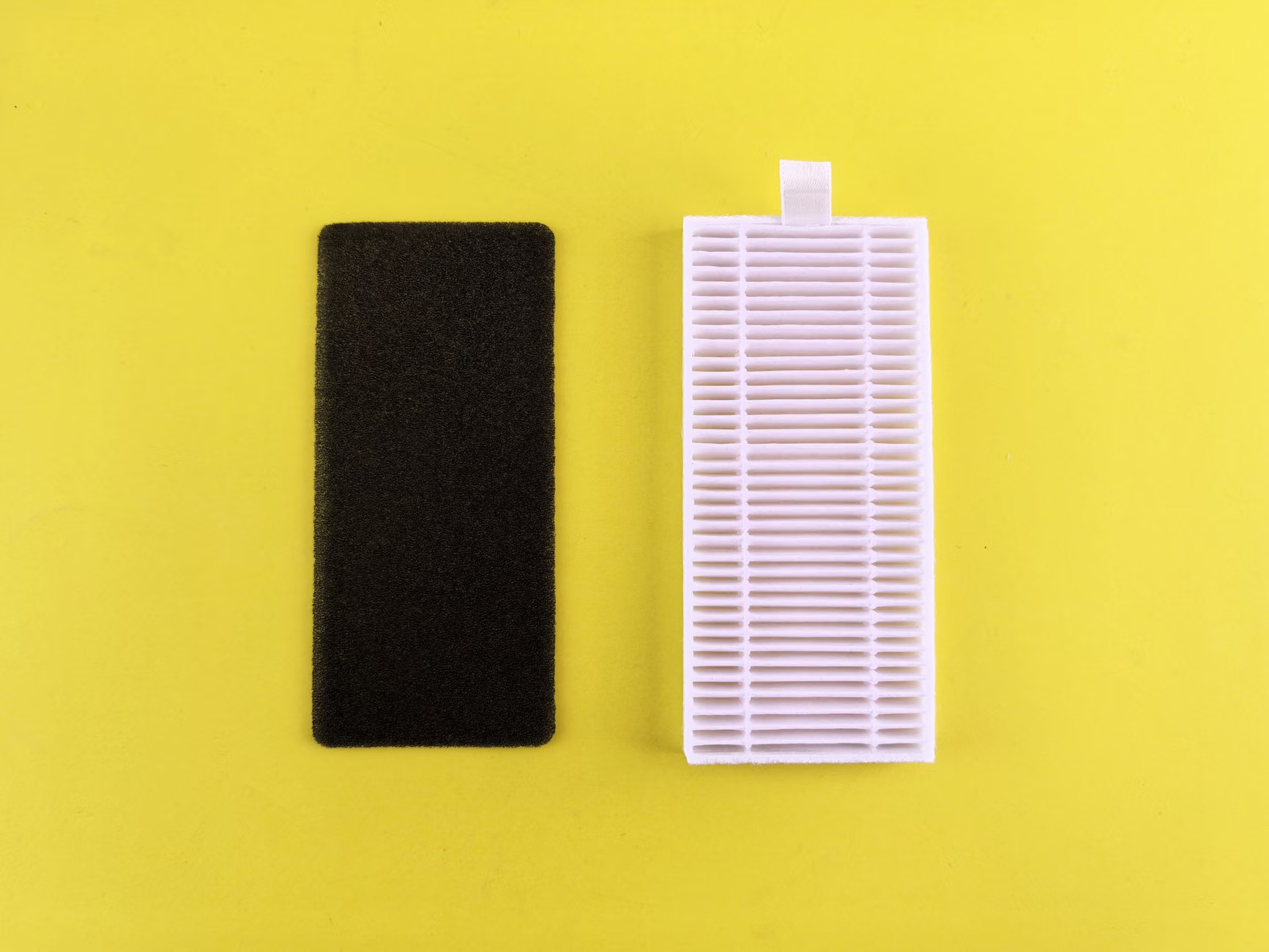
If you are lucky enough to have a smart purifier with a replaceable pre-filter (the thin mesh or foam sheet that catches larger dust particles), this is your secret weapon against wildfire smoke. The pre-filter is meant to be vacuumed or washed. By keeping the pre-filter clean, you prevent the expensive HEPA filter—which is the component that actually catches the smoke—from clogging prematurely.
During heavy smoke conditions, vacuum your pre-filter every 48 hours. This simple habit can extend the life of your main HEPA filter by weeks. If your model doesn’t have a dedicated pre-filter, check if you can purchase “universal” pre-filter sheets that can be cut to size and taped over the intake. This adds a sacrificial layer of protection that is much cheaper to replace than a multi-layered HEPA cartridge.
Comparing Filter Types for Smoke
Not all filters are created equal. When purchasing replacements, ensure you are buying genuine HEPA (High-Efficiency Particulate Air) filters. Look for the “True HEPA” label, which guarantees the filter captures 99.97% of particles that are 0.3 microns in diameter. Smoke particles are often even smaller, but True HEPA is the industry standard for capturing the vast majority of combustion byproducts.
| Filter Type | Effectiveness Against Smoke | Recommendation |
|---|---|---|
| Standard Dust Filter | Low | Avoid; does not capture fine smoke particles. |
| True HEPA (H13) | High | The gold standard for wildfire protection. |
| Activated Carbon | Variable | Essential for smoke *odors*, but doesn’t replace HEPA for particulates. |
If you find that the smell of smoke is still lingering in your home despite your HEPA filter running at full blast, you need an activated carbon filter. While HEPA catches the physical smoke particles, carbon is required to adsorb the VOCs (volatile organic compounds) and gases that cause the “smoky” smell. For the best results, use a combination of both.
The “Smart” Integration: Automating Your Defense
If your purifier connects to a smart home ecosystem like HomeKit, Google Home, or Amazon Alexa, you can automate your defense. Create a “Wildfire Mode” routine. Instead of relying on the unit’s internal sensor, which might be positioned in a location that doesn’t reflect the whole room’s air quality, use an external air quality monitor (like an indoor PM2.5 sensor) as the trigger.
When the external sensor detects an AQI above a certain threshold (e.g., 50), the routine should:
- Set the purifier to its maximum fan speed.
- Turn off any “Eco” or “Sleep” modes that might limit performance.
- Send a push notification to your phone to remind you to close all windows and doors.
This “Trigger-Action” approach removes the human error factor. In the middle of a busy workday, you might not notice the smoke creeping in, but your sensors will. By automating the response, you ensure that your home’s air quality is being managed with the urgency that wildfire smoke requires.
Troubleshooting Common Issues
Even with the best maintenance, things can go wrong. Here is how to handle the most common issues that arise during high-smoke events:
- The “Musty” Smell: If your purifier starts emitting a sour or musty odor, it is likely that the filter has become damp or has developed microbial growth. This happens in high-humidity areas when smoke particles mix with moisture. Discard the filter immediately—do not try to clean it. A musty filter is no longer safe to breathe through.
- The “High Pitch” Whine: This often indicates the motor is struggling against a heavily clogged filter. Stop the unit, check the intake and filter, and replace the filter. If the noise persists, the motor bearings may have been damaged by the increased load.
- Sensor Drift: Over time, the internal laser sensors that measure air quality can get dusty. If your purifier is telling you the air is “clean” but the room is visibly hazy, use a can of compressed air to gently blow out the sensor aperture (check your manual for the exact location).
Planning for the Future: The Multi-Unit Strategy
If you live in a region prone to annual wildfire seasons, one purifier is rarely enough. The most effective strategy for a family home is a “zoned” approach. Place a high-capacity unit in the main living area where you spend the most time during the day, and a smaller, quieter unit in the bedroom for nighttime.
During a smoke event, keep the bedroom door closed. This creates a “clean air room” where the purifier can maintain a much lower particulate count than it could in an open-concept living space. This is particularly important for children, whose smaller lungs are more susceptible to the long-term effects of wildfire smoke exposure.
Remember that the air purifier is only part of the solution. During extreme smoke events, you must also focus on “building envelope” management. Use weatherstripping on doors and windows, and consider using a window fan with a MERV-13 filter attached to it to create a positive pressure system. This pushes clean, filtered air into the house and prevents smoke from seeping through the cracks in your window frames.
Final Thoughts on Staying Protected
Maintenance is not just about keeping the machine running; it is about keeping your indoor environment a true refuge. By moving away from the “set it and forget it” mindset and adopting a proactive, data-driven approach to your air purifier, you can significantly reduce your family’s exposure to hazardous smoke particles.
Prioritize your filter inventory. Keep at least two spare sets of filters in your closet before the season starts. When the sky turns orange, you don’t want to be refreshing a shipping tracking page—you want to be protected. Stay vigilant, keep your filters clean, and remember that when it comes to your family’s health, a little bit of manual labor is well worth the peace of mind.
Frequently Asked Questions
Q: Can I vacuum my HEPA filter to make it last longer?
A: Generally, no. While you can vacuum the exterior of a pre-filter or the intake screen, vacuuming the actual pleated HEPA media can cause microscopic tears in the fibers. These tears allow smoke particles to pass through, effectively rendering the filter useless. Stick to replacing the filter once it is visibly discolored or when the unit’s airflow noticeably drops.
Q: Does opening a window for “fresh air” make my purifier useless?
A: Yes. During a wildfire event, the outdoor air is often significantly more polluted than the indoor air. Opening a window allows a massive influx of particulates that will instantly overwhelm your purifier’s capacity. During these events, keep windows and doors closed, and rely on your mechanical filtration system to circulate the air.
Q: My purifier says it has a “True HEPA” filter, but it also has an “Ionizer” setting. Should I use it during wildfire season?
A: It is generally recommended to keep the ionizer setting turned off. Ionizers work by charging particles so they stick to surfaces, but they can produce small amounts of ozone, which is an irritant that can exacerbate respiratory issues—the exact opposite of what you want when dealing with smoke. Stick to the physical filtration of the HEPA and carbon layers.
Official Resources for Further Reading: