Teaching your child to name their emotions is the single most effective tool for preventing behavioral meltdowns and building long-term social resilience. When a child can articulate that they feel “frustrated” or “overwhelmed” rather than just “mad,” they move from a state of reactive impulse to one of reflective communication, fundamentally changing how they interact with the world.
- Specificity reduces volatility: Using precise labels like “disappointed” or “anxious” helps the brain regulate the amygdala, the part of the brain responsible for the “fight or flight” response.
- Model the nuance: You cannot teach what you do not show; narrating your own complex feelings (“I feel a bit discouraged by this traffic, so I am going to take a deep breath”) provides a real-world template for your child.
- Beyond the “Big Three”: Move past “happy, sad, and mad” by introducing “emotion check-ins” during calm, everyday moments, not just when a tantrum is already in progress.
Why Your Child’s “Emotion Gap” Matters More Than You Think
We often treat “emotional intelligence” as a soft skill, something that would be nice to have, like learning to play the piano. In reality, for children in the early school years—roughly ages 5 to 9—emotional vocabulary is a survival skill. At this stage, children are transitioning from the simple, immediate needs of toddlerhood to the complex social hierarchies of the classroom. They are dealing with friendship disputes, academic pressure, and the internal friction of trying to “behave” while feeling a storm of private frustration.
When a child lacks the words to describe their internal state, that energy has to go somewhere. Usually, it exits the body as a physical outburst. By the time a child is seven or eight, we often expect them to “use their words.” But if we haven’t provided those words, we are essentially asking them to explain a complex engineering problem in a language they don’t speak. This is the “emotion gap.”
Research published by the Center on the Developing Child at Harvard University suggests that the ability to identify and label emotions is a foundational executive function. It is not just about “feeling good”; it is about self-regulation. When the brain labels an emotion, it activates the prefrontal cortex—the logical, planning part of the brain—and dampens the emotional alarm system. In short: naming it is the first step to taming it.
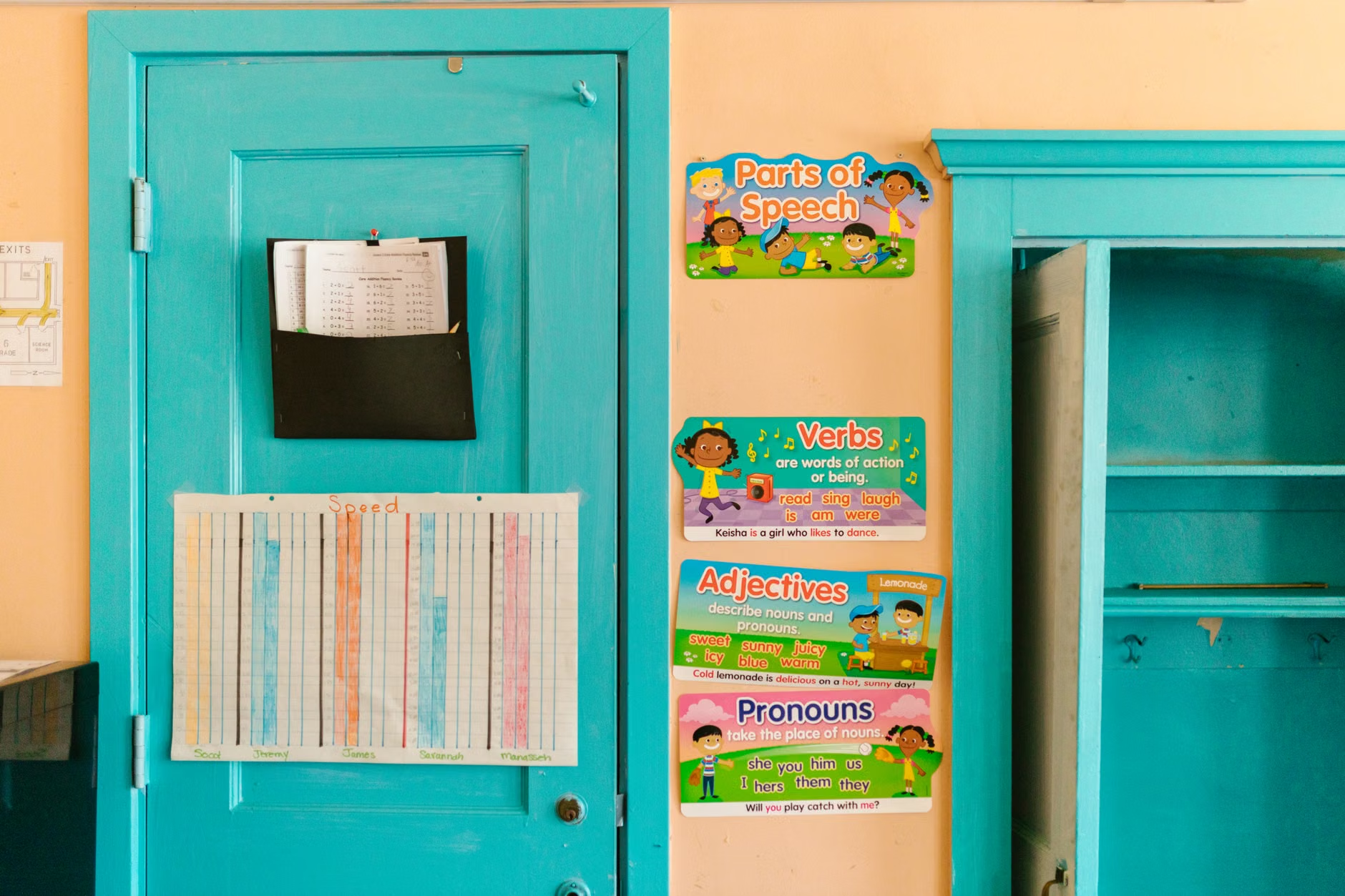
The Anatomy of a Robust Emotional Vocabulary
Most of us were raised with a very limited emotional map: happy, sad, mad, and maybe “scared.” While these are good starting points, they are insufficient for the nuanced life of a modern child. To help your child develop a broader range, you need to categorize emotions into “families.”
Think of it like a color palette. You don’t just have red; you have crimson, scarlet, and rose. Similarly, your child shouldn’t just have “mad”; they should have access to “frustrated,” “annoyed,” “jealous,” and “disappointed.”
The Four Core Families
To keep this manageable, organize your vocabulary building into these four buckets:
- The “Mad” Family (Anger/Frustration): Includes words like irritated, annoyed, cheated, impatient, and furious.
- The “Sad” Family (Grief/Disappointment): Includes lonely, disappointed, hurt, left out, and hopeless.
- The “Glad” Family (Joy/Contentment): Includes excited, proud, relieved, peaceful, and confident.
- The “Scared” Family (Fear/Anxiety): Includes nervous, worried, embarrassed, shy, and surprised.
Common Mistake: Many parents try to teach these words during a meltdown. This is a losing battle. When a child’s nervous system is flooded, their language centers are essentially offline. You cannot teach a child to use a dictionary while they are actively being chased by a bear. Save the vocabulary building for the dinner table, the car ride, or bedtime.
Step-by-Step: Implementing the “Check-in” Framework
If you want to build this vocabulary, you need a system that doesn’t feel like a lecture. Here is a practical, step-by-step approach to integrating this into your daily routine as a busy parent.
1. The Low-Stakes Daily Check-in
Start each day or end each day with a simple question. Instead of “How was your day?”, which usually gets a one-word answer, try: “What was the most ‘frustrating’ part of your day, and what was the most ‘proud’ part?” This forces the child to scan their memory and attach specific labels to their experiences.
2. The “Mirroring” Technique
When you see your child struggling, narrate their experience for them. If your child is struggling with a LEGO set and starts throwing pieces, don’t say, “Don’t throw that.” Instead, say, “I can see you are feeling frustrated because those pieces won’t click together. That looks really annoying.” By doing this, you are providing the vocabulary for the exact state they are currently in.
3. Using Media as a Mirror
When watching a movie or reading a book together, pause and ask, “How do you think the character feels right now? Is he just ‘mad,’ or is he ‘betrayed’?” This allows your child to practice empathy and vocabulary identification in a safe, fictional context without the pressure of their own emotional stakes.

Comparing Approaches: The “Fixer” vs. The “Coach”
How you respond to your child’s emotions dictates whether they will continue to use their vocabulary. Most parents fall into the “Fixer” trap, but the “Coach” approach is significantly more effective for long-term development.
| Scenario | The “Fixer” (Common Mistake) | The “Coach” (Recommended) |
|---|---|---|
| Child loses a board game. | “Don’t cry, it’s just a game. Let’s play again.” (Dismissive) | “You look really disappointed. It’s hard to lose when you really wanted to win.” (Validating) |
| Child is scared of a test. | “You’ll be fine! You’re smart.” (Minimizing) | “It sounds like you’re feeling nervous and a bit overwhelmed. What part of the test feels the biggest?” (Specific) |
| Child is acting out. | “Stop that behavior right now.” (Punitive) | “I see you’re feeling impatient. We can feel impatient, but we cannot hit.” (Boundaried) |
The “Fixer” wants the discomfort to end immediately. The “Coach” understands that discomfort is a learning opportunity. When you minimize feelings, you are effectively telling your child that their internal world is incorrect or unimportant. When you label them, you validate their experience and give them the tools to handle the next occurrence.
Hidden Costs and Unexpected Trade-offs
It is important to acknowledge that this process is not always linear. There is a common misconception that once a child learns to name an emotion, they will stop having “bad” feelings. This is false. In fact, you might find that your child expresses *more* negative emotions initially. This is actually a sign of success—they are finally letting go of the pent-up frustration they previously didn’t know how to express.
Another hidden variable is your own emotional bandwidth. If you are exhausted from work or personal stress, you may find it nearly impossible to be the “Coach.” This is not a failure; it is a reality of parenting in your 30s and 40s. If you find yourself snapping or unable to be patient, it is better to say, “I am feeling really tired and a bit overwhelmed right now, so I need a moment of quiet,” than to force a teaching moment when you are not in the right headspace. Modeling how you handle your own limitations is just as valuable as teaching the vocabulary itself.
Practical Tools for the Daily Grind
You don’t need expensive therapy apps or complex curricula to make this happen. Here are three low-cost, high-impact ways to integrate this starting today:
The Emotion Jar
Keep a jar in your common area. Write down different emotions on slips of paper. Once a week, pull one out and discuss a time you felt that way. It turns emotional intelligence into a game rather than a chore.
The “Feelings Check-in” Chart
Visual aids are powerful for school-age children. A simple poster on the wall with faces and words (like “anxious,” “bored,” “excited,” “frustrated”) serves as a reminder. When a child can’t find the word, they can point to it. This takes the pressure off verbalizing when they are already feeling dysregulated.
The “Body Scan”
Emotions are physical. Teach your child to notice where they feel their feelings. “When you feel nervous, does your tummy feel tight? When you feel angry, do your hands get hot?” This somatic awareness is a bridge to emotional vocabulary. If they can describe the physical sensation, you can help them name the emotion.
Addressing Common Hurdles
As you begin this, you will likely face some resistance. Children, like adults, sometimes prefer to keep their feelings private. Don’t force it. If your child says, “I don’t want to talk about it,” acknowledge that. “That’s okay. You don’t have to tell me, but I’m here if you ever want to name it.”
Another hurdle is the “I don’t know” response. This is usually not an act of defiance; it is a lack of vocabulary. When they say “I don’t know,” offer a menu: “Are you feeling disappointed that we have to leave, or are you feeling tired?” This gives them a starting point to agree or disagree.
Final Thoughts: The Long Game
Building an emotional vocabulary is a marathon, not a sprint. You are not looking for a sudden transformation where your child becomes a perfectly regulated Zen master. You are looking for small, incremental gains. Each time they choose a word over a scream, you have succeeded. Each time they identify that their friend might be feeling “lonely” rather than “mean,” you have succeeded.
Remember that your goal is to raise a human who understands themselves. By giving them the language to map their inner life, you are providing them with the most important compass they will ever own. Keep it simple, stay consistent, and don’t forget to check in on your own emotional state along the way.
For further reading on the science of emotional development, the Yale Center for Emotional Intelligence provides excellent resources on the RULER approach, which focuses on Recognizing, Understanding, Labeling, Expressing, and Regulating emotions. You can explore their research and frameworks at https://www.ycei.org.
Frequently Asked Questions
1. My child is 8 and still has extreme meltdowns. Is it too late to start teaching emotional vocabulary?
It is never too late. While younger children are more malleable, an 8-year-old is at a perfect age to begin understanding the logic behind their emotions. Start by validating their feelings rather than trying to stop the behavior immediately. The goal is to build the connection between the feeling and the verbal label, which can still be highly effective at this age.
2. Should I correct my child if they label their emotion incorrectly?
Avoid saying, “No, you aren’t mad, you’re just tired.” Instead, offer an alternative: “I hear you say you’re mad, but I wonder if you might be feeling tired, which is making you feel more irritable? What do you think?” This invites them to participate in the process rather than feeling corrected or dismissed.
3. How much time should I spend on this every day?
This should not be a scheduled “lesson” that takes 30 minutes. It should be woven into the fabric of your day—a 30-second comment during a car ride or a 2-minute conversation before lights out. Consistency in short bursts is far more effective than an occasional, long, forced discussion.