A standard ISP-provided router is no longer enough to secure a modern home office; shifting to a mesh network is the single most effective step you can take to isolate your professional data from the vulnerabilities of your household’s smart devices.
- Network Segmentation: Mesh systems allow you to create a “Guest” or “IoT” network, effectively walling off your work laptop from insecure smart home gadgets like webcams or lightbulbs.
- Automatic Security Updates: Unlike traditional routers that often require manual firmware updates, most modern mesh systems automate this, closing security holes before they can be exploited.
- Performance vs. Security: Mesh networks don’t just solve dead zones; they provide consistent encryption and monitoring across every corner of your home, ensuring your VPN and work connection remain stable.
If you are in your 30s or 40s, your home office likely shares bandwidth with a teenager’s gaming console, a smart fridge, and perhaps a tablet running cartoons. We often treat our home Wi-Fi as a single, trusted pipe. In reality, every device connected to your main network is a potential doorway for a cyberattack. If a cheap, unpatched smart lightbulb in your living room gets hacked, your work laptop sitting on the same network is suddenly at risk. This isn’t just theory; it’s a standard attack vector for modern malware.
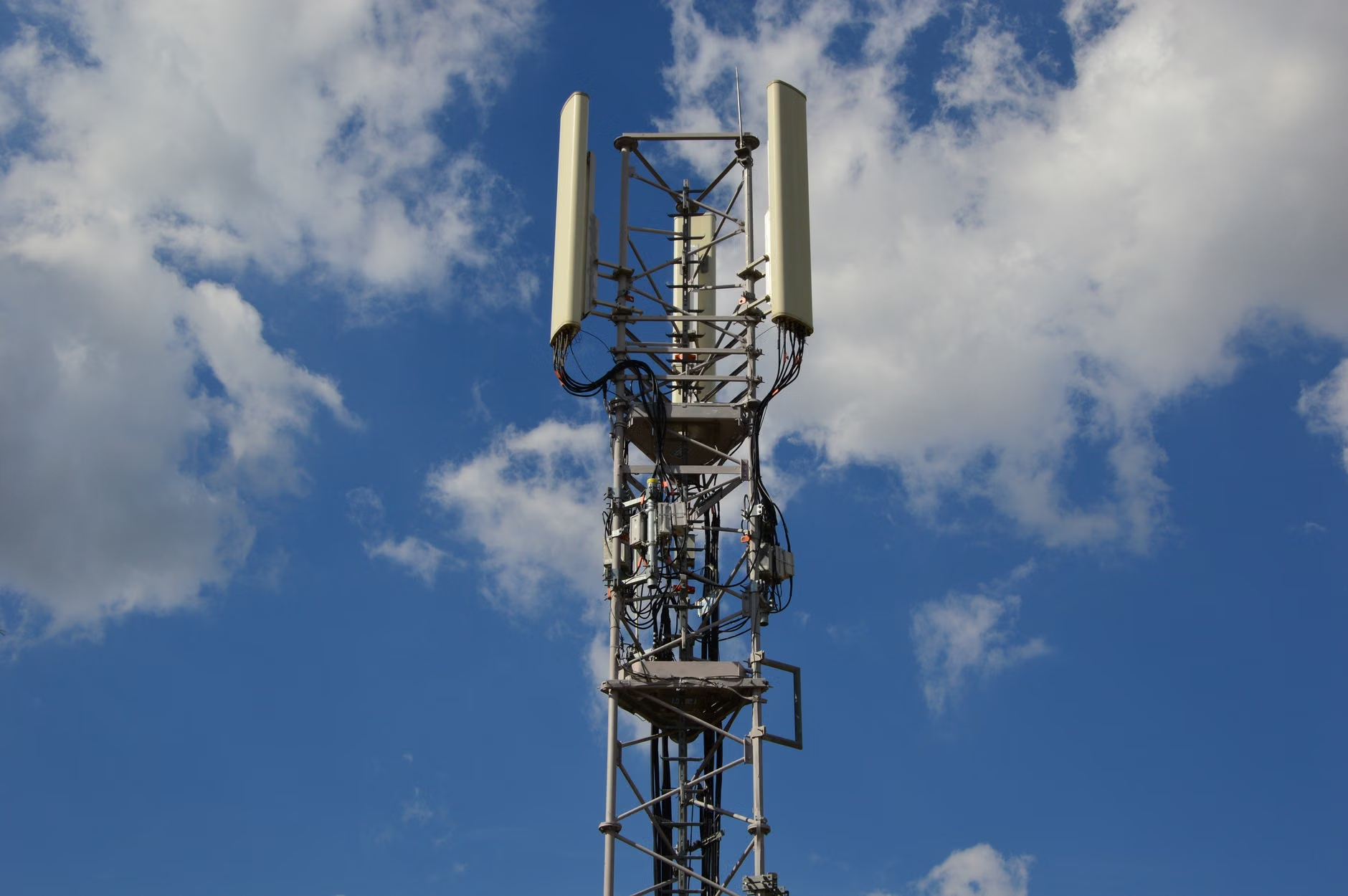
Understanding the Architecture: Why Your Current Router is a Single Point of Failure
To understand why a mesh network is necessary, we first have to look at how traditional routers function. A standard router is a “hub and spoke” system. All data flows through one central box. If that box is placed in a corner of your home—perhaps near the cable outlet in the living room—your home office upstairs likely suffers from weak signal strength. To compensate, many people use Wi-Fi extenders. Extenders are, frankly, a headache. They often create a separate network name (SSID), force you to manually switch connections, and frequently throttle your speeds. More importantly, they are often the weakest link in your security chain, rarely receiving the robust firmware updates that enterprise-grade or modern mesh systems do.
A mesh network, by contrast, uses multiple nodes that communicate with each other to create a single, seamless, and intelligent web of coverage. Think of it like moving from a single traffic controller trying to manage every car in a city to an entire network of smart traffic lights that communicate in real-time. Because these nodes are constantly talking to each other, they can route traffic more efficiently and, crucially, apply uniform security protocols across the entire physical footprint of your home.
The Security Advantage: Segmentation is Your Best Friend
The most powerful feature of a mesh system for a remote worker is the ability to create separate virtual networks. In cybersecurity, this is called VLAN (Virtual Local Area Network) or simply “Guest Network” functionality. When you set up your mesh system, you should immediately create at least two, if not three, distinct networks:
| Network Type | Purpose | Security Level |
|---|---|---|
| Main Network | Work laptop, personal computers, secure tablets. | High (WPA3 encryption, strict access control). |
| IoT/Smart Home | Smart bulbs, cameras, fridges, smart plugs. | Isolated (No access to main network). |
| Guest Network | Visitors, temporary devices. | Restricted (Internet only, no device-to-device communication). |
By isolating your smart home devices on their own network, you ensure that even if a manufacturer’s security is flawed, an attacker cannot pivot from your smart thermostat to your work laptop. This is a level of defense that most standard ISP routers simply do not offer or make incredibly difficult to configure.

Real-Life Scenarios: When Security Meets Parenting
Let’s consider a common scenario. You are in a high-stakes Zoom meeting with your manager. In the next room, your child is playing an online game on a console. If you are using an older, single-router setup, the console might be hogging the bandwidth or, worse, potentially interacting with an unsecured server. If the console is on your main network, any vulnerability in that game’s architecture could theoretically expose your local network to malicious traffic.
With a mesh system, you can use “Quality of Service” (QoS) settings to prioritize your work laptop. You can tell your mesh system: “Regardless of what is happening elsewhere, ensure the laptop at this specific MAC address gets top priority for latency and bandwidth.” This isn’t just about speed; it’s about maintaining a stable, secure connection that doesn’t drop, which prevents you from having to reconnect to a company VPN—a process that is often when security protocols are most easily bypassed or re-triggered.
The Hidden Risk of “Smart” Devices
Many of us have bought smart devices—video doorbells, robotic vacuums, or smart speakers—without considering their security lifespan. Most of these devices stop receiving firmware updates after two or three years. A device that hasn’t been patched since 2021 is a sitting duck. In a traditional network, that device is a permanent resident of your digital home. In a mesh network, you can quarantine it. By placing all these “legacy” smart devices on an isolated IoT network, you effectively render them harmless to your primary work machine.
What You Should Do: A Step-by-Step Implementation Guide
If you are ready to transition to a mesh system, don’t just buy the cheapest option on a shelf. Look for systems that prioritize security features over flashy marketing terms. Here is how you should approach the transition:
- Audit Your Current Hardware: Check if your ISP router can be set to “Bridge Mode.” This allows your new mesh system to handle all the routing and security, while the ISP box simply acts as a modem.
- Placement Matters: Do not hide your mesh nodes behind TVs or inside cabinets. They need line-of-sight to each other to maintain a strong “backhaul” (the signal between the nodes).
- Enable WPA3: When setting up your new network, ensure WPA3 encryption is enabled. It is the current gold standard for Wi-Fi security. If some older devices don’t support it, use a mixed-mode, but prioritize WPA3 for your primary work devices.
- Regular Audits: Use the companion app that comes with your mesh system. Once a month, look at the “Connected Devices” list. If you see a device you don’t recognize—or a device that should be in the kitchen but is showing up on the guest network—investigate immediately.

Common Pitfalls to Avoid
One common mistake is “over-extending.” Adding too many nodes to a small home can actually cause signal interference. A good rule of thumb is one node per 1,500 square feet. If you have a two-story home, one node on each floor is usually sufficient. Another mistake is using the default administrator password. Change the router’s admin login credentials immediately. This is different from your Wi-Fi password; this is the password used to change the settings of the router itself. If an attacker gains access to your router’s admin panel, they can redirect your traffic to malicious websites without you ever knowing.
The Trade-offs: Is There a Downside?
It is important to be realistic. A mesh network is not a “set it and forget it” magic bullet. You still need to be vigilant. Mesh systems often collect telemetry data to optimize network performance. If privacy is your absolute top priority, look for systems that allow you to opt-out of data collection in the settings. Also, be aware that mesh systems are generally more expensive than traditional routers. You are paying for the convenience of seamless roaming and the security of better management software.
Furthermore, if you have a very large home with concrete walls, even a mesh system might struggle. In these cases, you might need to look at “wired backhaul,” where the mesh nodes are connected to each other via Ethernet cables. This is the ultimate, most secure, and fastest configuration, but it requires running cables through your walls—a significant project, but one that is well worth it for a permanent home office.
Beyond the Basics: Advanced Security Insights
If you want to take your home office security to the next level, look for mesh systems that offer “Network Security Suites.” Many modern mesh routers (from brands like TP-Link, Asus, or Eero) offer subscription services that provide real-time scanning of incoming traffic. They can block known malicious websites before your laptop even tries to load them. While these services often come with a monthly fee, for a remote worker handling sensitive client data, it is a small price to pay for an automated layer of defense.
Another overlooked variable is the “DNS” (Domain Name System). Your ISP handles your DNS by default, which means they can track every website you visit. By changing your DNS settings in your mesh system to a secure provider like Cloudflare (1.1.1.2 for malware blocking) or Quad9, you add a layer of protection that filters out malicious domains globally. This is a simple setting change that provides a significant security boost for every device on your network.
Finally, consider the physical security of your nodes. If you have a node in a guest room or a hallway, ensure it is not easily accessible to someone who shouldn’t be touching it. Some mesh nodes have physical reset buttons that can revert the router to factory settings, potentially opening it up to unauthorized access if not configured correctly. Keep them in areas that are semi-private.
Summary of Recommendations
For the professional working from home, the investment in a mesh network is an investment in your career continuity. The ability to segment your network, prioritize work traffic, and receive automatic security updates provides a buffer that a standard ISP router simply cannot match. Start by assessing your home’s layout, choose a system that offers robust app-based management, and commit to a monthly routine of checking your connected devices.
The goal isn’t to turn your home into a fortress, but to ensure that your work life is appropriately separated from the digital clutter of family life. By taking these steps, you protect your data, your peace of mind, and your professional reputation. For more detailed information on securing your home network, you can refer to the CISA guidelines on securing home networks, which offer excellent, non-technical advice for remote employees.
Frequently Asked Questions
Q: Do I really need a mesh network if my home is small?
A: If your home is under 1,000 square feet, a high-quality, single-unit router might suffice. However, the security benefits—specifically the ability to easily create an isolated IoT network—often make a mesh system a better choice for anyone with multiple smart devices, regardless of square footage.
Q: Will a mesh network slow down my internet speed?
A: A well-configured mesh network should not slow down your internet. In fact, by providing a stronger, more consistent signal, it often improves real-world speeds compared to a single router struggling to reach the far corners of a home. Ensure your nodes are placed correctly to avoid signal degradation.
Q: How often should I update my mesh system?
A: Most modern mesh systems have an “Auto-Update” feature. You should always keep this enabled. If your system does not support auto-updates, check the manufacturer’s app or website at least once every three months for firmware patches, as these often contain critical security fixes.
Note: This article is for informational purposes and does not constitute professional IT security advice. Always check with your employer’s IT department regarding specific security requirements for remote work setups.