- Prioritize Warm Spectrum (below 2700K): Blue light suppresses melatonin; choosing amber or red-toned light is essential for keeping both you and your child in a “sleep-ready” state during night wakings.
- Automation is the Ultimate Efficiency: Using motion-sensor triggers or scheduled low-dimming profiles prevents the need for manual switches, minimizing the “jolt” of bright light that disrupts sleep cycles.
- Energy Savings are a Secondary Benefit: While low-energy LED smart bulbs reduce electricity costs, their primary value lies in the physiological benefits of controlled, low-intensity illumination during the “fourth trimester” and beyond.
The 3:00 AM wake-up call is a rite of passage for every parent. Whether you are soothing a newborn, checking on a toddler with a fever, or navigating a middle-of-the-night feeding, the environment in which you perform these tasks matters significantly. Many parents default to the “on” switch, flooding the room with harsh, high-intensity light. This is a physiological mistake. Not only does it make it harder for the child to settle back down, but it also snaps your own nervous system into an alert state, making it nearly impossible for you to fall back asleep once the task is done.
The solution lies in a strategic approach to smart lighting. By shifting from standard, full-brightness bulbs to low-energy, customizable smart lighting, you can create a “night-mode” environment that respects human circadian rhythms. This is not just about convenience; it is about managing biology through technology.
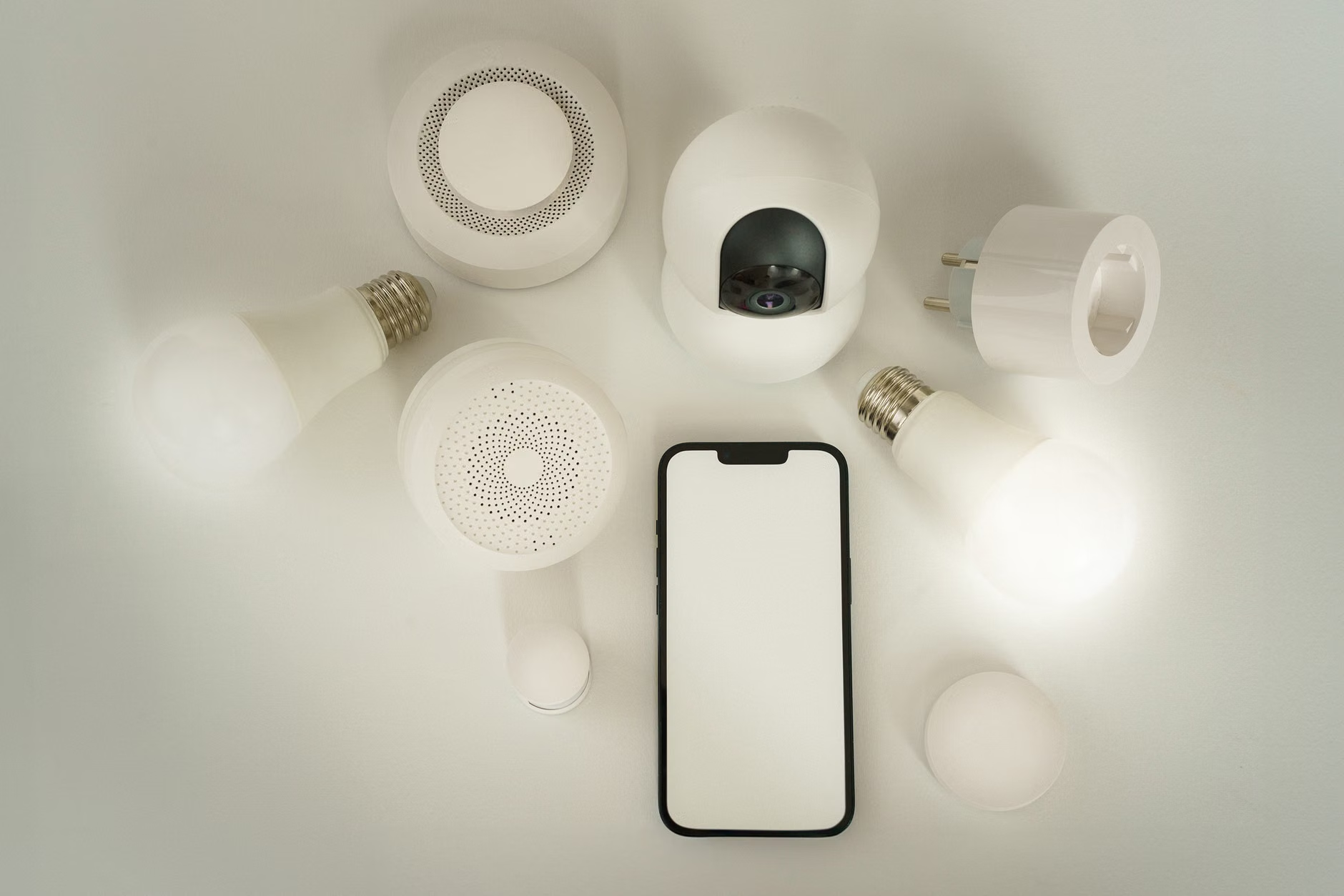
Why “Blue” Light is the Enemy of Night-time Parenting
To understand why low-energy, warm-spectrum lighting is critical, we must first look at the biology of light. Humans are biologically programmed to be awake in daylight and asleep in darkness. During the day, the blue-rich spectrum of sunlight signals our brains to produce cortisol and suppress melatonin. When you turn on a standard overhead light in the middle of the night, you are effectively telling your brain—and your child’s brain—that it is time to start the day.
Research from institutions like the Harvard Medical School suggests that blue light, which is prevalent in many standard LED bulbs and electronic devices, has a more potent effect on shifting circadian rhythms than other light colors. For a parent, this means that even a few minutes of bright, white light can reset the biological clock, leading to “sleep fragmentation.”
When you use smart lighting, you have the ability to filter out these blue wavelengths. By configuring your lights to emit a warm, amber, or deep red hue, you minimize the suppression of melatonin. This allows you to perform necessary parenting tasks—diaper changes, bottle preparation, or checking vitals—without fully waking the brain’s alertness centers. In practice, this means the transition from “active” to “asleep” becomes significantly smoother for everyone involved.
The Mechanics of Low-Energy Smart Bulbs
Smart lighting is often marketed as a “fun” home gadget, but its utility in a nursery or bedroom is strictly functional. Modern smart bulbs use LED technology, which is inherently more energy-efficient than incandescent or even early-generation CFL bulbs. However, the “smart” component adds a layer of control that allows for granular adjustments that were previously impossible.
Most smart bulbs on the market today offer a Kelvin (K) range. Kelvin is the unit of measurement for color temperature. For night-time parenting, you should aim for the lower end of the spectrum:
| Color Temperature | Appearance | Best Use Case |
|---|---|---|
| 1800K – 2200K | Deep Amber / Candlelight | Middle-of-the-night nursery visits |
| 2700K – 3000K | Soft Warm White | Evening bedtime routines |
| 5000K+ | Cool Daylight / Blue-white | Morning/Afternoon activity areas |
When you select a bulb, look for “Tunable White” or “Full Color” (RGBW) capability. A “Tunable White” bulb is often more cost-effective if you only need varying shades of white and amber. If you want the ability to set a deep red hue—which is even less disruptive to melatonin than amber—you will need a “Full Color” bulb.
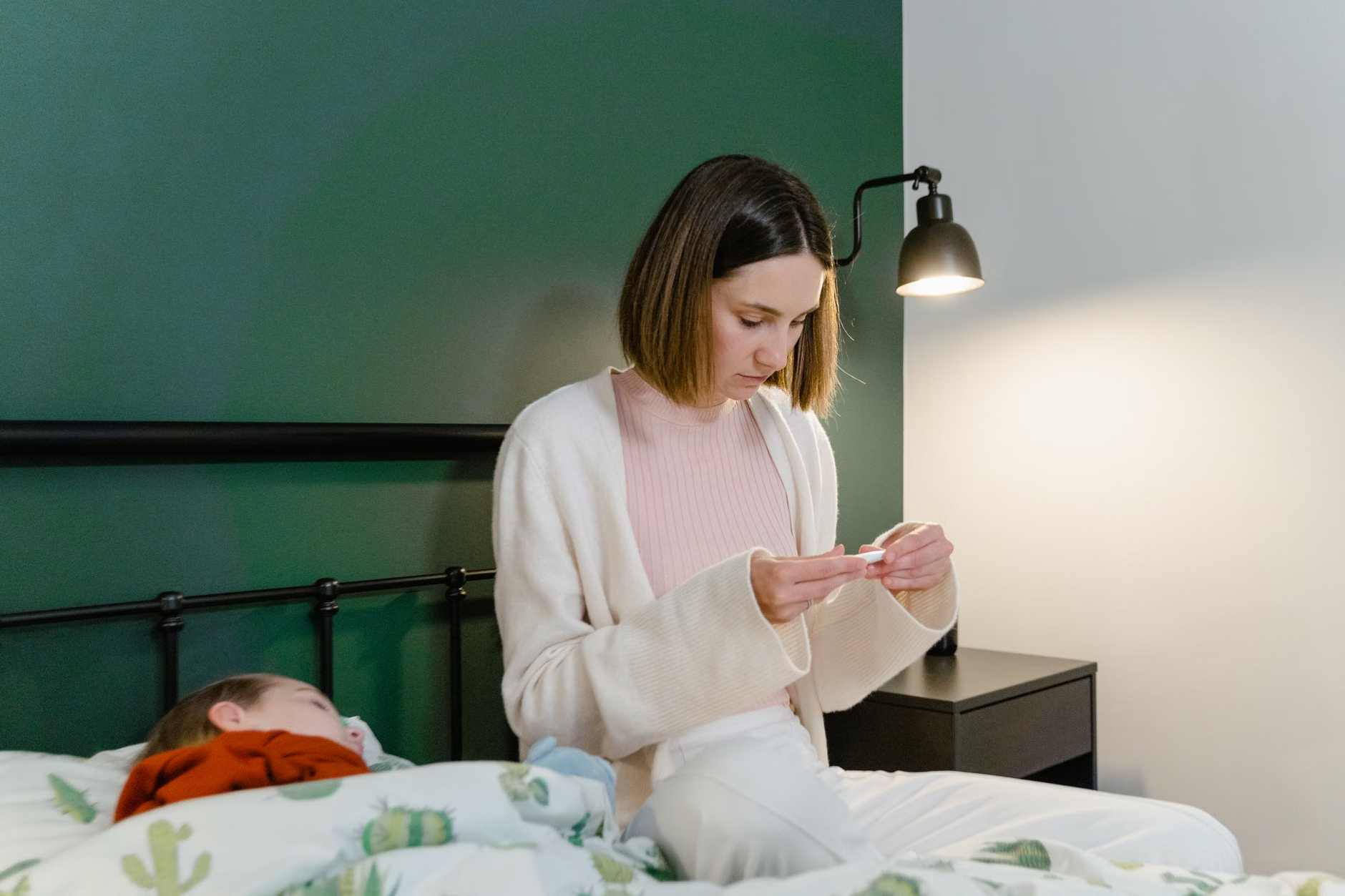
Automating the Night: Removing Manual Friction
The true power of smart lighting in a parenting context is not just the color, but the lack of interaction required. Standing up to flip a switch is a physical action that increases your heart rate and alertness. Smart lighting allows you to bypass this entirely.
Consider the “Trigger-Action” workflow. Most smart home ecosystems (such as those integrated with Apple HomeKit, Google Home, or Amazon Alexa) allow you to create routines. Here is how you can set up a “Night Parenting Routine”:
- Motion-Triggered Dimming: Place a small motion sensor near the nursery door. Configure it so that between 10:00 PM and 6:00 AM, the light turns on at only 5% brightness and in a deep amber color.
- Voice Activation: If you are holding an infant, you don’t want to fumble for a phone. Use voice commands like “Hey [Assistant], set nursery to Night Mode.” This keeps your hands free and your eyes focused on your child.
- Gradual Fade-Out: If you are using a smart plug with a regular lamp, you can program it to fade out over 10 minutes. This provides a gentle signal to older children that it is time to stop reading and drift off to sleep.
Common mistakes often include setting the “Night Mode” to be too bright or too cool. A common rule of thumb is the “3-foot rule”: if you can read a book comfortably from three feet away, the light is likely too bright for a middle-of-the-night intervention. Aim for a level where you can see enough to prevent tripping or mistakes, but not enough to stimulate full wakefulness.

Addressing the Hidden Costs and Trade-offs
While the benefits of smart lighting are compelling, it is important to address the reality of implementation. There is a learning curve, and there are potential pitfalls that many tech-enthusiast blogs gloss over. One of the primary concerns is “Connectivity Anxiety.” Nothing is more frustrating than a light that refuses to turn on because the Wi-Fi is glitching or the hub is offline.
To mitigate this, look for smart bulbs that support protocols like Zigbee or Thread. Unlike standard Wi-Fi bulbs, which can clog your home network and often require a stable internet connection to function, Zigbee and Thread devices create a “mesh network” between themselves. This means they are generally more reliable and faster to respond, even if your main internet connection is unstable.
Another factor is the “Phantom Load.” While LED smart bulbs use very little energy, they are technically never truly “off” because the wireless receiver must remain powered to listen for your commands. While the energy consumption is negligible—often less than 0.5 watts per bulb—it is a consideration for those striving for extreme energy efficiency. However, compared to leaving a standard 60-watt lamp on, the savings are massive.
Finally, consider the bulb’s “State Recovery” setting. This is a setting that determines what the light does after a power outage. You want to ensure your smart bulb is set to “Last State” or “Off.” If it is set to “On,” a power flicker in the middle of the night could cause your nursery lights to blast at 100% brightness, effectively ruining everyone’s sleep.
The Psychological Impact on Parenting Stress
Parenting in your 30s and 40s often comes with a higher baseline of stress. You are likely balancing professional responsibilities, household management, and the demands of raising children. Sleep deprivation is not just a nuisance; it is a significant factor in parental burnout and irritability.
By optimizing your lighting, you are performing a form of “environmental self-care.” When you can navigate a night-time feeding without fully waking up, you are preserving your own sleep cycles. This leads to a higher quality of rest, even if the total hours of sleep remain limited. The ability to return to deep sleep quickly after a disruption is the difference between feeling “functional” the next day and feeling completely depleted.
Furthermore, smart lighting can help establish a “Sleep Association” for your child. By keeping the lighting consistent during night-time routines, you provide a visual cue that the world is calm and it is time to sleep. Over time, this helps children internalize the difference between night and day, which is a major milestone in sleep training.
Integration Strategies for Different Age Groups
The needs of a parent change as the child grows. The lighting setup for a newborn is vastly different from that of a five-year-old. It is helpful to view your smart lighting as a modular system that evolves.
- The Newborn Phase (0-12 months): Focus on extreme dimming and warm colors. Use motion sensors to avoid any interaction with switches. The goal is 100% ease of use for the sleep-deprived parent.
- The Toddler Phase (1-3 years): Introduce “Wake-up” colors. You can use the smart bulb as a visual clock. For example, tell your toddler, “You can come out of your room when the light turns green.” This prevents the 5:00 AM “Is it morning yet?” wake-up calls.
- The School-Age Phase (4+ years): Transition to controlled “Reading” and “Play” modes. Use the smart lighting to signal transitions in their routine, such as dimming the lights to a soft purple when it is time to start the bedtime story.
This long-term utility makes the initial investment in smart bulbs (which are more expensive than standard LED bulbs) well worth the cost. You aren’t just buying a light; you are buying a tool that adapts to the shifting requirements of your family life.
Common Misconceptions About Smart Lighting
There is a persistent myth that smart lighting is “over-complicating” the home. Some parents fear that if the tech fails, they will be left in the dark. This is why it is critical to keep your manual switches in place. A good smart lighting setup is “additive,” not “exclusive.” If you or a babysitter cannot figure out the app, the physical light switch should still work as a standard on/off toggle. Always choose a product that allows for manual override.
Another misconception is that all “warm” bulbs are sleep-friendly. Many manufacturers label their bulbs as “Warm White” (usually 2700K), but these bulbs can still contain a significant amount of blue light in their spectrum. If you are serious about sleep hygiene, look for bulbs that explicitly mention “Circadian Rhythm” support or have a “Night Mode” that allows for 1800K or 2000K settings. The lower the Kelvin, the better for your melatonin production.
Structuring Your Home for Success: A Step-by-Step Guide
If you are ready to transition your home to a more sleep-friendly lighting environment, follow this structured approach to ensure you don’t waste money on incompatible hardware:
Step 1: Audit Your Current Fixtures
Check the base of your lamps and the sockets in your nursery. Are they standard E26 (screw-in) bases? Do you have dimmable fixtures? Most smart bulbs are not designed to work with old-fashioned “wall dimmers.” Using a smart bulb with an existing wall dimmer will cause flickering and may destroy the electronics inside the bulb. If you have wall dimmers, either replace them with standard switches or use “Smart Dimmers” (which replace the wall switch itself) rather than smart bulbs.
Step 2: Choose Your Ecosystem
Do not mix and match too many brands. If you are an Apple user, stick to HomeKit-compatible devices. If you use Android, Google Home is your best bet. A unified ecosystem ensures that your “Goodnight” routine can turn off all the lights in the house at once, not just the ones in the nursery.
Step 3: Test the “Night Mode”
Once installed, set up your primary night-time scene. Test it at 2:00 AM. Is it still too bright? If so, lower the percentage. The goal is to find the lowest possible brightness that still allows you to see the baby’s face or the markings on a milk bottle. You will be surprised at how little light you actually need once your eyes have adjusted to the dark.
Step 4: Educate the Household
If you have a partner or other caregivers, ensure they know how the system works. If the smart lighting is a “black box” that only you understand, it will become a point of friction. Keep a simple note or a physical “Cheat Sheet” on the wall if necessary, explaining the voice commands or the location of the motion sensor.
Final Thoughts on Investing in Your Sleep
The pursuit of “low-energy” living often focuses on electricity bills, but in the context of parenting, the most valuable energy you save is your own. By automating your lighting, you remove a layer of decision-making and physical effort from your night-time routine. This allows you to stay in a lower state of arousal, which is the key to falling back asleep quickly.
Do not view this as just another tech gadget. View it as a foundational element of your family’s sleep hygiene. A well-lit home is a functional home, but a wisely-lit home is a restorative one. Start with the nursery, optimize for the lowest possible Kelvin, and let your home technology do the heavy lifting while you focus on what truly matters: getting that extra hour of rest.
Frequently Asked Questions
- Do I need a smart bridge or hub for these lights to work?
It depends on the brand. Many Wi-Fi-based smart bulbs work directly with your router, while others (like Philips Hue or Lutron) require a central bridge. If you are starting out, Wi-Fi bulbs are easier, but if you plan to automate your entire house, a hub-based system (Zigbee or Thread) is more reliable and won’t slow down your internet. - Will a smart bulb work in a lamp that already has a dimmer switch on the wall?
Generally, no. You should never use a smart bulb with a traditional wall-mounted dimmer switch. It will cause the bulb to flicker, hum, or fail prematurely. You must either replace the wall dimmer with a standard on/off switch or use a “Smart Dimmer” switch that is specifically designed to work with smart lighting. - Is it true that red light is better than amber light for sleep?
Yes. While amber light is significantly better than white or blue light, red light has the longest wavelength and the least impact on melatonin suppression. If you have the option, a “Full Color” bulb set to a deep red or soft orange-red is the gold standard for middle-of-the-night visibility.
For more information on the effects of light on human health, you can consult the official resources provided by the Sleep Foundation at https://www.sleepfoundation.org, which offers extensive, research-backed guidance on creating sleep-conducive environments.