The core of the “post-growth” parenting movement is simple: your family’s well-being is no longer tied to the relentless pursuit of more—more toys, more extracurriculars, or more square footage—but to the intentional reduction of consumption to create space for actual connection.
Key Takeaways
- Redefine Success: Post-growth parenting shifts the metric of a “successful” childhood from material accumulation to the development of cognitive and emotional resilience through slow, intentional experiences.
- The Maintenance Advantage: Moving away from disposable culture toward a repair-and-reuse model saves significant household income and teaches children tangible problem-solving skills.
- Urban Efficiency: In high-density living, post-growth habits—like shared tool libraries and neighborhood swapping—are not just eco-friendly; they are the most effective way to reclaim square footage and mental bandwidth.
If you live in a major city, you’ve likely felt the “parenting treadmill” effect. You work hard to afford a lifestyle, which necessitates more gear, which requires more space, which demands more cleaning and organizing, which leads to less time with your kids. It’s a closed loop that feels like progress but often results in exhaustion.
The post-growth movement isn’t about asceticism or poverty. It is a deliberate economic and behavioral shift. It challenges the assumption that the “best” parent is the one who provides the most “stuff.” Instead, it argues that in an era of hyper-consumption, the greatest gift you can provide is a low-friction environment where your child’s imagination is the primary source of entertainment, not a plastic gadget destined for the landfill.
Why the Current Growth-Based Parenting Model is Failing
In the mid-20th century, the economic model for the middle class was built on the idea that growth—more house, more clothes, more educational toys—was a proxy for love. For parents in their 30s and 40s today, this model has hit a ceiling. The “growth” model assumes that time is a fixed resource that can be bought with money. However, empirical studies on parental stress, such as those published by the American Psychological Association, show that the “time-affluence” gap is the single biggest predictor of burnout.
When we look at the urban environment, this growth model becomes physically impossible. Apartments have finite storage. The “more” eventually has to go somewhere, and that “somewhere” is usually your mental space. Every item you own demands a “maintenance tax”—the time spent cleaning it, organizing it, repairing it, or deciding to discard it.
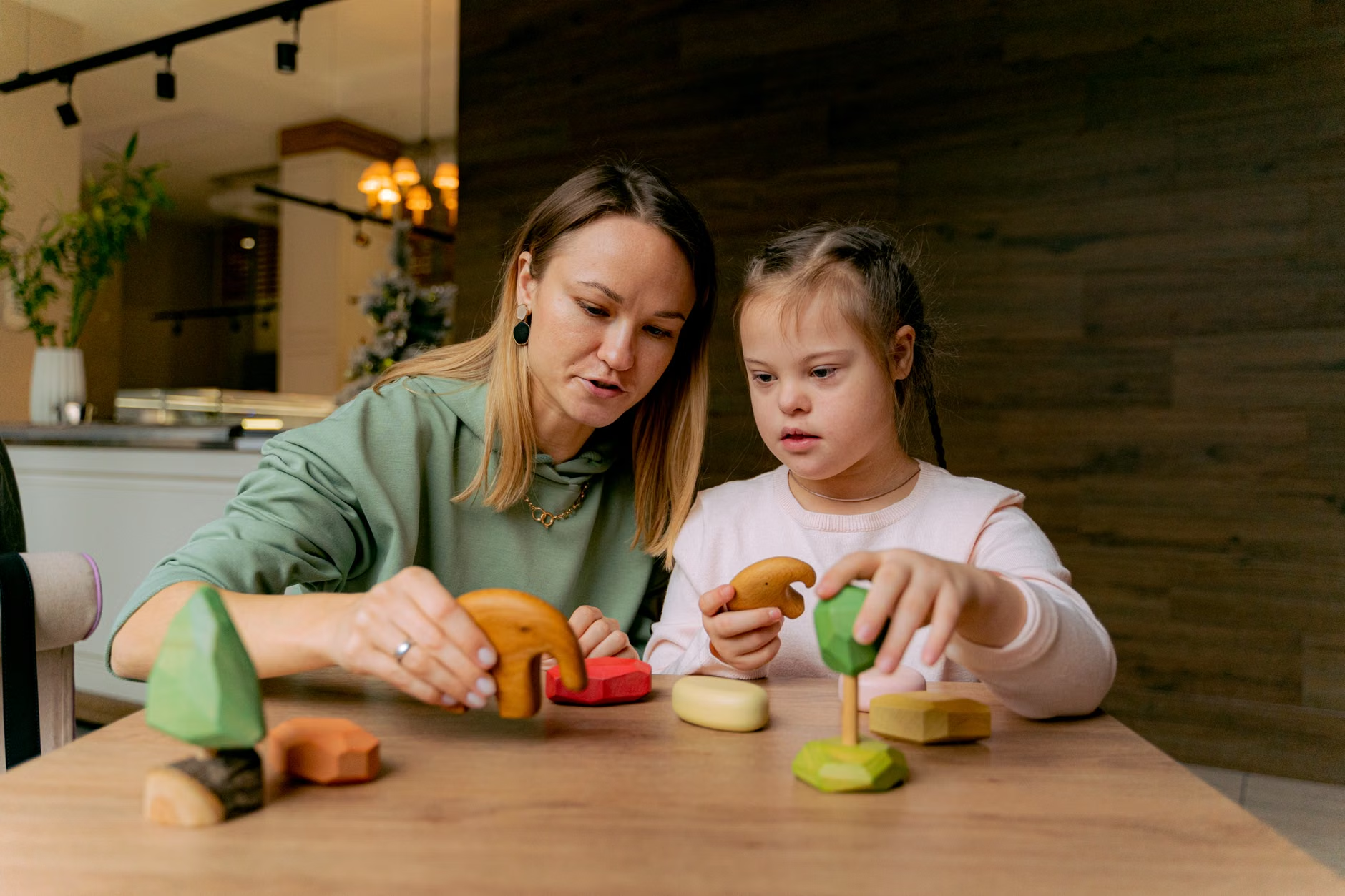
Consider the “Toy Saturation Point.” Research in developmental psychology, including studies published in Infant Behavior and Development, suggests that toddlers with fewer toys exhibit higher levels of sustained attention and more creative play. When a room is flooded with options, the brain enters a state of choice paralysis. By limiting the inputs, you aren’t depriving your child; you are optimizing their environment for focus.
The Economics of Less: Reclaiming Your Household Budget
Adopting a post-growth mindset is arguably the most effective financial strategy for urban families. Most household budgets are drained by “micro-purchases” intended to solve minor inconveniences or keep children occupied. But what happens when you stop buying the “solution” and start building the skill?
Let’s look at the “Repair vs. Replace” calculation. If a plastic toy breaks, the growth-based response is to discard it and buy a new one. The post-growth response is to evaluate the object. Is it worth fixing? Does it teach a skill? By repairing a toy, you shift the child’s perspective from “consumer” to “creator.” This isn’t just about saving $20; it’s about breaking the psychological cycle of disposability.
| Category | Growth-Based Approach | Post-Growth Approach |
|---|---|---|
| Toys | Buying new, trend-driven sets. | Curated, open-ended materials (blocks, fabric). |
| Travel | Resort-style, high-consumption trips. | Slow, local, or transit-based exploration. |
| Clothing | Fast-fashion seasonal hauls. | Capsule wardrobes, swapping, and mending. |
| Education | Maximizing extracurriculars. | Unstructured play and community skill-sharing. |
The table above highlights a critical distinction: the Post-Growth approach isn’t about “doing nothing.” It’s about doing things that have a higher “return on connection.” A child who learns to navigate the city on a bike with their parent is developing more resilience than a child who is driven to a structured, paid sports camp where the parent sits on the sidelines checking emails.
Urban Efficiency: Reclaiming Square Footage
In an urban apartment, space is your most valuable asset. The post-growth parenting model views every square foot as a resource to be protected from clutter. The “One-In, One-Out” rule is the baseline, but the advanced strategy is “No-In, All-Out.”
How does this work in real life? It starts with the “Community Infrastructure.” If you need a drill to hang a shelf, you don’t buy one. You use a local tool library. If your child wants a specific, large toy, you check a local toy library before purchasing. These systems exist in almost every major metropolitan area—they are often under-utilized because the cultural default is to buy new.
Common Mistake: Many parents attempt to “minimalize” by doing a massive decluttering weekend. This rarely works because it doesn’t address the inflow of goods. The post-growth shift requires a policy change at the household level. Before any non-essential item enters the home, it must pass a three-question test:
- Does this item serve a function that cannot be fulfilled by what we already own?
- Is this item repairable, or is it designed for a single lifecycle?
- Are we purchasing this to solve a problem of “boredom” that could be solved by our own presence or creativity?

The “Slow Parenting” Component: Protecting Your Time
Post-growth parenting isn’t just about physical objects; it’s about the “growth” of the calendar. We are conditioned to believe that a full schedule equals a high-value childhood. This is a fallacy. When you fill every hour with structured activity, you eliminate the “boredom” phase of development. Boredom is the precursor to imagination.
In a post-growth framework, you intentionally leave “white space” in your week. This is not “free time”—it is “opportunity time.” It is the time where you walk to the park, observe the local neighborhood, or simply sit with your child without the pressure of a destination or a goal. This is where the most profound bonding happens. It is low-cost, high-impact, and entirely sustainable.
The Trade-off: The challenge here is the social pressure. Your peers may be enrolled in three languages, two sports, and a coding camp. By opting out, you are essentially going against the grain of current urban middle-class parenting. You will need to be comfortable with the fact that your child’s “resume” of activities will look different. The payoff, however, is a child who is self-directed rather than program-directed.
Implementing the Shift: A Step-by-Step Guide
Transitioning to this lifestyle doesn’t happen overnight. It’s a process of unwinding years of consumer-based habits. Follow these steps to begin:
1. Audit the “Maintenance Tax”
Walk through your home and identify the items that take up your time. How much time do you spend cleaning, organizing, or moving toys? If an item takes more than 5 minutes of maintenance a week, it is a liability. Consider donating or selling it. The goal is to reach a “low-friction” state where your home supports your life, not the other way around.
2. Decentralize the “Stuff”
Instead of owning everything, participate in the “Sharing Economy.” Use local libraries, tool swaps, and community centers. If you are in a city, you likely have access to these resources. The more you rely on community, the more you build social capital, which is far more valuable than physical capital.
3. Shift from “Output” to “Input”
Stop rewarding “output” (the finished craft, the completed worksheet). Focus on “input” (the time spent, the curiosity shown, the effort made). When a child brings you a drawing, don’t ask “What is it?” or “Where are we going to hang it?” Ask, “Tell me about how you decided to use these colors.” This validates the process, not the product.

The Hidden Costs of “Growth”
It is important to address the “hidden costs” that often go unnoticed in standard parenting advice. We talk about the cost of tuition or the price of a stroller, but we rarely discuss the “Cognitive Load.” Every item in your house is a visual signal to your brain. If you are surrounded by clutter, your brain is constantly processing that visual noise, which leaves less bandwidth for parenting. This is why you feel “short-tempered” after a long day of cleaning up toys—it’s not the toys, it’s the cognitive exhaustion of managing an environment that is designed to grow beyond your capacity.
Furthermore, consider the “Environmental Debt.” By choosing post-growth, you are modeling a specific set of values for your child. They are learning that their worth is not defined by what they consume. This is perhaps the most critical lesson for a generation that will face the realities of resource scarcity. You are preparing them for a world that will require adaptation, not just consumption.
FAQs: Addressing Common Concerns
Is post-growth parenting just a polite term for being cheap?
Not at all. It is a value-based decision to prioritize quality and intentionality over quantity. It often costs more to buy high-quality, repairable items that last for years than it does to buy cheap, disposable items. The goal is long-term utility and reduced environmental impact, not short-term savings.
Won’t my child feel left out if they don’t have the latest gadgets?
This is a valid social concern. However, children are generally more interested in engagement than in the object itself. If you provide meaningful alternatives—like spending time at a local park, learning a skill together, or being involved in community projects—the “need” for the latest gadget usually fades. The focus shifts from the product to the experience.
How do I handle family members who keep buying gifts?
This is the most common friction point. The best approach is transparency. Tell your family: “We are trying to simplify our living space and focus on shared experiences. Instead of a toy, could we consider a membership to a local museum, a park pass, or just an afternoon at the library?” Most family members are happy to oblige when they understand the intent is to create more time for them to spend with your children.
Final Thoughts: The Priority is You
The transition to a post-growth parenting life is ultimately about reclaiming your agency. We have been sold a narrative that parenting is a job that requires constant input of resources. It is not. Parenting is a relationship. Every time you choose to opt out of the “growth” cycle, you are clearing a path for that relationship to flourish.
Start small. Clear one shelf. Decline one unnecessary purchase. Spend one afternoon doing nothing but observing your child. You will find that the “less” you have, the more you actually experience. The goal is not to have a perfect, minimalist home, but to have a home that serves as a foundation for your family’s growth—the human kind, not the material kind.
For more reading on the mechanics of consumption and its impact on household happiness, you can look into the OECD’s work on Sustainable Consumption, which provides a macro view of why these shifts are becoming necessary globally.