- Co-regulation is a biological necessity where your nervous system helps stabilize your child’s, rather than just a technique for behavior management.
- For school-aged children, playtime should transition from “directive” (telling them what to do) to “relational” (being present while they lead) to foster autonomy.
- You cannot regulate a child if you are dysregulated yourself; the most effective tool in your kit is your own physiological state of calm.
The most effective way to help your school-aged child handle the pressures of school, friendship drama, and extracurricular expectations isn’t a lecture or a punishment—it is co-regulation. Many of us grew up hearing that we needed to “pull ourselves together” or “go to our room” until we were calm. We now know that for children aged 6 to 12, the prefrontal cortex—the part of the brain responsible for impulse control and emotional regulation—is still under heavy construction. They literally cannot manage high-stress emotions alone, and expecting them to do so is like asking a toddler to drive a car.
Co-regulation is the process where a regulated adult’s nervous system helps stabilize a child’s nervous system. When you are calm, your heart rate, breathing, and non-verbal cues signal “safety” to your child’s brain. This is not about letting them get away with bad behavior; it is about building the biological infrastructure they need to eventually self-regulate. In this article, we’ll break down how you can use intentional playtime to foster this connection, moving past the “why” and into the “how” of daily practice.

What is Co-Regulation and Why Does It Matter at Age 8 or 10?
If you think co-regulation is only for infants, think again. While a baby needs it for survival, a school-aged child needs it for emotional intelligence. Between the ages of 6 and 12, children face an explosion of social complexity. They are navigating hierarchical peer groups, academic performance anxiety, and the beginnings of abstract thinking. When they come home after a long day, they are often “emotionally bankrupt.”
When a child is dysregulated—meaning they are anxious, angry, or shut down—their amygdala (the brain’s alarm system) has hijacked their rational brain. If you respond with your own frustration or try to “logic” them out of their feelings, you are effectively adding fuel to their fire. Your nervous system is contagious. If you remain calm, your child’s brain subconsciously picks up on your signals of safety, which lowers their cortisol levels and allows them to return to a baseline state.
Common Misconception: Many parents think co-regulation means “giving in.” It does not. You can hold a boundary (e.g., “We are not throwing toys”) while remaining regulated (using a steady, kind voice). The goal is to provide the “anchor” while they navigate the storm. If you are consistently dysregulated—yelling, rushing, or distracted—your child will struggle to learn the rhythm of emotional recovery.
The Physiology of Calm: Why Your Presence is a Tool
Research into attachment theory and neuroscience suggests that humans are wired to regulate in groups. When you sit with your child during a moment of distress, you are engaging in “bio-behavioral synchrony.” Your steady breathing and relaxed posture act as a biological mirror. Over time, the child internalizes this pattern. They learn that “I am upset, but I am not alone, and I can return to calm.” This is the foundational skill for resilience.
Transforming Playtime into a Regulatory Bridge
Play is the language of childhood. However, for school-aged kids, play often becomes overly structured or competitive. To use playtime for co-regulation, you need to shift the focus from “doing” to “being.” This means choosing activities that are low-stakes and highly engaging, where the outcome is less important than the interaction.
The “Side-by-Side” Strategy: Many children find direct eye contact during a conflict to be intimidating or “confrontational.” By playing a game where you are sitting side-by-side—like building a model, playing a card game, or drawing—you reduce the perceived pressure. This allows the child to open up without feeling like they are under a microscope.
Criteria for Choosing Co-Regulation Games
Not all activities are created equal when it comes to regulation. You want to avoid games that spike adrenaline too high (like high-speed video games or overly competitive sports) if your goal is to help your child settle. Instead, look for activities that promote flow state—that feeling of being completely absorbed in a task.
| Activity Type | Why It Works | Example |
|---|---|---|
| Tactile/Sensory | Engages the senses to ground the body. | Clay sculpting, baking, or gardening. |
| Cooperative | Removes the “winner/loser” dynamic. | Co-op board games or building a puzzle. |
| Parallel | Offers connection without intense pressure. | Reading books in the same room or coloring. |
The table above highlights that the best activities for regulation are those that require focus but don’t demand high-speed reaction times. When you play these games, your primary job is to mirror their emotional state when it is positive and remain a stable “baseline” when it is frustrated.
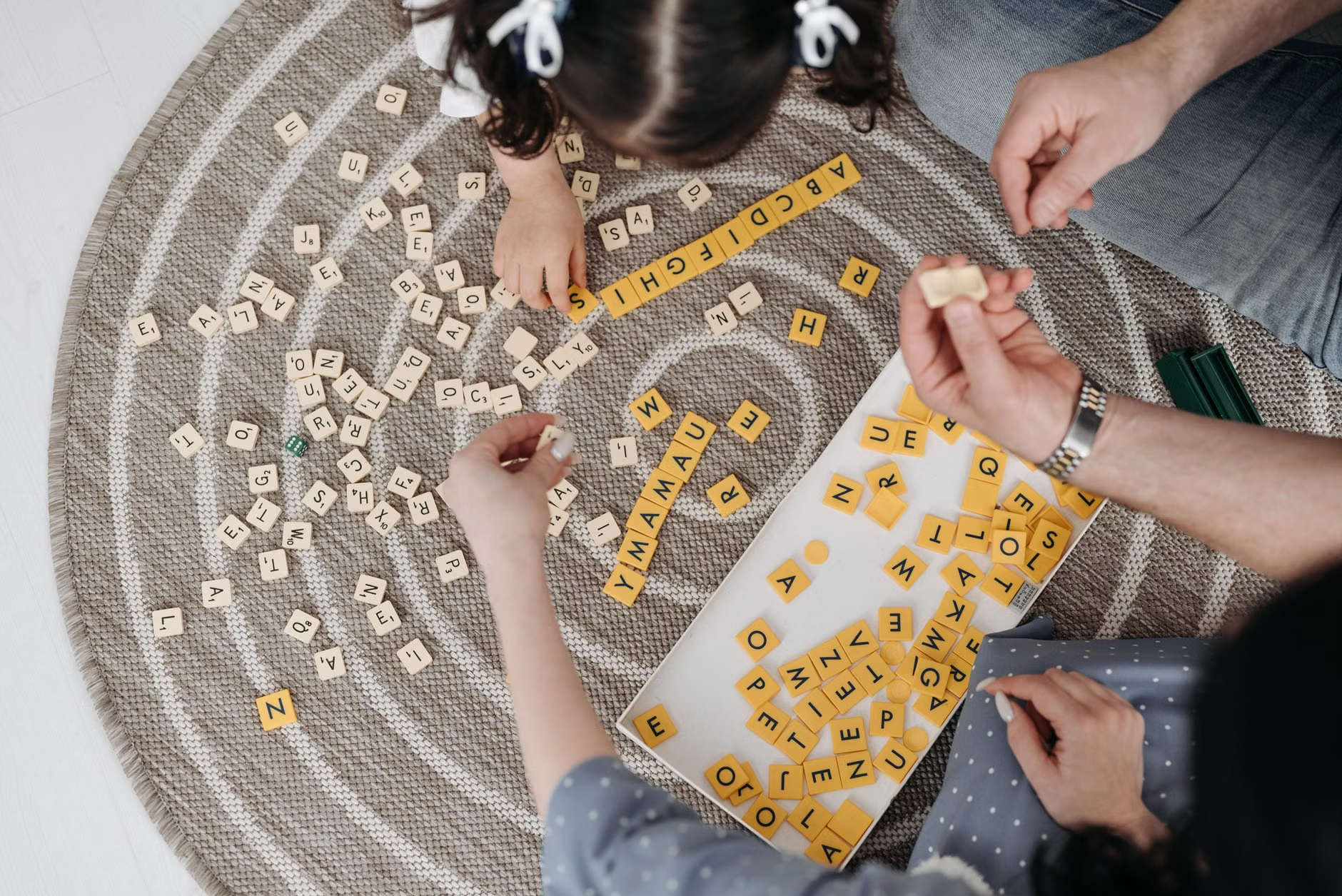
The “Four-Step” Framework for Implementation
How do you actually start? It doesn’t require a special schedule or expensive toys. It requires a commitment to a consistent, brief window of time each day. Here is a practical, step-by-step approach to integrating co-regulation into your routine.
Step 1: The “Check-In” Ritual
Before starting any activity, take 30 seconds to observe your child’s energy. Are they “high energy” (bouncing off the walls) or “low energy” (withdrawn and quiet)? If they are high energy, start with a physical activity—jumping jacks or a quick stretch—to help them discharge that energy before moving to something sedentary. If they are low, start with something gentle and engaging.
Step 2: Set the Environment
Technology is the enemy of co-regulation. Put your phone in another room. The “hidden cost” of parenting in the digital age is the constant task-switching. If you are checking an email while playing with your child, your nervous system is split. Your child can sense this lack of presence, which keeps their own nervous system on high alert. Create a “screen-free zone” for at least 15 minutes.
Step 3: Follow, Don’t Lead
This is where most parents fail. We want to teach, correct, or optimize the game. Instead, let your child lead. If they want to build the LEGO tower differently than the instructions, let them. If they want to change the rules of the card game, go with it. When you relinquish control, you give your child a sense of agency, which is a massive regulator for anxiety.
Step 4: The “Co-Regulation” Pause
If the game hits a snag—they get frustrated because a piece doesn’t fit—do not jump in to “fix” it. Instead, say, “That piece is being stubborn, isn’t it? Let’s take a breath and try again.” You are modeling the behavior of a regulated person facing a minor challenge. You are showing them that frustration is temporary and manageable.
It is easy to think that if you just follow these steps, your child will never have another meltdown. This is a misconception. Regulation is not about preventing emotions; it is about providing the support to recover from them. A child who feels safe will express their frustration, and that is a sign that your co-regulation is working.
The “Too Much” Trap: Don’t force 60 minutes of “quality time.” For many school-aged kids, 15 to 20 minutes of high-quality, undistracted play is more effective than an hour of forced interaction. If you try to push it too long, the quality drops, and you both end up irritated. Know your limits and your child’s limits.
The “Fixing” Temptation: When a child is struggling, our natural instinct is to solve the problem. If they are failing at a game, we want to show them the “right way.” This is a mistake. By fixing the problem, you deny them the opportunity to build their own frustration tolerance. Your role is to sit in the frustration with them, not to remove the frustration for them.

Building Your Own Resilience as the “Regulator”
You cannot give what you do not have. If you are constantly running on caffeine and stress, your ability to co-regulate will be compromised. This is the “hidden variable” of parenting: your own emotional health is the most important factor in your child’s stability. If you feel your own heart rate rising, the best thing you can do is pause the game. Simply say, “I’m feeling a bit frustrated/tired, let’s take a five-minute break and come back to this.” This is a powerful lesson for your child: it shows them that adults have limits, and that it is okay to step away to regain composure.
Consider the “A/B” comparison of two parenting styles:
- Style A (The Fixer): “Why are you crying? It’s just a game. Here, let me do it for you.” (Result: Child feels incompetent and dependent).
- Style B (The Co-Regulator): “I can see you’re frustrated. That piece is tricky. I’m going to take a deep breath, and I’m here while you figure it out.” (Result: Child feels supported and empowered to try again).
Style B is not about letting them win; it’s about being a steady presence that allows them to fail safely. This is where resilience is born.
Practical Steps to Start Today
To begin, pick one time of the day—perhaps right after school or before dinner—where you commit to 15 minutes of “unplugged” time. Use the following checklist to ensure you are setting yourself up for success:
- Clear the Space: Remove distractions (phones, tablets, TV).
- Lower the Stakes: Pick an activity where the goal is connection, not performance.
- Monitor Your Own State: Check your breathing. If you are tense, take three deep breaths before you start.
- Observe, Don’t Direct: Let your child lead the play.
- Validate, Don’t Fix: If emotions surface, acknowledge them without rushing to change them.
Remember that this is a practice, not a test. Some days you will be a perfect co-regulator, and other days you will lose your cool. That is part of life. The goal is not perfection, but a consistent, reliable presence that your child can count on. By showing them how to handle their emotions through your own example, you are giving them the most valuable gift they will carry into their teenage and adult years: the ability to return to calm, no matter what life throws at them.
For further reading on the science of attachment and emotional development, you can explore resources from the Center on the Developing Child at Harvard University, which provides extensive research on how the environment and relationships shape brain architecture.
Frequently Asked Questions
1. Is it possible to over-regulate a child?
Yes. If you are constantly “hovering” to ensure your child is calm, you may inadvertently prevent them from learning how to manage their own mild distress. The goal is to provide enough support so they don’t get overwhelmed, but enough space so they can practice their own coping skills. If your child is doing fine on their own, don’t feel the need to intervene.
2. What if my child refuses to play with me?
This is common, especially as they get older. If they push you away, don’t take it personally. Try “parallel play”—simply doing your own activity (reading, knitting, or organizing) in the same room without demanding their attention. Often, once the pressure is off, they will naturally gravitate toward you or start to engage in their own activity, which can be the first step to a shared moment.
3. Can I co-regulate if I am also feeling angry or sad?
It is very difficult to co-regulate when you are in a state of high emotional distress. If you are feeling overwhelmed, it is actually more honest and helpful to tell your child, “I’m having a hard time right now, and I need a moment to myself to calm down.” This models healthy boundaries and emotional awareness. You can return to co-regulating once you have regained your own baseline.
Parenting is a marathon, not a sprint. By focusing on your own calm and being a steady presence for your child, you are building the foundation for a lifetime of emotional resilience. Take it one small, quiet moment at a time.