The most effective way to reclaim your weekends is not by booking an expensive flight, but by applying the “Staycation-Equity” framework to map your immediate surroundings for high-value rest that fits your actual energy levels as a parent.
Three Key Takeaways
- Energy Budgeting: Stop planning “adventures” that require more recovery time than they provide; instead, categorize local spots by the “Cognitive Load” they demand from parents.
- The 30-Minute Radius Rule: Limit your staycation radius to 30 minutes of travel time to minimize transit fatigue, which is the primary killer of family weekend morale.
- Equity Mapping: Use a simple matrix to ensure your local outings provide equal “recharge equity” for both parents, rather than defaulting to child-centric activities that leave adults exhausted.
If you are in your 30s or 40s, your weekends have likely become a blur of grocery shopping, laundry, and “managing” the kids, punctuated by the occasional guilt-ridden trip to a crowded playground. We talk about staycations as a way to save money, but the real value isn’t financial—it’s about reclaiming the mental bandwidth that gets consumed by the logistics of long-distance travel. When you travel, you move your domestic chaos to a new location. When you “staycation” with equity, you transform your local environment into a source of genuine replenishment.
Understanding the “Cognitive Load” of Weekend Planning
The biggest mistake parents make when planning a weekend is ignoring the “hidden cost” of the activity. We often confuse “fun for the kids” with “rest for the family.” If you take your children to a massive theme park, you are spending hours navigating crowds, managing snacks, and maintaining constant vigilance. That is not a staycation; that is a high-stakes logistics operation.
In the Staycation-Equity model, we categorize activities based on Cognitive Load. This is the measure of how much executive function is required to execute the outing. For a parent, checking the train schedule, packing for three weather scenarios, and navigating a busy city center is a high-load activity. Sitting in a quiet, local botanical garden with a packed lunch and an audiobook is a low-load activity.
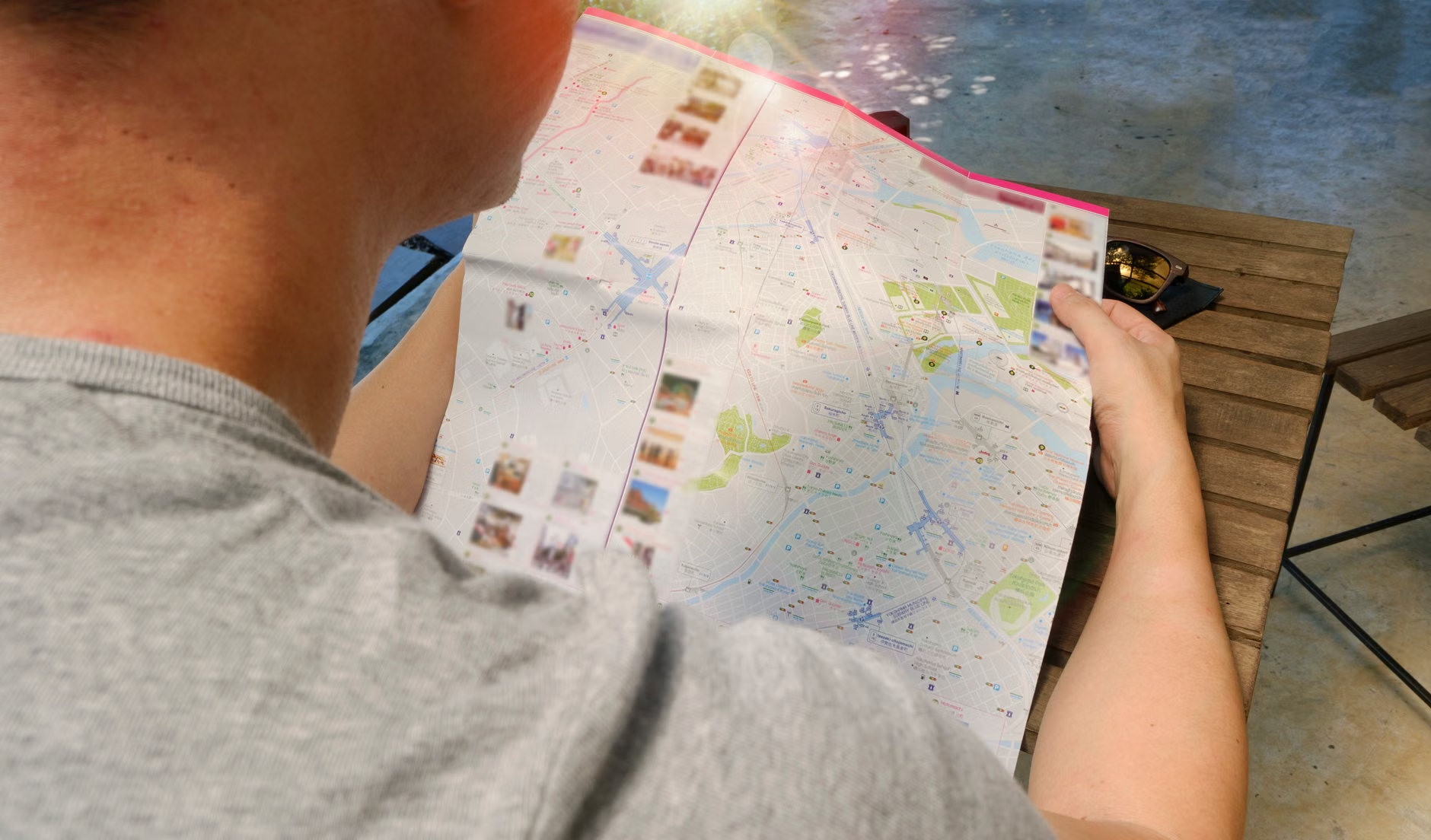
To implement this, you must first audit your local area. Take a map of your city and draw a circle representing a 30-minute commute. Within this circle, identify three types of locations:
- Low-Load Zones: Places with minimal barriers, such as neighborhood parks, local libraries, or quiet residential walking paths.
- Medium-Load Zones: Places that require some planning but offer high reward, such as local museums with predictable schedules or community swimming pools.
- High-Load Zones: Major tourist attractions, large shopping malls, or events that require significant travel and crowd management.
The Strategy: Limit your weekend to one “Medium-Load” activity per month. The rest of your time should be spent in “Low-Load” zones. Most parents try to pack multiple high-load activities into a weekend, which is why you feel more tired on Monday morning than you did on Friday afternoon.
The Equity Matrix: Balancing Parent Needs vs. Child Needs
Equity in a staycation means that the activity must provide a “recharge” for the adults, not just entertainment for the children. If you find yourself in a situation where the kids are happy but you are staring at your phone, stressed about the time, you have failed the equity test.
Consider the “Parallel Play” approach. This involves selecting a location where the children can engage in supervised play while the adults are physically present but mentally disengaged from the “management” of the children. A local park with a fenced-in playground is the classic example. The child is safe, and the parent can sit on a bench and read or talk to their partner.
We can use a simple table to evaluate potential outings before we commit to them:
| Activity Type | Parental Effort | Child Engagement | Recharge Value |
|---|---|---|---|
| Indoor Soft Play | High (Noise/Crowds) | High | Low (You are on duty) |
| Nature Preserve Hike | Medium (Physical) | Medium | High (Mental quiet) |
| Local Library Hour | Low | High | Medium (Quiet time) |
| City Center Market | High (Logistics) | Low/Medium | Low (Stressful) |
The goal is to move your selection toward the bottom-left of the “effort” scale and the top-right of the “recharge” scale. If you are choosing an activity that is high-effort and low-recharge, you must justify why it is necessary. Is it a special birthday? Is it a rare school holiday event? If not, skip it. You do not need to be a “hero parent” every weekend.
Step-by-Step: Building Your Local Exploration Map
To stop “doom-scrolling” for ideas on Friday night, you need a pre-prepared menu of options. This is your “Staycation-Equity Map.” Building this takes about two hours, but it saves you hundreds of hours of decision fatigue over the year.
Phase 1: The Inventory
Spend one evening looking at Google Maps or your local council’s tourism website. List every potential spot within your 30-minute radius. Do not filter yet; just list them. Include parks, cafes with outdoor seating, museums, community centers, and even quiet residential streets with interesting architecture.
Phase 2: The Categorization
Assign each item a “Load Score” (1 to 5, with 1 being the lowest). A neighborhood park is a 1. An amusement park is a 5. Then, assign an “Equity Score” (1 to 5, with 5 being the most restorative for adults). A coffee shop with a small play area might be a 4 (good coffee for you, play for them). A loud, crowded indoor play center is a 1 (high stress for you).
Phase 3: The “Go-To” List
Select your top five “High-Equity, Low-Load” spots. These are your “Emergency Weekend” locations. When it’s Saturday morning and you haven’t planned anything, you don’t look for new ideas. You pick one of these five. This removes the “decision fatigue” that often leads to staying home and feeling guilty.

Common Pitfalls and How to Avoid Them
One of the most common mistakes is the “Travel Trap.” Many families in their 30s and 40s feel that if they haven’t “gone somewhere,” they haven’t had a proper weekend. This is a cultural relic of the “vacation” mindset. We assume that distance equals value. It does not. In fact, for a parent with young children, distance usually equals stress.
Another pitfall is the “Activity Overload.” You might feel that because you have the whole day, you should visit three different places. This is a recipe for disaster. Every transition—packing the car, getting the kids in, driving, parking, un-packing—is a transition that costs emotional energy. Stick to one location per outing. If you stay at the park for four hours instead of two, that is a success, not a failure. It means you found a place where you could actually relax.
Finally, avoid the “Equipment Burden.” If your outing requires a trunk full of gear—scooters, helmets, changes of clothes, specialized snacks—it is a High-Load activity. Aim for “Grab-and-Go” outings. If you can’t leave the house in under 15 minutes, the barrier to entry is too high. Keep a “Go-Bag” in your car or by the door with basic essentials like a first-aid kit, a few non-perishable snacks, and a blanket. This lowers the cognitive load of leaving the house significantly.
Real-Life Application: The Sunday Morning Audit
Let’s look at a hypothetical scenario to see how this works in practice. Sarah and Mark, parents of two children aged 4 and 7, usually spend their Sundays in a state of mild panic. They often try to drive to a “big” attraction 45 minutes away. By the time they arrive, the kids are hungry, the parking is full, and the parents are already arguing about directions.
By applying the Staycation-Equity map, they identify a local nature trail only 10 minutes away. It’s a “Low-Load” (easy drive, no parking stress) and “High-Equity” (quiet, good for walking and talking) activity. They pack a simple thermos of coffee and some fruit. They are home by 1:00 PM for nap time. They feel refreshed rather than drained. They didn’t “do” a big activity, but they “had” a great weekend.
This isn’t about giving up on exploration; it’s about changing the definition of exploration. Exploring your local environment can be just as rewarding as visiting a new city if you approach it with the right mindset. It’s about noticing the changing seasons in your local park, finding a new coffee shop, or walking down a street you usually only drive through.

The Hidden Costs of “Big” Weekends
We often ignore the “recovery cost” of our weekend choices. If you attend a birthday party, visit a museum, and go to the grocery store all in one weekend, you are paying for that on Monday morning. Your professional life and your parenting life are both suffering because you didn’t have enough downtime.
The Staycation-Equity map helps you visualize this. When you see your week on a calendar, you can see where you have “Load” spikes. If your work week is high-load, your weekend must be low-load. If you have a high-load weekend, you are essentially borrowing energy from your next week. This is why many people feel like they are constantly “behind” or “catching up.”
Consider the “Three-Day Rule.” If you have a three-day weekend, you might allow yourself one “Medium-Load” activity. But for a standard two-day weekend, stick to “Low-Load.” It sounds boring, but the result is a consistent, sustainable energy level. In your 30s and 40s, consistency is the key to maintaining your sanity. Don’t look for peak experiences; look for sustainable rhythms.
Final Thoughts on Building Your Own Rhythm
The goal of the Staycation-Equity map is to give you permission to do less. We live in a culture that pushes us to be “productive” even in our leisure. We feel we need to show photos of our weekend, or that we need to have “done something.” Forget that. Your primary duty as a parent is to be present and relatively sane. You cannot do that if you are constantly running from one activity to the next.
Start small. This weekend, don’t try to “fix” your whole life. Just identify one “Low-Load, High-Equity” spot near your home and go there. Keep it simple. If you find yourself enjoying it, you have found a new pillar for your weekend routine. If not, try another. The map is a living document; it should change as your kids grow and as your own energy levels fluctuate.
You have more potential for rest within a 30-minute radius of your home than you realize. It’s time to stop looking at the horizon and start looking at the ground beneath your feet. You might be surprised at what you find when you stop trying so hard to “get away.”
Frequently Asked Questions
- How do I handle the “FOMO” (Fear Of Missing Out) when everyone else is posting about big trips?
Remember that social media is a highlight reel. Most people are struggling with the same logistical exhaustion you are. Focus on the quality of your own rest rather than the appearance of your leisure. Your goal is to be a better parent and a happier person, not to win a digital popularity contest. - What if my kids complain that a local park is “boring”?
Boredom is a skill. By providing a “low-load” environment, you are giving your children the space to develop their own play. If they complain, bring a simple, non-electronic activity like a ball or a sketchbook. You are not an entertainment director; you are a facilitator of experiences. It is okay for children to learn how to occupy themselves in a quiet space. - Does this mean I should never travel long-distance again?
Absolutely not. This framework is about your standard, day-to-day weekend life. When you decide to take a “real” vacation, use the money and energy you saved by doing local staycations to make that trip truly special and manageable. The Staycation-Equity framework actually makes long-distance travel more possible because you aren’t burned out from every weekend of the year.
For more research on the importance of local leisure and urban planning, you can explore resources from organizations like the Project for Public Spaces, which provides insights into how public spaces impact community well-being and family life.