By 2026, the era of “set it and forget it” for smart home devices will effectively end as new international data-sovereignty laws mandate that your family’s digital footprint stay within your control, not on a corporate server halfway across the globe.
- Local Processing Mandates: Manufacturers must now prioritize “edge computing,” meaning your voice recordings and video feeds are processed on the device rather than in the cloud.
- Right to Data Deletion: You will gain simplified, legally mandated dashboards to purge your family’s biometric and behavioral data with a single click.
- Strict Consent for Minors: New regulations effectively ban the “default-on” data collection for smart toys and children’s educational gadgets, requiring explicit parental activation.
You probably have a few smart devices humming in the background right now. Maybe it’s a video doorbell that alerts you when the kids get home from school, a smart speaker playing lullabies, or a robot vacuum mapping your living room floor. For years, these devices operated on a simple, unspoken trade: you get convenience, and the manufacturer gets your data. But as we approach 2026, the legislative tide is turning sharply toward the user.
Governments in the EU, North America, and parts of Asia are finalizing a new wave of “Data-Sovereignty” frameworks. These aren’t just minor updates to existing privacy policies; they are fundamental shifts in how hardware must be built. If you are a parent trying to balance the benefits of a connected home with the very real anxiety of digital surveillance, this change is not just bureaucratic noise—it’s a massive win for your household’s privacy.
What “Data Sovereignty” Actually Means for Your Living Room
When we talk about data sovereignty in the context of a family home, we are talking about the right to own your digital identity. Currently, if your smart camera captures a video of your toddler taking their first steps, that data is often transmitted to a server, encrypted by a third party, and stored for an indefinite period. Even if you “delete” it, the metadata—the time, the location, the frequency of movement—often stays in the manufacturer’s ecosystem.
By 2026, the legal landscape will shift the default. The core principle is Data Minimization. Devices will be legally required to collect only what is strictly necessary to perform their primary function. If a smart lamp doesn’t need to know your GPS location, it will be illegal for the manufacturer to request it. More importantly, these laws mandate that processing happens “on the edge”—a technical term for “on the device.”
Think of it like this: instead of sending a postcard of your home life to a mail sorting office (the cloud) to be read, scanned, and filed, your device will now keep that information inside a locked drawer in your house. The data never leaves your local network unless you explicitly authorize a specific, temporary transfer.
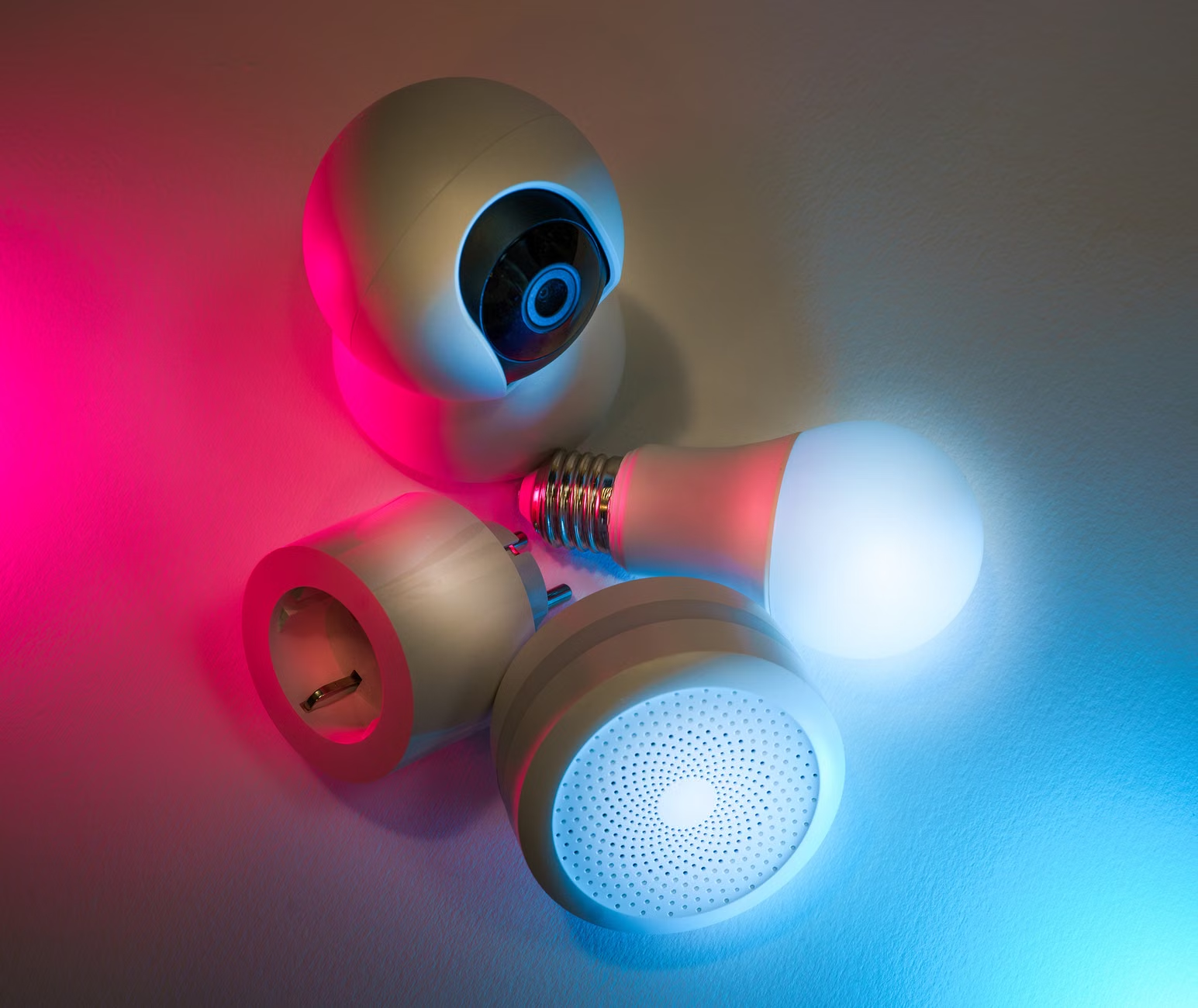
Why 2026 is the Deadline for Your Smart Home Upgrade
Why now? The rapid evolution of AI-driven home assistants has created a “privacy gap.” These devices don’t just record audio; they analyze it to predict behavior, shopping habits, and even moods. Regulators have realized that traditional privacy policies—those 40-page documents nobody reads—are insufficient for protecting families.
The 2026 legislative packages (such as the updated EU Data Governance Act and similar emerging frameworks in the US and Canada) are moving toward “Privacy by Design.” This means that before a device hits the shelf, its architecture must be audited to ensure that it cannot “phone home” with your private habits. For you, this means that devices manufactured before 2026 might become “legacy” hardware. They won’t necessarily stop working, but they will likely stop receiving security updates, and they won’t comply with the new, strict data-isolation standards.
The Comparison: Smart Home Privacy, Then vs. Now
| Feature | Pre-2026 Standard | Post-2026 Mandate |
|---|---|---|
| Voice Data | Sent to cloud for processing. | Processed locally on device. |
| Data Deletion | Obscure menus; cloud backups remain. | Universal “Delete All” dashboard. |
| Child Privacy | Passive consent via “Terms of Use.” | Active, granular parental opt-in. |
| Cross-Device Tracking | Shared across ad-tech networks. | Isolated to the specific home hub. |
As you can see, the shift is from a “company-first” model to a “user-first” model. The key takeaway here is that if you are planning to upgrade your home security or smart lighting, it is worth waiting for “2026-compliant” labeling. These devices will carry a certification seal that guarantees they meet the new, rigorous local-processing standards.
The Hidden Impact on Smart Toys and Educational Tools
Perhaps the most critical area affected by these laws is the “connected toy” market. We’ve all seen the smart dolls and interactive learning tablets that listen to our children. Under the old rules, these devices were notorious for harvesting conversational data to build “interest profiles” on children—a practice that will be effectively outlawed by 2026.
If you have a child using a smart tablet or toy, you need to be aware of the “Child-Specific Data Protocol.” By 2026, any device marketed to children under 13 must have a “Hardware Kill-Switch” for microphones and cameras. This is not a software toggle that can be bypassed by an app update; it is a physical, mechanical disconnect. When you flip that switch, there is no digital connection. This is a game-changer for parents who want the educational benefits of smart tech without the constant risk of data leakage.

What You Should Do Today: A Practical Action Plan
You don’t need to wait until 2026 to start securing your home. In fact, the habits you build now will make the transition much easier. Here is a step-by-step approach to auditing your current smart home environment.
1. Audit Your “Ghost” Devices
Most of us have devices we haven’t touched in months. A smart plug that was used for Christmas lights, a camera from an old baby monitor, or a smart scale you stopped using. These “ghost devices” are the biggest security risks. They are often sitting on your network with outdated firmware, acting as an open door for potential intruders. Decision Rule: If you haven’t used it in 30 days, unplug it and factory reset it.
2. Isolate Your Guest Network
Most modern routers allow you to create a “Guest Network.” This is a separate digital lane for your smart devices. Move all your IoT (Internet of Things) devices—bulbs, vacuums, smart speakers—to this network. Even if a smart bulb is compromised, it won’t have a direct line to your laptop, your banking apps, or your primary storage, which should remain on your main, secure network.
3. Demand Data Portability
Start looking for the “Export Data” button in your device apps. Under the new laws, companies are required to make your data portable and readable. If a company makes it impossible for you to download or delete your data, consider that a red flag. You don’t need to wait for the law to force their hand; vote with your wallet by choosing brands that prioritize transparency today.
Common Misconceptions About Data Sovereignty
There is a lot of confusion regarding what these laws can actually achieve. A common misconception is that “data sovereignty” means you are invisible. You aren’t. Your ISP (Internet Service Provider) still sees your traffic, and your devices still need to connect to the internet to function. The law doesn’t stop the collection of data; it stops the unnecessary retention and exploitation of that data.
Another myth is that this will make smart homes “dumb.” Some fear that if devices process everything locally, they will lose their “smart” features like predictive scheduling or advanced voice recognition. While there is a slight trade-off in processing power, modern chips are incredibly efficient. Your smart hub will still be smart; it will just be doing the thinking itself rather than outsourcing it to a server in a different country.
The next 18 months will be a transitional period. You will see companies rebranding their privacy policies and pushing “new and improved” security features. Don’t be fooled by marketing fluff. Look for technical specifications like “Local-Only Processing” or “Zero-Cloud Architecture.”
When you are shopping for a new device, ask these three questions:
- Can this device function without a cloud account? If the answer is “no,” look for a different product.
- Is the data encrypted at rest on the device? You want to ensure that even if the device is stolen, the data inside cannot be accessed.
- Does the manufacturer offer a clear, manual override for all sensors? You should always have the final say on when a camera or microphone is active.
If a product doesn’t meet these criteria, you are essentially paying for a device that is partially owned by the manufacturer. By 2026, this will be the standard for all consumer electronics, but you can start demanding it now.
The Future of Your Connected Home
The 2026 regulations represent a shift in the power dynamic between the consumer and the tech giant. For the last decade, we have been the product. With these new mandates, we are returning to being the customer. This requires a bit of effort on your part—learning to manage your network, being selective about which devices you allow into your home, and staying informed about your rights.
Take comfort in the fact that the tech industry is being forced to adapt to your needs. The smart home of the future isn’t just one that is more automated; it is one that is more respectful of the sanctity of your private life. Keep your software updated, keep your network segmented, and don’t be afraid to disconnect the things that don’t respect your boundaries.
The goal is a home that supports your family’s needs, not one that observes them. Stay curious, stay vigilant, and enjoy the convenience of modern technology on your own terms.
Frequently Asked Questions
1. Will my current smart home devices stop working in 2026?
Most devices will continue to function, but they may become “unsupported.” This means you won’t get security patches. If a device is critical—like a camera or a smart lock—it is wise to plan for a replacement with a 2026-compliant model to ensure you have the latest security protections.
2. Does “local processing” mean my smart home will be slower?
Actually, it can be the opposite. Because the device doesn’t have to send a request to a remote server and wait for a response, many local-processing devices are faster and more reliable, especially if your internet connection happens to be spotty.
3. Where can I find out if a specific device is compliant with upcoming laws?
Look for certifications from reputable third-party security auditors or check the manufacturer’s “Privacy Commitment” page specifically for mentions of “Local-Only Data” or “Edge Computing.” You can also check international regulatory databases like the European Data Protection Board for guidance on what standards reputable manufacturers are currently adopting.
Note: This article provides information based on current legislative trends and data-privacy standards. Always check local laws in your specific region, as enforcement and implementation details can vary by country.