The most effective way to reduce preschool “meltdowns” isn’t by enforcing stricter discipline, but by giving your child the precise language to label their internal state before it boils over into a tantrum.
- Precision beats generalization: Moving beyond “happy” and “sad” to words like “frustrated,” “disappointed,” or “overwhelmed” allows children to communicate their needs before they act out.
- Model, don’t just teach: Children learn emotional granularity by hearing parents narrate their own complex feelings, not just by being told to “use your words.”
- The “Pause and Label” technique: By identifying an emotion the moment it appears, you shift the brain’s activity from the reactive amygdala to the language-processing prefrontal cortex.
If you have ever spent twenty minutes trying to figure out why your four-year-old is crying over a broken cracker, you know the frustration of the “emotional wall.” We ask, “Why are you upset?” and get nothing but more tears. The reality is that your child isn’t necessarily being stubborn; they are often suffering from a vocabulary deficit. They are experiencing a complex cocktail of physical fatigue, disappointment, and hunger, but they only have two labels for it: “Happy” or “Sad.”
Why Emotional Granularity Matters for Behavior
Psychologists refer to the ability to identify and label specific emotions as “emotional granularity.” Think of it like the difference between saying, “I feel bad,” and saying, “I feel exhausted, slightly anxious about my deadline, and hungry.” The latter provides a roadmap for what to do next. When a preschooler can distinguish between being “bored” and being “frustrated,” they stop needing to hit or scream to express their discomfort.
When a child lacks these words, their body takes over. The amygdala—the brain’s alarm system—triggers a “fight or flight” response because it feels a surge of unidentifiable energy. By providing the word, you provide a container for that energy. You are essentially teaching your child to use their prefrontal cortex, the part of the brain responsible for logic and self-regulation, to process their internal state.
Research published in the Journal of Child Psychology and Psychiatry highlights that children who can identify their own and others’ emotions show higher levels of social competence and fewer behavioral problems in school settings. This isn’t just about “being nice”; it is a foundational cognitive skill that helps them navigate the social complexities of kindergarten and beyond.
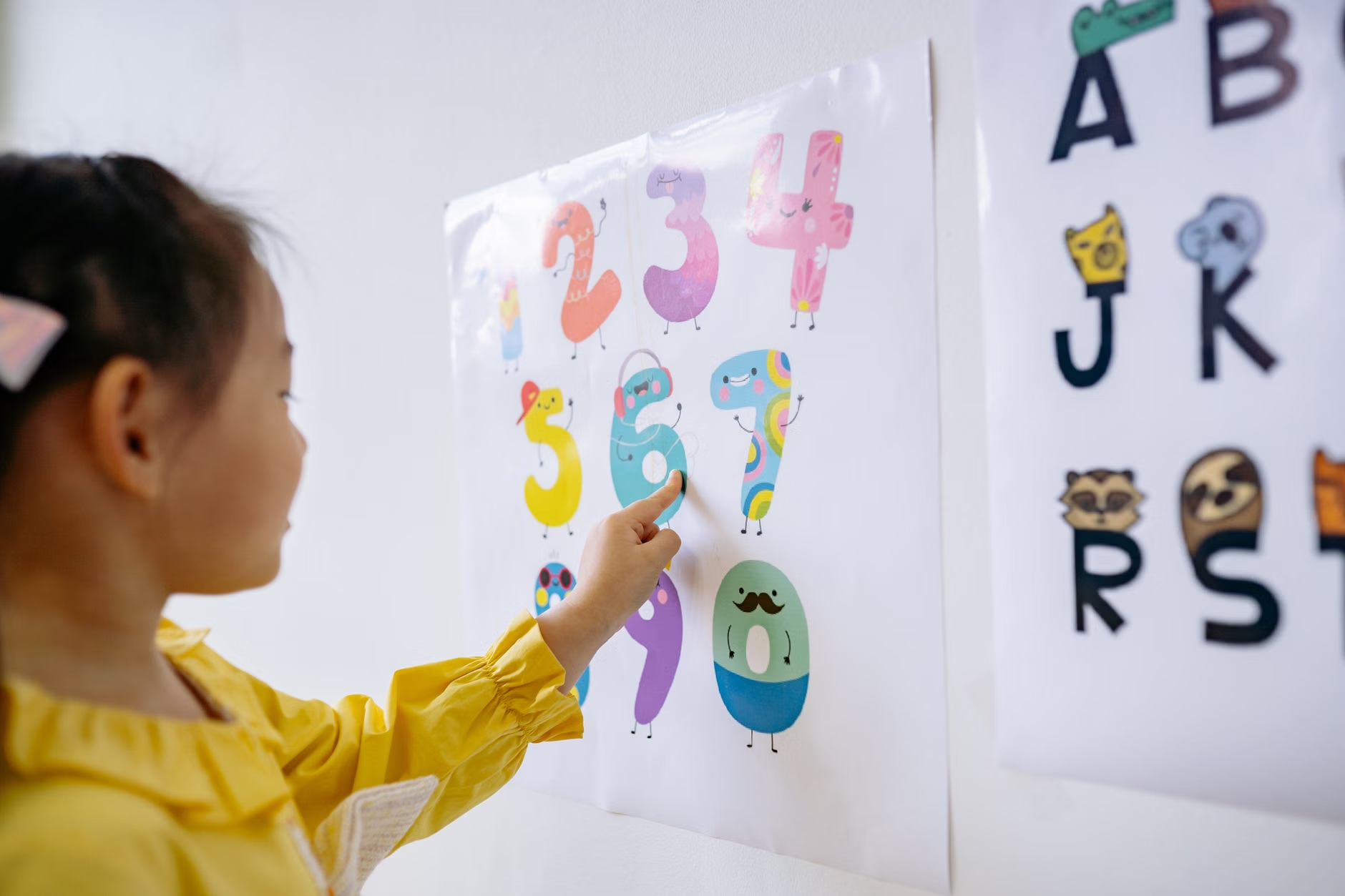
The “Feelings Toolkit”: Moving Beyond the Basics
Most parents start with the “Big Four”: Happy, Sad, Angry, and Scared. These are fine for toddlers, but by age three or four, children are ready for more nuance. If you only provide these four, you are missing out on the subtle shades of human experience that your child is already feeling. A child who is “disappointed” that the park is closed is not necessarily “angry,” and treating them as such can lead to a misunderstanding of their needs.
Expanding the Lexicon: A Categorical Approach
Don’t try to teach a dictionary of emotions at once. Instead, introduce them in clusters based on the situations your child encounters daily. Use the table below to decide which words to introduce based on your child’s current challenges.
| Emotional Cluster | Goal Words | When to Use |
|---|---|---|
| Low Energy/Discomfort | Tired, bored, lonely, overwhelmed | During transition times or late afternoon lulls. |
| High Energy/Excitement | Proud, curious, eager, surprised | When they master a new task or explore a new toy. |
| Negative/Blocked | Frustrated, disappointed, embarrassed, jealous | When a toy breaks or a plan changes unexpectedly. |
The strategy here is to use these words in the moment. When you see your child struggling to build a tower, don’t say, “Don’t be angry.” Say, “I see you are feeling frustrated because that block won’t stay put. It’s really hard when things don’t go the way we planned.” By naming it, you validate the feeling and give them the word they need to express it next time.
The Parent’s Role: Modeling Emotional Vulnerability
One of the most common mistakes parents make is hiding their own emotions to “stay strong” for their children. While you certainly shouldn’t burden a preschooler with adult-level stressors, you should model the process of emotional regulation. If you are frustrated because you can’t find your keys, say it out loud.
“I am feeling a little frustrated right now because I can’t find my keys and I’m worried we will be late. I’m going to take three deep breaths to calm down.”
This does three things: First, it validates that adults feel negative emotions too. Second, it demonstrates that feelings are manageable. Third, it provides a “script” for your child to use when they feel the same way. When you see them later struggling with a shoe, they might mirror your language: “I’m frustrated. I need to take a breath.”

Practical Steps to Integrate Emotional Learning into Daily Life
Building this vocabulary does not require formal lessons or expensive worksheets. It happens in the “gaps” of your day. Here are four actionable strategies to weave this into your routine.
1. The “Feelings Check-in” during Storytime
When reading picture books, don’t just read the words. Pause and look at the characters’ faces. Ask, “How do you think the bear feels right now? Look at his eyebrows—they are scrunched up. Is he angry, or is he just disappointed?” This allows your child to practice identifying emotions in a “safe,” low-stakes environment where they aren’t the ones in the middle of a crisis.
2. Create a “Calm-Down Corner”
Establish a physical space in your home—a corner with a few pillows, a soft blanket, and perhaps a book or a stuffed animal. Make it clear that this is not a “timeout” corner for punishment, but a place to go when big feelings happen. Keep a small mirror or a poster with pictures of different facial expressions in this corner. When a child is upset, you can say, “You seem really overwhelmed. Would you like to go to the calm-down corner to find a word for how you feel?”
3. The “Name It to Tame It” Rule
This is a concept popularized by psychiatrist Dr. Dan Siegel. Whenever a child is acting out, your first priority is to connect, not correct. If they are hitting, hold their hands gently and say, “I see you are furious that I took the tablet away. It is okay to be furious, but it is not okay to hit.” You are providing a label for the emotion, acknowledging the validity of the feeling, and setting a firm boundary on the behavior simultaneously.
4. Avoid the “Don’t” Trap
Parents often say, “Don’t be sad,” or “Don’t be scared.” While well-intentioned, these phrases inadvertently teach children that certain emotions are “bad” or “wrong.” This can lead to children suppressing their feelings, which usually results in those feelings manifesting later as physical symptoms or more intense outbursts. Instead, replace “Don’t be sad” with “I see you are sad. It’s hard when we have to say goodbye to Grandma.”

Common Misconceptions and Hidden Trade-offs
It is important to acknowledge that teaching emotional vocabulary is not a “magic button” that eliminates all bad behavior. A child who can say “I am frustrated” may still throw the block. The difference is that you are now dealing with a child who is participating in the solution rather than just reacting to the stimulus.
Another common mistake is “over-processing.” If a child is in the middle of a full-blown tantrum, their brain is in “survival mode.” Trying to have a deep conversation about their feelings while they are screaming is ineffective. Wait until the storm has passed. Once they are calm, say, “Earlier, you were really overwhelmed. That happens to me too. What can we do next time you feel that way?”
Also, beware of “labeling” your child. Avoid saying, “You are an angry child” or “You are so sensitive.” These labels become part of their identity. Instead, focus on the state: “You are feeling angry right now.” The emotion is a visitor; it is not who they are.
Addressing the “Why” and “How” of Emotional Development
Why is this so difficult for children? It comes down to brain architecture. The emotional centers of the brain develop long before the language centers. This is why a two-year-old can feel profound rage but only say “No!” The gap between what they feel and what they can express is the source of the “terrible twos” and the “threenager” phase. Your job is to bridge that gap.
By the time children reach age four or five, they should be able to identify and name a wider range of emotions. If you notice your child consistently struggles to identify feelings, or if their reactions seem vastly disproportionate to the situation, it can be helpful to observe if they are struggling with sensory processing or other developmental delays. However, for most children, the primary “delay” is simply a lack of exposure to the vocabulary.
Consider the environment you are creating. Is it an environment where emotions are discussed? If you are a parent who prefers to keep things “even-keeled,” you might inadvertently be teaching your child that emotions are things to be hidden. You don’t have to be dramatic, but you should be expressive. Let your child see you laugh, let them see you look confused when you can’t assemble a piece of furniture, and let them see you feel proud when you finish a project.
The Long-Term Payoff: Resilience
The end goal of this work is not just a quiet house or a compliant child. It is the development of resilience. A child who understands their own internal state is less likely to be hijacked by their emotions during the inevitable challenges of school and friendships. They will be able to say, “I’m feeling left out,” rather than just attacking a peer. They will be able to say, “I’m embarrassed,” rather than withdrawing from a group activity.
This is a slow process. You won’t see results overnight. But if you start today, you are giving your child the most important tool they will ever own: the ability to understand themselves. The next time your child has a meltdown, take a breath, look at them, and offer them the word they are searching for. It might just change the entire trajectory of the conversation.
Frequently Asked Questions
What if my child refuses to talk about their feelings?
If your child is resistant, don’t force a conversation. Sometimes children feel “put on the spot” when asked “How do you feel?” Instead, narrate for them. Say, “You seem really disappointed that we can’t go to the park. I’d be disappointed too if I were you.” This shows them that you are an observer and an ally, not an interrogator.
At what age should I start using complex emotion words?
You can start as early as toddlerhood. While they may not use the words themselves right away, they are absorbing the labels. By age three, most children can begin to use words like “frustrated,” “excited,” and “scared.” Use the words in context, and they will eventually mirror them back to you.
Is it okay to show my child when I am sad or crying?
Yes, provided you are not using them as an emotional crutch. If you are crying, it is helpful to say, “I am feeling very sad because I miss Grandma. It’s okay to cry when we are sad. I will be okay soon, and I’m going to take a break to rest.” This teaches them that negative emotions are temporary and manageable, which is a vital lesson for their own emotional regulation.
For further reading on child development and emotional intelligence, you may find the resources provided by the Center on the Developing Child at Harvard University to be particularly helpful in understanding the science of executive function and emotional regulation.