- The “One-Activity Rule”: Limit your weekend to one primary, low-pressure anchor activity to prevent the “logistical fatigue” common in parenting.
- Design for Transitions: Most stress occurs during the switch between home-life and excursion-life; building in a 30-minute buffer zone is more important than the destination itself.
- Prioritize “Low-Decision” Environments: Choose locations where the environment dictates the flow (like a forest trail or a library) rather than places requiring constant supervision and decision-making.
If your weekends currently feel like a frantic relay race between grocery shopping, extracurricular activities, and trying to “make memories,” you aren’t failing—you’re just over-optimizing. The modern parent often treats the weekend like a project management task, leading to what researchers call “leisure-time burnout.” You return to work on Monday more tired than when you left on Friday because your “rest” was actually a series of tightly scheduled logistical hurdles.
The “Slow-Adventure” approach isn’t about doing less; it’s about shifting the focus from consumption (seeing things, buying tickets, checking off lists) to presence. It is a framework for parents in their 30s and 40s to reclaim their weekends by removing the cognitive load of constant decision-making.
Why Your Current Weekend Planning Strategy Is Likely Failing
Most of us approach the weekend with a “maximize the time” mindset. We look for the most interesting museum, the best-rated park, or the trendiest brunch spot. This is a trap. When you pick high-stimulation, high-planning venues, you are essentially moving your workplace stress—coordination, timing, and crowd management—into your personal life.
The psychological cost of this is “decision fatigue.” By the time you’ve navigated traffic, found parking, and kept the kids entertained, your prefrontal cortex is exhausted. For parents, this is usually when the “weekend meltdown” happens. The solution isn’t to stay home and stare at walls; it’s to choose “Low-Decision Environments” (LDEs). An LDE is a space where the rules of engagement are simple and the environment provides the entertainment without you needing to curate it.
Think of it as the difference between a theme park (high decision, high input) and a local nature reserve (low decision, low input). In the nature reserve, the goal is simply to be there. The “adventure” isn’t about reaching a summit; it’s about the unexpected discovery of a beetle, a strange-shaped rock, or just the absence of a schedule.

The Anatomy of a Low-Stress Itinerary
A successful slow-adventure weekend relies on a structure that respects the “transition cost.” We often underestimate how long it takes to move from “home mode” to “out-and-about mode.” If you have young children, this transition can take upwards of 45 minutes. A slow-adventure plan accounts for this by front-loading the ease.
Here is a breakdown of how to structure your Saturday or Sunday to avoid the typical burnout triggers:
| Phase | Focus | Common Mistake |
|---|---|---|
| The Buffer (30m) | Low-energy transition; packing bags without rushing. | Starting the “fun” before everyone is actually ready to leave. |
| The Anchor (2-3h) | One main activity in a low-decision environment. | Trying to “fit in” a second activity or errand. |
| The Reset (Evening) | Zero-pressure time; no screens or complex logistics. | Over-planning dinner or evening activities. |
The key here is the “Anchor Activity.” If you are going to a local forest trail, the anchor is the walk. You don’t need to plan a picnic, a photo shoot, and a stop at a café afterward. If you do the walk and then go home, you have succeeded. The “extra” stuff is usually where the stress creeps back in.
Choosing Your Environment: The “Low-Decision” Criteria
Not all outdoor or cultural spaces are created equal. When you are filtering for a slow-adventure spot, use these three criteria to ensure you aren’t signing yourself up for a logistical nightmare.
1. The “No-Queue” Threshold
If a destination requires booking, waiting in line, or fighting for a parking spot, it is not a slow-adventure candidate. These environments force you into a state of “vigilance” rather than “presence.” Instead, look for places that are accessible but secondary—the smaller state park rather than the famous national monument, or the local library branch instead of the city’s main museum.
2. The “Self-Contained” Rule
Can you spend three hours there without needing to leave to find food or restrooms? A location that provides these basics, even if they are simple, removes the need for you to be the “logistics officer.” If you have to pack a lunch, ensure it’s something that can be eaten cold and requires no setup. The goal is to minimize the amount of “stuff” you are managing.
3. The “Passive Entertainment” Potential
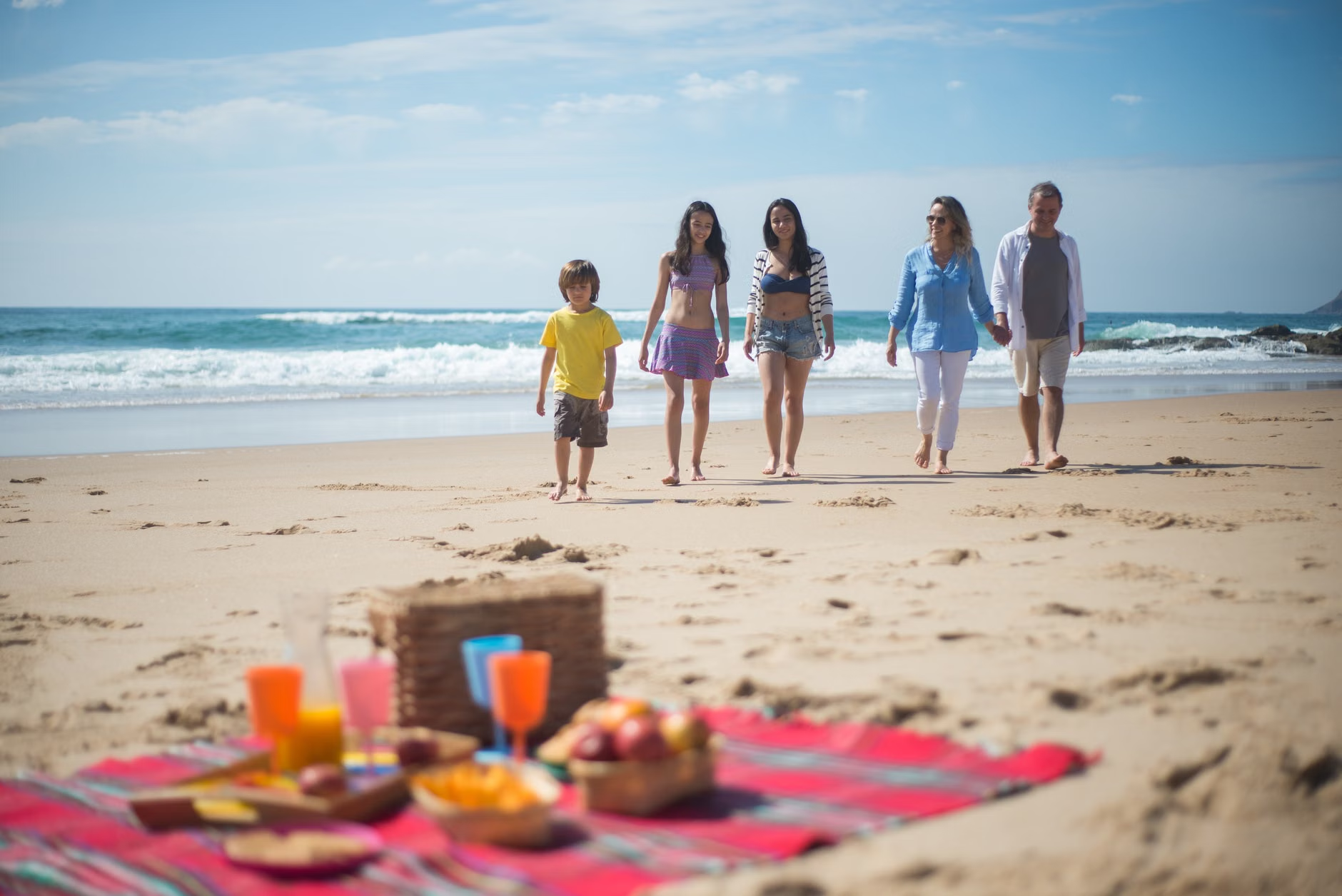
Does the environment naturally occupy the kids? A playground is active, but it requires you to be on high alert. A creek, a beach, or a forest path is “passive”—the kids occupy themselves with the environment, and you can sit on a bench or walk alongside them without needing to initiate the play. This is the difference between being a “facilitator” and an “observer.”
The Unexpected Trade-Offs of Slow Living
There is a hidden cost to choosing the “slow” path: the fear of missing out (FOMO). You will see friends on social media posting about their high-octane trips to expensive theme parks or busy festivals. It is easy to interpret your quiet weekend as “boring” or “less than.”
However, research into family dynamics suggests that the quality of interaction is often inversely proportional to the complexity of the activity. When you are stressed about logistics, you are less emotionally available to your children. When you are relaxed in a simple environment, you are more likely to engage in the “micro-moments”—the small, unscripted conversations that actually build long-term connection.
Another trade-off is the “boredom threshold.” If your kids are used to constant stimulation, they may complain during the first hour of your slow-adventure weekend. This is not a failure. It is the “detox” phase. Allow them to be bored. Eventually, they will start interacting with their surroundings. If you cave and pull out a tablet or suggest a high-stimulation alternative, you are training them to avoid the very stillness you are trying to cultivate.
Step-by-Step: Planning Your First Slow-Adventure
If you are ready to try this, don’t over-complicate the planning process. Here is your action plan for the coming weekend:
- Audit Your Constraints: On Thursday, look at your energy levels. If you are exhausted, your slow-adventure should be close to home. If you have energy, you can go further afield.
- Pick One Location: Open a map app. Look for green spaces or quiet zones within a 30-minute drive. If you are in a city, look for large botanical gardens or quiet, residential-adjacent parks.
- Identify the “Anchor”: Your anchor is the only thing on the agenda. Write it down. Everything else is a “maybe,” not a “must.”
- The “Go-Bag” Strategy: Pack your essentials (water, snacks, layers) on Friday night. Keep it in the car or by the door. This eliminates the Saturday morning “where are the keys/water bottles” panic.
- The Exit Strategy: Decide your “out” time before you leave. Tell the kids, “We are going for a walk, and we will head home for lunch.” Having a clear end-time reduces the pressure to “squeeze more out of the day.”
If you find yourself wanting to add a second activity, ask yourself: “Does this add value to my rest, or does it add to my to-do list?” If the answer is the latter, drop it. The beauty of the slow-adventure is that it leaves you with a “buffer” of time in the afternoon—time where nothing is required of you.

Common Pitfalls and How to Pivot
Even with a perfect plan, things can go sideways. Here is how to handle the most common “slow-adventure” derailments:
The “We’re Not Having Fun” Complaint: This usually happens when expectations are too high. If the kids are grumpy, shift the anchor. If the planned park walk isn’t working, move to a “discovery mode.” Ask them to find three different types of leaves or the strangest rock. Change the goal from “walking” to “exploring.”
The “I Forgot Something” Panic: We are conditioned to believe that if we forget a snack or a specific toy, the day is ruined. It isn’t. If you forget lunch, find the simplest food available—even if it’s just a bag of apples from a grocery store. The “adventure” is often in the improvisation, not the preparation.
The “Suddenly Busy” Environment: You arrive at your quiet park, and it’s crowded with a school field trip or a festival. Don’t fight it. If the crowd is too much, have a backup “Low-Decision” spot in your pocket—a quiet library, a local bookstore, or even your own backyard. The goal is the state of mind, not the physical geography.
Understanding the “Restorative” Science
There is a concept in environmental psychology called “Attention Restoration Theory” (ART). It suggests that urban environments and constant digital connectivity drain our “directed attention”—the focus we use for work and complex tasks. Nature, or any low-stimulation environment, allows this directed attention to rest.
For parents, who are constantly using directed attention to manage schedules, safety, and school logistics, this is vital. By placing yourself in a setting that doesn’t require high-level cognitive processing, you are physically allowing your brain to recover. This is why a simple walk in the woods feels fundamentally different from a walk through a shopping mall. One is restorative; the other is merely a change of scenery.
When you prioritize these environments, you aren’t just being “lazy” or “simple.” You are engaging in a necessary form of biological maintenance. Your 30s and 40s are often the highest-demand years of your life. Treating your weekends as a recovery period rather than a productivity period is a strategic decision for your long-term health and your ability to be present for your family.
Refining Your Approach Over Time
After your first few slow-adventure weekends, you will start to notice what works for your specific family dynamic. Some families thrive on physical movement, while others prefer quiet exploration. Use these insights to build a “bank” of go-to locations.
Don’t fall into the trap of trying to find a “new” adventure every week. Repetition is actually a friend of the slow-adventure. Returning to the same park allows you to notice the changes in seasons, the growth of trees, and the shifting light. It removes the “navigation” stress entirely because you already know where the bathrooms are, where to park, and how long it takes to walk the loop. This familiarity is the ultimate form of low-decision living.
As you get more comfortable with the rhythm, you will find that your weekends become a source of energy rather than a source of stress. You will stop measuring your success by how many photos you took or how many “attractions” you visited. You will measure it by how much clearer your head feels on Monday morning.
Practical Takeaways for Your Next Weekend
Start small. You don’t need to commit to a full weekend away. A two-hour window on a Saturday morning is a perfect “proof of concept.”
- Keep the logistics invisible: If you are planning a trip, do it on Thursday or Friday. Don’t spend your Saturday morning researching opening times.
- Embrace the “Boring”: If your kids are bored, let them be. The creativity that follows boredom is one of the best rewards of the slow-adventure.
- Protect the “Exit”: Always have a clear, non-negotiable time to go home. It makes the activity feel like a treat rather than a marathon.
Remember, the goal of the slow-adventure is to create space. Space for your kids to be kids, and space for you to simply exist without a list of tasks. It is a radical act of self-care in a world that demands constant output. Take that space, and don’t feel the need to justify it with a busy itinerary.
Frequently Asked Questions
What if my children insist on high-stimulation activities like theme parks?
It’s about balance, not prohibition. If you choose a high-stimulation activity, treat it as a “big event” that requires significant pre-planning and post-event recovery. The slow-adventure framework is for your regular weekends. If you spend 40 weekends a year chasing high-stimulation, you will burn out. If you spend 30 of those weekends in a slow-adventure mode, you will have the energy to handle the 10 big trips when they happen.
Is it really a “slow-adventure” if we are just walking in a local park?
Yes. The “adventure” isn’t the distance traveled; it’s the shift in mindset. When you stop treating your time as a commodity to be filled with “experiences” and start treating it as a resource to be protected, the experience itself changes. A local park can be a world of discovery if you allow yourself the time to actually look at it.
How do I handle the pressure to keep up with other families’ weekend plans?
Recognize that what people post on social media is the “highlight reel,” not the “logistical reality.” Many families who post about their busy weekends are dealing with the same exhaustion you are. By choosing a slower pace, you are opting out of the competition. It is a quiet, internal victory that pays off in your own mental health and the quality of your family relationships.
For more research on the benefits of low-stimulation environments, you can look at the work of the American Psychological Association on the health benefits of nature, which underscores how even short periods of time in natural environments can significantly reduce cortisol levels and improve cognitive function.