The most effective way to recover from the relentless pace of modern parenting is not a week of sightseeing, but a deliberate, scheduled period of “doing nothing” in a rural, low-stimulation environment.
- Prioritize Low-Stimulation: The “Quiet-Retreat” trend succeeds by removing decision fatigue, not by adding itinerary items.
- The 48-Hour Threshold: Research suggests that true nervous system regulation begins only after 36 to 48 hours of disconnecting from work and household routines.
- Strategic Location Selection: Choose accommodations that explicitly market “unplugged” experiences, as they are equipped to handle the logistical gaps (like lack of Wi-Fi or nearby stores) that might otherwise cause stress.
If you are in your 30s or 40s, your version of a “vacation” likely involves a high-stress transition: packing for three, managing airport security, navigating toddler tantrums in public, or worrying about the project deadline you left behind. By the time you reach your destination, you aren’t rested; you are just tired in a different geographic location. The Quiet-Retreat trend—often referred to as “slow travel” or “digital detoxing”—isn’t just a travel aesthetic; it is a defensive strategy against the chronic burnout that defines the current generation of parents.
Why Your Brain Is Craving ‘Nothing’
We are living through an era of extreme cognitive load. Between managing school schedules, work emails, and the “mental load” of household management, our prefrontal cortex is constantly firing. When you take a traditional vacation, you are often just replacing household tasks with “leisure tasks”—like researching the best restaurant in a new city or finding the most efficient route to a museum. You are still performing, just in a different setting.
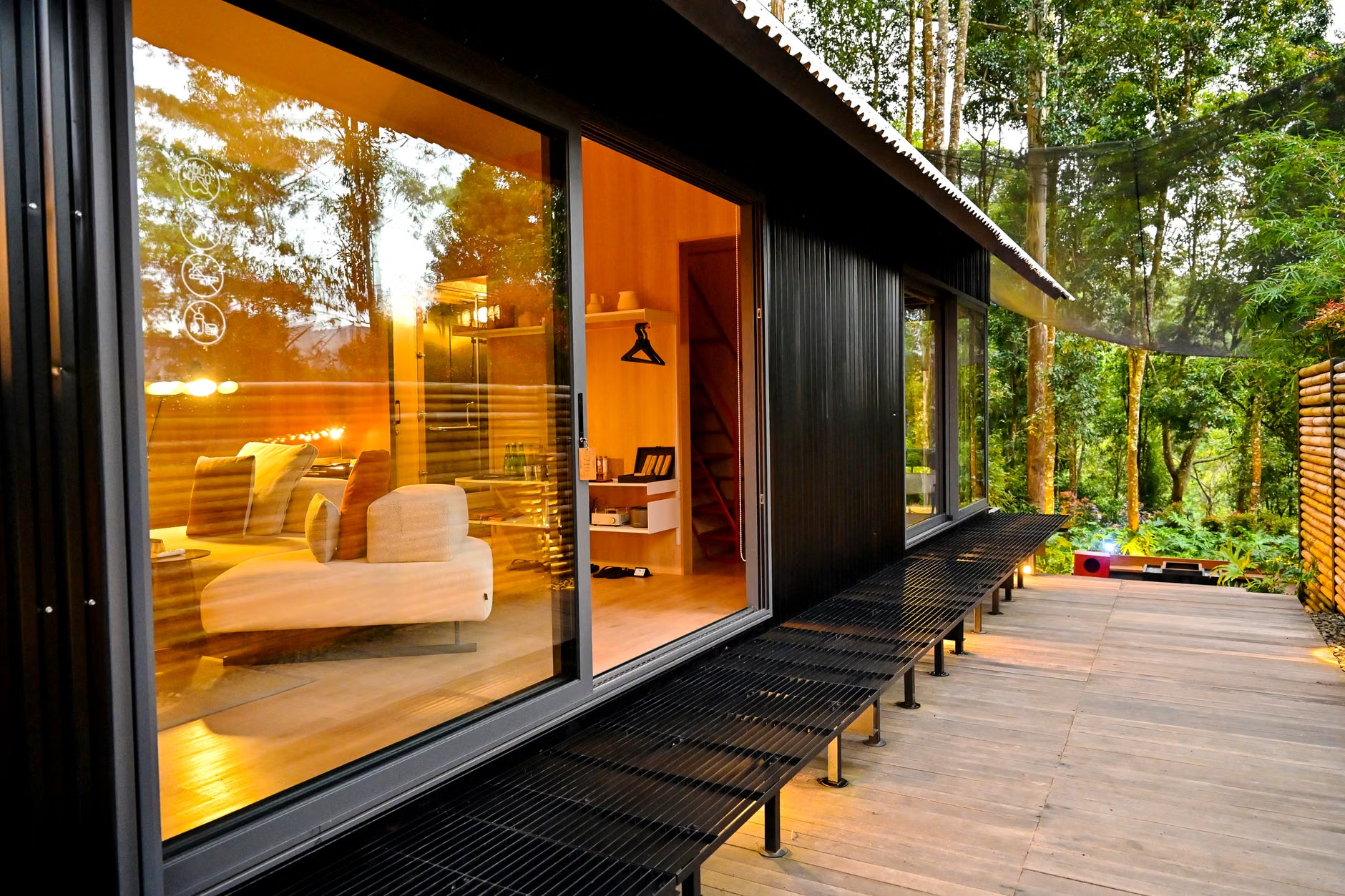
A Quiet-Retreat is fundamentally different because it removes the “performance” requirement. It isn’t about seeing the sights; it’s about reducing sensory input. When you enter a rural space—a cabin in the woods, a quiet farmhouse, or a secluded cottage—you are shifting your environment to match your physiological needs. This matters because, for many, the noise of everyday life is a constant stressor that keeps the body in a state of high cortisol. Removing that noise allows your nervous system to reset.
In practice, this looks like choosing a location where the primary activity is simply existing. No “must-see” landmarks. No “top-rated” tourist traps. Just you, a quiet environment, and the removal of the digital leash. If your phone is constantly pinging with notifications, you aren’t actually on retreat; you are just working remotely from a different chair.
The Anatomy of a Successful Quiet-Retreat
Planning a retreat that doesn’t feel like a chore is an art. If you over-plan, you fail. The goal is to create a “frictionless” environment. Here is how you can structure your next getaway to ensure it actually delivers restorative benefits.
1. The Logistics of Disconnection
The biggest mistake most people make is trying to find a “quiet” place that still has high-speed internet and proximity to everything. If you have the option to be “connected,” you will be. You need to choose a location where the signal is unreliable by design. This removes the temptation to check your email just “one last time.”
2. The “No-Itinerary” Rule
For parents used to managing a household, the urge to create a schedule is strong. Resist it. Instead of an itinerary, create a “needs list.” What do you actually need to feel human again? Is it 8 hours of uninterrupted sleep? Is it the ability to read a book for three hours straight? Is it a long, aimless walk? Build your retreat around those two or three core needs, and ignore everything else.
3. Managing Expectations with Family
If you are taking your family with you, a Quiet-Retreat requires a different set of ground rules. You cannot force a child to be quiet for 48 hours. However, you can create “quiet zones.” Establish a rule where, for two hours in the afternoon, everyone is responsible for their own entertainment. This isn’t just for you; it teaches children the value of self-regulation and independent play—a skill that is increasingly rare in our hyper-scheduled world.
| Feature | Traditional Vacation | Quiet-Retreat |
|---|---|---|
| Primary Goal | Experiences/Sightseeing | Rest/Nervous System Reset |
| Cognitive Load | High (Planning/Navigation) | Low (Minimal Decisions) |
| Digital Usage | High (Maps/Social Media) | Minimal (Detox) |
| Output | Memories/Photos | Mental Clarity/Energy |
As shown in the table above, the trade-off is clear: you are sacrificing the “novelty” of a traditional trip for the “stability” of a retreat. For the burnt-out parent, this is almost always the better investment.
Choosing the Right Environment: A Decision Framework
Not all rural stays are created equal. You need to distinguish between “rustic” (which can be stressful if the plumbing fails or the heat doesn’t work) and “minimalist” (which is intentionally simple but well-maintained). When searching for a property, look for these specific indicators:
- The “Host Vibe” Check: Look for hosts who emphasize peace, quiet, and nature. If the listing is covered in photos of nearby shopping centers or crowded attractions, keep looking.
- The Kitchen Factor: You don’t want to be forced to go out to eat every meal. A well-equipped kitchen allows you to buy local produce and cook simple meals. This is part of the “slow living” experience.
- The “Physical Distance” Rule: Ensure the property is at least a 20-minute drive from the nearest “busy” area. This distance acts as a psychological buffer, making it much harder to justify a spontaneous trip to a crowded supermarket or tourist spot.

Common Pitfalls and How to Avoid Them
Even with the best intentions, it is easy to sabotage your own retreat. Here are the most common mistakes I’ve observed and how to sidestep them.
The “Productivity Trap”
Many people use a quiet getaway to try and “catch up” on things they’ve been neglecting: reading that stack of books, finally learning a new language, or writing a journal. While these are noble goals, they are still “work.” If you find yourself feeling guilty because you didn’t finish your book, you have missed the point. The goal is to do nothing, even if that “nothing” is staring at a wall.
The “Under-Provisioning” Disaster
Nothing kills a retreat faster than realizing you forgot the coffee or didn’t bring enough food. Because you are in a rural area, you cannot just “pop out” to the store. Spend time on a meal plan before you leave. Pack enough supplies for the entire duration of your stay. The goal is to arrive, unpack, and not leave the property until you check out.
The “Digital Relapse”
If you bring your laptop, you will open it. If you have your work Slack on your phone, you will check it. If you absolutely must bring a device for safety (like a phone for emergencies), put it in a lockbox or the glove compartment of your car. If it is within reach, it will dominate your attention.
The Science of “Slow” and Why It Matters
There is a growing body of research on the benefits of “Green Exercise” and exposure to natural environments. A study from the International Journal of Environmental Research and Public Health suggests that even short-term exposure to forest environments can significantly lower blood pressure and cortisol levels in adults. This isn’t just “nice to have”; it is a biological necessity for those of us living in high-stress, urban environments.
When you are in your 30s and 40s, you are likely carrying the weight of multiple responsibilities. Your brain is conditioned to scan for threats and manage logistics. When you enter a forest or a quiet rural landscape, you are essentially telling your brain: “There are no threats here. The logistics are handled.” This allows your brain to shift from “Executive Function Mode” to “Rest and Digest Mode.”

Practical Steps to Start Your First Quiet-Retreat
If you are ready to take the plunge, here is a step-by-step guide to planning your first trip:
- Set a Hard Boundary: Pick a date and mark it as “Unavailable” on your work calendar. Tell your family that this is a “no-phone, no-plans” zone.
- Book the “Right” Spot: Use platforms like Airbnb or specialized cabin-rental sites. Look for properties with reviews that specifically mention “quiet,” “secluded,” and “relaxing.” Avoid places that mention “great for parties” or “close to the nightlife.”
- The Supply Run: Two days before you leave, do a large grocery haul. Prioritize easy, healthy meals that don’t require complex prep. Think pre-cut vegetables, high-quality proteins, and simple snacks.
- The Digital Purge: Before you leave the driveway, turn off all non-essential notifications on your phone. Delete your work email app if you have to. If you are worried about family emergencies, give your spouse or a trusted neighbor the landline number of the cabin, but keep your personal phone out of sight.
- The First 24 Hours: Expect to feel “bored” or “anxious” during the first day. This is normal. Your brain is going through withdrawal from the constant dopamine hits of social media and work stress. Push through it. By the second morning, you will start to notice the silence. That is where the healing begins.
Refining Your Approach: Advanced Tips
Once you have mastered the basic quiet retreat, you might want to adjust the intensity. Some people find that complete silence is too much for their first time. If that is you, consider a “soft” retreat—a stay in a small town where you can walk to a cafe, but where there is no pressure to visit museums or landmarks. The key isn’t necessarily total isolation, but the removal of the *expectation* of activity.
Another variable to consider is the time of year. A rural retreat in the winter is very different from one in the summer. Winter retreats are excellent for deep, introspective work, while summer retreats are better for physical movement and soaking up the sun. Choose the season that aligns with your current energy levels.
Finally, track your results. After your first retreat, ask yourself: How did I feel on the drive back? Was I more patient with my children? Was my mind clearer at work? If the answer is yes, you have found a tool that works for you. Make it a recurring event—perhaps once every quarter—to ensure you are consistently resetting your baseline.
Important Considerations and Cautions
While the Quiet-Retreat trend is powerful, it is not a cure-all. If you are experiencing severe clinical burnout, depression, or anxiety, a weekend in a cabin is not a substitute for professional mental health support. If your stress is stemming from systemic issues in your work or home life, a retreat will provide temporary relief, but it won’t fix the underlying problem. Use these retreats as a tool to help you gain the clarity needed to address those larger issues, not as a way to hide from them.
Additionally, be mindful of your own personality. If you are someone who truly thrives on high-energy social interaction, a week of complete isolation might actually leave you feeling lonelier, not refreshed. If that is the case, consider a “quiet retreat” with one other person who respects your need for silence. It is possible to share a space while both engaging in independent, quiet activities.
Ultimately, the goal of the Quiet-Retreat is to empower you to reclaim your time and your mental space. In a world that constantly demands your attention, your ability to disconnect is a radical act of self-care. Start small, be consistent, and don’t be afraid to do absolutely nothing.
Frequently Asked Questions
Q: Is it really a ‘vacation’ if I don’t go anywhere or do anything?
A: We often conflate “vacation” with “travel.” A Quiet-Retreat is not a vacation in the traditional sense; it is a period of recovery. If you define a successful vacation by how many photos you took or how many landmarks you saw, you will be disappointed. If you define it by how much your stress levels dropped and how much clarity you gained, it is the most successful vacation you will ever take.
Q: How do I handle the ‘FOMO’ (Fear Of Missing Out) when I disconnect?
A: FOMO is a symptom of a nervous system that is over-indexed on the lives of others. When you are in a state of deep rest, your focus shifts inward. The more you practice disconnecting, the more you will realize that the “news” or the “updates” you were missing aren’t actually important to your life. The best way to combat FOMO is to replace it with JOMO—the Joy Of Missing Out.
Q: What if I have young children and cannot leave them behind?
A: A quiet retreat is still possible with children, but you must change the format. Instead of a “silent” retreat, aim for a “low-stress” retreat. Choose a location with a large backyard or a safe, enclosed area where the kids can play independently. The goal is to minimize the amount of “management” you have to do. If you have a partner, consider taking turns—one parent handles the kids for four hours while the other rests, then switch. It isn’t a solo retreat, but it is a massive upgrade from a standard family vacation.
For more information on the benefits of nature and mental health, you may find these resources helpful:
- American Psychological Association: Nurtured by Nature
- National Center for Biotechnology Information: The Physiological Effects of Forest Environments
Ultimately, the most important thing you can do is start. Don’t wait for the perfect time or the perfect cabin. Book something, turn off your phone, and give yourself the permission to be quiet. You have earned it.