- Design Mandates: By 2026, many regions will require manufacturers to provide accessible spare parts and repair manuals, ending the era of “disposable” kitchen electronics.
- Financial Impact: While upfront costs for modular appliances might be slightly higher, the long-term cost of ownership will drop as you replace individual parts rather than entire units.
- Actionable DIY: You don’t need to be an engineer; the new standards prioritize “non-destructive” entry, meaning you’ll be able to open devices without breaking plastic clips or voids.
If you have ever spent two hours trying to fix a $200 blender only to realize the entire unit is glued shut, you have already felt the frustration that the 2026 Right-to-Repair legislation aims to solve. We live in an era where a single broken heating element in an air fryer or a worn-out gasket in a coffee machine often signals the end of the product’s life. It is not just annoying—it is a massive drain on your household budget and the environment.
The global push for “Right-to-Repair” laws, which are hitting major milestones in 2026 across the EU, parts of North America, and beyond, is essentially a legislative effort to force manufacturers to stop making “disposable” tech. For those of us in our 30s and 40s balancing work, kids, and the endless cycle of home maintenance, this is a game-changer. It means moving away from a “replace-it” culture toward a “fix-it” reality.
Why Your Kitchen Appliances Are Currently Designed to Fail
To understand why this legislation is so radical, we have to look at how appliances are currently designed. Many modern kitchen gadgets utilize what engineers call “planned obsolescence” or, more simply, “sealed-unit design.” When you look at an air fryer or a high-end toaster, you often see a sleek, seamless exterior. There are no screws, or if there are, they are proprietary, “tamper-proof” screws that require specialized bits no hardware store carries.

This design choice isn’t accidental. It is a strategic move to save manufacturing costs and ensure that the only “repair” option is to send the unit back to the manufacturer—who will almost always tell you that the cost of labor and shipping is higher than the price of a brand-new, updated model. For the average family, this creates a “repair gap.” You have the motivation to save your device, but you lack the physical access to the internal components. By 2026, the law will demand that manufacturers use standard fasteners and provide documentation that allows anyone—not just authorized service centers—to peek inside the hood.
The Hidden Cost of the “Disposable” Kitchen
Let’s break down the economics. If you buy a premium air fryer for $250 and it breaks after two years, the current market reality often forces you to buy a new one. That is $125 per year in annual appliance depreciation. If you could replace a $20 thermal fuse or a $15 fan motor, the cost of that repair is negligible compared to the replacement cost. The 2026 regulations are designed to make these parts “commercially available,” meaning you won’t have to hunt down obscure grey-market websites just to find a replacement part.
| Feature | Current Reality (Pre-2026) | Future Reality (Post-2026) |
|---|---|---|
| Access | Glued, ultrasonic welds, tamper-proof screws. | Standard screws, accessible compartments. |
| Manuals | Hidden from public/reserved for “authorized” shops. | Publicly available, step-by-step schematics. |
| Parts Availability | Discontinued after 1–2 years. | Required availability for 5–7+ years. |
This table highlights the transition from a “closed system” to an “open ecosystem.” For the consumer, this means that when you are shopping for a new kitchen gadget in 2026 and beyond, you should look for the “repairability index” or similar labels that are already beginning to appear in countries like France and are slowly becoming a global benchmark.
What the 2026 Legislation Actually Mandates
The 2026 standards are not just about “being nice” to consumers; they are about forced compliance. The core of the legislation focuses on three pillars: disassembly, documentation, and parts distribution. It is important to realize that this doesn’t mean manufacturers have to teach you how to be an electrical engineer, but they do have to stop actively preventing you from performing basic maintenance.
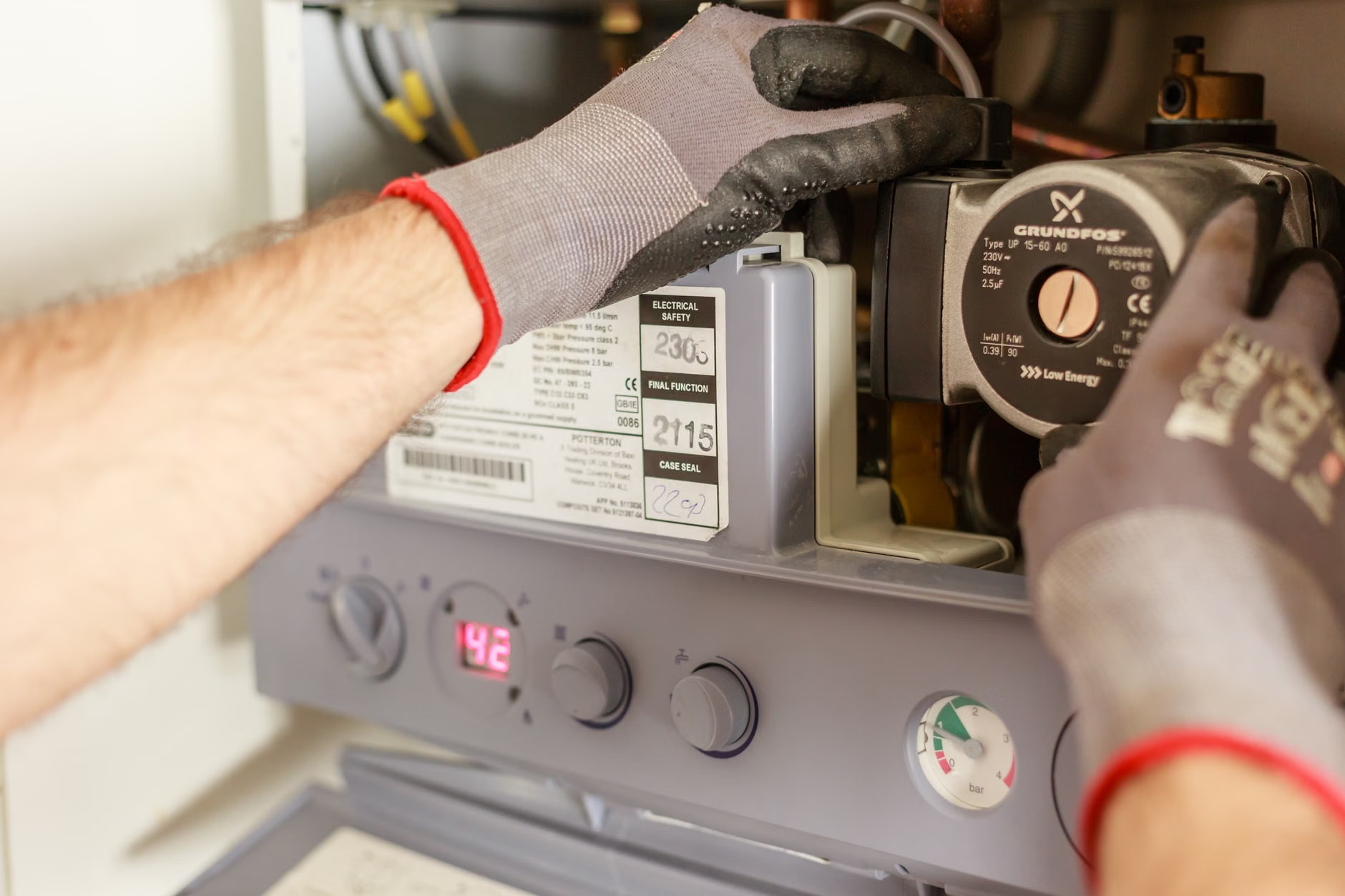
First, non-destructive disassembly is the new gold standard. If a manufacturer builds a device that requires you to snap plastic tabs—which inevitably break—to open it, they are effectively violating the spirit of the law. Future appliances will be designed with screws, clips, and modular boards that can be removed with standard household tools. This is a massive victory for parents who have had to deal with a child-proofed coffee maker that is also “adult-proofed” against repairs.
Documentation: The End of “Secret” Manuals
How many times have you searched for a service manual, only to find a forum thread where someone says, “I found this by calling the manufacturer’s internal support line, but they told me they can’t share it”? The 2026 laws will mandate that repair manuals, including circuit diagrams and component lists, be made accessible to the public. For the DIY-inclined parent, this means you can actually troubleshoot a blinking error code rather than guessing if the machine is truly broken or just needs a reset.
Real-Life Scenarios: When to Repair vs. When to Replace
Even with the right to repair, you shouldn’t feel obligated to fix everything. Some repairs are dangerous or simply not worth the time. Let’s look at a realistic scenario: your toaster stops popping up. Under the new laws, you can open it to see if a spring has snapped or a solenoid has failed. If it’s a simple mechanical spring, you can fix it. If the entire heating element is corroded and the wiring is brittle, you might decide the safety risk of a DIY electrical repair outweighs the benefit.
Decision Rule: If the repair involves high-voltage capacitors or internal heating elements that require specialized safety calibration, proceed with extreme caution. Always prioritize safety over savings. The goal of the 2026 legislation is to give you the choice to fix it, not to force you into dangerous electrical work.
Common Mistakes to Avoid
- Ignoring Safety: Always unplug the device for at least 24 hours before opening it to allow capacitors to discharge. Never work on a plugged-in appliance.
- Over-estimating Skills: Don’t start your repair journey with a complex, high-pressure espresso machine. Start with something simple like a hand mixer or a toaster to get a feel for how modern modular components are laid out.
- Buying Proprietary Parts: Even after 2026, some manufacturers will try to push their own “official” parts at a premium. Check if the component is a standard part (like a generic fuse or thermal switch) that can be bought from a local electronics supply store for a fraction of the cost.
How to Prepare Your Home for the Repair Revolution
If you want to be ahead of the curve, start building your “repair toolkit” now. You don’t need a professional workshop. A basic set of precision screwdrivers (specifically ones that include Torx, Hex, and Phillips bits) will cover 90% of the appliances you’ll encounter. You should also consider keeping a small “appliance library” of digital manuals for the devices you currently own.
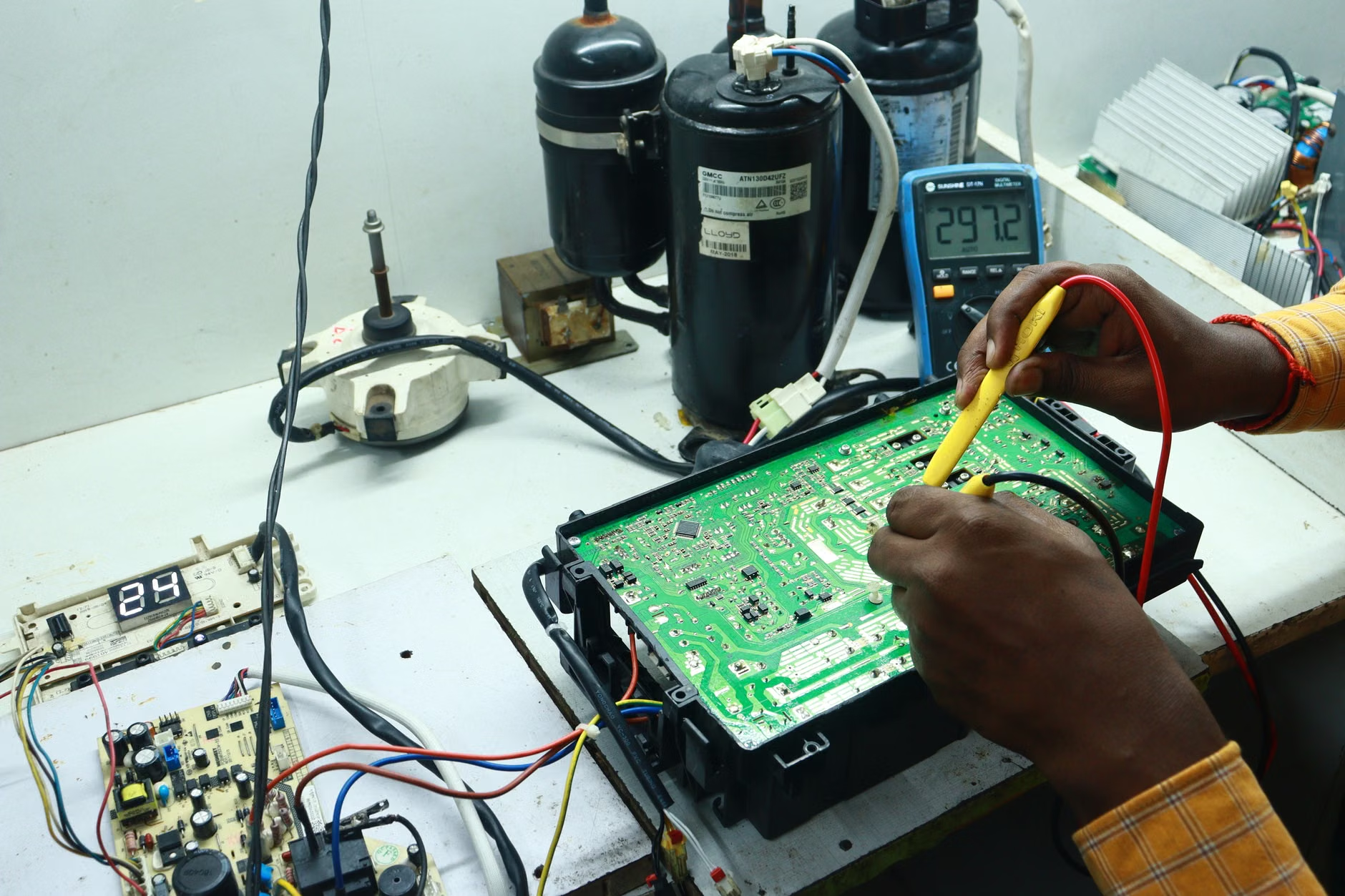
Another overlooked aspect is the “community” side of repair. Websites like iFixit have been doing this for years, but the 2026 laws will turn these sites from “hackers’ forums” into the mainstream standard for household maintenance. Start checking these resources before you toss that broken gadget. You might find that a repair guide already exists and that the fix is as simple as cleaning a sensor with a Q-tip and some isopropyl alcohol.
The Long-Term Impact on Your Household Budget
Think about the cumulative effect of these laws over the next decade. If you extend the life of your major kitchen electronics by just two years each, you are saving hundreds, if not thousands, of dollars over the lifetime of your household. This isn’t just about the money; it’s about the time and energy saved from researching new models, reading endless reviews, and dealing with the shipping and disposal of old, bulky appliances.
Furthermore, as these laws take effect, we expect to see a market shift. We will likely see “repair-friendly” brands gaining popularity. Companies that make their products easy to fix will start marketing that as a core feature, similar to how we currently look for energy efficiency ratings. This creates a virtuous cycle where manufacturers compete on longevity, not just on who can produce the cheapest, most disposable plastic shell.
Important Considerations and Cautions
While the 2026 shift is overwhelmingly positive, there are some trade-offs to keep in mind. First, don’t expect the price of appliances to drop. In fact, high-quality, modular appliances might cost a bit more upfront because they are designed to be disassembled and reassembled. This is a “buy once, buy right” shift. You are paying for the privilege of owning a device that you can actually maintain.
Secondly, keep an eye on “software locks.” Some modern smart appliances use firmware that detects if you have replaced a part. If you swap a heating element but the machine’s software doesn’t “recognize” it, it might still refuse to turn on. The Right-to-Repair movement is currently fighting these digital locks as hard as they are fighting physical ones. When buying new tech, look for devices that are “open” and don’t require proprietary software handshakes to function.
Finally, remember that the law provides the right to repair, but it doesn’t provide the skill. You are still responsible for your own safety and the quality of your work. If you are unsure about a repair, there is no shame in taking it to a professional. The difference is that now, you’ll be able to ask that professional to use parts you sourced yourself, or at least you’ll understand what they are doing when they quote you a price.
The Future of Your Kitchen
The 2026 legislation is essentially a return to the values of our parents’ and grandparents’ generations—where things were built to last, and if they broke, you fixed them. We are moving away from the “consumer-as-a-user” model and back to the “consumer-as-an-owner” model. This shift empowers you to take control of your household, reduce your waste, and save your hard-earned money.
Start looking at your kitchen not as a collection of gadgets, but as a system of tools that you own and maintain. The next time something breaks, don’t rush to the checkout page of an online retailer. Take a moment, check the manufacturer’s site for a manual, and see if there is a way to bring that device back to life. You’ll be surprised at how capable you are when the tools and information are finally on your side.
Frequently Asked Questions
1. Will the 2026 legislation force me to repair my own appliances?
Absolutely not. The law gives you the right to repair, not the obligation. It simply ensures that if you choose to fix your device—or hire a local independent repair shop to do it for you—the manufacturer cannot legally block you from doing so by withholding parts or documentation.
2. Does this apply to all kitchen electronics, including smart devices?
The legislation generally covers a broad range of electronic devices, but the specifics vary by region. Generally, it applies to household appliances with electronic components. However, “smart” devices that rely on cloud-based firmware may have additional hurdles, as manufacturers often try to protect their software ecosystems even when they are forced to open their hardware.
3. Where can I find official repair manuals once these laws are in effect?
Manufacturers will be required to provide these manuals on their official websites. Many companies are already starting to host “Support” or “Repair” portals to get ahead of the regulation. Always check the official brand website first, and if they are non-compliant, you can often find community-sourced documentation on sites like iFixit.
For more information on the evolving landscape of consumer rights and environmental standards, you can refer to the official documentation from the European Commission’s Circular Economy Action Plan or the ongoing proceedings of the Federal Trade Commission (FTC) regarding repair restrictions.
Official Resources: