The most effective way to help your teen transition to high school isn’t by managing their schedule for them, but by building a “scaffolding” of executive-function habits that they can eventually manage on their own. High school demands a level of self-regulation that middle school rarely requires, and treating these skills as a learnable toolkit—rather than an innate talent—is the single biggest predictor of academic and emotional stability during these formative years.
- Executive function is a set of brain-based processes: It includes working memory, cognitive flexibility, and inhibitory control, all of which are still developing in the teenage brain.
- The “Body-Double” technique works: For teens struggling to start tasks, simply having a parent or peer working quietly nearby can increase focus and reduce procrastination.
- Externalize the internal: Use physical or digital tools to “offload” the mental burden of remembering deadlines and assignments, freeing the brain for actual problem-solving.
Understanding the Developmental Gap in the Teenage Brain
If you feel like your teenager is suddenly “forgetting” everything they learned about organization in middle school, you aren’t imagining it. The transition to high school coincides with a period of massive neurological remodeling. The prefrontal cortex—the command center responsible for executive function—is the last part of the brain to fully mature, often not reaching peak efficiency until the mid-20s.
Executive function is essentially the brain’s “Air Traffic Control” system. It allows a student to hold information in their mind (working memory), switch tasks when priorities change (cognitive flexibility), and resist the urge to scroll through social media when they should be studying (inhibitory control). When a student enters high school, the volume of information they must track increases exponentially. If their “Air Traffic Control” system isn’t supported by external tools, the result is often a crash in grades or a spike in anxiety.
For parents in their 30s and 40s, it is helpful to shift your mindset from “manager” to “consultant.” You are no longer the one flying the plane; you are the one helping them design the flight plan. This shift reduces the friction between you and your teen, as it respects their growing autonomy while acknowledging their current cognitive limitations.

The Five Pillars of the Executive-Function Toolkit
To survive the high school transition, your teen needs a system that is low-effort to maintain but high-impact in its results. If a system is too complex, they will abandon it within three weeks. Here are five pillars that form a robust, sustainable toolkit.
1. The External Brain: Offloading Working Memory
The biggest mistake students make is trying to keep their assignments, test dates, and extracurricular commitments in their heads. This is a recipe for disaster. The “External Brain” is any system that records these details so the brain doesn’t have to. Whether it’s a shared Google Calendar, a physical paper planner, or an app like Todoist, the key is centralization.
The Rule of One: All information must go to one place. If they have a sticky note on the fridge, an app on their phone, and a verbal reminder from a teacher, they will inevitably lose something. Sit down with your teen before the term starts and agree on one system. If they prefer analog, buy a high-quality planner. If they are digital, set up a shared family calendar account.
2. The Art of Task Decomposition
Large projects are the enemies of executive function. When a teen sees “History Essay: Due Friday,” their brain often short-circuits because it doesn’t know where to start. This leads to the “freeze” response—procrastination. The solution is breaking the task into “micro-steps” that take no more than 15 minutes each.
| Vague Task | Micro-Step Breakdown |
|---|---|
| Write Biology Lab Report | 1. Open Doc. 2. Copy rubric requirements. 3. Find 2 sources. 4. Draft intro paragraph. |
| Study for Math Exam | 1. Collect all past quizzes. 2. Solve 5 problems from Ch 1. 3. Check answers. 4. Review mistakes. |
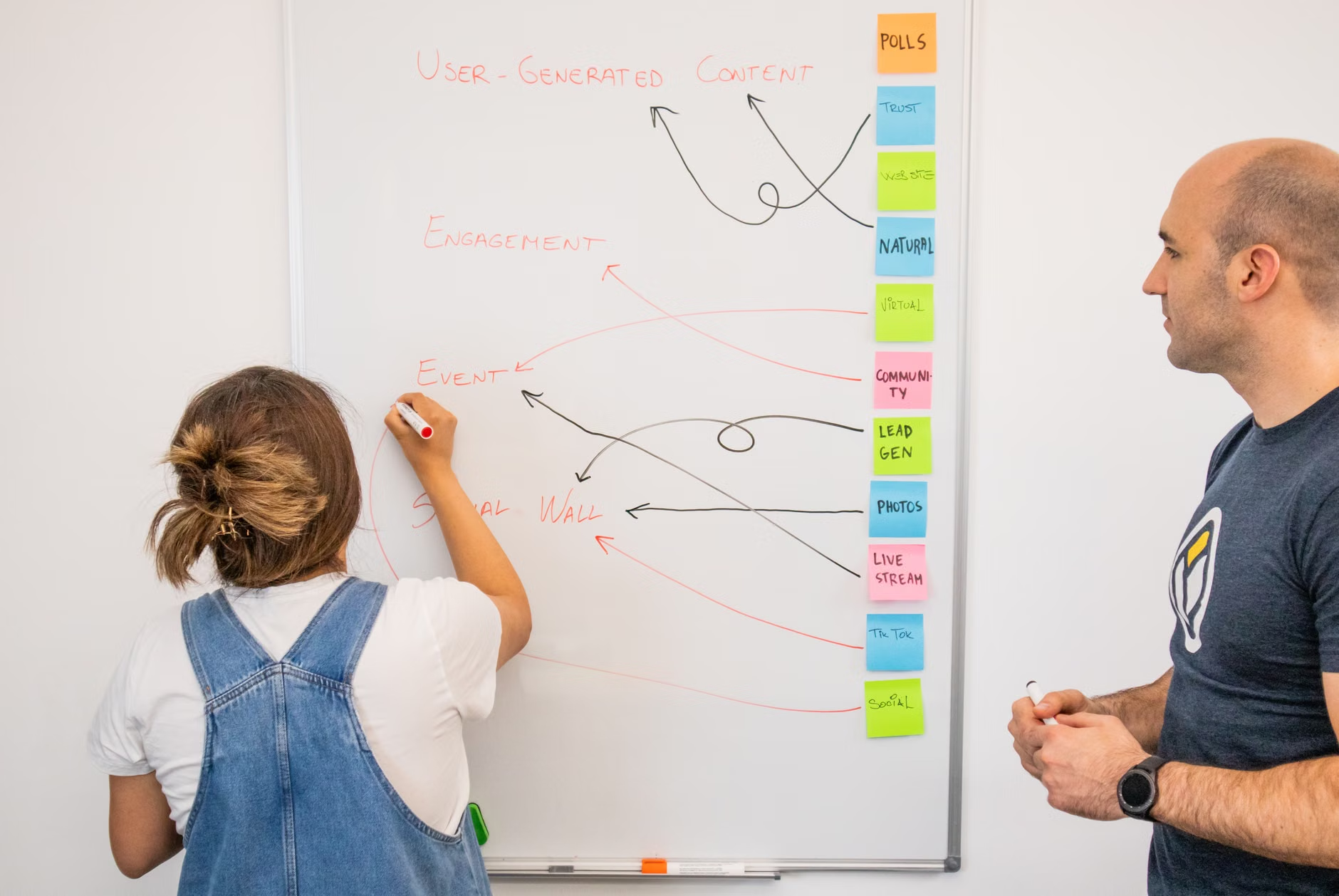
Actionable Tip: Encourage your teen to write these micro-steps on a physical whiteboard or a digital checklist. Crossing off a 15-minute task provides a dopamine hit that fuels the motivation to start the next one.
3. Time-Blocking and the “Pomodoro” Adaptation
Time is abstract to the teenage brain. They often underestimate how long a task will take, leading to late-night panic sessions. Time-blocking involves assigning specific windows in the day to specific tasks. The Pomodoro Technique—working for 25 minutes followed by a 5-minute break—is particularly effective for students who struggle with sustained attention.
The Trade-off: Don’t force them to study for hours on end. The brain needs recovery. Help them identify their “peak hours”—some teens are sharper right after school, while others need a two-hour break before they can focus effectively in the evening. Work with their biology, not against it.
4. Environment Design: Reducing Friction
Executive function is depleted by distraction. If a student has to clear a pile of laundry off their desk before they can start their homework, they have already used up a portion of their “willpower budget.” Environment design is about making the desired behavior (studying) the path of least resistance.
Practical Steps:
- The Landing Strip: Create a dedicated spot near the door where their backpack, keys, and charger always go.
- Digital Minimalism: Use apps like ‘Freedom’ or ‘Forest’ to block distracting websites during study sessions.
- The “Body-Double”: If they are struggling to focus, suggest they do their homework at the kitchen table while you are doing your own administrative tasks (paying bills, reading, etc.). Your presence provides a quiet accountability anchor.
5. The Weekly Review: A Critical Check-in
Once a week—ideally Sunday evening—hold a 10-minute “High School Logistics Meeting.” This isn’t a time to nag about grades; it’s a time to review the calendar for the week ahead. Ask: “What’s the biggest project due this week?” and “What do you need from me to make that happen?”
This reinforces the habit of looking ahead. It transforms the week from a series of reactive fires to put out into a planned sequence of events. If they missed something, don’t rescue them immediately. Use it as a coaching moment: “How can we adjust the system so this doesn’t happen next week?”
Common Pitfalls: Why Even Good Systems Fail
Even with the best tools, you will face hurdles. Understanding these common traps will help you pivot rather than give up.
The “Over-Engineering” Trap
Many parents and teens get excited about complex organizational systems—color-coded binders, fancy apps, elaborate spreadsheets. While these look great, they often become a form of “productive procrastination.” If the system takes more than 5% of the time they spend on schoolwork to maintain, it is too complicated. Simplification is key. If they stop using a tool, ask them why, and look for a simpler alternative.
The Rescue Reflex
It is painful to watch your teen fail. When they forget a project or lose a notebook, the instinct is to swoop in and fix it. Resist this. If you are the one constantly tracking their deadlines, they will never develop the neural pathways to do it themselves. Let them experience the natural consequences of a missed deadline while they are still in a safe, supported environment. The goal is for them to learn how to recover from a mistake, not to avoid making them entirely.
Ignoring the Emotional Component
Executive function is heavily influenced by emotional state. If a student is overwhelmed by anxiety, their executive function will effectively “go offline.” If you notice a sudden drop in their ability to organize, look for stressors beyond schoolwork—friendship issues, lack of sleep, or burnout. Sometimes, the most “productive” thing a teen can do is take a night off to rest and recharge.
Data-Driven Insights for the Modern Household
Research into adolescent development consistently highlights that “autonomy-supportive parenting” is the most effective approach for high schoolers. According to various studies on self-determination theory, adolescents who feel they have control over their methods of study show higher levels of intrinsic motivation and better long-term academic outcomes.
What does this mean for you? It means that if your teen hates your suggested planner, let them use a different one. The “best” system is the one they actually use. You are providing the framework, but they must provide the buy-in. When they choose their own tools, they take ownership of the process. This shift from “I have to do this because my parent said so” to “I am doing this because it helps me manage my stress” is the hallmark of a successful transition to high school.
Furthermore, consider the role of sleep. Chronic sleep deprivation in teenagers significantly impairs the prefrontal cortex, effectively mimicking the symptoms of ADHD. If your teen is struggling with executive function, check their sleep hygiene before you buy more planners. A student getting 8-9 hours of quality sleep will always outperform a sleep-deprived student, regardless of how many apps they use.
Putting It Into Action: Your Next 48 Hours
Don’t try to implement all these changes at once. If you overhaul their entire life in one weekend, you will likely encounter significant resistance. Start small and focus on one area of the toolkit.
Your Action Plan:
- Next 24 hours: Have a low-pressure conversation about their current biggest friction point. Is it remembering assignments? Starting tasks? Losing papers? Let them identify the problem.
- Next 48 hours: Agree on one “External Brain” tool. It doesn’t have to be perfect; it just has to be used. Spend 15 minutes setting it up together.
- Next week: Try the Sunday night “Logistics Meeting.” Keep it short, focused on the calendar, and end with a positive note about the week ahead.
The transition to high school is a marathon, not a sprint. By focusing on building these executive-function muscles, you are giving your child a set of skills that will serve them long after they graduate. They aren’t just learning to pass a class; they are learning how to manage their own lives.
Frequently Asked Questions
Q: My teen refuses to use a planner or any digital system. What should I do?
A: Don’t force a specific tool, as this will lead to a power struggle. Instead, ask them how they currently track their work. If they say they “just remember,” wait for the inevitable missed assignment. When it happens, don’t say “I told you so.” Instead, ask, “How can we make sure we catch that next time?” This invites them to co-create a system that feels natural to them.
Q: How much should I be checking their grades online?
A: The frequency of your check-ins should decrease as they gain independence. A good rule of thumb is to check grades once every two weeks. If you are checking daily, you are effectively doing their monitoring for them. If a grade drops, use it as a data point for a conversation rather than a reason for punishment. Ask, “What was the most challenging part of this unit?”
Q: Is it “normal” for my teenager to be this disorganized?
A: Yes. The brain’s executive function centers are undergoing significant pruning and reorganization during the teenage years. What looks like laziness or apathy is often a cognitive struggle to manage increased expectations. Patience, combined with the consistent application of these external tools, will help them bridge the gap as their brain matures.
For further reading on the science of executive function and adolescent development, you can explore resources from the Harvard University Center on the Developing Child, which offers excellent, research-backed insights into how these skills are built and supported.