Key Takeaways
- UBS is not UBI: Unlike Universal Basic Income (cash), Universal Basic Services (UBS) provides free or heavily subsidized access to essential services like childcare, aiming to reduce the cost-of-living burden directly.
- The “Childcare Cliff”: UBS models target the gap between parental leave and compulsory schooling, a period where private costs often consume 20% to 40% of household income for middle-income families.
- Structural Trade-offs: While UBS lowers monthly expenses, it often comes with higher tax requirements and potential trade-offs regarding facility flexibility and waitlist management compared to premium private care.
If you are a parent in your 30s or 40s, your monthly budget likely has one glaring, painful line item: childcare. For many, it acts like a second mortgage, often forcing one parent to either scale back their career or exit the workforce entirely to make the math work. This is where the concept of “Universal Basic Services” (UBS) enters the conversation. It is not just another buzzword—it is a fundamental shift in how governments view the “care economy.”
Instead of providing cash handouts, the UBS model argues that the state should guarantee access to essential services—healthcare, transport, and crucially, childcare—as a right of citizenship. But what does this actually look like for your family, and is it a magic bullet for your work-life balance?
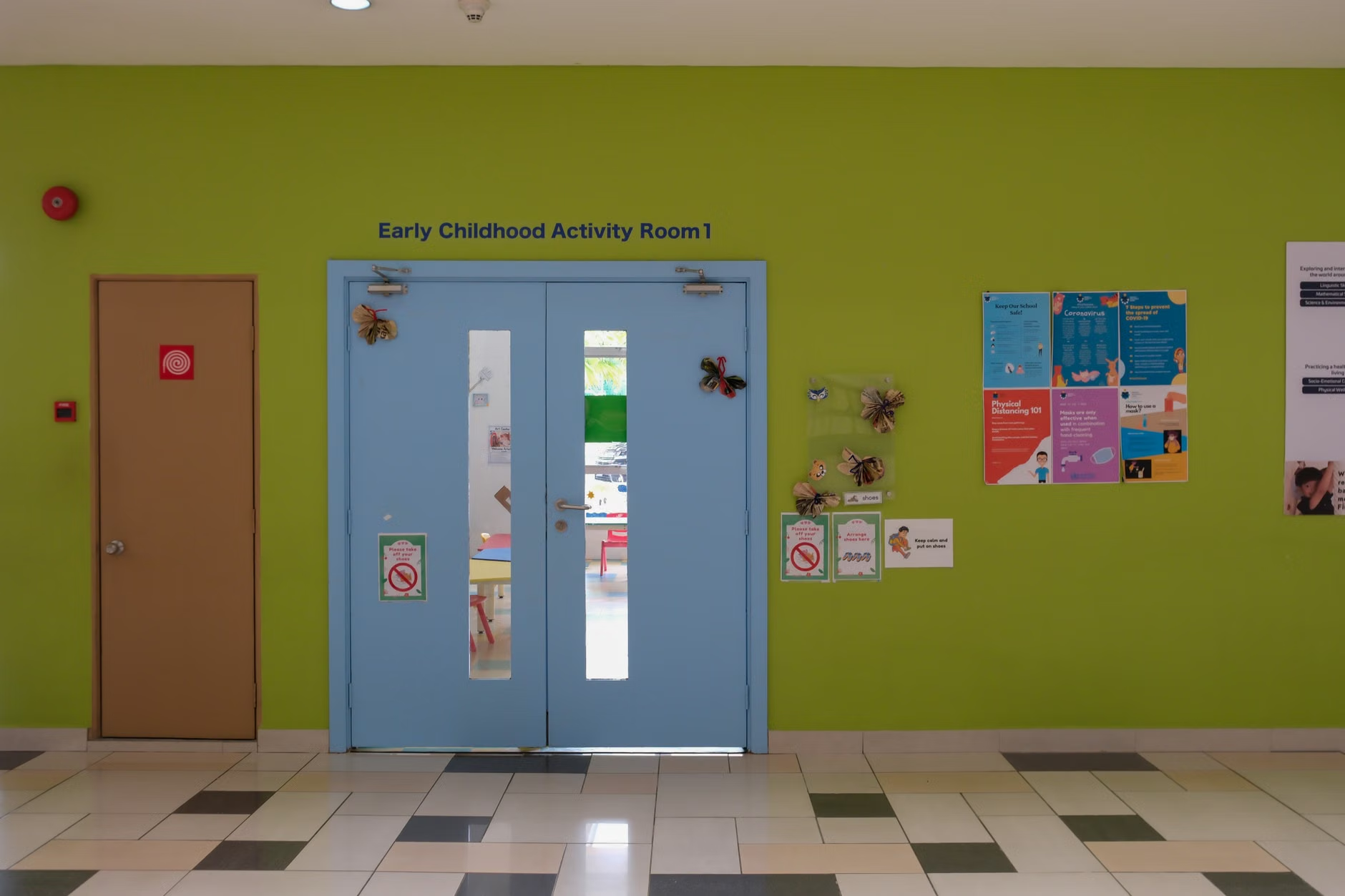
Understanding the Shift: From Individual Burden to Public Infrastructure
For decades, childcare has been treated as a private consumer good. You research, you tour, you pay, and you hope the quality matches the price tag. The UBS model proposes that high-quality, early-years education and care should be treated like public education or libraries. It is not about the government telling you how to raise your child; it is about ensuring that the cost of care does not become a barrier to economic participation.
In countries like Norway or parts of Canada (notably Quebec), we see versions of this in action. The logic is simple: if the state covers the bulk of the cost, households have more disposable income to circulate in the economy, and parents—statistically more often mothers—are more likely to maintain or advance their careers. This isn’t just “free stuff”; it is an infrastructure investment. Just as we don’t expect parents to pay a subscription fee to use a public road to get to work, the argument goes, we shouldn’t expect them to pay a premium for the basic social infrastructure required to keep the next generation safe and educated.
The Math: Why the Current System Struggles
To understand why UBS is gaining traction, we have to look at the “Childcare Cliff.” This is the period between the end of paid parental leave (often around 12 to 18 months) and the start of universal primary schooling (usually age 5). In many nations, this is the most expensive window of a family’s financial life.
Let’s look at a hypothetical scenario. A couple in their mid-30s living in a metropolitan area earns a combined income of $120,000. In a private-market system, full-time childcare can easily cost $2,000 to $3,000 per month per child. That is $24,000 to $36,000 annually, post-tax. When you account for the taxes already paid on that income, the “effective cost” of working for the lower-earning parent can be nearly zero, or even negative.
Under a UBS framework, childcare costs are capped or fully subsidized. If your out-of-pocket expense drops from $2,500 to $500, that is an immediate $2,000 monthly raise. For a family in their 30s, that money doesn’t just sit in a savings account; it goes toward debt reduction, housing stability, or building a retirement nest egg. It changes the calculus of career progression entirely.

The Trade-offs: What You Actually Give Up
It would be disingenuous to paint UBS as a flawless utopia. Whenever you move a service from the private market to a public system, you trade market flexibility for universal access. This is a crucial distinction for parents to understand.
In a private childcare market, you can often “buy” your way into specific niches: Montessori-style curriculum, extended hours for shift workers, or specific nutritional programs. Private providers compete on these differentiators. In a universal, tax-funded model, the system is designed for the “median” child. This means:
- Standardization: You might not get the specific pedagogical approach you prefer. The curriculum is usually set by state standards to ensure consistency, which can sometimes feel rigid.
- Waitlist Management: When a service is “free” or low-cost, demand almost always outstrips supply. You may find yourself waiting for a spot in a local public center, whereas paying a premium in the private sector might have guaranteed you an immediate placement.
- Operating Hours: Public systems often operate on standard business hours (e.g., 8:00 AM to 5:30 PM). If you are a nurse, a retail manager, or a professional with a non-traditional schedule, the “universal” model might not actually cover your needs, forcing you to find supplemental care anyway.
How to Evaluate if Your Region is Moving Toward UBS
If you are trying to figure out where your local or national government stands on this, don’t look for the term “Universal Basic Services” on a ballot. Politicians rarely use the academic label. Instead, look for these specific policy markers:
| Indicator | What to Look For | Impact on You |
|---|---|---|
| Fee Caps | Legislated maximums on daily or monthly childcare fees. | Predictable, lower monthly expenses. |
| Public-Private Partnerships | Government subsidies paid directly to private providers in exchange for price ceilings. | Maintains variety but limits price hikes. |
| Direct Public Provision | Government-run, state-funded centers. | Higher reliability, but potentially longer wait times. |
If your local area is trending toward fee caps, the most important thing you can do is track the quality metrics. When prices are capped, the only way for a provider to remain profitable is to cut costs, which often translates to higher child-to-staff ratios. Always ask about staff retention rates and the turnover of educators. A low-cost center is only a bargain if the quality of care remains high.
Managing the “Work-Life” Reality
Even with universal services, the pressure to “do it all” remains. One of the common misconceptions about UBS is that it removes the need for parents to juggle. It doesn’t. It simply removes the financial penalty for having a career while raising a child. You will still face the daily logistics of drop-offs, sick days, and school holidays.
In fact, one overlooked variable in the UBS conversation is the “hidden labor” of coordination. Even in countries with robust public childcare, parents spend significant time managing the administrative side of these systems—filling out forms, navigating enrollment portals, and coordinating pickups. This is what researchers call “cognitive labor.” It is the invisible work of keeping a family running, and it doesn’t disappear just because the bill is lower.
If you are in a position to advocate for better services, focus your energy on flexibility rather than just affordability. Push for policies that support “wraparound care”—care that extends before and after standard school hours—and systems that allow for part-time, flexible enrollment, which is often the biggest missing piece for modern, dual-income households.

Decision Rules for Your Household
If you are currently deciding between a private, premium childcare option and a state-subsidized one, use this decision matrix:
- The Financial Threshold: Does the private option cost more than 20% of your net household income? If yes, the subsidy provided by a UBS-style model is likely worth the trade-off in flexibility.
- The Career Trajectory: Is your career one that requires high-availability or frequent travel? If so, the rigid hours of public systems may force you to hire additional help, which could negate the savings.
- The Developmental Priority: Does your child have specific needs (e.g., speech therapy, specialized learning support) that a standard public facility is ill-equipped to handle? If so, the “universal” model may not be the right fit for your child’s specific developmental path.
Don’t fall into the trap of thinking that “cheaper” is automatically “worse.” Many public systems have higher teacher-qualification requirements than private ones. Conversely, don’t assume that “expensive” equals “better.” Private childcare is a business, and marketing budgets can often mask average-quality care.
We are currently in a transition phase. Many Western nations are moving away from the “every family for themselves” model toward a more integrated, state-supported approach. For parents in their 30s and 40s, this means you need to be an active participant in your local political landscape. Attend town halls, join parent associations, and look at the fine print of local childcare funding bills.
The most successful parents in this environment are those who view childcare not as a static line item, but as a dynamic part of their family’s infrastructure. They are willing to pivot when new programs open up, but they also maintain a “plan B” for when the public system inevitably hits capacity issues. It is about balancing the benefits of public support with the necessity of maintaining personal control over your family’s daily routine.
Ultimately, the goal of Universal Basic Services is to provide you with more options, not fewer. By reducing the financial barrier to childcare, it aims to restore the “bandwidth” that parents so desperately need. When you aren’t constantly stressed about the cost of a Tuesday morning, you have more energy for the parts of parenting that actually matter—the ones that don’t come with an invoice.
Frequently Asked Questions
Does Universal Basic Services replace the need for parental leave?
No. UBS for childcare is intended to support the years after parental leave concludes. Parental leave is about family bonding and physical recovery; UBS is about economic participation and early childhood development. Both are required for a stable family life, but they serve different functions at different stages of your child’s life.
If my country implements UBS, will I lose my current childcare provider?
Not necessarily. Most governments implement UBS through a “mixed model” where private providers receive government funding to lower their costs for parents. However, these providers must meet strict government standards. If your current provider refuses to comply with these standards, they may transition to a purely private, non-subsidized model, which could significantly increase your costs.
Is the quality of care in a state-funded system truly comparable to private care?
It can be, but it depends on the regulatory oversight. In many cases, state-funded centers have higher requirements for educator qualifications and staff-to-child ratios than private, for-profit centers. The main difference is usually in the “extras”—such as premium facilities, gourmet food programs, or extended-hour availability—which are rarely prioritized in a universal, taxpayer-funded model.
Official Resources and Further Reading:
- OECD Childcare and Early Education Data: Provides a global look at how different countries structure childcare funding and accessibility.
- UNICEF Early Childhood Development Framework: Explains the importance of quality, accessible care from a global perspective.
Note: Policies regarding childcare subsidies vary wildly by region. Always consult your local government’s education department or social services portal for the specific programs available in your municipality.
The transition to more universal support systems is a marathon, not a sprint. Keep your eyes on the long-term benefit for your family budget, but stay practical about the day-to-day logistics. You are navigating a changing landscape, and being informed is your best defense against the “childcare crunch.”